
Energy communities in Belgium: CER, CEC, CEL
Energy communities are at the heart of Belgium’s energy transition. Framed by the European Union and adapted by each region — Wallonia, Brussels, Flanders — they let citizens, businesses and local authorities produce, share and consume their own energy. This article walks through the three official forms (CER, CEC, CEL), explains how energy sharing actually works, introduces the key actors, and summarises the financial and ecological benefits.
What is an energy community?
An energy community is a legal entity — usually a non-profit (ASBL) or a cooperative — that brings together individuals, SMEs and/or local authorities to produce, share, store or sell energy collectively. Participation is open and voluntary, and governance stays local.
Operationally, an energy community is the legal layer. Inside it, one or more sharing operations carry out the actual energy exchange (more on this below). The same community can, for example, run one operation inside a single building and another at neighbourhood scale.
Why do they exist? The European context
Energy communities were born from the EU Clean Energy Package, which bundles two key directives:
- Directive 2018/2001 (RED II), which frames renewable energy communities;
- Directive 2019/944, which creates citizen energy communities under the internal electricity market.
More recently, Directive 2023/2413 raised Belgium’s renewable target to 21.7% by 2030 (up from the original 20.4% in the National Energy and Climate Plan). In 2024, Belgium reached 14.21%, slightly down from 2023 according to the federal economy department. Hitting the target will require decentralising production and valorising renewable electricity locally — exactly what energy communities enable.
Three types: CER, CEC, CEL
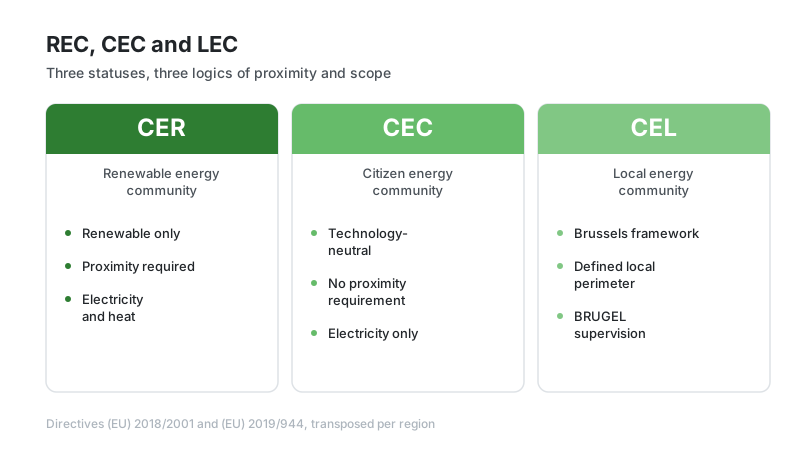
CER — Renewable Energy Community
Stemming from Directive 2018/2001, the CER (Communauté d’Énergie Renouvelable) is the most common form in Wallonia. Its key features:
- Renewable sources only (PV, wind, biomass cogeneration, etc.);
- A limited geographic perimeter (members must be in proximity);
- Activities cover electricity and heat;
- Members are restricted to individuals, SMEs and local authorities.
CEC — Citizen Energy Community
The CEC (Communauté d’Énergie Citoyenne) comes from Directive 2019/944 and offers a more flexible framework:
- All energy sources are allowed (including non-renewable cogeneration);
- Activities are limited to electricity;
- No geographic restriction — members can be far apart;
- Members are again individuals, SMEs and local authorities.
CEL — Local Energy Community
Specific to the Brussels-Capital Region, the CEL (Communauté d’Énergie Locale) is overseen by BRUGEL and operated technically by Sibelga. It targets multi-building neighbourhood-scale configurations and accepts both renewable and cogeneration sources. It can also extend into ancillary activities: storage, EV charging, flexibility services.
Quick comparison
| Criterion | CER | CEC | CEL |
|---|---|---|---|
| Legal basis (EU) | 2018/2001 | 2019/944 | 2019/944 + Brussels framework |
| Energy sources | Renewable only | All | All |
| Energy shared | Electricity + heat | Electricity | Electricity (+ services) |
| Geographic perimeter | Limited (proximity) | None | Neighbourhood, multi-building |
| Most active region | Wallonia | Wallonia | Brussels |
Energy community vs. sharing operation
A sharing operation is the operational unit that materialises energy sharing between members. A single energy community can host several operations, each falling into one of these forms:
- Within a single building (intra-building collective self-consumption)
- CER
- CEC
- CEL
Crucial point to grasp: energy sharing is administrative, not physical. Electrons keep flowing through the public grid as usual. The distribution system operator (DSO) uses readings from smart meters at a 15-minute resolution to compute how much shared energy each member receives, then passes that information to suppliers, who adjust the bill accordingly.
The actors involved
- DSOs — ORES, RESA, AIEG in Wallonia; Sibelga in Brussels; Fluvius in Flanders — operate meters, validate participants and compute allocations. See for example the dedicated ORES page.
- Regional regulators — CWaPE in Wallonia, BRUGEL in Brussels, Vlaamse Nutsregulator (ex-VREG) in Flanders — set rules, supervise tariffs and publish guidance for communities.
- Energy suppliers continue to bill residual energy, i.e. the share of consumption not covered by the community’s internal sharing.
- Members are prosumers (e.g. equipped with PV), pure consumers, SMEs or local authorities.
- The community manager is the entity that runs the community day to day: onboarding new members, configuring allocation keys, reporting to the DSO. This is exactly the role that OptimCE simplifies — see the user guide and the public registry of open sharing operations.
Benefits — financial and ecological
Financially, shared energy is valued at a price negotiated within the community, typically more attractive than the standard supplier tariff. Producers (PV owners, cogeneration sites) shorten their payback by selling their surplus to other members; consumers smooth out their bill against market price volatility.
Ecologically, energy sharing maximises local consumption of local renewable production. This reduces line losses, eases pressure on the transmission grid and limits curtailment of solar production at peak hours. It is one of the concrete levers to reach Belgium’s 20.4–21.7% renewables target by 2030.
Socially, energy communities foster cooperation between neighbours, energy literacy and resilience to price shocks.
FAQ
Who can join an energy community?
Individuals, SMEs and local authorities can take part. Participation is open and voluntary, and a member can leave the community at any time.
Do I have to change my electricity supplier?
No. You keep your current supplier, who continues to bill the residual energy — the share of your consumption that the community did not cover.
How is my discount calculated?
The DSO analyses your 15-minute readings, applies the allocation key defined by the community, and tells your supplier how much shared energy was attributed to you. That share is billed at the rate negotiated within the community, typically below the market rate. For the detail of the key types accepted in each region, see our guide “Allocation key in Belgium: the 3 regions”.
Is there a geographic limit?
It depends on the type:
- CER: yes, a proximity perimeter defined by the region;
- CEC: no, no geographic restriction;
- CEL: yes, at the scale of a Brussels neighbourhood.
Can a business or municipality join?
Yes. SMEs and local authorities are explicitly allowed to take part, provided that energy is not their main activity.
What about Flanders?
Flanders has an equivalent framework supervised by VREG, with Fluvius as DSO. CER and CEC exist there under their Dutch names (Hernieuwbare-energiegemeenschap and Burgerenergiegemeenschap).
How is shared energy measured?
Through the smart meters rolled out by the DSOs, which transmit data every 15 minutes. No additional hardware is required at the consumer’s premises once a smart meter is installed.
Want to create your own energy community?
In Wallonia, the framework has been stable since 2022 and the procedure is fully documented. We’ve written a dedicated step-by-step guide:
Create an energy community in Wallonia
Choosing between CER and CEC, framing the project, notifying the CWaPE, receiving the acknowledgement, and launching the sharing with ORES, RESA or AIEG.
Coming soon — Brussels and Flanders
The procedures on the BRUGEL / Sibelga (Brussels) and VREG / Fluvius (Flanders) sides will be covered in dedicated guides. Stay tuned.
Want to join an energy community?
In Wallonia, hundreds of sharing operations are actively looking for new members. You don’t have to create your own community to benefit from sharing — a practical guide walks you through joining an existing operation in a few weeks.
Join an energy community in Wallonia
Who can join, where to find an open operation (OptimCE registry, SPW facilitator, Énergie commune), step-by-step enrolment and points to check before you sign.
Coming soon — Brussels and Flanders
Joining procedures in Brussels (BRUGEL / Sibelga) and Flanders (VREG / Fluvius) will be covered in dedicated guides. Stay tuned.
Sources
- CWaPE — Energy communities and energy sharing — Walloon regulator: legal framework and guidance.
- CWaPE — Decrees on energy communities — Walloon legislation and 2025 evaluation report.
- CWaPE — CER vs. CEC comparison — detailed differences between the two models.
- environnement.brussels — Energy sharing and communities — Brussels framework and sharing types.
- ORES — Energy communities — perspective of the Walloon DSO.
- Federal Public Service Economy — Share of renewable energy sources — 2024 figures and 2030 targets.
- Vlaamse Nutsregulator (ex-VREG) — Flemish energy regulator.
- Sun-Job — Belgian solar installer.
- EU Directives 2018/2001 (RED II), 2019/944 and 2023/2413 — Clean Energy Package.