
Reduce your electricity bill: energy communities
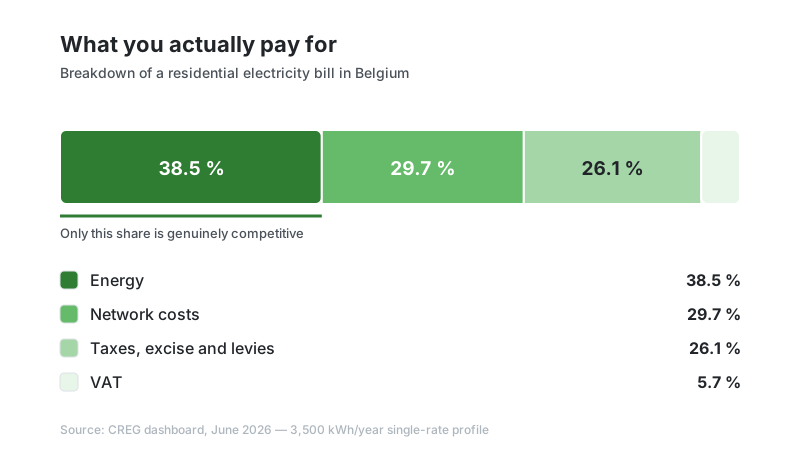
Since 2022, Belgian electricity bills have seen sharp, unpredictable increases. Against that volatility, energy communities offer a concrete, lasting lever: paying less for your electricity at a more stable price, without changing supplier or installing a single solar panel. This article explains exactly how those savings build up, how far they can go, what differs from region to region, and who benefits most. And if your first question is why your bill stays high even though energy prices have fallen, start with our breakdown “Why your electricity bill stays high in Belgium”: it quantifies, block by block, what sharing acts on — and what it does not.
What is an energy community? (in brief)
An energy community is a structure that lets individuals, SMEs and local authorities produce, share and consume their own electricity locally. Sharing is administrative, not physical: electrons still flow over the public grid, but the distribution system operator reallocates a share of local production to each member every 15 minutes.
We don’t cover the types (CER, CEC, CEL) or the legal framework here — that’s all explained in our reference guide “Energy communities in Belgium: CER, CEC, CEL”. This article focuses on the financial side.
How an energy community reduces your bill
The reduction doesn’t come from a single magic discount, but from several levers that stack up.
1. A negotiated local price, below market. Energy shared within the community is billed at a rate agreed among members, generally lower than the standard supply tariff. Documented Belgian cases put this internal price between 6 and 14 c€/kWh — 6 c€/kWh in the Walloon simulations by Renouvelle, 14 c€/kWh for the Brussels community Énergie Solidaire du Balai (Guide Bâtiment Durable) — against an energy component of around 14 c€/kWh from a supplier. The gap depends entirely on the rules the community sets itself: we detail how it is built in “Internal transfer price in an energy community”.
2. A more stable, predictable price. This is often the most underrated benefit. As Énergie Commune points out, the driver of sharing is “first of all the economic interest of the consumer”: part of their consumption becomes cheaper, but above all prices stabilise, shielding the household from market shocks — including low-income households.
3. Sometimes reduced grid fees — but less often than people think. Favourable tariff treatment does exist, but it depends on the proximity of the participants, not on being in a community. In Wallonia, CWaPE is explicit: the 80% reduction on the proportional terms applies only to sharing within the same building, and “there is no tariff reduction for sharing within an energy community” (CWaPE). Brussels is the only region offering a genuine graduated preferential regime (see the table below).
4. You keep your supplier. No contract change is needed: your supplier keeps billing only the residual energy — the portion not covered by sharing. This point is detailed in the FAQ of our reference guide.
5. A reduction computed via an allocation key. The exact amount you receive depends on the allocation key chosen by the community, which determines what share of local production is assigned to you at each 15-minute interval. We detail the keys accepted in each region in “Allocation key in Belgium: the 3 regions”.
A worked example
Énergie Commune documented a real sharing case, featured as a good practice under the Interreg Europe programme. For a consumer receiving 500 kWh of shared energy per year, with green certificates and reduced grid fees:
| Consumer profile | Estimated annual saving |
|---|---|
| On the social tariff | ≈ €70 / year (+ €24 on common areas) |
| On the standard tariff (non-social) | ≈ €145 / year (+ €24 on common areas) |
In that project, the payback time of the shared installation was about 6 years. These figures are illustrative: they depend on the volume shared, the consumption profile and the community’s terms, and are not a guarantee. They mainly show the principle — a real, recurring saving combined with price stability.
Why this is especially relevant in Belgium
Belgium combines several conditions that make energy sharing particularly worthwhile:
- Massive and growing solar production. The country has repeatedly crossed the 50% mark for solar in its instantaneous production, and has even seen moments at 100% renewable. The photovoltaic fleet, around 8 GWp, is expected to exceed 15 GWp (source: Énergie Commune).
- Local production currently wasted. At peak production hours, the local grid experiences overvoltage that forces some PV systems to shut down. Consuming that energy locally, through sharing, avoids the waste and puts it to use.
- Volatile prices since 2022. The price stability a community provides answers this context directly.
- Smart meters already deployed. Sharing relies on 15-minute metering; no extra equipment is needed once a smart meter is installed.
- A mature regulatory framework. Belgium targets 21.7% renewable energy by 2030 (versus 14.21% in 2024, per the FPS Economy), and each region has structured its sharing framework.
Wallonia, Brussels, Flanders: what changes for your bill
The savings mechanisms exist in all three regions, but the actors and some terms differ. Here’s the essential, from a bill perspective.
| Criterion | Wallonia | Brussels | Flanders |
|---|---|---|---|
| Regulator | CWaPE | BRUGEL | VREG |
| Distribution system operator (DSO) | ORES, RESA, AIEG | Sibelga | Fluvius |
| Grid tariff on shared energy | No reduction in a community; −80% on the proportional terms within the same building | Graduated reduction across four perimeters: proportional term removed within the same building, −50% on the same LV cabin; the fixed term is charged in none of the four | No reduction |
| Extra income for the producer | Green certificates | Green certificates (≈ first 10 years) | Specific support — see VREG |
| Smart meter required | Yes | Yes | Yes |
| Allocation key | CWaPE standard families | Fixed / pro rata / hybrid (BRUGEL) | Vaste / relatieve / optimale (VREG) |
For the detail of allocation keys and their impact on the shared amount, see our dedicated article: “Allocation key in Belgium: the 3 regions”. In Brussels, producers can also earn extra income from reselling green certificates during the first years of their installation (Sibelga).
Who benefits most?
Sharing benefits all members, but some profiles get more out of it:
- Consumers with daytime consumption (working from home, schedulable appliances, daytime EV charging) capture more local solar production.
- Low-income households, for whom price stability — on top of the saving — brings real budget security, including alongside the social tariff.
- Prosumers (panel owners): they cut their bill and monetise their surplus to other members, on top of green certificates. Their payback shortens accordingly.
- Tenants without a roof, who can access cheaper local electricity without installing anything.
- SMEs and local authorities, whose roof space or consumption profiles suit sharing well, with a direct impact on their costs.
Energy sharing is obviously not the only lever available to you. If you live in Wallonia, our guide “Reduce your electricity bill: Wallonia 2026” places the energy community among ten costed levers, from CWaPE’s official comparator to the social tariff.
One question this article does not settle: is sharing even available where you live? The answer depends on your region far more than you might expect, and “Cheaper electricity without switching supplier” costs it out region by region — including the fact that peer-to-peer sharing remains inoperative in Wallonia.
FAQ
How much can I save?
The saving applies to the energy component of your bill, which accounts for about 38% of the Belgian total (CREG, June 2026) — not to the whole bill. Documented Belgian cases put the internal price between 6 and 14 c€/kWh, against an energy component of around 14 c€/kWh from a supplier. The real amount depends on the volume shared, your profile and your community’s terms. Regulators don’t publish a “guaranteed” percentage: think of the saving as recurring and combined with better predictability.
Do I need to buy solar panels?
No. You can be a plain consumer and benefit from energy shared by the community’s producers, with no investment at all.
Do I need to change electricity supplier?
No. You keep your supplier, who now bills only the residual energy not covered by sharing.
Is the shared price guaranteed over time?
The price is negotiated within the community and far more stable than the market, but it isn’t frozen: it remains defined by the community’s rules. That stability, greater than the market’s, is precisely the advantage.
Are there hidden fees?
Sharing doesn’t remove the mandatory components of the bill (residual grid, taxes, levies). The saving applies to the shared share of energy and, depending on the setup, to some grid fees. Everything should be transparent in the community’s terms.
What if I produce my own electricity (prosumer)?
On top of cutting your bill, you monetise your surplus to other members. In Brussels in particular, you can also earn income by reselling green certificates during the first years (Sibelga).
Take action
The simplest way to cut your bill is to join an existing sharing operation — or create one.
Join an energy community in Wallonia
Who can join, where to find an open operation, and the step-by-step process.
Create an energy community in Wallonia
From choosing the community type to launching sharing with your DSO.
Ready to cut your bill? Start with OptimCE
Browse the public registry of open energy communities near you, reach out to the one that fits, or create your own. OptimCE — an open-source platform — then automates member management, allocation keys and reporting to your network operator.
Sources
- CWaPE — Grid fees on shared electricity — tariffs due on shared kWh; the 80% reduction is limited to sharing within a building.
- CREG — Monthly electricity and natural gas dashboard — weight of the energy component in the Belgian bill.
- Guide Bâtiment Durable — Énergie Solidaire du Balai — full price structure of a Brussels community.
- Renouvelle — Examples of profitability calculations for electricity sharing in Wallonia — internal prices in practice and the impact of supplier fees.
- Énergie Commune — Electricity sharing (Interreg Europe good practice) — worked example, the economic driver of sharing, Belgian solar context.
- Sibelga — Energy sharing in Brussels — how it works in practice and grid tariffs by location.
- Sibelga — Green certificates — extra income for Brussels producers.
- BRUGEL — Energy Sharing — Brussels sharing framework and tariffs.
- BRUGEL — Network tariffs applicable to energy sharing — decision 285bis of 4 November 2024: the four perimeters A to D and the treatment of each tariff term, source of the Brussels detail in the table above.
- CWaPE — Energy communities and sharing — Walloon framework.
- FPS Economy — Share of renewable energy sources — 2024 statistics and 2030 target.