
Energy community: CWaPE documents and deadlines
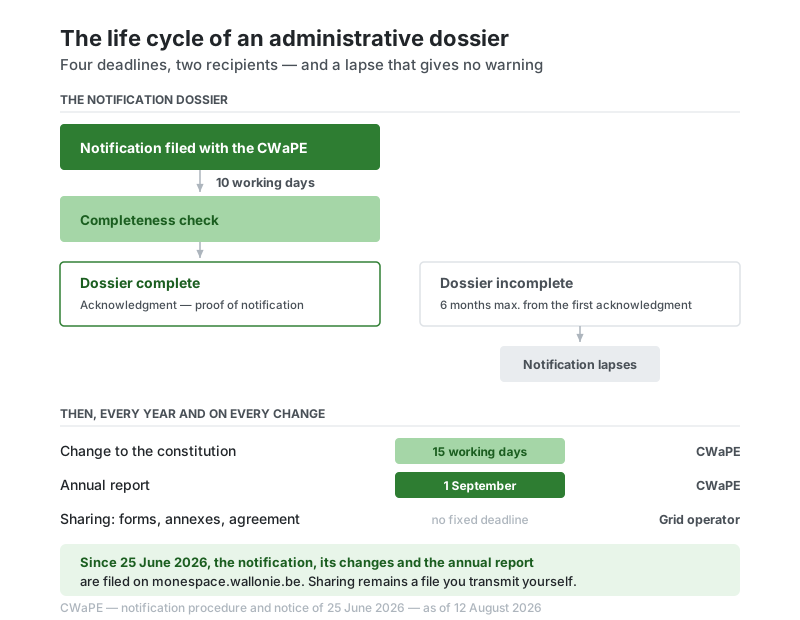
A Walloon energy community is rarely judged on its engineering. Smart meters exist, allocation keys can be computed, volumes are counted quarter-hour by quarter-hour. What blocks things is the paperwork — and above all its dates. The CWaPE has ten working days to check whether your notification dossier is complete. A dossier left incomplete lapses after six months. A change to the conditions of constitution must be notified within fifteen working days. And every year, by 1 September at the latest, the community must file its annual report.
None of these deadlines is negotiable, and none of them is announced to you. The first runs without your knowledge, the second expires in silence, the third assumes you noticed that a change had become a modification in the regulatory sense, and the fourth falls in the middle of the holiday season.
The scale of the obstacle is measurable. The CWaPE assessment reported in March 2025 counted 4 sharing operations within a single building and 3 within an energy community for a region of 3.6 million inhabitants. This is not a problem of solar resource or of citizen appetite: it is, in large part, a problem of administrative load measured against organisations that are often non-profits run by a handful of volunteers.
One thing changed recently, and it went largely unnoticed: since 25 June 2026, the notification of the creation of an energy community, its modifications and the filing of its annual report are carried out through digitalised forms hosted on monespace.wallonie.be. Three procedures on the Region’s single portal, with everything else — everything touching sharing itself — remaining files to download. The border between the two worlds is not intuitive, and it is currently the main source of confusion.
This article does not re-explain what an energy community is, nor what distinguishes a CER from a CEC: that is covered in “Energy communities in Belgium: CER, CEC, CEL”. Nor does it retrace the path to constitution, covered in “Creating an energy community in Wallonia”. It answers three precise questions: which documents a Walloon energy community must produce, by when, and what can now be prepared, dated and archived automatically.
What Wallonia expects from an energy community
The first difficulty is realising that there is not one counterpart but two. The documents do not go to the same place, do not follow the same calendar, and a community that is perfectly in order with the CWaPE may have no operational sharing at all.
Two recipients, two logics
The CWaPE is the regulator. It receives the notification that brings the energy community into existence as such, its modifications, and its annual report. Its role is declaratory: it verifies that the dossier is complete, not that it is compliant. The acknowledgment it issues says so explicitly — it counts as proof of notification and nothing more.
The distribution system operator — ORES, RESA, AIEG or AIESH depending on your municipality — receives everything concerning the sharing activity: the electricity sharing form, its annexes, the participants’ sworn declarations, and the agreement binding it to the sharing representative. It is the operator that will technically apply the allocation key, quarter-hour by quarter-hour.
A community that is notified but has no declared sharing exists legally and shares nothing. This situation is more common than one might think, and it explains part of the gap between the number of listed communities and the number of genuinely active operations.
The four deadlines
| Obligation | Recipient | Deadline | Starting point |
|---|---|---|---|
| Completeness check of the notification | CWaPE | 10 working days | Filing of the dossier |
| Completing an incomplete dossier | CWaPE | 6 months maximum, on pain of lapsing | The first acknowledgment |
| Notifying a modification | CWaPE | 15 working days | The change occurring |
| Annual report | CWaPE | 1 September, every year | Fixed calendar date |
Two of these deserve comment, because they are consistently misread.
The six months are not a processing time, they are an expiry date. They run from the first acknowledgment, not from the latest exchange. Several rounds with the CWaPE are possible, but they all take place inside the same six-month window. A community that conscientiously answers three successive requests may still see its dossier declared void, because the clock was never reset.
The annual report is not an anniversary. It is not twelve months after your notification: it is 1 September, for everyone, every year. A community declared complete in March must report by the following 1 September — five months later, not eighteen.
What counts as a “modification”
The term is broader than it looks. Notably to be notified within fifteen working days: a change to the contact details of the community or of its representative, the adoption or amendment of internal rules, the notification of a conflict of interest involving all members or shareholders, and a complete cessation of the community’s activities on the electricity market.
On the sharing side, a separate form is used to request any change to the activity from the grid operator: a change of identity or contact details of the sharing representative, the addition or removal of participants, and the addition or removal of production installations. That last category is the one that comes up most often, and the one most easily forgotten — a member who moves house is a modification.
The documents, one by one
The CWaPE publishes its forms and model agreements on its website, each under a stable document number. Here is what each bundle actually covers.
Constituting the community
| Document | CWaPE number | Format |
|---|---|---|
| Energy community notification form | — | Digitalised form (Mon Espace) |
| Annex 6 — Energy community notification form | 5617 | Excel |
| Annex 7 — Companies and associations | — | |
| Energy community modification form | — | Digitalised form (Mon Espace) |
Annex 7 concerns only communities set up as a company or an association — that is, virtually all of them, since an energy community must have legal personality.
Making the sharing work
| Document | CWaPE number | Format |
|---|---|---|
| Electricity sharing form | 5609 | |
| Explanatory guide to the sharing form | 5610 | |
| Annex 6 — List of sharing participants and production installations | 5611 | Excel |
| Annex 6bis — Sworn declaration, storage installation | 6578 | |
| Annex 8 — Sworn declaration of persons taking part in the sharing | 5612 | |
| Electricity sharing modification form | 6018 | |
| Explanatory guide to the modification form | 6017 | |
| Annex 2 — List of participants and/or installations (modification) | 6019 | Excel |
| Annex 3 — Sworn declaration of new participants | 6020 | |
| Annex 3bis — Sworn declaration, storage (modification) | 6579 |
The two explanatory guides are not documents to be filed, but they save round trips: read them before filling in anything.
Contracting with the grid operator
Two model agreements, both dated 12 October 2023, both in Word format:
- the agreement between the grid operator and the representative of an energy community;
- the agreement between the grid operator and the representative of a sharing activity between active customers acting collectively within a single building.
You sign one, not both: the choice follows from the form of sharing you have chosen. These are not forms — they are contracts, with places to complete and, in some spots, alternative preambles between which someone must decide.
Reporting every year
The annual report goes through the online form “Notification: update of the energy community’s information / Annual report”, accompanied by the updated lists of participants and installations.
What changed on 25 June 2026
On that day the CWaPE announced that three procedures were moving to the regional portal: the notification of the creation of an energy community, its modifications, and the filing of the annual report are now carried out through digitalised forms hosted on monespace.wallonie.be.
That is good news for anyone who hates printing, and a source of confusion for everyone else, because the shift is partial. What moved and what did not follows no logic visible from the outside:
| Procedure | Where it happens today |
|---|---|
| Notification of the creation of a community | Mon Espace — digitalised form |
| Modification of the community | Mon Espace — digitalised form |
| Annual report | Mon Espace — digitalised form |
| Electricity sharing form and annexes | PDF and Excel files, to the grid operator |
| Modification of the sharing activity | PDF and Excel files, to the grid operator |
| Model agreements with the grid operator | Word documents, to complete and sign |
The dividing line is in fact the one between recipients described above: what goes to the CWaPE has been digitalised, what goes to the grid operator has not. Once you have that in mind, the map becomes readable.
What digitalisation does not change is the substance: the deadlines are the same, the annexes still have to be prepared, and the data still has to be assembled. An online form does not fill in your participant list for you.
Where dossiers actually fail
Having accompanied communities through these procedures, the same five breaking points come back every time. None of them is regulatory; all of them are organisational.
Silent lapsing. The dossier goes out, the CWaPE flags three missing items, someone takes care of it, then that person changes role. Six months later the notification has lapsed and nobody saw it coming, because no letter announces the deadline: it is the absence of an event that triggers it.
The forgotten annual report. It is the most regular deadline and the easiest to miss, precisely because nothing causes it. No change on your side brings it about. It falls on 1 September whether you did anything or not.
Inconsistencies between annexes. The participant list appears in the notification annex, in the sharing annex, and in the annual report. It is maintained in three places, usually in three spreadsheets of different vintages. A member who joined in March appears in one and not in the other two, and the grid operator returns the dossier.
Overwritten versions. The file notification_v3_final_OK.xlsx replaced v2, which had replaced v1. When the CWaPE asks, eight months later, exactly what was transmitted, nobody can say. That question does get asked in practice, and “we think it was that version” is not an answer.
No trace of what was sent. Who transmitted the sharing form, on what date, and what reply came back? In most communities the answer sits in one person’s mailbox, and that person is a volunteer.
These five points have one thing in common: none of them requires any particular intelligence, only memory and discipline. That is exactly the kind of work software does better than people.
What OptimCE now does
This is the point of the block of features delivered in August 2026: an administrative document module, dashboards, and email sending — which, until then, did not exist on the platform at all.
Eleven documents prefilled from the official files
OptimCE ships eleven document bundles: six fillable PDFs, three Excel workbooks and two Word agreements. The important part is not the count, it is the nature of the files.
They are the CWaPE’s own files, unmodified. Rendering only writes values into form fields and cells; it changes nothing else. What gets filed is the official document, not a reproduction that resembles it. For the Word agreements, the integration work consisted of replacing the regulator’s “to be completed” markers with variables — the legal text, the numbering, the styles and the cross-references to annexes were left untouched.
Two practical consequences:
- Fields OptimCE cannot derive stay editable. Fields not bound to a data point are left untouched, and the PDF produced remains a fillable form. Nothing is lost and nothing is guessed.
- The forms’ real capacities are respected. They are read from the workbooks’ own validation ranges — 100 members and 50 production units on the notification annex, 100 delivery points and 20 + 20 units on the sharing annex. Exceeding one produces an explicit error rather than a truncated file: the CWaPE provides no way to split a filing, and submitting incomplete legal data would be worse than submitting nothing.
The data comes from the CRM — members, delivery points, installations, meters — so the participant list is maintained in one place and propagates to the three annexes that require it.
A journal that is never rewritten
A dossier moves through in preparation → submitted → complete → closed, with lapsed as a side exit. A document moves through draft → ready → sent → acknowledged, with obsolete.
What matters here is less the list of states than the way they change. A status is never edited in place: every change appends a row to the journal, and a database constraint rejects any status not backed by a journal entry. A correction does not erase the mistake, it is appended after it. The interface puts it in those terms: “Every status change is recorded permanently. Corrections are added, they erase nothing.”
The same principle applies to files. Every submission is kept as a definitive version, addressed by its content, with no update path. Eight months later, the question “what exactly did we transmit?” has an answer, and that answer is the file itself.
Deadlines computed, not typed in
The regulatory rules are data, not code: a transition triggers evaluation of the applicable rules and materialises the corresponding deadlines. Working-day periods are computed on the Belgian calendar, movable feasts included — which, for a ten-working-day period starting in early April, is not a detail.
A daily sweep runs at 06:00 Brussels time and raises both upcoming and missed deadlines. The reminder window is fourteen days.
The manager dashboard surfaces these in two tiles, “Administrative deadlines” and “Administrative dossiers”, with the number of open deadlines and the number of overdue ones.
Email, at last
Until this summer, OptimCE sent no email whatsoever. A dedicated service now handles it, with six message types, each available in French, Dutch, German and English:
| Message | When | Category |
|---|---|---|
| Member invitation | On invitation | Transactional |
| Manager invitation | On invitation | Transactional |
| Invoice available | On issue | Transactional |
| Invoice overdue | On expiry | Transactional |
| Administrative deadline approaching | 14 days before | Informational |
| Administrative deadline missed | On expiry | Transactional |
The distinction is not cosmetic. An informational message can be turned off from the Notifications tab of your profile, channel by channel — “In the app” and “Email” are two separate settings. A transactional message cannot: “Essential messages — invoices, invitations and missed regulatory deadlines — are always sent and cannot be disabled.”
In other words, you can decide not to be warned fourteen days ahead. You cannot decide not to be warned once the deadline has passed.
Other events exist as in-app notifications only, with no email: a document upload, a member update, the acknowledgment of a dossier, the completion of a billing run, and the publication of a news post or a poll.
Three dashboards, three different questions
The dashboard module delivered at the same time answers three questions that do not arise in the same place.
The community manager opens “Points to check”. The tile lists what actually blocks: operations without a valid allocation key, keys awaiting approval, meters awaiting the grid operator or awaiting confirmation, meters not part of any sharing operation, incomplete member records, members pending validation, and missing fields at community level — VAT number, legal name, IBAN, registered address, regulator. When everything is in order, the tile says so: “Everything we check is in order.” Alongside it sit the month’s energy, the sharing operations, arrivals in progress and the activity log.
The member sees “My participation” — their share in the allocation key, including edge cases such as “Pro rata to consumption” or “Not included in the allocation key” — along with energy consumed and received through sharing, their member record, and their documents.
The home page, finally, spans communities: it works even with no active community, and shows “{count} thing(s) waiting for you” — invitations, missing profile fields, unread notifications. When there is nothing, it shows nothing.
“What has been declared about me”
This is the feature we are happiest with, and the least spectacular.
Someone taking part in a sharing operation appears, by name, in documents transmitted to a regulator: their name, their delivery points, their production installations, any storage installations. In the usual way of working they know nothing about it — the annexes circulate between the representative, the CWaPE and the grid operator.
OptimCE gives every member a page titled “What has been declared about me”, with this subtitle: “The information about you transmitted to the regulator by your community.” It is available to any member, with no particular role, and shows what was actually filed, as at the filing date. The page says as much: these values are the ones transmitted on the date shown, and they do not change if your information is corrected afterwards.
It is a direct consequence of the immutable journal described above: because nothing is overwritten, we can show a member what was said about them, and when.
What it does not do
Four limits, better known before you commit.
OptimCE does not file on your behalf. There is no automated interface between the platform and the CWaPE. Filing happens on Mon Espace for the notification, its modifications and the annual report, and with your grid operator for sharing and the agreements. What the platform does is prepare the document, record that you transmitted it and when, and keep the exact version that went out.
OptimCE signs nothing. There is no electronic signature in the platform. The Word agreements remain contracts the parties edit and sign; the PDFs produced remain fillable forms. “Prefilled, ready to sign” is accurate; “signed in the app” would not be.
Coverage is Walloon. The module knows only the CWaPE today. Brugel and the VREG are already declared in the regulator registry shared across the services, but they are inactive there, and deliberately so: an inactive regulator raises an explicit error rather than falling back silently on the Walloon rules, which would produce wrong documents with every appearance of rigour. Adding a region means first authoring that region’s document bundles — Brussels and Flanders mandate different documents. We will not announce a date until that work is done.
The module is optional. Administrative document management, like billing or the news board, is enabled per community. The dashboards adapt: tiles belonging to a module that is not subscribed simply do not appear.
One closing caveat, for honesty: none of this replaces reading the CWaPE’s explanatory guides, and none of it excuses you from checking what you file. A form prefilled from wrong data is a wrong form, produced faster.
Where to start
My community already exists
Look first at today’s date against 1 September. If the annual report has not gone out, that is the priority, and it is done on Mon Espace. Then take your participant list and compare it with the one in your last filed annex: any discrepancy is a modification to notify, within fifteen working days of it occurring.
I am setting up a community
The critical point is the six-month clock, and it starts at the first acknowledgment. Assemble the annexes before filing rather than after: the list of participants and installations is what takes longest, because it depends on third parties. The CWaPE’s explanatory guides are worth the half hour they cost. The full path is described in “Creating an energy community in Wallonia”.
I want to join a community
You will sign a sworn declaration, and your delivery points will appear in an annex transmitted to the regulator. The eligibility conditions and the points to check before signing are detailed in “Joining an energy community in Wallonia”.
I already manage all this in spreadsheets
The gain is not where you expect it. Filling in the forms is not what costs; reconciling three participant lists and reconstructing, after the fact, what was transmitted is. Start by centralising members and delivery points; the documents follow from them. The logical next step is billing, described in “Billing an energy community”, which rests on the same allocation data.
Key takeaways
- Four deadlines structure the administrative life of a Walloon community: 10 working days for the completeness check, 6 months before an incomplete dossier lapses, 15 working days to notify a modification, and 1 September for the annual report.
- The six months run from the first acknowledgment, not from the last exchange. It is an expiry date, not a processing time.
- The annual report is a fixed date, not an anniversary. A community declared complete in March reports by the following 1 September.
- Since 25 June 2026 the move to Mon Espace is partial: what goes to the CWaPE has been digitalised, what goes to the grid operator remains a file to download and sign.
- OptimCE prepares eleven documents from the official, unmodified files — what is filed is the regulator’s own document, not a reproduction — and leaves editable the fields it cannot derive.
- Nothing is overwritten: statuses are appended to a journal, transmitted versions are kept as they were, and members can see what was declared about them and on what date.
- Filing and signing remain yours to do, and coverage is Walloon today.
What not to expect: none of these features makes an energy community more profitable, and none replaces reading the regulatory framework. What they do, and shared spreadsheets do not, is guarantee that a deadline does not slip by unnoticed and that a transmitted version stays retrievable — the only two causes, in our experience, of dossiers lost for bad reasons.
Manage your administrative documents with OptimCE
Open source platform built for Belgian energy communities: members, meters, allocation keys and sharing operations in one place — through to preparing the CWaPE forms, tracking deadlines and preserving every transmitted version.
FAQ
Which documents are needed to create an energy community in Wallonia?
There are three distinct bundles. To constitute the community, a notification to the CWaPE, together with the annex listing participants and production installations and, if the community is a company or an association, the annex covering legal entities. To make sharing work, an electricity sharing form filed with the distribution system operator, its participant annex, and a sworn declaration signed by every person taking part in the sharing. Finally, a model agreement between the grid operator and the representative, in either its energy community version or its same-building version. The CWaPE also publishes an explanatory guide for each of the two main forms, and it is worth reading before filling in anything.
When is the annual report of an energy community due?
Every year, by 1 September at the latest. The CWaPE requires an update of the energy community’s information through the online form titled “Notification: update of the energy community’s information / Annual report”. It is a fixed calendar date, not an anniversary of your notification: a community declared complete in March must report by the following 1 September, not in March of the year after. It is the easiest deadline to miss, because it depends on no event at your end and falls in the middle of the holiday season.
What happens if my notification dossier is incomplete?
The CWaPE has ten working days from filing to check whether the dossier is complete. If it is not, it sends the community representative a letter identifying the missing items. Several exchanges are possible, but the representative must complete the dossier within a maximum of six months from the CWaPE’s first acknowledgment. Past that deadline the notification is declared void and everything starts again. If the dossier is complete, the CWaPE sends an acknowledgment that counts as proof of notification — but that does not certify the community’s compliance with the legal provisions applicable to it.
Are the PDF forms still used now that Mon Espace exists?
It depends on the procedure. Since 25 June 2026, the notification of the creation of an energy community, its modifications and the filing of the annual report are carried out through digitalised forms hosted on monespace.wallonie.be. Everything touching the sharing activity itself, however — the electricity sharing form, the sharing modification form, their participant annexes and the sworn declarations — is still published by the CWaPE as PDF and Excel files to download, fill in and transmit to the distribution system operator. The model agreements with the grid operator likewise remain Word documents to complete and sign.
Does OptimCE file the documents with the CWaPE for me?
No, and that is deliberate. OptimCE prepares the documents from your data, computes the deadlines, keeps every version that was sent and records who transmitted what and when. Filing itself remains yours to do: on Mon Espace for the notification, its modifications and the annual report, and with your distribution system operator for sharing and the agreements. There is no automated interface between the platform and the regulator. OptimCE does not sign anything either: the Word agreements remain documents the parties edit and sign, and the PDFs produced remain fillable forms, so whatever OptimCE cannot derive stays editable by hand.
What about Brussels and Flanders?
Administrative document management currently covers Wallonia and the CWaPE only. The architecture is keyed by regulator, and both Brugel and the VREG are already declared in the platform’s shared registry, but they are inactive there: an unknown or inactive regulator raises an explicit error rather than falling back silently on the Walloon rules. The reason is editorial rather than technical: adding a region mostly means authoring that region’s document bundles, and Brussels and Flanders mandate different documents. We would rather not announce a date until those bundles are written.
Sources
- CWaPE — Energy communities — notification procedure: the ten working days allowed to the CWaPE to check the completeness of the dossier, the maximum six months from the first acknowledgment to complete an incomplete dossier on pain of lapsing, the scope of the acknowledgment which counts as proof of notification without certifying compliance, the obligation to notify any change to the conditions of constitution within fifteen working days, and the annual report to be filed by 1 September at the latest through the form “Notification: update of the energy community’s information / Annual report”.
- CWaPE — Energy sharing — list and numbering of the forms and annexes cited in this article: the electricity sharing form (5609) and its explanatory guide (5610), annex 6 of participants and production installations (5611), annex 6bis on storage installations (6578), annex 8 of sworn declarations (5612), the sharing modification form (6018) and its guide (6017) with annexes 2 (6019), 3 (6020) and 3bis (6579), as well as the two model agreements of 12 October 2023 between the grid operator and the representative, in their energy community and same-building versions.
- CWaPE — Energy community forms available through the Walloon “Mon Espace” portal — notice of 25 June 2026: the notification of the creation of an energy community, its modifications and the filing of its annual report are carried out through digitalised forms hosted on monespace.wallonie.be.
- Renouvelle — Energy sharing and communities in Wallonia: the CWaPE’s assessment — assessment of 18 March 2025: 4 sharing operations within a single building and 3 within an energy community recorded in Wallonia, and the obstacles identified by the regulator.
- OptimCE — platform source code — source of every product claim in this article: the eleven document bundles and their nature as unmodified official files, the capacities read from the forms themselves, the journaled state machine of dossiers and documents, the immutability of transmitted versions, the computation of deadlines in Belgian working days with a daily sweep at 06:00 and a fourteen-day reminder window, the six email types in four languages and their split between informational and transactional messages, the manager and member dashboards, and the restriction of the regulator registry to the CWaPE alone.