
Electricity meter readings in Wallonia: the guide
Reading your electricity meter takes two minutes, and the reading is the only figure on your bill that you produce yourself. Your distribution system operator (DSO) validates it and passes it to your supplier, which bills on that basis. If it is missing, the DSO estimates your consumption, and the gap comes back one day, often on the annual settlement bill. This guide shows how to read each meter, when the DSO asks for your readings, how to send them to each of the five Walloon DSOs, and what to do about an estimated or wrong reading.
It does not repeat what is written elsewhere on this site. How to read the bill is in “Read your Belgian electricity bill line by line”, and how to dispute a statement in “Electricity settlement bill too high: what to do”. The smart meter has its own guide, “Smart meters in Wallonia: the complete guide”, and so does the EAN code that every reading form asks for: “Belgian EAN code: where to find it, what it’s for”.
The rules described are Walloon. Brussels and Flanders are summarised at the end. Most DSO pages are in French only; the French names are given where you will need them.
Reading your meter, type by type
A meter shows a reading, or index: the total kilowatt-hours (kWh) that have passed through it since it was installed. Your consumption is the difference between two readings. Three rules apply to every conventional meter, according to ORES’s meter-reading brochure (August 2026):
- check the meter number first: its last digits must match those on the reading letter; on an electronic meter, do not confuse it with the module number in the middle;
- do not note the digits after the decimal separator; at REW, a red digit is a decimal;
- on a meter without a decimal separator, note every digit: there may be 5, 6 or 7.
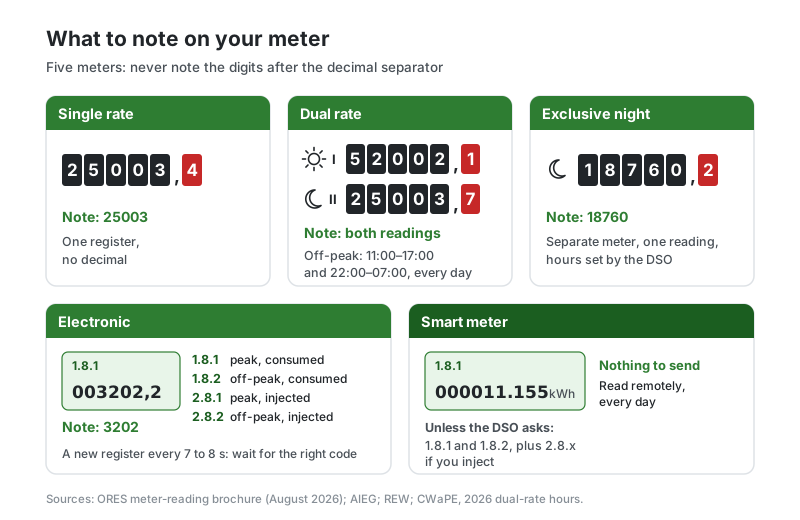
| Meter | What it shows | What you note |
|---|---|---|
| Single rate (monohoraire) | one register | one reading, without decimals |
| Dual rate (bihoraire) | peak (sun, I, 1) and off-peak (moon, II, 2) | both readings |
| Exclusive night (exclusif nuit) | a second meter, reserved for heating that runs at night | its reading, in addition to the main meter’s |
| Electronic | registers that change: 1.8.1 peak, 1.8.2 off-peak, 2.8.1 and 2.8.2 injection | each register in use; the 2.8 codes if you produce |
| Smart (compteur communicant) | the same codes | nothing, unless the DSO asks |
Assumptions: instructions from ORES (August 2026 brochure, reading examples page), AIEG and REW, accessed on 14 November 2026, in French. The codes 1.8.x and 2.8.x have the same meaning at ORES, AIEG, AIESH, REW and Fluvius; some meters show 181 or PHP for peak hours, 182 or PHC for off-peak hours.
On a dual-rate meter, an indicator, a small arrow or a triangle that turns green, shows which register is running. Since 1 January 2026, off-peak hours are the same at every Walloon DSO: from 11:00 to 17:00 and from 22:00 to 07:00, seven days a week. The exclusive night meter keeps the hours of its substation: at ORES, from 22:00 to 07:00 or from 21:00 to 06:00.
On an electronic meter, the registers follow one another on a single screen, every 7 to 8 seconds according to ORES: wait for the right code. On a single-rate contract, a smart meter shows the sum of peak and off-peak at codes 1.8.0 and 2.8.0.
When the DSO asks for a reading
The Walloon technical regulation for distribution grids (RTDE, article V.54, § 2) requires every customer to let the DSO read the meter at least once a year, and to send the readings themselves “if the DSO asks and/or if they were absent during the reading visits”. Without remote reading, the DSO must visit at least once every twenty-four months; the CWaPE, the Walloon regulator, sums it up as “every other year”.
- ORES: “every other year, a meter reader comes to read your meter”; in the other year, a letter or email invites you to send your readings.
- RESA: an invitation every year; a meter reader visits “when we consider it necessary”, but not if you have already sent your readings. The reading period for your address can be looked up on its website with the EAN code.
- AIEG: a reference month per municipality, in October or November, a meter reader every two years, and a reply slip in the other years. In 2026, readings were due by 15 November.
- REW: a meter reader at least once every two years; otherwise a letter or email.
- AIESH: we found no published reading calendar.
The deadline is on the letter. The RTDE accepts a reading taken between ten working days before the reading month and ten working days after its end (article V.70, § 2); without a validated reading, the DSO sends an estimate to the supplier.
Outside that calendar, you may send a reading to your DSO up to once every three months, in particular to have your instalments adjusted (Walloon electricity decree, article 34, § 1, 2°). ORES calls this an “informative reading” (index informatif): never less than a month after another reading, with an email reply within five working days.
Sending your readings: each Walloon DSO’s channels
The channels depend on the DSO, not on the supplier. Check your DSO before looking for its portal: the “Find my DSO” tool finds it from your postcode.
| DSO | Online | Other channels | What you need |
|---|---|---|---|
| ORES | info.ores.be/releve or myORES | Indexphone 078/15.70.01 | the eight-digit reference number on the letter, the last 4 digits of the meter number |
| RESA | reading form | 04/220.12.11, weekdays 8:00 to 18:00; reading card in the window if you are out | the unique 10-digit code on the letter, the EAN code and the meter number |
| AIEG | webindex.aieg.be, during the campaign | reply slip by post; bt@aieg.be; no phone | the EAN code and the meter number |
| AIESH | aiesh.be/index | desk on 060/45.91.60 | the last 6 digits of the EAN code, the meter’s serial number |
| REW | annual form | releve@grdwavre.be; 010/22 26 53, option 1, 8:00 to 12:00 | the EAN code and the meter number |
Assumptions: channels taken from the five DSOs’ websites on 14 November 2026. AIEG refuses readings by phone “to ensure traceability” in case of dispute. REW keeps its form for annual readings; for a change of supplier or a move, it asks for an email or a call.
Keep a record. Photograph the meter when you read it: the dated photo is the evidence RESA asks for to correct a reading.
Forgotten or disputed reading: the estimate and how to correct it
Without a reading, the DSO estimates. The RTDE replaces missing data with “fair values” calculated on objective criteria, for example by comparison with an equivalent period (article V.56). The CWaPE explains that the estimate is based on your consumption history; ORES calls it “a legal obligation”. The bill must show the readings and their dates, and state whether consumption is actual or estimated (Royal Decree of 9 December 2021, article 4).
An estimate repeats the past and misses what has changed: a heat pump, a child born or gone, working from home. The gap slides to a later bill, often the settlement.
| Gap between estimate and reality | Volume | Amount carried over |
|---|---|---|
| 5% | 175 kWh | 73.74 € |
| 10% | 350 kWh | 147.47 € |
| 20% | 700 kWh | 294.95 € |
Assumptions: Walloon household using 3,500 kWh a year on a single-rate meter, average “all-in” price of 1,474.73 € a year from the CREG’s September 2026 dashboard, i.e. 42.14 c€/kWh. The gap is valued at this average price, which includes the fixed fees: the real amount is slightly lower.
To correct a reading, where you start depends on the DSO:
- ORES: your supplier, which “will contact ORES to request a new reading”;
- RESA: your supplier, or mri@resa.be with the dated photo of the meter;
- AIEG and REW: a meter reader visits and corrects the reading after the visit.
A reading you took yourself can be replaced “only once per annual statement”, with any supporting evidence (RTDE, article V.76, § 3). A new physical reading is free if the DSO made the mistake, and charged at the CWaPE-approved rate otherwise (articles V.58 and V.76, § 2). If a settlement or closing bill based on an estimated reading leaves you in debt, the formal notice entitles you to ask for a free reading (Walloon Government Order of 30 March 2006, article 30). The twenty-four-month limit and the written complaint are in the settlement bill guide.
What is changing. The new RTDE, approved by the CWaPE on 27 August 2026 but not yet published in the Belgian Official Gazette, will allow the DSO to “estimate upwards” when the reading is missing because of the customer.
Readings to take yourself: moving house, changing supplier
When you move, take the readings on the day you hand over the keys, together with the next occupant, on the CWaPE’s energy takeover form (formulaire de reprise des énergies). It is filled in twice, one copy each, and goes to the supplier as soon as possible; “the document has legal value”, the CWaPE states. A version exists for homes with solar panels. Send the reading for your new home too. Each supplier must state on its website how to send it a reading, and confirm in writing within seven days a reading given by phone (Walloon Government Order of 30 March 2006, article 3bis).
When you change supplier, ORES and RESA invite you to send your readings; the CWaPE advises giving the reading to both the old and the new supplier.
With a smart meter, the DSO reads remotely in both cases, and RESA considers it unnecessary to write the readings on the takeover form. The CWaPE still asks for the form when you move.
With a smart meter, nothing left to do
An active smart meter is read remotely: the RTDE uses the readings recorded at 00:00:00 and gives remote readings precedence over those you might send (article V.63, § 3). At ORES, readings go to the DSO every day and to the supplier once a year. AIEG reads on 1 November for its 2026 campaign; REW on 1 April in Limal, 1 May in Bierges, 1 October for Wavre 1 and 1 November for Wavre 2.
Two cases bring back manual reading: a deactivated communication function, which requires a reading “when a market process requires it” (Walloon electricity decree, article 35, § 3), and a meter that does not communicate yet, which RESA treats as a conventional meter. The rest, from the P1 port to energy sharing, is in the smart meter guide.
Brussels and Flanders
In Brussels, Brugel, the regional regulator, states that Sibelga reads the meter on site every year and that, without a reading, consumption is estimated from previous consumption.
In Flanders, Fluvius asks for readings every year, usually in the same period, and a meter reader visits every two years. Readings are entered on Mijn meterstanden with the access code from the letter or email; without them, Fluvius estimates from your history and the standard load profile (SLP). When you move, the equivalent of the takeover form is the energieovernamedocument.
Key takeaways
- Never note the digits after the decimal separator, check the meter number and take both readings of a dual-rate meter.
- The DSO visits at least once every two years; in the other years, you send your readings before the date on the letter.
- Each DSO has its own channel: myORES or Indexphone at ORES, a unique 10-digit code at RESA, no phone at AIEG.
- Without a reading, the DSO estimates from your history, and the gap comes back at the settlement; a dated photo of the meter is your best evidence.
- With an active smart meter, there is nothing left to send, except the takeover form when you move.
Check your DSO before looking for its portal
Each grid operator has its own reading form. Enter your postcode: OptimCE’s free tool shows your electricity and gas DSO, in all 565 Belgian municipalities.
FAQ
How do I submit my meter reading to ORES?
Online, at info.ores.be/releve or in myORES, with the eight-digit reference number on your letter and the last four digits of your meter number. Otherwise, by Indexphone on 078/15.70.01. Do not note the digits after the decimal separator.
How do I send my meter reading to RESA?
With the unique 10-digit code on the reading letter, on RESA’s online form, or by phone on 04/220.12.11, weekdays from 8:00 to 18:00. If you are out when the meter reader calls, you can display the reading card in your window.
How do I read a dual-rate meter?
Note two readings, without decimals: peak (sun, I or 1.8.1) and off-peak (moon, II or 1.8.2). Since 2026, off-peak hours run from 11:00 to 17:00 and from 22:00 to 07:00, every day, at every Walloon DSO.
What happens if I forget to send my meter reading?
The DSO estimates your consumption from your history and passes the estimate to the supplier; the bill says so. The gap with reality is caught up later, often at the settlement.
My reading is wrong or estimated: how do I get it corrected?
At ORES, through your supplier. At RESA, also through mri@resa.be, with a dated photo of the meter. At AIEG and REW, a meter reader comes to check. You can send a new reading only once per annual statement.
Do I need to read my meter when I move house?
Yes, together with the next occupant, on the CWaPE’s energy takeover form, in two copies, sent to your supplier. With a smart meter, the DSO reads remotely, but the CWaPE still asks for the form.
Sources
- Wallex — Decree of 12 April 2001 on the organisation of the regional electricity market, consolidated version (in French) — article 34, § 1, 2° (validation and transmission of customers’ readings, at most once every three months, instalment adjustment), article 35, § 3 (manual reading when the communication function is deactivated). Accessed on 14 November 2026.
- CWaPE — Technical regulation for the management of electricity distribution grids in Wallonia, proposal CD-21a29-CWaPE-1874 (in French), approved by the Walloon Government Order of 27 May 2021 — articles V.54, § 2 (reading at least once a year, readings sent at the DSO’s request, physical reading at least once every twenty-four months), V.56 (estimate by fair values), V.58 (additional reading), V.63, § 3 (00:00:00 readings, precedence of remote reading), V.70, § 2 (reading window), V.76, §§ 2 and 3 (dispute, new reading once per statement). Accessed on 14 November 2026.
- CWaPE — Decision CD-26h27-CWaPE-1284 approving the technical regulation (in French) — article V.56 (upward estimate when the reading is missing because of the user). Document of 27 August 2026, not yet published in the Belgian Official Gazette, accessed on 14 November 2026.
- Wallex — Walloon Government Order of 30 March 2006 on public service obligations in the electricity market (in French) — article 3bis (supplier’s channels and deadlines for readings, written confirmation of a phoned reading within seven days), article 30 (free reading when the debt comes from a settlement or closing bill based on an estimated reading). Accessed on 14 November 2026.
- Belgian Official Gazette — Royal Decree of 9 December 2021 setting the other minimum requirements for gas and electricity bills and billing information (in French) — article 4 (opening and closing readings, dates, actual or estimated consumption). Accessed on 14 November 2026.
- CWaPE — Guidelines CD-24f27-CWaPE-0055 (in French) — § 7.2, peak and off-peak hours of the dual rate, identical at every DSO since 1 January 2026. Document of 27 June 2024, accessed on 14 November 2026.
- CWaPE — Quand relever mon compteur ?, Comment relever mon compteur ?, Relevé du compteur, Je change d’adresse and Formulaire de reprise des énergies (in French) — DSO visit every other year, estimate from history, reading at a change of supplier and when moving, two-copy form with legal value, solar version. Accessed on 14 November 2026.
- ORES — Comment relever les index de votre compteur ? (August 2026 brochure), Le relevé d’index, Exemples de relevé and Exclusif de nuit (in French) — meter reader every other year, reference number and last four digits of the meter, Indexphone, digits to note, 1.8.x and 2.8.x codes, informative reading, correction through the supplier, exclusive night hours. Accessed on 14 November 2026.
- RESA — Mon index, Relevé d’index, Quand et comment transmettre mes index ?, Changement de fournisseur ou déménagement and Mes index ont été estimés (in French) — annual invitation, unique 10-digit code, phone, card in the window, correction through mri@resa.be with a dated photo. Accessed on 14 November 2026.
- AIEG — Comment relever mon index ?, Présentation du compteur and Questions fréquentes (in French) — reference month per municipality, meter reader every two years, 2026 campaign, channels, no phone, displayed codes. Accessed on 14 November 2026.
- AIESH — Connexion pour encoder vos index (in French) — last six digits of the EAN code and meter number, desk. Accessed on 14 November 2026.
- REW — Communiquer votre index and FAQ (in French) — meter reader at least once every two years, annual form, email and phone, smart meter reading dates, estimate, correction after a visit. Accessed on 14 November 2026.
- Brugel — Comprendre ma facture and Les compteurs (in French) — annual on-site reading by Sibelga, estimate from previous consumption. Accessed on 14 November 2026.
- Fluvius — Meteropname: hoe en wanneer vragen we je meterstand op? and Hoe schat Fluvius je verbruik? (in Dutch) — annual request, meter reader every two years, Mijn meterstanden, estimate from history and SLP. Accessed on 14 November 2026.