
Energy sharing in Brussels: the guide
Energy sharing in Brussels has been open since 30 April 2022, in three forms: between two neighbours, between the occupants of a single building, and within an energy community. On 21 October 2026, Brugel, the Brussels energy regulator, counted 3,992 participants. No other Belgian region has such a complete framework. Yet three points are rarely explained: the organiser of the sharing scheme receives Sibelga’s network bill and passes it on, the most distant participant sets the tariff for the whole group, and free public support has been suspended since 3 September 2026.
This guide describes the framework in force on 27 November 2026. It points to the pages that already cover the rest: Sibelga’s allocation methods in “Allocation key in Belgium: the 3 regions”, statutes in “Energy communities in Belgium: CER, CEC, CEL”, the principle of sharing in “Energy self-consumption in Belgium”, and condominium law in “Energy sharing in a condominium: the guide”. Official names are given in French where you will come across them.
The forms of energy sharing allowed in Brussels
The electricity ordinance of 19 July 2001, amended on 17 March 2022, provides for three frameworks: two in article 13bis, the third in articles 28bis to 28septiesdecies.
- Peer-to-peer exchange links two customers, anywhere in the Region, for renewable electricity. As soon as the purchase involves several customers, the buyer is subject to a supplier’s obligations (article 13bis, § 3).
- Sharing within a single building brings together at least two occupants around a renewable installation located in or on that building.
- An energy community is a legal entity that shares between more than two participants, anywhere in the Region. It can be a citizen energy community (CEC), a renewable energy community (CER) or a local energy community (CEL).
| Peer-to-peer | Same building | Energy community | |
|---|---|---|---|
| Participants | 2 meters | 2 or more, in the building | More than 2, in the Region |
| Electricity shared | Renewable | Renewable, produced in or on the building | Renewable; cogeneration allowed in a CEC |
| Legal entity | No | No | Yes |
| Brugel authorisation | No | No | Yes, 10 years, renewable |
| Declaration to Sibelga | Yes | Yes | Yes |
| A participant leaving | 3 weeks’ notice | 3 weeks’ notice | 24 hours |
Assumptions: electricity ordinance as of 27 November 2026 (articles 13bis, 28ter, 28quinquies, 28septies, 28quindecies and 28sexiesdecies). The 24-hour exit period has applied to communities since 1 January 2026; it was three weeks before that.
Ownership of the installation matters when it comes to financing it. A CEC or a CER shares only the output of installations it owns. A CEL can also share the output of installations owned by a member or that it merely has the use of, which opens the door to a third-party investor. In peer-to-peer exchange and within a single building, Sibelga accepts this if the contract leaves the customer as owner of their injection.
Each participant keeps their own supplier, and a meter consumes or injects in only one sharing scheme at a time (technical regulation, article 4.61). In 2025, Brugel recorded 143 new projects, against 106 in 2024.
The steps: Brugel, Sibelga, agreements
- Size the project. On request, Sibelga gives the participants’ network perimeter, which is unnecessary within a single building, and their consumption history. The perimeter decides the network tariff.
- Equip the meters and sign the agreement. Each participant needs a meter that measures every quarter-hour, under the R3 or AMR metering regime. The smart meter is free for participants in a sharing scheme, unless the connection has to be reinforced. The agreement sets the price, the allocation, billing and exit; Bruxelles Environnement (Brussels Environment) publishes models.
- For a community only, obtain Brugel’s authorisation.
- Declare the sharing scheme to Sibelga, through its online form, at least five working days before the desired date. Sibelga validates a complete file within five working days and notifies each participant, who has ten days to object. Sharing starts on the first day of the following month, if all the meters are smart (articles 4.65 and 4.68).
Sibelga and energy sharing: the single point of contact
Every sharing scheme has a single point of contact, Sibelga’s “SPOC”: the holder of the injection point, a third party they appoint, or the community. In a building with several producers, they choose it among themselves; failing agreement, it is the holder of the largest installation (article 4.62, § 5). Only the SPOC activates and removes participants. A new participant joins on the first of the following month if they are notified no later than five working days before the end of the month (article 4.69).
Each month, Sibelga sends the SPOC the offtake, the injection and the shared portion of each participant (article 4.70): an Excel file uploaded online or sent by SFTP, with a “Gridfee” column for the network charges on shared volumes.
Brugel and energy communities: the authorisation
The application goes through an online form, with the statutes (not necessarily already published in the Belgian Official Gazette, the Moniteur belge), the list of members other than natural persons, the draft agreement for the first activity, and proof of ownership of, or a right to use, the installation. Brugel decides within sixty days. The authorisation is valid for ten years and renewable, and proof of it accompanies the declaration to Sibelga. As of 27 November 2026, Brugel’s public list counts 36 authorised communities, from 16 May 2023 to 17 September 2026: 35 non-profit associations (ASBL) and one cooperative.
What the network costs on shared electricity
Sharing does not remove network charges: it reduces them depending on how close the participants are, and it can even increase them.
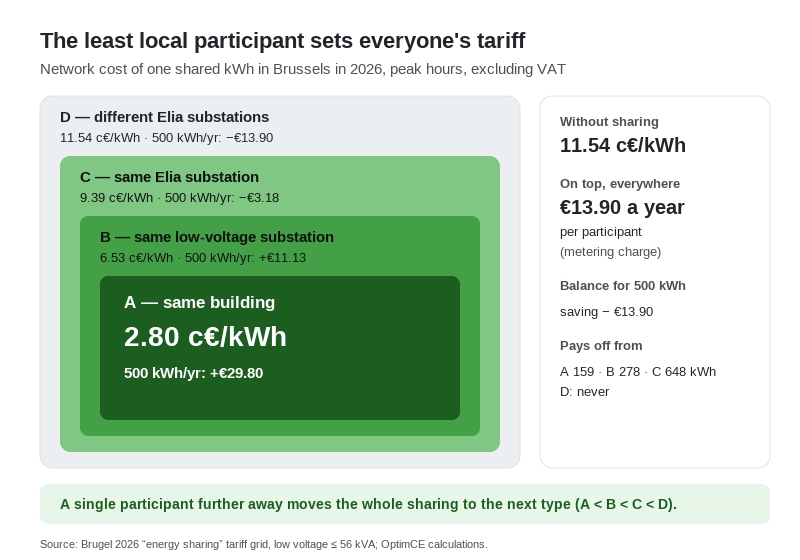
Brugel’s tariff methodology for 2025-2029 distinguishes four perimeters. In A, participants are supplied by the production of their own building; in B, by the same low-voltage cabin; in C, by the same Elia substation; in D, by different Elia substations. The least local participant sets the type for the whole sharing scheme. A condominium in type A that takes in a neighbour connected to another cabin moves entirely to type B.
On shared volumes, the 2026 grid cancels the proportional charges in A and halves them in B, removes transmission in A, B and C, and the road-use levy in A. On the other hand, a metering charge of 13.90 € a year is billed “to each grid user (URD) taking part in an energy sharing scheme” (our translation), in other words to each participant.
| Perimeter | Network cost per shared kWh | Saving per kWh | Balance for 500 kWh shared a year | Break-even point |
|---|---|---|---|---|
| No sharing | 11.54 c€ | — | — | — |
| A — same building | 2.80 c€ | 8.74 c€ | +29.80 € | 159 kWh a year |
| B — same LV cabin | 6.53 c€ | 5.01 c€ | +11.13 € | 278 kWh a year |
| C — same Elia substation | 9.39 c€ | 2.14 c€ | −3.18 € | 648 kWh a year |
| D — different Elia substations | 11.54 c€ | 0 | −13.90 € | never |
Assumptions: Brugel’s 2026 “Partages d’énergie” (energy sharing) tariff grid, low-voltage connection of 56 kVA at most, peak hours, excluding VAT. The network cost adds up the proportional charge, public service obligations, surcharges, the road-use levy and transmission. The balance deducts the metering charge of 13.90 € a year from the saving made on 500 kWh, the reference shared volume in our guides. In off-peak hours, it falls to +18.36 € in A and +5.41 € in B. These are our calculations, made on the unrounded values in Brugel’s documents.
Sibelga’s 2026 simulation follows the same mechanism: for 1,000 kWh fully shared, 103.00 € of distribution charges in type A and 190.42 € in type D, against 176.50 € without sharing. In C and D, sharing is therefore justified only by the energy price agreed between participants. These tariffs are approved for 2025-2027 by decision 285bis; those for 2028-2029 will be the subject of a new proposal.
Who pays these charges? Sibelga bills them to the single point of contact, once a year when all participants have 56 kVA at most (article 4.72), and the SPOC passes them on together with the shared energy. The supplier bills only the complementary volume, the electricity that sharing does not cover: the participant receives two bills. If the single point of contact does not pay Sibelga, the sharing scheme stops (article 4.72, § 4). Within a single building or in peer-to-peer exchange, for a main residence, an unpaid bill requires at least a reminder and a formal notice (article 13bis, § 9).
Public support
Brussels’ energy sharing facilitator: suspended
Bruxelles Environnement’s “Partage et Communautés d’énergie” (energy sharing and energy communities) facilitator supported project leaders free of charge, from the legal set-up to billing. Its page, updated on 3 September 2026, describes it as “temporarily unavailable”, with no restart date. Some Sibelga pages and Brugel’s FAQ still present it as available: the Bruxelles Environnement page is the one that counts.
Still available:
- Bruxelles Environnement’s models (sharing agreements, ASBL statutes), in the Guide Bâtiment Durable, the region’s sustainable building guide. Brugel notes that the vast majority of project leaders use them;
- Brugel, for the law and the authorisation: energysharing@brugel.brussels;
- Sibelga, for the perimeter, meters and the form: 02 549 41 00, on weekdays from 8am to 5pm.
Brussels and Wallonia: the differences in a table
| Brussels | Wallonia | |
|---|---|---|
| Forms open | Peer-to-peer, same building, community | Same building, community; peer-to-peer awaits a government order |
| Grid operator | Sibelga, for the 19 municipalities | ORES, RESA, AIEG, AIESH or REW |
| Regulator’s role | Brugel authorises the community, for 10 years | The CWaPE receives the notification and authorises each sharing activity |
| Adding a participant | On the 1st of the following month | Up to 110 working days |
| Network tariff reduction | From 8.74 c€/kWh in A to nothing in D, minus 13.90 € a year per participant | −80% on proportional charges within a single building; nothing in a community |
| Who bills the network on the shared volume | Sibelga, to the single point of contact | The supplier, on the whole volume |
| A participant leaving | 24 hours in a community; 3 weeks otherwise | Up to 50 working days |
| Public support | Facilitator suspended | SPW Énergie facilitator, free |
| Reform under way | Draft ordinance of 25 June 2026 | Peer-to-peer order awaited |
Assumptions: situation as of 27 November 2026. Brussels amounts from the 2026 grid, peak hours, excluding VAT. Walloon deadlines from the CWaPE guide on modifying a sharing scheme (July 2025); reduction and billing according to the CWaPE FAQs.
The case of Brussels condominiums
Sharing within a single building in Brussels
A condominium is the textbook case of perimeter A, the only one where the network costs markedly less. You need renewable production in or on the building, participants in that building, and proof supplied to Sibelga. The participants are often the common-areas meter, flats and sometimes a shop. Not everyone has to take part, and others can join along the way. Neither a legal entity nor an authorisation from Brugel is needed. The general meeting, ownership of the panels and the managing agent (syndic) fall under the Civil Code, covered in “Energy sharing in a condominium: the guide”.
Two choices change the outcome. Keeping the sharing inside the building: a single outside participant takes the whole sharing scheme out of type A; compare what their arrival brings with what all the others lose. Cogeneration: sharing within a single building allows only renewables. A condominium equipped with gas-fired cogeneration has to go through a citizen energy community, which owns the installations it shares; if all the participants are in the building, perimeter A still applies. On Brugel’s list, 9 of the 36 communities declare “photovoltaics and cogeneration”, including condominiums such as Les Eaux Vives in Uccle and Bellini - Vivaldi in Ganshoren.
What is likely to change
On 25 June 2026, the Brussels government adopted at first reading a draft ordinance that transposes the European reform of the electricity market (directive 2024/1711). According to Brugel’s opinion of 27 August 2026, it repeals peer-to-peer exchange and creates sharing between residential customers, SMEs and public authorities outside a single building, without a community, if they are connected to the same grid. Brugel also asks for the authorisation of communities to be replaced by a simple notification.
As of 27 November 2026, nothing has been adopted: the rules in this guide apply. If you are setting up a peer-to-peer exchange today, keep an eye on the text: it is the very form it abolishes.
What OptimCE covers, honestly
OptimCE is an open-source platform for managing energy communities, in alpha, designed first for the Walloon framework. Brussels is planned but not yet implemented. In practice, a community cannot yet be linked to Brugel in the application; billing applies the CWaPE’s Walloon rules and does not handle the network charges Sibelga bills to the single point of contact; the procedures it tracks are the CWaPE’s.
A regional tool exists: BEST, the platform of the non-profit Simply Energy, developed with support from Bruxelles Environnement. It manages members and issues invoices, from 100 € excluding VAT per sharing scheme per year. Separately, the “Find my DSO” tool confirms that Sibelga serves all 19 Brussels municipalities.
To find a community to join, OptimCE’s community directory, which requires an OptimCE account, lists only the communities registered in the application. The official list of authorised Brussels communities (in French) is Brugel’s.
Key takeaways
- Three forms are open: peer-to-peer, same building, community. Only a community needs a legal entity and an authorisation from Brugel, valid for 10 years.
- Every sharing scheme is declared to Sibelga, five working days before the desired date, and starts on the first of the following month if all the meters are smart.
- The least local participant sets everyone’s tariff: 2.80 c€ of network charges per kilowatt-hour shared within a single building, against 11.54 c€ without sharing.
- Sharing can cost more in network charges: with 13.90 € of metering per participant, 500 kWh shared bring in +29.80 € in A, but cost 3.18 € in C and 13.90 € in D.
- The single point of contact pays the network to Sibelga and passes it on; if they do not pay, the sharing scheme stops.
- The public facilitator has been suspended since 3 September 2026.
- A reform is in preparation: the end of peer-to-peer, sharing outside a building without a community. Nothing has been voted.
FAQ
Do you need Brugel’s authorisation to share electricity in an apartment building in Brussels?
No, only energy communities are authorised by Brugel. Sharing within a single building is declared to Sibelga, with proof that all participants are in the building, and an agreement between them is enough.
Can I share my electricity with a neighbour in Brussels without setting up an ASBL?
Yes, through peer-to-peer exchange between two meters, with an agreement and a declaration to Sibelga. The draft of 25 June 2026 would replace it with sharing outside a building without a community; nothing has been voted.
How much does the network cost on shared electricity in Brussels?
In peak hours and excluding VAT, 2.80 c€ per kilowatt-hour in type A, 6.53 c€ in B, 9.39 c€ in C and 11.54 c€ in D, the same as without sharing, plus 13.90 € of metering a year per participant.
Is Bruxelles Environnement’s energy sharing facilitator available?
No, it has been “temporarily unavailable” since 3 September 2026. The models in the Guide Bâtiment Durable, Brugel and Sibelga remain.
How long does it take to leave an energy sharing scheme in Brussels?
24 hours in a community since 1 January 2026; three weeks’ notice, free of charge, within a single building or in peer-to-peer exchange. A move ends the sharing on the date the occupant changes.
Can I run a Brussels energy community with OptimCE?
Not yet: Brussels is planned but not yet implemented. The regional tool is BEST, from the non-profit Simply Energy, from 100 € excluding VAT per sharing scheme per year.
Sources
- Justel — Ordinance of 19 July 2001 on the organisation of the electricity market in the Brussels-Capital Region, consolidated text (in French) — article 13bis (§ 3 on peer-to-peer exchange and supplier obligations, § 6 on sharing within a single building, § 8 on three weeks’ notice, § 9 on unpaid bills), articles 28ter, 28quinquies and 28septies (eligible sources and ownership of installations), 28quindecies (exit within 24 hours by 1 January 2026 at the latest) and 28sexiesdecies (Brugel authorisation, decision within sixty days, ten years, renewable). Provisions inserted by the ordinance of 17 March 2022, in force on 30 April 2022. Accessed on 27 November 2026.
- Brugel — Technical regulation for the management of the electricity distribution network, version updated to 1 April 2026 (in French) — title IV, chapter 9: articles 4.61 (a single sharing scheme per access point), 4.62 (declaration and single point of contact), 4.64 (R3 or AMR metering regime), 4.65 (form, five working days, objection within ten days), 4.68 (start on the first of the month), 4.69 (joining, leaving, change of occupant), 4.70 (monthly data) and 4.72 (network billed to the single point of contact, end of sharing in the event of non-payment). Accessed on 27 November 2026.
- Brugel — Decision 264, tariff methodology 2025-2029, part 2 (in French) — section 7.12: perimeters A to D renewed for 2025-2029, least-local-participant rule, measurement and metering charge billed “to each grid user (URD) taking part in an energy sharing scheme”, road-use levy removed in type A. Accessed on 27 November 2026.
- Brugel — Decision 285bis on Sibelga’s adapted tariff proposal 2025-2029 (in French) — approval of the 2025-2027 sharing tariffs; 2028-2029 tariffs to be proposed again. The document is dated 26 November 2024; Brugel’s website gives 4 November 2024. Accessed on 27 November 2026.
- Brugel — 2026 “Partages d’énergie” (energy sharing) tariff grid (in French) — page 1, low-voltage connections of 56 kVA at most: values per type A to D from which we derive the network cost table. Accessed on 27 November 2026.
- Brugel — Terms of application of the 2025-2029 electricity tariffs (in French) — page 3: the measurement and metering tariff is billed to each market player that receives the metering data, “where applicable, to the manager of an energy sharing scheme” (our translation). Accessed on 27 November 2026.
- Brugel — Network tariffs for energy sharing (in French) — definition of types A to D, reductions per component, free smart meter for participants. Accessed on 27 November 2026.
- Brugel — Energy sharing FAQ (in French) — authorisation reserved for communities, declaration of every form to Sibelga, exit deadlines, two bills. Undated page, part of which has not been updated (24-hour deadline in the future tense, facilitator presented as available). Accessed on 27 November 2026.
- Brugel — Authorisation application form for an energy community (in French) — documents to provide, answer within 60 days, 10-year renewable authorisation, contact energysharing@brugel.brussels. Accessed on 27 November 2026.
- Brugel — Authorised communities (in French) — 36 communities recounted on 27 November 2026, from “Illuminons notre quartier” (16 May 2023) to “Sun Is Up 2” (17 September 2026), 9 of which declare “photovoltaics and cogeneration”. Live page, with no update date. Accessed on 27 November 2026.
- Brugel — A new energy community authorised in Brussels (in French) — 3,992 participants in energy sharing in Brussels, news item of 21 October 2026. Accessed on 27 November 2026.
- Brugel — Annual report 2025 (in French) — 143 new sharing projects in 2025 against 106 in 2024, 2,880 members, 30 MWp. Published on 20 May 2026, accessed on 27 November 2026.
- Brugel — Opinion 420 on the draft transposition ordinance (in French) — draft adopted at first reading on 25 June 2026; repeal of peer-to-peer exchange (article 13bis, § 3); new § 6bis opening sharing outside a single building without a community; request to remove the prior authorisation of communities. Opinion of 27 August 2026, accessed on 27 November 2026.
- Brugel — Own-initiative opinion 415 on the Brussels regulatory texts (in French) — point 6.3: proposal to replace the authorisation of communities with a notification and checks after the fact; most project leaders use the model statutes and agreements. Opinion of 22 April 2026, accessed on 27 November 2026.
- Sibelga — How to start energy sharing, peer-to-peer sharing, sharing within a single building and sharing through an energy community (in French) — steps, conditions, third-party investor, free smart meter when no reinforcement is needed, ownership of installations by type of community. Accessed on 27 November 2026.
- Sibelga — Requesting the electricity network perimeter and billing method (in French) — the same tariff for all participants, monthly file with a “Gridfee” column, network bill to the single point of contact, two bills for the participant. Accessed on 27 November 2026.
- Sibelga — Electricity distribution tariffs (in French) — 2026 simulation for 1,000 kWh: 176.50 € without sharing, 103.00 € in type A and 190.42 € in type D when 100% is shared. Accessed on 27 November 2026.
- Bruxelles Environnement — “Partage et Communautés d’énergie” facilitator (in French) — service “temporarily unavailable”, page updated on 3 September 2026; model agreements and statutes still available in the Guide Bâtiment Durable (in French). Accessed on 27 November 2026.
- Bruxelles Environnement — Energy sharing made simpler with the BEST tool (in French) — platform of the non-profit Simply Energy, news item of 2 June 2026; subscription price taken from Simply Energy’s offers page (in French). Accessed on 27 November 2026.
- CWaPE — Puis-je vendre ou donner l’électricité que je produis à mes voisins ? (peer-to-peer “not yet possible” in Wallonia), Faut-il payer les frais de réseau en cas de partage d’énergie ? (−80% within a single building, no reduction in a community), Qui facture l’électricité partagée ? (network billed by the supplier on the whole volume) and Explanatory guide to the form for modifying electricity sharing, July 2025 (adding and removing a participant), all in French. Accessed on 27 November 2026.
- SPW Énergie — Energy sharing and energy community facilitators (in French) — free expert service in Wallonia. Accessed on 27 November 2026.