
Invoicing shared electricity in Belgium
An energy community shares kWh — but it also produces invoices. And that is where the confusion begins: every quarter, a sharing participant receives not one but two invoices. One from their usual supplier, one from the community. No one has explained which covers what, nor why network fees always appear on the first even though they are consuming “local” electricity.
This article sorts out the roles. Who has the right — and the obligation — to issue the invoice for shared energy? What must it contain? Which VAT applies, and how do excise duties and green certificates fit in? If instead you are after what price to set per kWh, our guide “Internal transfer price in an energy community” answers that in detail; and if the allocation key is still unfamiliar, start with our reference article “Allocation key in Belgium: the 3 regions”. Here, a single question: who invoices what?
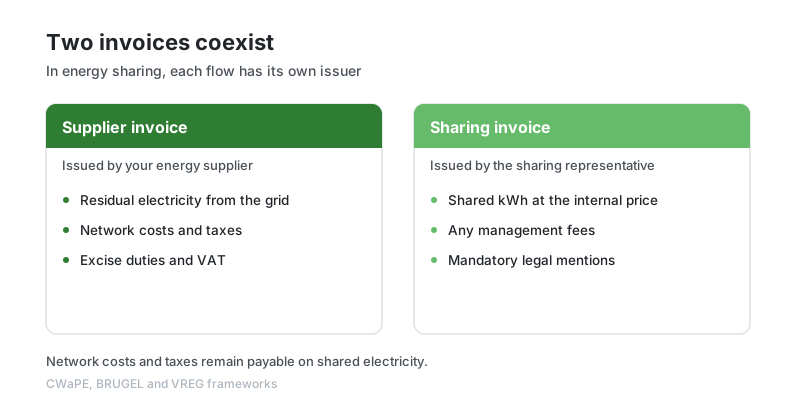
Two invoices, not one: sharing does not replace your supplier
This is the founding misunderstanding. Taking part in energy sharing does not terminate your supply contract: sharing covers only part of your consumption, the part the allocation key assigns you quarter-hour by quarter-hour. The rest — the residual energy — still comes from the grid and is still billed by your supplier.
Two invoices therefore coexist, and they do not cover the same thing:
| Supplier’s invoice | Sharing representative’s invoice | |
|---|---|---|
| Energy | the residual energy, not covered by sharing, at your contract rate | the shared energy, valued at the community’s internal price |
| Network | network fees on the entire volume of kWh drawn, sharing included | — |
| Taxes & excise | regional taxes and surcharges on the residual energy | VAT, excise duties and the PSO to surrender green-certificate quotas, on the shared energy |
The least intuitive line is the network one: network fees remain due on the shared kWh, and it is your supplier who bills them, because shared electricity still transits the public grid. Sharing changes who sells you the energy, not where it flows. That is also why the real saving is always read across both documents together, never on the sharing invoice alone — a mechanism detailed in our article on reducing the electricity bill through sharing.
The sharing representative, issuer of the sharing invoice
In energy sharing, one actor — and only one — carries responsibility for invoicing: the sharing representative. The CWaPE leaves no ambiguity: it is the sharing representative who invoices shared energy to the participants (CWaPE). This is the person, or the entity, designated in the sharing agreement to organise the operation and handle its administrative follow-up.
The point that surprises project leaders most: the grid operator does not invoice. It computes the sharing quarter-hour by quarter-hour, applies the chosen allocation key, then forwards the volumes to the various actors “to enable invoicing”. The invoice itself is then drawn up “on the basis of the consumption data received from the grid operator, taking the chosen allocation key into account” (CWaPE). In other words: the grid supplies the figures, the representative turns them into documents.
This division of roles has a direct consequence: it is the representative who carries the obligations — issuing compliant invoices, applying the right VAT, keeping accounts. In a co-ownership or a building, that role most often falls to the building manager (syndic), who effectively becomes the issuer of the sharing invoices for all occupants. We already noted, in our guide to creating an energy community in Wallonia, that it is in the operational phase that this burden becomes real.
What the sharing invoice contains
The representative’s invoice is narrower than a classic supplier’s: it covers only the shared energy, valued at the community’s internal price — not your entire consumption. Which amount to set per kWh is the whole point of our guide on the internal transfer price, which maps out the defensible range and five calculation methods.
To that energy price are added, on the same invoice, “VAT, excise duties and the public-service obligation to surrender green-certificate quotas” (CWaPE). What does not appear on it, on the other hand, are the network fees: they stay on the supplier’s invoice, computed on the total kWh drawn. A well-made sharing invoice actually states this explicitly — it covers the shared energy, excluding network fees.
VAT: 6% or 21%, and the obligation to register
As soon as a community invoices energy to its members, it carries out an economic activity, and the VAT question arises. Two rates coexist, depending on the profile of the member being billed:
- 6% for the supply of electricity to a residential customer;
- 21% for a professional customer.
A practical consequence often discovered too late: a community with mixed membership — households and businesses — must bill at two rates. The price per kWh is the same; the VAT applied on top is not.
Then comes the registration question. In principle, the activity of invoicing energy makes the entity liable for VAT, with the obligations that come with it: identification, invoice mentions, returns. But below €25,000 of annual turnover excluding VAT, the small-business exemption scheme can relieve the community from charging VAT — the case for many small sharing schemes. There is no dedicated circular on energy sharing: do not freeze your regime on a forum post or a template found online. Have your situation validated by the SPF Finances or your accountant before issuing the first invoice — it is the choice that governs every mention that follows.
Excise duties and green certificates: the levies the representative passes on
Beyond VAT, the representative’s invoice carries two levies that the CWaPE explicitly lists among the elements due on shared electricity: excise duties and the PSO to surrender green-certificate quotas (CWaPE). They are added to the energy price, shared kWh by shared kWh.
Two precautions here avoid common mistakes:
- The federal contribution no longer exists. It was abolished on 31 December 2021 and absorbed into the special excise duty (CREG). Many invoice templates and simulators still in circulation mention it: do not carry it over.
- The exact fiscal mechanics of excise duties remain technical. Knowing who is precisely liable and how to pass it on to a sharing invoice is a matter for your accountant and the applicable tax texts, not a universal rule. The principle is clear — excise duties are due on the shared kWh and appear on the community’s invoice; the execution detail is validated case by case.
The mandatory mentions of an invoice
A sharing invoice is an invoice like any other: it must satisfy the Belgian invoicing and VAT rules. Concretely, every document issued by the representative includes:
- a number in a continuous, gapless series — a requirement, not a preference;
- the issue date and the due date;
- the identity and VAT number of the issuer (the community, as sharing representative) and of the recipient;
- the breakdown of volumes: the shared kWh per connection point (EAN) multiplied by the unit price, over the period concerned;
- the amount excluding VAT, the rate and the amount of VAT;
- a Belgian structured payment reference and the community’s IBAN, to reconcile payments unambiguously.
One rule deserves isolating, because it trips up beginners: an issued invoice is never edited. An error in a volume, a price or a recipient is not corrected by reopening the document — you issue a credit note that cancels it, then re-invoice cleanly. The history stays intact and verifiable, which is exactly what you will be asked for on the day of an audit or a dispute. The invoicing guide published for sharing representatives details this documentary chain (ORES / Federia).
The case of co-ownership and buildings
Sharing within a building deserves separate treatment, because it concentrates the invoicing questions — and one real advantage. Here, sharing takes place within a single building, between occupants, and the building manager (syndic) is the natural candidate for the representative role: they already manage the co-ownership’s accounts, collect charges, issue statements.
Three specific points:
- A genuine network advantage, but bounded to the building. In Wallonia, sharing within a single building enjoys an 80% reduction on the proportional terms of the network tariff. Careful: this advantage applies to the building, not to the energy community — the CWaPE states that “there is no tariff reduction for sharing within an energy community” (CWaPE).
- The syndic can bill its management. The administrative work — participant entries and exits, invoice issuing, follow-up — can be handled and billed by the syndic, or outsourced. Nothing requires it to be free.
- The schedule can follow the accounting year. It is possible to align the sharing invoicing with the co-ownership’s accounting rhythm, rather than opening a parallel cycle.
What this section does not cover is the question that precedes it: who owns the installation, and by what majority the general meeting decided it. The assets of the association of co-owners are bounded by article 3.86, § 3, of the Civil Code, and the majority threshold depends on the structure chosen — two thirds or four fifths. The full path is set out in “Energy sharing in a condominium: the guide”.
Finally, one item never to forget in the reckoning: your supplier may bill fees for your participation in sharing. The CWaPE confirms nothing prohibits it (CWaPE), and the amounts recorded reach around €150 per year and per supply point. On small shared volumes, these fees can wipe out the gain: they belong in the simulation, not on the invoice as a surprise.
Summary: the representative’s obligations
For the sharing representative — syndic, cooperative, non-profit (ASBL) or mandated person — the obligations fit into a checklist:
- An agreement that designates the representative and sets the invoicing terms, the allocation key and the price of the shared energy.
- A VAT regime settled with an accountant: registration or exemption, rate of 6% and/or 21% depending on the members.
- Compliant invoicing: gapless numbering, mandatory mentions, VAT, excise duties and PSO correctly passed on.
- Accounts and a history: documents kept, corrections by credit notes, a dated and enforceable price.
- A periodic price review, consistent with the market, decided at the general meeting.
It is doable by hand for a handful of members. At twenty or fifty supply points, every quarter, it becomes a burden in its own right — and a source of errors.
Invoicing without a spreadsheet: OptimCE’s billing module
That is precisely what OptimCE’s billing module takes on, available since July 2026. You set your prices, you choose a period, and OptimCE generates every member’s documents from the official settlement data already imported into the platform — with no re-entry and no intermediate spreadsheet.
The module distinguishes three documents, each with its own continuous series: the invoice (F-…) for the shared energy consumed by a member, the credit note (NC-…) to correct an issued invoice, and the remuneration statement (DP-…) for a producer’s shared injection. Each document details the kWh per EAN multiplied by the unit price, the total excluding VAT, the VAT and the amount due, with the community’s IBAN, a structured payment reference and the legal mentions — including the note that the invoice covers the shared energy, excluding network fees. An issued invoice receives a legal number and can no longer be modified; payment tracking, partial payments included, is built in.
This first version is designed for the Walloon framework (CWaPE) and generates documents in French. Upcoming versions will extend the scope to the Flemish and Brussels frameworks — true to OptimCE’s approach: ship early, test in the field, iterate with communities.
Conclusion
Invoicing an energy-sharing scheme is not a legal mystery: it is a clear division of roles, once you know it. The grid operator computes and forwards. The supplier bills the residual energy, the network fees and the regional taxes. The sharing representative bills the shared energy, plus VAT, excise duties and the green-certificate PSO — and it is the representative who carries the obligations: the right VAT rate, mandatory mentions, gapless numbering, credit notes to correct.
The rest is a matter of execution: settle the VAT regime with an accountant, write a clean agreement, and issue compliant documents every quarter — by hand while it is bearable, with a tool as soon as it is not.
On the household side, the bill you keep receiving from your supplier also reads line by line: we take it apart in “Read your Belgian electricity bill line by line”.
Invoice your energy community with OptimCE
Open-source platform built for Belgian energy communities: import your settlement data, define your prices, generate invoices, credit notes and statements as PDFs — with legal numbering, a structured payment reference and payment tracking.
FAQ
Who must issue the invoice for shared energy?
The sharing representative — the party designated in the agreement to organise the sharing. The CWaPE puts it plainly: it is the sharing representative who invoices shared energy to the participants. The grid operator computes the volumes quarter-hour by quarter-hour and forwards them, but it does not invoice. The supplier only bills the energy that sharing did not cover.
How do you invoice shared electricity in a building in Belgium?
The sharing representative — often the building manager (syndic) in a co-ownership — takes the shared volumes forwarded by the grid operator for each EAN, applies the internal price set in the agreement, then issues one invoice per member with VAT, gapless numbering and a structured payment reference. In Wallonia, sharing within a single building also enjoys an 80% reduction on the proportional network-tariff terms — a benefit reserved for the building, not for the community.
Which VAT rate applies to shared electricity?
6% for residential members and 21% for professional members: a community with mixed membership therefore bills at two rates. Below €25,000 of annual turnover excluding VAT, the small-business exemption scheme may relieve you from charging VAT. No circular deals specifically with energy sharing: have your situation validated by the SPF Finances or your accountant before the first invoice.
What is the difference between the supplier’s invoice and the sharing invoice?
They do not cover the same energy. The supplier’s invoice covers the residual energy — what sharing did not cover — plus network fees (computed on the total kWh drawn) and regional taxes. The sharing representative’s invoice covers only the shared energy, valued at the internal price, plus VAT, excise duties and the public-service obligation to surrender green-certificate quotas.
Does the community need to register for VAT?
As soon as it invoices energy to its members, the community in principle carries out an economic activity subject to VAT. The small-business exemption scheme (annual turnover below €25,000 excl. VAT) may nonetheless relieve it from charging VAT. It is a decision to settle with an accountant, entity by entity: it governs your invoice mentions and your reporting obligations.
What must a shared-energy invoice contain?
The mentions of a compliant Belgian invoice: a number in a continuous, gapless series, the issue date and the due date, the identity and VAT number of both issuer and recipient, the breakdown of shared kWh per EAN multiplied by the unit price, the amount excluding VAT, the VAT rate and amount, and finally a structured payment reference and the community’s IBAN. An issued invoice is never corrected by editing it: you issue a credit note that cancels it, then re-invoice.
Sources
- CWaPE — Who invoices shared electricity? — the sharing representative invoices, on the basis of the grid operator’s data and the allocation key; contents of the invoice (energy, VAT, excise duties, green-certificate PSO).
- CWaPE — What is the cost of shared electricity? — elements billed on top of the energy price: VAT, excise duties and the PSO to surrender green-certificate quotas.
- CWaPE — Network fees on shared electricity — network fees due on the shared kWh; 80% reduction limited to sharing within a single building.
- CWaPE — Possible supplier fees — the supplier may bill fees related to participation in sharing.
- Sibelga — The principles of energy sharing — roles of the actors (producer, representative, supplier, grid operator) and data flow.
- ORES / Federia — Explanatory invoicing guide for the representative of an energy-sharing scheme — receiving files, reading the data and issuing invoices as the representative.
- Test-Achats — Energy sharing — consumer dossier with a concrete building case and dual invoicing.
- SPF Finances — VAT — invoicing, accounting and VAT obligations for Belgian companies and legal entities.
- SPF Finances — Tax exemption scheme — the €25,000 threshold for small businesses.
- CREG — Federal contribution — abolished on 31 December 2021.