
Read your Belgian electricity bill line by line
Count the documents your electricity supplier sends you over a year: eleven instalments and one statement, or three instalments and one statement, depending on your contract. They all carry the word “invoice”. Only one tells you what you actually owe. The others are advances calculated from an estimate.
That is the first thing to know about reading a Belgian bill, and it explains a good share of the nasty year-end surprises. The second is that since 1 January 2022, your bill is no longer a free-form document: a royal decree requires every supplier active in Belgium to use five named sections, on two pages. Whether you are with Engie, Luminus, Mega, TotalEnergies or a cooperative supplier, the skeleton is the same. Learning to read it once is enough for a lifetime.
This article does not re-explain why your bill is high — we did that in euros in “Why your electricity bill stays high” — nor how to reduce it, costed in “Cutting your electricity bill: Wallonia 2026”. It explains how to read the document: which lines to check, in what order, what each one pays for, who actually collects it, and whom to contact when a figure looks wrong.
Four documents are called an invoice — only one settles the account
Before reading a single line, identify the document in your hand. This is mistake number one: panicking over an instalment, or filing away an annual statement without checking it.
| Document | What it is based on | What it proves |
|---|---|---|
| Instalment invoice | an estimate of your annual consumption, usually last year’s | nothing about your actual consumption — it is an advance |
| Annual statement (settlement invoice) | the meter readings taken over the period | your real consumption; balance to pay or to be refunded |
| Closing invoice | the final meter reading when you move or switch supplier | the closing of the account on a specific date |
| Monthly statement (smart meter) | your actual monthly consumption | the outright replacement of instalments |
The instalment is sent monthly, or every two or three months depending on the contract, and is calculated from an estimate of annual consumption based on the previous year, whereas the settlement invoice is based on the electricity meter readings and lets the supplier calculate real consumption (Ecoconso). The closing invoice contains the same elements as the settlement invoice, but relies on the final reading.
The fourth document is the newest and the least understood: with a smart meter, several suppliers offer a monthly statement where you no longer pay instalments, only what you have consumed (Test-Achats). The benefit is not financial — you pay the same in total — but it removes the gap between estimate and reality, and with it the year-end shock.
Practical consequence. If you only read one document a year in detail, read the annual statement. It is the only one containing actual meter readings, and therefore the only one you can dispute on the substance.
The five sections mandated by law since 2022
Here is the point almost no guide mentions, and it makes reading far easier: the structure of your bill is set by law.
The royal decree of 9 December 2021 laying down the minimum requirements for gas and electricity invoices and billing information, published in the Belgian Official Gazette on 20 December 2021 and in force since 1 January 2022, transposes article 18 and Annex I of European directive 2019/944 on the internal electricity market (FPS Economy). It repeals the royal decree of 3 April 2003 that previously governed supply invoices.
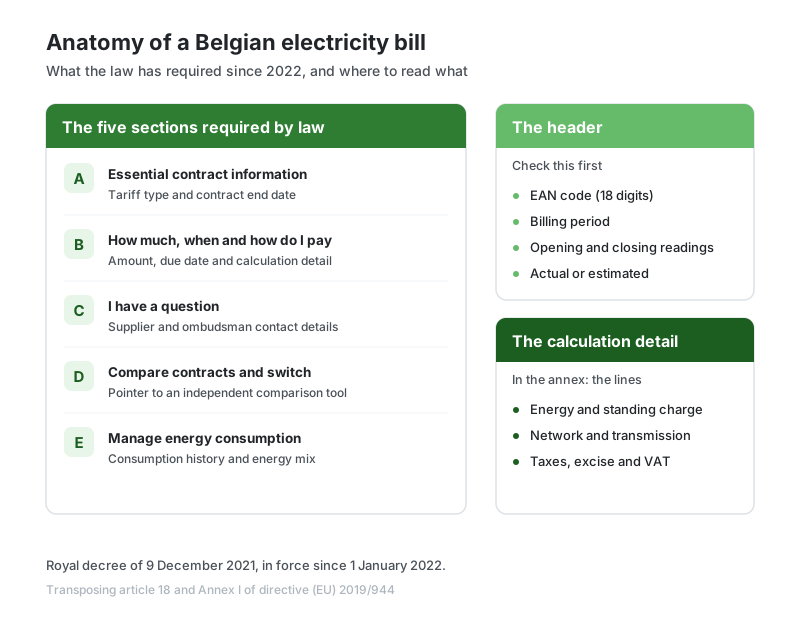
Its article 14 requires five named sections for residential customers:
| Section | Legal heading | What you check there |
|---|---|---|
| A | “essential contract information” | product name, tariff type (fixed, variable or dynamic), contract end date, EAN code, billing period |
| B | “how much, when and how do I pay” | the amount, the due date, the structured reference, and the calculation detail |
| C | “I have a question” | contact details for the supplier and the competent ombudsman service |
| D | “compare contracts and switch” | the pointer to an independent comparison tool |
| E | “manage energy consumption” | your consumption history and the product’s energy mix |
The stated aim was to fit on two pages: the information is simplified and presented on two pages only (UVCW). The calculation detail itself is moved to an annex — the document most people never look at, and precisely the one that contains the lines.
Two habits follow. First, section A contains your contract end date: it is the most profitable single piece of information on the whole bill, because it tells you when to compare. Second, if a bill does not carry these sections, it is not compliant — and you can say so. As for section E, it displays the product energy mix without a word about what backs it: what that line actually proves is taken apart in “Green electricity in Belgium: really green?”.
The header: four lines to check before you even look at the amount
The identification block at the top looks like administrative filler. It is in fact where most of the expensive errors hide.
The EAN code. It is a unique number for your supply point that never changes, even if the meter is replaced (Ecoconso). Eighteen digits, starting with 54 in Belgium. The key point: it identifies a place, not a meter and not a contract. Switch supplier, the EAN stays. Have your meter replaced, the EAN stays. It is what you will be asked for when moving, when complaining, or when registering your point in an energy sharing operation. In an apartment building, check it digit by digit: two neighbouring flats have EANs that differ only in the last few characters, and a mix-up is paid for over years.
The billing period. Compare it with the period that has actually elapsed. This is where the standing-charge trap hides, which we come back to below.
The opening and closing readings. Your consumption is a subtraction: closing reading minus opening reading. If you make only one arithmetic check on your bill, make that one, and compare the closing reading with what your meter shows today.
Actual or estimated. The royal decree requires the bill to state whether the billed consumption was read or estimated. An estimated reading is not an anomaly — it is the normal basis for instalments, since the network operator only takes an actual reading once a year. But it manufactures a phantom increase: if the estimate was low, the next statement catches up the gap in one go, and it feels like a price surge even though your consumption has not moved. The gap is settled annually, either as an amount still owed if consumption exceeded the estimate, or as a refund (Ecoconso).
The useful reflex: if your annual statement is itself based on an estimate — which happens when the reading could not be taken — do not let it pass. Submit an actual reading rather than waiting another twelve months for the truth to catch up.
Line by line: who sets the amount, who collects it
Here is the most widespread misunderstanding about the Belgian bill. You pay everything to your supplier — but your supplier keeps only part of what you pay.
ORES puts it plainly: it is the energy supplier that issues and sends your energy bill, it is the supplier you must pay, and the supplier then distributes the money to all the parties involved (ORES). In other words, your supplier is a collector for the distribution system operator, for the transmission system operator and for the state. Switching supplier therefore changes only a fraction of the lines.
| Line on the bill | Who sets the amount | Who ultimately receives it | Negotiable? |
|---|---|---|---|
| Standing charge / fixed term | your supplier | your supplier | Yes |
| Consumption in kWh (unit price) | your supplier, competitively | your supplier | Yes |
| Distribution volumetric term | the DSO, tariffs approved by the regional regulator | ORES, RESA, Sibelga, Fluvius… | No — but the tariff formula is a choice |
| Fixed or capacity network term | same | the DSO | No |
| Transmission | Elia tariffs approved by the CREG | Elia | No |
| Prosumer tariff (Wallonia) | the CWaPE | the DSO | No |
| Green certificates and cogeneration | the region | the DSO, then producers | No |
| Public service obligations | the region | the DSO | No |
| Connection fee (W) / energy fund (F) / PSO surcharge (Bxl) | the region | the region | No |
| Excise duties | the federal state | the FPS Finance | No |
| VAT 6 % | the federal state | the FPS Finance | No |
Two subtleties that line-by-line reading reveals and that averages hide.
VAT does not hit everything. It applies at 6 % to most items, but the CREG flags three exemptions: the Walloon connection fee, the Flemish energy fund contribution and the protected-customer surcharge for gas in Wallonia (CREG). If you recalculate your bill and the VAT total does not add up, that is often why.
The percentages differ from one source to another, and that is not a contradiction. ORES illustrates a €1,200 electricity bill as 44 % energy (€528), 8 % transmission (€90), 28 % distribution (€339) and 20 % taxes and VAT (€243). The CREG’s June 2026 dashboard gives 38.5 % energy, 29.7 % network costs, 26.1 % taxes and 5.7 % VAT. Both are accurate: they cover neither the same consumption profile, nor the same region, nor the same date, and one isolates VAT where the other folds it into taxes. Reading that gap is part of reading a bill — be wary of any breakdown quoted without its profile, its region and its date. The economic analysis of these blocks, in euros and region by region, is developed in “Why your electricity bill stays high”.
For scale on the tax lines: excise duty on electricity stands at €0.05033/kWh and the energy contribution at €0.0002/kWh (Ecoconso) — the latter disappearing on 1 August 2026.
The standing charge: the line that costs the most to misread
One line deserves separate treatment, because it does not depend on your kWh and because it is the best-documented source of error on the Belgian bill.
The standing charge is your supplier’s annual flat fee. In 2026 it reaches up to 143 euros a year on some contracts (Test-Achats). At that level it weighs more than many energy-saving measures.
The trap springs when you switch supplier. Consumers who are not paying attention when switching risk paying two standing charges in the same year: one to the old supplier, one to the new (Test-Achats). The documented case is striking: an invoice covering 434 days when only 92 days had actually elapsed.
Current rules already partly frame this:
- Variable contracts (since July 2022): if you terminate within the first six months, the supplier may bill the charge as a flat six months; beyond six months, the calculation must be pro-rated by the day.
- Fixed contracts: under the consumer agreement, from the second year onwards the supplier must bill this charge at least partly pro rata.
The move to make: on your closing invoice, divide the standing charge by the number of days actually covered and compare with the annual rate on your tariff sheet. If it does not add up, you have a solid dispute.
What changes on your bill in 2026 and 2027
On 17 June 2026, the Chamber’s Energy Committee approved a set of measures intended to make bills more readable and prices more comparable (Test-Achats). Several affect lines you read directly.
- Pro-rata standing charge for everyone. From 2027, all energy suppliers will have to bill the standing charge pro rata — the end of the flat charge per contract year started.
- A tariff sheet change means a new product name. Today a supplier can alter a product’s parameters without changing its name, which makes the history impossible to compare. The obligation takes effect before the end of this year.
- Welcome discounts restricted. From October 2026, temporary or conditional promotions on the price per kWh will in principle be banned — the advertised price will move closer to the price paid.
- QR code to the tariff sheet. Suppliers will have to print a QR code on every instalment invoice, every closing invoice and at every contract renewal, linking to the applicable tariff sheet. It is the missing link between the bill and the document that sets the prices.
- Estimated total annual cost. Suppliers will always have to give customers an estimate of the total price on an annual basis.
- Renewal announced at least two months before the contract ends.
A note of honesty, in the register we keep on this blog: at this stage this is committee approval, and the application dates are staggered and announced rather than all enacted. We report here what was communicated in June 2026; for a binding amount or obligation, refer to your tariff sheet and to the texts published in the Belgian Official Gazette.
Finally, two ghost lines worth recognising: the federal contribution has not existed since the end of 2021 but still appears in plenty of templates and simulators, and the energy contribution disappears on 1 August 2026. If either shows up on a later bill, ask the question. The excise reform is covered in our article on the level of the bill.
Disputing a line? The right body depends on the line
None of our articles covered recourse until now. Yet it is the logical sequel to reading line by line, and the division of powers is counter-intuitive: it is not the same body depending on which line you dispute.
Compulsory first step. A written complaint to your supplier or your network operator. A first amicable step must have been taken in writing — fax, email or letter — and a copy is required, except in emergencies (CWaPE). The federal ombudsman confirms the rule: your complaint is only accepted once you have already taken steps with the electricity or natural gas company (Federal Energy Ombudsman). So write, and keep the trace.
Then choose the right service. In Wallonia:
| You are disputing… | Competent service |
|---|---|
| meter readings or consumption | SRME (regional, CWaPE) |
| distribution tariffs | SRME |
| a technical meter or network problem, an outage, a power surge | SRME |
| the installation of a budget meter, a connection | SRME |
| the price of the energy billed or consumed | Energy Ombudsman Service (federal) |
| your supply contract or a breach of it | federal |
| a mishandled house move, aggressive doorstep selling | federal |
The logic is easy to remember: anything to do with the meter and the network is regional; anything to do with the contract and the price is federal. A disputed reading goes to the SRME; a disputed unit price goes to the federal service. In Brussels and Flanders the corresponding regional bodies are Brugel and the VREG.
The CWaPE asks you to wait twenty working days after sending your letter before referring the matter to it, and notes that the processing times it publishes are indicative and vary with the complexity of the file.
Where energy sharing shows up on your bill
If you take part in an energy community or in sharing between neighbours, your reading changes on one precise point — and only one.
You receive two documents, not one. Your supplier continues to bill you for residual energy, that is, whatever you consumed beyond the shared kWh, plus all of the network costs and taxes. The sharing representative separately bills you for the shared kWh. On your supplier’s bill, the effect of sharing therefore does not read as a discount line: it reads as a lower kWh volume on the energy line, with the other lines unchanged.
One line to watch nonetheless: nothing prevents a supplier from charging fees linked to your participation in sharing. The full mechanism, the mandatory items on a sharing invoice and the split of roles between supplier, network operator and representative are detailed in “Who invoices shared electricity in Belgium”, and how the price of shared kWh is set in “Internal transfer price in an energy community”.
Key takeaways
A Belgian electricity bill is read in this order, and the order matters:
- Identify the document. Instalment or annual statement? Only the statement, based on actual readings, settles the account.
- Check the header. EAN code, billing period, opening and closing readings, actual or estimated. Subtracting the readings is the one arithmetic check you cannot skip.
- Open the calculation detail, in the annex. That is where the lines are — page 1 only gives the amount.
- Separate what is negotiable from what is not. Standing charge and price per kWh are competitive; network, taxes and excise duties are not, whoever your supplier is.
- Check the standing charge pro rata, especially on a closing invoice.
- Note the contract end date in section A, and set a reminder two months ahead.
- If you disagree, write first, then refer the matter to the competent service: meter and network to the regional body, contract and price to the federal one.
An unreadable bill is not a regulatory fate: since 2022 the law has imposed a structure, and since June 2026 it has been imposing more price transparency step by step. What remains up to you is knowing where to look.
And if your reading leads you to want to act on the energy line rather than absorb it, energy sharing is one of the few options that requires no works, no panels and no change of supplier: “Joining an energy community in Wallonia” sets out the concrete steps.
Manage your energy sharing with OptimCE
Open source platform built for Belgian energy communities: members, meters, allocation keys and sharing operations in one place — through to generating invoices, credit notes and settlements as PDFs from your official allocation data.
FAQ
What are the five mandatory sections of a Belgian energy bill?
The royal decree of 9 December 2021, in force since 1 January 2022, requires five sections on every bill sent to a residential customer: A “essential contract information”, B “how much, when and how do I pay”, C “I have a question”, D “compare contracts and switch” and E “manage energy consumption”. These sections are identical across every supplier active in Belgium, because they transpose article 18 and Annex I of European directive 2019/944. A bill that does not contain them is not compliant.
What is the difference between an instalment invoice and an annual statement?
An instalment is an advance calculated from an estimate, usually your previous year’s consumption: it proves nothing about what you actually used. The annual statement, also called the settlement invoice, is based on meter readings and calculates your real consumption over the period; it is the only document that settles the account, in your favour or against it. Two other documents carry the same name: the closing invoice, issued when you move or switch supplier, based on the final reading, and the monthly statement offered with a smart meter, where you no longer pay instalments but your actual monthly consumption.
What is the EAN code on my electricity bill for?
It is the unique identifier of your supply point — an 18-digit number starting with 54 that designates the place where electricity enters your home, not the meter and not the contract. It never changes, even if the meter is replaced, even if you switch supplier. It is the key to everything: it is what you are asked for when moving, switching supplier or filing a complaint, and it identifies your point in an energy sharing operation. Check that it matches your home, especially in an apartment building where several EANs look alike.
How do I know whether my meter reading is actual or estimated?
The bill has to say so: the royal decree of 9 December 2021 requires the actual or estimated nature of the billed consumption to be stated. Look for the wording next to the opening and closing readings — the labels vary from supplier to supplier. An estimated reading is not an error in itself, it is the normal basis for instalments, but it manufactures a phantom rise or fall that will be corrected at the next statement. If your annual statement is itself based on an estimate, that is when to act: submit an actual reading rather than waiting another twelve months.
What should I do if I disagree with my electricity bill?
First a written complaint to your supplier or your distribution system operator — the prior amicable step is compulsory and you must keep a copy. After that, the right body depends on the line you are disputing. In Wallonia, the regional energy ombudsman service housed at the CWaPE handles meter readings and consumption, distribution tariffs, budget meters, technical meter or network problems, outages and connections. The federal Energy Ombudsman Service handles the price of the energy billed, the supply contract and breaches of it, house moves and aggressive doorstep selling. The CWaPE asks you to wait twenty working days after sending your letter before referring the matter to it.
What is the standing charge and can you pay it twice?
It is the flat annual amount your supplier charges regardless of your kWh — up to 143 euros a year in 2026 on some contracts. And yes, you can pay it twice: if you switch supplier mid-year, the outgoing one may bill it over a longer period than actually elapsed, and the new one bills it in turn. Test-Achats documented a case of an invoice covering 434 days for 92 days of actual supply. Current rules already limit the excess on variable contracts, and the reform approved on 17 June 2026 by the Chamber’s Energy Committee provides for pro-rata calculation by all suppliers from 2027.
Sources
- FPS Economy — Royal decree of 9 December 2021 on minimum requirements for gas and electricity invoices — reference text: publication in the Belgian Official Gazette on 20 December 2021, entry into force on 1 January 2022, transposition of article 18 and Annex I of directive (EU) 2019/944, repeal of the royal decree of 3 April 2003.
- Belgian Official Gazette — Royal decree of 9 December 2021 (full text) — article 14 and the five mandatory sections of the residential bill, plus the list of mandatory items (supply point identification, period, actual or estimated status, unit price, tariff type, contract end date).
- UVCW — Changes to the energy bill from 1 January 2022 — implementation of the royal decree, the split into five sections and the two-page presentation objective.
- CREG — How the energy price is made up — the four components, the list of levies and surcharges by region, the three VAT exemptions and suppliers’ commitment to clear, legible and understandable bills.
- ORES — Understanding my energy bill — the supplier’s role as collector redistributing to all parties, the scope of distribution and a 2026 example of a €1,200 bill split 44 / 8 / 28 / 20 %.
- Ecoconso — Understanding your electricity bill — instalment / settlement / closing distinction, definition of the EAN code, actual and estimated readings, excise duty at €0.05033/kWh and energy contribution at €0.0002/kWh.
- Test-Achats — Gas or electricity bill: how to read it — the four document types, including the monthly statement for smart meters, and how to dispute a bill.
- Test-Achats — New rules on energy bills: what changes — measures approved on 17 June 2026 by the Chamber’s Energy Committee: pro-rata standing charge in 2027, product naming, conditional discounts in October 2026, QR code and annual estimate.
- Test-Achats — Careful not to pay the standing charge twice — standing charge up to €143/year in 2026, pro-rata rules for variable and fixed contracts, and the case of an invoice covering 434 days for 92 days of supply.
- CWaPE — Regional energy ombudsman service — division of powers between the SRME and the federal service, the compulsory written amicable step and the twenty-working-day wait before referral.
- Energy Ombudsman Service — federal competence over disputes between final customers and electricity or gas companies, and the admissibility condition of a prior step with the company.
- Energuide — How to read your energy bill — general-audience presentation of the three main cost blocks and their relative weight for electricity and gas.
- Renouvelle — Understanding your electricity bill — plain-language account of the four components and their average proportions.
- CREG — Monthly dashboard — shares per component and all-in price by region (June 2026 edition: 38.5 / 29.7 / 26.1 / 5.7 %).