
Why your electricity bill stays high in Belgium
Since the autumn 2022 peak, the retail price of electricity in Belgium has fallen back from roughly 0.45–0.60 €/kWh to a 0.28–0.35 €/kWh range (Selectra, updated May 2026). In 2025, electricity and gas even touched their lowest level in four years (Mega, April 2026). And on 1 August 2026 the excise duty on electricity follows suit: from 50.33 down to 46 €/MWh, on a declining path to 2029 (RTBF, June 2026).
Three pieces of good news. And yet the bill barely moves.
This is neither an illusion nor an anomaly — it is arithmetic. The price of energy accounts for only about 40 % of your electricity bill; the CREG says so in plain terms (CREG, April 2026). The other 60 % is regulated network costs, taxes, excise duties and VAT, and it follows logics that have nothing to do with the energy market. Some of it, in 2026, rises precisely as the energy price falls.
This article takes your bill apart into its four blocks in euros, not just percentages: what each one pays for, who sets it, how it moves in 2026 across the three regions, and which ones you can still influence. We will finish with the question many readers of this blog are asking: which of these blocks does energy sharing actually touch?
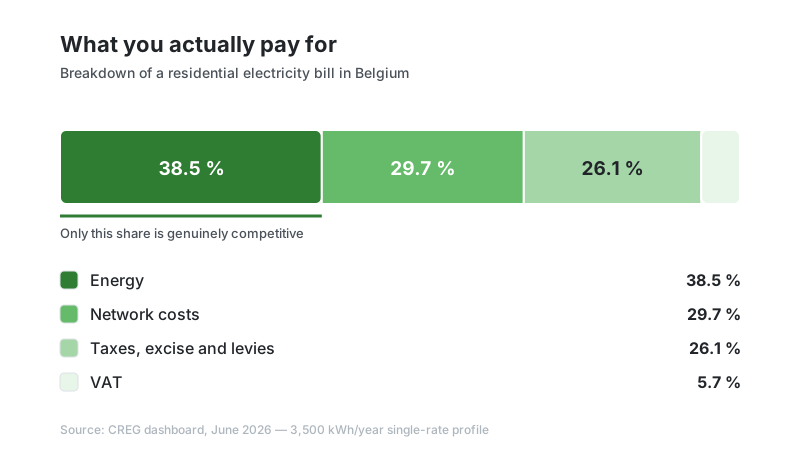
Your bill is not an energy bill: four blocks, only one of which is a price
The CREG distinguishes four components in the price paid by a consumer: energy, network costs, taxes and levies, and VAT (CREG). Only one is a market price, freely set and negotiable. The other three are regulated or legislated amounts, identical whoever your supplier is.
Here is what that looks like for a typical residential household consuming 3,500 kWh per year, based on the shares published in the CREG monthly dashboard for June 2026 (Belgian average, single-rate profile, all-in price of 36.94 c€/kWh). The euro column is a calculation: the CREG publishes the shares and the price per kWh, not this annual amount.
| Block | Share | ≈ €/year for 3,500 kWh | Who sets it | Any leverage? |
|---|---|---|---|---|
| Energy | 38.5 % | ≈ 498 € | your supplier, in competition | Yes — compare, switch, share |
| Network costs (transmission + distribution) | 29.7 % | ≈ 384 € | the network operator, tariffs approved by the regional regulator | Indirectly — tariff formula and peaks |
| Taxes, excise duties and surcharges | 26.1 % | ≈ 337 € | the federal state and the regions | On volume only, not on the rates |
| VAT (6 %) | 5.7 % | ≈ 74 € | the federal state | No — it follows everything else |
| Total | 100 % | ≈ 1,293 € |
These orders of magnitude line up with what price comparison sites observe: an annual bill typically between 1,000 € and 1,800 € depending on region and supplier (I am Beezy, May 2026), and an average bill of around 1,200 € for 3,500 kWh (Test-Achats, February 2026).
Three immediate consequences, and they explain most of the frustration:
- A drop in energy is damped by a factor of two and a half. If the commodity price falls 20 %, your bill falls only about 8 %. On 1,293 €, that is around a hundred euros — visible, but a long way from what the headlines suggest.
- VAT amplifies increases in the other blocks. At 6 %, it applies on top of energy, network and most surcharges. Any rise in the network tariff is therefore marked up by 6 % on the way through. Two notable exceptions: the Walloon connection fee and the Flemish energy fund contribution are exempt (CREG).
- The weight of the network changes sharply with location. In Wallonia it climbs to 32.7 % of the bill, against 24.6 % in Brussels (CREG, June 2026, detailed in our guide “Internal transfer price in an energy community”). The same action does not produce the same effect from one region to the next.
Network costs rise as your kWh fall
This is the most counter-intuitive mechanism in the Belgian bill, and the most structural. A network operator does not sell electricity: it runs infrastructure whose costs are largely fixed, and the regulator grants it an allowed revenue for the tariff period. That revenue is then spread over the kWh actually withdrawn.
When billed consumption falls — because households install solar, insulate, or simply consume better — the same revenue is spread over fewer kWh. The unit tariff rises. Add the grid reinforcement made necessary by “the new modes of energy consumption (photovoltaics, heat pumps, etc.)” (Renouvelle, January 2025), the rollout of smart meters, and rising transmission costs paid to Elia, and you get an upward trajectory that the falling energy price does not offset.
Here is where 2026 stands, region by region.
| Wallonia (ORES, RESA, AIEG, AIESH) | Brussels (Sibelga) | Flanders (Fluvius) | |
|---|---|---|---|
| 2026 change in distribution tariffs | +4 to 8 % for an average dual-rate consumer | ≈ +6 % | ≈ −4 % |
| Estimated annual effect | ≈ 305 to 387 € of distribution costs | ≈ +25 € | ≈ −20 €, for ≈ 463 € in total |
| Power-related term | base term at 0 €/kW for the first 12.7 kW of connection capacity | 47.24 €/year (≤ 13 kVA), 94.48 €/year (> 13 kVA) — +14 % | capacity term on the average monthly peak, floor of 2.5 kW |
| New in 2026 | new dual-rate time bands + optional Impact tariff | — | — |
Sources: Engie (February 2026) for the regional changes; Inforgazelec (January 2026) for the Brussels tariffs — 5.72 c€/kWh in peak hours and 3.43 c€/kWh off-peak, Elia transmission at 2.144 c€/kWh; Vlaamse Nutsregulator for the Flemish 463 €/year (3,500 kWh, average monthly peak of 4.26 kW, VAT included); the Walloon 2026-2029 tariffs were approved by the CWaPE on 26 June 2025.
Note the third column above all. In Flanders, electricity distribution tariffs fall in 2026. The idea that network costs rise everywhere and always is wrong: they follow distinct regional tariff periods, investment programmes and volumes. What is true is that they are negotiable nowhere — switching supplier changes nothing at all, since these amounts are set by the regulator and simply passed through onto your bill.
For the longer trend: in Brussels, electricity distribution was announced as rising 11.6 % in 2025, then 5.1 % in 2026 and 4.3 % in 2027, with a transmission tariff up 60 % (Renouvelle, January 2025). These are successive steps, not an isolated spike.
The capacity term: the item that no longer depends on your kWh
One quiet shift deserves to be singled out, because it changes the very nature of the bill: a growing share of network costs is no longer calculated on the volume consumed, but on the power drawn.
Flanders has gone furthest. Its capacity term is based on the highest quarter-hour peak of the month, and everyone pays at least a contribution corresponding to a 2.5 kW peak, even if their actual peak is lower (Fluvius). Brussels bills a term tied to connection capacity — 47.24 € per year up to 13 kVA, double beyond that — up 14 % in 2026. Wallonia, for now, leaves the first 12.7 kW of connection capacity at 0 €/kW in its 2026-2029 grid, which neutralises the item for the large majority of residential connections.
The practical consequence is a reversal of the usual saving logic. Consuming less still makes full sense for the energy block and for excise duties, which are proportional to kWh. But for the capacity term, what matters is consuming flatter: not charging the electric car while the washing machine, the oven and the heat pump all run. Classic energy sobriety and peak shaving are two different levers, and they do not act on the same lines of the bill.
One special case for prosumers: in Flanders, holders of a reversing meter face an additional monthly capacity term. Here too, the item is not negotiated — it is managed.
In Wallonia, 2026 reshuffles the off-peak hours
This is the one place in the bill where a Walloon household can act in 2026 with a quantifiable effect, and it has gone largely unnoticed.
First, the dual-rate time bands change. They become identical every day, weekends included: off-peak from 11am to 5pm and from 10pm to 7am, peak from 7am to 11am and from 5pm to 10pm (ORES 2026 tariff schedule, approved by CWaPE on 18 December 2025). As a result, 62.5 % of the hours in the week become off-peak, against 55 % previously (Test-Achats, November 2025). The midday window — precisely when Belgian photovoltaics produce most — moves into off-peak.
Second, a new optional Impact tariff, reserved for smart meters with communication enabled. It introduces three time bands, and the gap between them is considerable. Here are the proportional terms from the 2026 ORES grid:
| Band | Time window | Proportional term |
|---|---|---|
| ECO | 1am – 7am and 11am – 5pm | 2.71 c€/kWh |
| MEDIUM | 7am – 11am and 10pm – 1am | 8.13 c€/kWh ≈ ×3 |
| PIC | 5pm – 10pm | 13.54 c€/kWh ≈ ×5 |
A ratio of 1 to 5 between the night kWh and the early-evening kWh: this is a price signal of a magnitude the Belgian bill has never carried. For an electric water heater using 1,800 kWh a year, Test-Achats puts a figure on the gap, all costs included (energy, taxes, 6 % VAT): 603 € on single-rate, 520 € on dual-rate off-peak, 479 € in ECO hours. That is roughly 120 € a year on a single appliance, purely by moving when it runs.
Three cautions before switching:
- Nothing changes automatically. Your current formula continues to apply in 2026 if you do nothing, and moving to the Impact tariff is reversible.
- The gain assumes real flexibility. A household whose consumption concentrates between 5pm and 10pm — the PIC window — would pay more. The Impact tariff rewards shifting, not good intentions.
- A smart meter is required, with communication enabled.
This is also the point of the tariff reform the CWaPE has been pursuing since its 2025-2029 methodology: making the real cost of a consumption peak visible in the tariff.
Taxes and excise duties: the cut is real, and it is tiny
The third block — around a quarter of the bill — is the most opaque, and 2026 brings it the most widely reported change of the year.
Today the excise duty on electricity stands at 50.33 €/MWh, which works out at roughly 166 € per year for a 3,500 kWh household, on an average bill of 1,200 € (Test-Achats, February 2026). The programme law passed by the Chamber on 29 May 2026 organises a shift of excise duties from electricity towards fossil fuels: on 1 August 2026 the electricity excise falls to 46 €/MWh and keeps declining until 2029, while duties on gas and heating oil rise (RTBF, June 2026). The same reform abolishes the energy contribution (Inforgazelec, June 2026).
One point of honesty: the published trajectories do not agree from one source to another on the year-by-year amounts, depending on whether they cover the total excise or only the special excise duty once the energy contribution has been absorbed into it. We therefore quote only the August 2026 step and the direction of travel. For an amount you can rely on, refer to the rates published by SPF Finances.
What is solid is the order of magnitude for a household: around 40 € of saving per year by 2029, and up to 110 € for a household with a heat pump and an electric vehicle — but 40 to 80 € more per year on gas from 2026 (Engie, February 2026). Economist Philippe Defeyt sums it up bluntly: sums so small they “will be lost in the other variations” (RTBF, June 2026). Set that against the 25 € rise in Brussels network costs or the 4 to 8 % in Wallonia, and the sum is quickly done.
Two ghost lines, finally, worth recognising:
- The federal contribution no longer exists. Abolished on 31 December 2021 and absorbed into the special excise duty (CREG). It still appears in many invoice templates and simulators in circulation.
- The energy contribution disappears in August 2026. If it still shows up on a later bill, ask the question.
The rest of the block depends on your region: connection fee in Wallonia, energy fund contribution in Flanders, public service mission surcharge in Brussels, on top of which everyone pays for green certificate and cogeneration support and the network operator’s public service obligations (CREG). None of these amounts is negotiable.
The supplier’s margin: the only negotiable block, and the least transparent
That leaves the energy block — where your money funds the purchase of the commodity, your supplier’s structural costs, and its margin.
Let us be clear from the outset: there is no public margin figure per supplier. The CREG asks every active supplier each month to report the fixed cost, the coefficients, the margin and the indexation parameters of their formulas, but it publishes market averages, not each player’s margin. Nobody can read off their bill how much their supplier earns — and be wary of any article claiming otherwise.
What is observable, however, is quite enough to act on:
- The spread between offers. For a typical 3,500 kWh household, the gap between the cheapest and the most expensive offer “can exceed 200 € per year”, with annual bills ranging from about 1,000 € to 1,350 € depending on the supplier (I am Beezy, May 2026). It is the only lever on the bill that produces an immediate effect, with no works and no change of habit.
- The risk premium on fixed contracts. In April 2026, the energy component of fixed contracts jumped 16.40 % in a single month, and the risk premium gap between fixed and variable products reached up to 50 % for electricity (CREG, April 2026). A fixed contract buys predictability, and that predictability carries an explicit price.
Hence three formulas, and three ways of allocating risk. Fixed shields you from volatility and charges you for the shield. Variable indexes the price to market parameters: cheaper on average, more exposed. Dynamic pricing, tied to hourly market prices, takes the logic all the way — it can be very advantageous for anyone who genuinely shifts consumption, and expensive for everyone else. It pairs naturally with the new Walloon time bands: the same hours are off-peak on the network side and often cheap on the market side.
The conclusion is a little thankless, but it holds: comparing offers once a year pays more than most energy-saving tips, because it is the only place where your decision bears on a genuinely negotiable price.
What energy sharing changes — and what it does not
Which brings us to the question that interests readers of this blog. If energy is only 40 % of the bill, what can energy sharing really do?
Sharing acts on the energy block — the very one suppliers compete on — and on almost nothing else. The CWaPE leaves no room for interpretation: since the electricity transits the network, all network fees (transmission and distribution), together with the related taxes and surcharges, are due on shared electricity, and “there is no tariff reduction for sharing within an energy community” (CWaPE). Shared electrons travel over the public grid: sharing changes who sells you the energy, not where it flows.
The exception depends on proximity, not on status. Since 1 January 2025, an 80 % reduction on the proportional terms of the network tariff applies to sharing carried out within the same building — a configuration that requires no legal entity, only an agreement notified to the network operator (CWaPE). Sharing between different buildings, peer-to-peer or in a community, is explicitly excluded (Renouvelle). Brussels is more generous and grades the benefit by how close the participants are; Flanders grants no reduction at all. In other words: an apartment block with a solar roof is in the best position in Belgium — collective self-consumption at building scale, and the network tariff responds to it.
And one item almost no simulation anticipates: your supplier may charge fees for your participation in the sharing scheme. Nothing prohibits it, and reported amounts run up to around 150 € per year per supply point. On small shared volumes, those fees wipe out the gain — it was the reason Test-Achats stopped recommending sharing in Wallonia and Flanders (assessment dated May 2024, to be re-checked before any decision).
So what does sharing actually buy? A lower and, above all, more stable price on part of the energy block, without changing supplier or installing panels. The saving mechanisms, with figures, are set out in “Reduce your electricity bill: energy communities”; how to set the internal price, in “Internal transfer price in an energy community”; and the choice between individual self-consumption, collective self-consumption and an energy community, in “Energy self-consumption in Belgium”. If you are still at the stage of volumes rather than euros, our reference article “Allocation key in Belgium: the 3 regions” explains how the share of local production allotted to you is decided.
What to take away
Your bill has not fallen because only a third to two fifths of it reflects a market price. The rest is regulated, legislated or calculated — and in 2026 part of that rest is rising faster than energy is falling.
In decreasing order of effectiveness, here is what you have leverage over:
- Compare your supply offer. More than 200 € a year between the best and the worst offer, immediate effect, no investment.
- Check your network tariff formula and your peaks. In Wallonia, the new dual-rate bands and the Impact tariff can be worth around a hundred euros a year on a single large shiftable load. In Flanders, flattening the monthly peak acts directly on the capacity term.
- Shift before you cut, then cut as well. Volume drives energy and excise duties; the shape of the curve drives the network.
- Consider energy sharing — expecting an effect on the energy block, and on the network only if your sharing happens within a single building. And factoring your supplier’s possible fees into the simulation from the start.
What not to expect: that the fall in wholesale prices, or in excise duties, will read clearly off your annual statement. It is in there — diluted in a total of which it is only a fraction.
And if what you want now is the list of actions rather than the explanation, our guide “Reduce your electricity bill: Wallonia 2026” costs out ten Walloon levers from the ORES 2026 tariff schedule — six of which cost nothing.
And if your question is now about the document itself — what each line means, where to read the EAN code, why an estimated meter reading manufactures an increase that is not real — our guide “Read your Belgian electricity bill line by line” decodes the bill item by item. And if you want to know whether energy sharing is even available where you live, “Cheaper electricity without switching supplier” runs the three-region test.
Manage your energy sharing with OptimCE
Open source platform built for Belgian energy communities: members, meters, allocation keys and sharing operations in one place — through to generating invoices, credit notes and settlements as PDFs from your official allocation data.
FAQ
Why is my electricity bill not falling even though energy prices have dropped?
Because the energy price accounts for only around 40 % of your bill. The CREG states it explicitly: the energy component represents about 40 % of the total electricity bill. The remaining 60 % consists of regulated network costs, taxes, excise duties and VAT. A 20 % drop in energy therefore removes only about 8 % from the bill — and if network tariffs rise by 6 to 8 % in the same year, as they do in 2026 in Wallonia and Brussels, the gain is absorbed.
What share of a Belgian electricity bill is the energy itself?
Roughly 38 to 40 % for a typical residential household. According to the CREG monthly dashboard for June 2026 (3,500 kWh/year, single-rate profile), the Belgian average split is 38.5 % energy, 29.7 % network costs, 26.1 % taxes, excise duties and surcharges, and 5.7 % VAT, on an all-in price of 36.94 c€/kWh. The network share varies sharply by region: 32.7 % in Wallonia against 24.6 % in Brussels.
Are network costs rising in Belgium in 2026?
In two regions out of three. In Wallonia, the increase in distribution costs is estimated at 4 to 8 % for an average dual-rate consumer, or roughly 305 to 387 € per year. In Brussels, about 6 %, or 25 € more per year, with a Sibelga capacity term jumping 14 %. In Flanders, by contrast, electricity distribution tariffs fall by about 4 %, some twenty euros less per year. Network costs are not a one-way ratchet.
Are excise duties on electricity falling in 2026?
Yes. The programme law passed by the Chamber on 29 May 2026 cuts the excise duty on electricity from 50.33 €/MWh to 46 €/MWh on 1 August 2026, on a declining path to 2029, and abolishes the energy contribution. But the order of magnitude is modest: around 40 € per year of saving for a standard household by 2029, up to 110 € for one with a heat pump and an electric vehicle. Meanwhile, excise duties on gas and heating oil go up.
How do I know whether I am overpaying for electricity?
Compare your offer. It is the only genuinely competitive block of the bill, and the gap between the cheapest and the most expensive offer exceeds 200 € per year for a typical 3,500 kWh household. Then check your network tariff formula — single-rate, dual-rate or incentive pricing — and when you consume, because in Wallonia the new 2026 time bands and the Impact tariff change the maths for large shiftable loads.
Does energy sharing reduce network costs and taxes?
As a general rule, no. The CWaPE is explicit: all network fees, together with the taxes and surcharges relating to them, remain due on shared electricity, and “there is no tariff reduction for sharing within an energy community”. Sharing acts on the energy block, the very one suppliers compete on. The exception depends on proximity, not on legal status: in Wallonia, an 80 % reduction on the proportional terms of the network tariff applies to sharing within the same building; in Brussels, the regime is graded according to how close the participants are.
Sources
- CREG — How the energy price is composed — the four official bill components, the list of levies per region and the scope of the 6 % VAT rate.
- CREG — Household energy prices, April 2026 findings — the energy component represents about 40 % of the bill; +16.40 % on fixed contracts in one month; fixed-versus-variable risk premium up to 50 %.
- CREG — Monthly dashboard — shares per component and all-in price per region (June 2026 edition used here).
- CREG — Federal contribution — abolition on 31 December 2021 and absorption into the special excise duty.
- CWaPE — Periodic electricity distribution tariffs 2026-2029 (ORES, RESA, AIEG, AIESH) — approval of 26 June 2025, new dual-rate time bands and entry into force of the Impact tariff.
- CWaPE — Are network fees due on shared energy? — network fees, taxes and surcharges due on shared electricity; 80 % reduction limited to the same building; no reduction within an energy community.
- CWaPE — Sharing within one building or within a community? — perimeter, legal form, tariff treatment and procedure for each configuration.
- Test-Achats — Incentive electricity pricing in Wallonia — +8 % distribution tariffs in 2026, new dual-rate bands, ECO/MEDIUM/PIC bands and the costed water-heater case (November 2025).
- Test-Achats — Consequences of the excise duty reform — excise duty of 50.33 €/MWh, i.e. 166 € per year for 3,500 kWh, on an average bill of 1,200 € (February 2026).
- RTBF — What will the energy excise reform cost you? — Chamber vote of 29 May 2026, entry into force on 1 August 2026, move to 46 €/MWh and the path to 2029 (June 2026).
- Inforgazelec — Reform of the special excise duty and abolition of the energy contribution — abolition of the energy contribution in August 2026 and an alternative trajectory for the special excise duty (June 2026).
- Inforgazelec — Brussels network tariffs in 2026 — Sibelga at 5.72 and 3.43 c€/kWh, capacity term at 47.24 € (+14 %), Elia transmission at 2.144 c€/kWh (January 2026).
- Engie — Energy 2026: what changes for your budget — 2026 changes per region (+4 to 8 % in Wallonia, +6 % in Brussels, −4 % in Flanders) and excise effects per household profile (February 2026).
- Renouvelle — Rising distribution and transmission tariffs — 2025-2027 trajectories per region and the reasons for the increases (January 2025).
- Renouvelle — The CWaPE gives a boost to sharing within the same building — 2025-2029 tariff methodology and the explicit exclusion of peer-to-peer and inter-building communities.
- Vlaamse Nutsregulator — How much are the distribution tariffs? — 463 €/year of distribution costs in 2026 for 3,500 kWh and an average monthly peak of 4.26 kW.
- Fluvius — Capacity tariff — calculation on the highest quarter-hour peak of the month and the 2.5 kW floor.
- I am Beezy — Electricity prices in Belgium 2026: five suppliers compared — spread between offers exceeding 200 €/year and the range of annual bills per supplier (May 2026).
- Selectra — Evolution of energy prices in Belgium — retail price levels before 2021, at the 2022 peak and over 2024-2026 (updated May 2026).
- Mega — Electricity prices: lessons from 2025 and outlook for 2026 — lowest level in four years in 2025 and uncertainties for 2026 (April 2026).
- SPF Finances — Customs and excise — applicable excise rates, for verifying the year-by-year amounts.