
Reduce your electricity bill: Wallonia 2026
Your electricity bill has not gone down, and that is not your imagination. Wholesale prices have collapsed since 2022, excise duties fall on 1 August 2026, and yet the annual statement barely moves. The reason is arithmetic: the energy component accounts for only about 40% of the total, and we broke it down in euros in “Why your electricity bill stays high in Belgium”.
This article does not re-explain the problem. It lists what you can actually do, in Wallonia, in 2026. Ten levers, ranked from the best return on effort to the most demanding. The first six cost nothing — no works, no hardware, and for half of them no change of habit either.
A word on the figures. Most articles on this subject recycle second-hand estimates. The ones below come from the ORES periodic tariff schedule for 2026, approved by CWaPE on 18 December 2025 (tariff document), from CREG’s quarterly notes, and from official Walloon public service pages. Where a figure is our own calculation from those schedules, we say so. ORES covers most of Walloon territory; if your operator is RESA, AIEG or AIESH the orders of magnitude hold but the decimals differ.
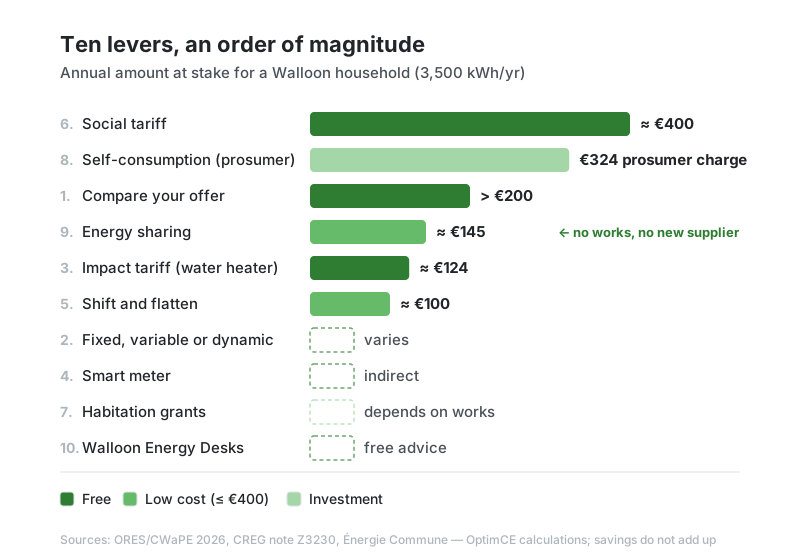
The ten levers at a glance
| # | Lever | Entry cost | Realistic annual saving | Condition |
|---|---|---|---|---|
| 1 | Compare your offer | €0 | > €200 | none |
| 2 | Choose your price formula | €0 | varies | accepting risk |
| 3 | Revised dual-rate or Impact tariff | €0 | ≈ €124 per appliance shifted | smart meter for Impact |
| 4 | Activate your smart meter | €0 | indirect | request to the DSO |
| 5 | Shift and flatten consumption | €0 to €400 | ≈ €100 and up | genuine flexibility |
| 6 | Claim the social tariff | €0 | ≈ €400 | protected-customer status |
| 7 | Habitation grants and housing audit | €0 to €456 | depends on the works | apply before 30/09/2026 |
| 8 | Solar and collective self-consumption | investment | €324 prosumer charge at stake | a roof or a shared building |
| 9 | Energy sharing and communities | €0 to low | ≈ €145 for 500 kWh shared | a sharing operation nearby |
| 10 | Walloon Energy Desks | €0 | all of the above, applied to your case | one phone call |
The savings do not add up: lever 6 largely rules out lever 1, and lever 3 is calculated on kWh already counted under lever 5. Read the column lever by lever, not as a running total.
1. Compare your offer on the regulator’s own comparator
This is the only block of your bill that is a freely negotiable market price, and it is the move with the fastest effect: a few minutes, no investment, no change of habit.
CWaPE runs CompaCWaPE, a free and independent comparator that estimates an annual bill from the current month’s tariff sheets, for every supplier active in the Walloon Region that reports its offers to the regulator (CWaPE). The tool sits at compacwape.be, and you can enter your real consumption rather than a standard profile — take the figure from your last annual statement, the result is nothing like the default.
The size of the prize: for a typical household using 3,500 kWh, the gap between the cheapest and the most expensive offer “can exceed €200 a year” (I am Beezy, May 2026).
Two useful habits. Repeat the exercise every year: tariff sheets move monthly, and a contract that was competitive when signed does not stay that way. And be wary of commercial comparators, which only list suppliers they have a commission agreement with — CompaCWaPE has nothing to sell.
2. Pick the formula that matches your tolerance for risk
Three families of contract, three ways of splitting the risk between you and your supplier. There is no universal answer, only an answer per profile.
- A fixed contract shields you from volatility, and charges you for the shield. In April 2026 CREG recorded a risk-premium gap between fixed and variable electricity products of up to 50%, and a 16.40% jump in the energy component of fixed contracts in a single month (CREG, April 2026).
- A variable contract indexes the price to market parameters: cheaper on average over time, more exposed to shocks.
- Dynamic pricing tracks hourly market prices. It is very favourable to anyone who genuinely shifts consumption, and expensive for everyone else. It pairs well with the next lever, because cheap market hours often overlap with off-peak network hours.
The key point: this is not a bet on future prices, it is a choice about who carries the risk. If a €300 settlement invoice would put you in difficulty, the fixed premium is worth paying. Otherwise it is expensive.
The costed comparison of these formulas — together with the social tariff and energy sharing — is set out in “Which electricity tariff to choose in Belgium?”, which covers all three regions.
3. Move to the network tariff that matches your hours
Here begins the specifically Walloon part, and it went largely unnoticed. Two changes took effect in 2026.
The dual-rate bands have changed, and they are now identical seven days a week, weekends included:
| Dual-rate 2026 | Time bands | ORES proportional term (excl. VAT) |
|---|---|---|
| Off-peak | 11:00 – 17:00 and 22:00 – 07:00 | 4.88 c€/kWh |
| Peak | 07:00 – 11:00 and 17:00 – 22:00 | 10.43 c€/kWh |
Off-peak now covers 15 hours out of 24, or 62.5% of the time, against 55% under the old split. And the middle of the day — the window when Belgian solar output peaks — moves into off-peak.
The Impact tariff is the genuinely new thing. It is Wallonia’s optional incentive tariff, splitting the day into three bands instead of two:
| Band | Time range | ORES proportional term (excl. VAT) |
|---|---|---|
| ECO | 11:00 – 17:00 and 01:00 – 07:00 | 2.71 c€/kWh |
| MEDIUM | 07:00 – 11:00 and 22:00 – 01:00 | 8.13 c€/kWh ≈ ×3 |
| PIC | 17:00 – 22:00 | 13.54 c€/kWh ≈ ×5 |
A ratio of one to five between a midday kWh and a late-afternoon one. No Belgian bill has ever carried a price signal of that magnitude.
What it is worth in practice. For an electric water heater using 1,800 kWh a year, on the distribution proportional term alone and using the ORES 2026 schedule: €166 on the single rate, €88 on dual-rate off-peak, €49 in ECO hours. That is roughly €117 excluding VAT, or €124 including VAT, saved per year on one appliance, purely by scheduling when it runs. (OptimCE calculation: 1,800 kWh × the proportional term of each band. The schedule publishes rates per kWh, not this annual amount.) ORES for its part quotes a flexible family saving “nearly 33% on distribution charges compared with the single rate, or €224” (ORES).
Four cautions before switching:
- Nothing changes automatically. Without action on your part your current formula continues to apply, and the switch to Impact is reversible.
- The Impact tariff does not reward good intentions, it rewards shifting. A household whose consumption clusters between 17:00 and 22:00 would pay more.
- Do not confuse the two grids. The dual-rate and Impact bands differ: 22:00–01:00 is off-peak under dual-rate but MEDIUM under Impact.
- Access conditions for Impact: a connection of 56 kVA or less and a smart meter with the communication function switched on — hence the next lever.
CWaPE provides a simulator and an eligibility test at tarifimpact.be. The switch is requested from your supplier, not from the network operator.
4. Ask for your smart meter to be activated
The smart meter is not a saving in itself: it is the key that unlocks levers 3, 5 and 8. Without it there is no Impact tariff, no dynamic contract, no proportional prosumer billing, and no reliable data on your own habits.
Three things to know. Replacement is free and continues until the end of 2029 in Wallonia; you can request one without waiting your turn. The communication function must be active — a smart meter with communication switched off unlocks nothing. And for a prosumer, ORES is explicit: a smart meter lets you “benefit from the most advantageous prosumer tariff” if you are on compensation (ORES).
One reassuring point that is rarely spelled out: installing a smart meter does not change your compensation rights, which are secured until 31 December 2030 for installations commissioned before 1 January 2024.
5. Shift first, then cut
Classic frugality — using less — acts on the energy component and on excise duties, both proportional to kWh. But since 2026 a growing share of the network tariff depends on when you consume, not only on how much. These are two distinct levers, and they touch different lines of the bill.
The loads that shift easily and weigh heavily:
- The electric water heater — the best candidate by far, fully programmable, no impact on comfort.
- Washing machine, tumble dryer and dishwasher — delayed start, a function every appliance has had for fifteen years.
- The electric car — the most rewarding load to move, and the easiest: overnight or midday charging is a setting, not a sacrifice.
- The heat pump — trickier, but nudging the pre-heating window is often enough to clear the PIC band.
The single most expensive habit, conversely: running several of those loads together between 17:00 and 22:00.
To automate all this, Wallonia supports control equipment through the home automation grant, covering 40% of eligible spending with a €400 ceiling, for smart energy metering and management systems (SPW Économie). Check that the hardware appears on the SPW’s list of eligible equipment before you buy.
6. Check whether you qualify for the social tariff
This is the most under-used lever on the list, and by far the most powerful for the households concerned.
The social tariff is a maximum price set by CREG every quarter, aligned on the cheapest commercial offers on the Belgian market. For the third quarter of 2026 it stands at 24.927 c€/kWh including VAT on the single rate, 26.797 on dual-rate day, 23.328 on dual-rate night and 20.195 on exclusive night (CREG, note Z3230, Q3 2026).
For scale: the Belgian average all-in price was around 36.94 c€/kWh in CREG’s June 2026 dashboard. Over 3,500 kWh, the gap is worth on the order of €400 a year. (Order of magnitude: the two prices do not cover exactly the same set of surcharges. The exact amount depends on your profile.)
Who is entitled, and how. CWaPE is clear: all protected customers are entitled to it, but the procedure differs by category (CWaPE). Federal protected customers — recipients of certain forms of public welfare centre support, of certain Federal Pension Service allowances, of disability-related allowances, as well as tenants of social housing heated by a collective installation — generally get it automatically, through data matching, without asking. Regional protected customers must obtain a certificate from their public welfare centre or debt mediator and pass it to their network operator, and only qualify if they are supplied by that operator.
One misconception to clear up while we are here, because it is still widely repeated: increased-reimbursement status alone no longer opens entitlement to the social tariff. The extension introduced during the energy crisis ran from 1 February 2021 to 30 June 2023 and came to an end on 1 July 2023 (FPS Economy). If you hold that status without falling into one of the categories above, you are not on the social tariff, even if you were in 2022.
The reflex to have: if your situation has changed — job loss, separation, a new allowance coming into force, moving into social housing — the social tariff does not always trigger by itself. That is worth a phone call. And if the bill has already become unpayable, the social tariff is only one piece of a wider system: “Energy poverty in Wallonia: available support” maps what the CPAS can open, from MEBAR to the Social Heating Fund.
7. Habitation grants: the window closes on 30 September 2026
This is the most concrete deadline of the year, and the one many Walloon households will discover too late.
The current Habitation grant scheme is a temporary support scheme running from 14 February 2025 to 30 September 2026. Every application — audit and works, final invoice included — must be submitted by that date (SPW Logement).
The compulsory gateway is the housing audit: an approved auditor visits your home, produces a report and a prioritised list of works. It conditions almost every grant; only roof interventions — covering, frame, roof and attic insulation, rainwater collection — are exempt. The audit itself is subsidised, with a grant that varies by income bracket.
What matters if you are hesitating: an audit carried out under the current scheme secures your entitlement for eight years. You are therefore not obliged to complete the works before the deadline — but you must have started the process.
From 1 October 2026 a new scheme takes over, built around a strengthened Rénopack and Rénoprêt — a 0% loan with part of the capital written off, rather than a direct grant — with announced priority for the worst-performing homes. One point of honesty: that new scheme was only adopted at first reading by the Walloon Government, on 16 July 2026. The final amounts, ceilings and conditions have not been published. Do not base an investment decision on the figures circulating: check the state of the text at the time you read this.
8. Self-consumption: the rate matters more than the capacity
Now for the levers that require investment. And let us correct the most common mistake straight away: what determines the return on a solar installation is not the number of panels, it is the share of the output you consume on site.
The prosumer tariff prices exactly that. On the ORES 2026 schedule it stands at €80.98 per kWe of net deliverable capacity, or roughly €324 a year excluding VAT for a 4 kWe installation. Two essential nuances, taken straight from the tariff document:
- This flat charge applies only to prosumers whose meter does not record actual gross withdrawals from the grid.
- For those who benefit from compensation and have a meter that records those gross withdrawals, total network costs are capped at the amount calculated on net withdrawals plus the prosumer tariff. In other words, the system automatically keeps whichever formula favours you.
Compensation — the meter that runs backwards — remains secured until 31 December 2030 for installations commissioned before 1 January 2024. After that, injection and withdrawal will be valued separately, and the self-consumption rate becomes the only parameter that really counts. The full profitability calculation under that new regime, and the trade-off between keeping compensation and joining an energy sharing operation, are set out in “Solar panels 2026: still worth it in Wallonia?”.
And batteries? A battery lifts a typical self-consumption rate from 30–40% to 70–80%. But let us be factual: it costs €4,000 to €10,000 for 5 to 10 kWh, Wallonia pays no direct grant for domestic storage, and payback lands around ten to thirteen years — often beyond the warranty. What changes in 2026 is the Impact tariff: charging in the ECO band at 2.71 c€/kWh to discharge in the PIC band at 13.54 c€/kWh adds an arbitrage revenue the classic calculation ignored. Have the simulation redone on that assumption before deciding.
Finally, the most profitable option of all cannot be bought: collective self-consumption. At building scale, a solar roof shared between occupants mechanically raises the self-consumption rate, because several households’ load curves complement one another. The mechanisms, indicators and configurations are set out in “Collective self-consumption in Belgium”.
This lever has a blind spot: it assumes somebody is there to consume. When the house is empty from 08:00 to 18:00, the appliance that pays best is not the one you would expect, and it is often wired to the wrong time signal — see “Solar panels: nobody home during the day”.
9. Energy sharing: the option almost nobody activates
We come to the least known lever, and to the point where Walloon regulation holds a real surprise.
Energy sharing means routing part of local generation from a producer to other supply points, at a price agreed between participants. It acts on the energy component — precisely the one suppliers compete on — without changing supplier or installing anything at your home.
What it does not do, to be clear from the outset: it reduces neither network costs nor taxes, which remain payable on shared electricity because that electricity travels over the public grid.
Except in one case, and it is written into the ORES 2026 tariff schedule itself: “A reduction of 80% is applied to the proportional term on energy shared in the case of a sharing operation within a single building.” No reduction on residual electricity drawn, but 80% off the proportional term on the shared share. A block of flats with a solar roof is therefore in the best position in Wallonia — and that configuration requires no legal entity, only an agreement notified to the network operator.
What that is worth, in euros. Énergie Commune has documented a real sharing case, taken up as good practice by Interreg Europe: for a consumer receiving 500 kWh of shared energy a year, the saving reaches about €145 a year on the standard tariff, or about €70 for a household already on the social tariff, plus some twenty euros on the building’s common areas. These amounts are illustrative — they depend on the volume shared, the internal price and the configuration — but they set the order of magnitude: with no works, no hardware and no change of supplier, sharing plays in the same league as switching to the Impact tariff.
Three things to check before committing:
- The agreed internal price. It determines your real gain, and it is negotiated within a range bounded by the injection tariff below and the energy component of your contract above. The five calculation methods and a costed case appear in “Internal transfer price in an energy community”.
- Possible supplier fees. Nothing stops your supplier charging for your participation in sharing, and amounts of up to about €150 a year per supply point have been recorded. On small shared volumes those fees wipe out the gain. (Test-Achats finding dated May 2024 — check with your own supplier before signing.)
- What you will actually receive. You will keep receiving an invoice from your supplier, plus a statement for the shared energy. The orders of magnitude of the savings are quantified in “How an energy community reduces your electricity bill”.
In practice, in Wallonia you can join an existing sharing operation rather than create one: eligibility conditions, where to find an open operation and the lead time to expect are set out in “Joining an energy community in Wallonia”.
10. The Walloon Energy Desks: 40 free advisers
The tenth lever does not cut anything directly. It exists to apply the other nine to your own situation, free of charge, by someone with nothing to sell you.
The Walloon public service runs 16 offices across the Region and a team of 40 consultants, in Walloon Brabant, Hainaut, Liège, Luxembourg and Namur (SPW Énergie). The technical advice there is personalised, neutral and entirely free.
What they do, and few people know it: answer questions on heating, insulation, renewable generation and electrical appliances; simulate supplier options; assess a photovoltaic investment; follow up a permit application; and occasionally visit your home. First contact goes through the freephone number 1718.
If you make only one call from this article, make it that one — especially before 30 September for the grants.
What to remember
There is no single move that halves a Walloon bill. There is a sequence, and it runs in this order:
- Today, for free — check your eligibility for the social tariff, then compare your offer on CompaCWaPE. Those two steps take an hour and cover the largest amounts in this whole article.
- This week — request activation of your smart meter, then check whether the revised dual-rate or the Impact tariff fits your hours. A reprogrammed water heater is worth about €124 a year.
- Before 30 September 2026 — if works are anywhere in your plans, even distant ones, get the housing audit done. It secures your entitlement for eight years.
- Only then — self-consumption, storage, energy sharing. These are the most structural levers, but also the slowest, and they are sized far better once the first four are settled.
Two closing warnings. The savings do not stack: the social tariff already puts you at the best price on the market and makes offer comparison moot, and a water heater can only be shifted once. And none of this happens automatically — not the Impact tariff, not the grants, not the regional social tariff, not sharing. The Walloon bill rewards initiative, not patience.
Manage your energy sharing with OptimCE
An open source platform built for Belgian energy communities: members, meters, allocation keys and sharing operations in one place — right through to generating invoices, credit notes and statements as PDFs from your official allocation data.
FAQ
How can I reduce my electricity bill in Wallonia in 2026?
In order of effectiveness: compare your offer on CompaCWaPE, the Walloon regulator’s free comparator, where the gap between the cheapest and the most expensive offer exceeds €200 a year; check whether you qualify for the social tariff, worth roughly €400 a year for an eligible household; then pick the right network tariff formula. On the ORES 2026 schedule, moving a 1,800 kWh water heater from the single-rate tariff to the Impact ECO band is worth about €124 including VAT per year on the distribution proportional term alone. The first six levers in this article require no investment at all.
What is the Impact tariff and who benefits from it?
It is the incentive-based distribution tariff available in Wallonia since 2026. It splits the day into three bands: ECO from 11:00 to 17:00 and from 01:00 to 07:00, MEDIUM from 07:00 to 11:00 and from 22:00 to 01:00, PIC from 17:00 to 22:00, seven days a week. On the ORES 2026 schedule approved by CWaPE, the proportional term is 2.71 c€/kWh in ECO, 8.13 in MEDIUM and 13.54 in PIC — a ratio of one to five. The tariff is optional, reversible, and restricted to connections of 56 kVA or less fitted with a smart meter whose communication function is active. It rewards genuine load shifting: a household whose consumption is concentrated between 17:00 and 22:00 would pay more.
What are the new dual-rate time bands in Wallonia in 2026?
Since 2026 the bands are identical every day, weekends included. Off-peak: 11:00 to 17:00 and 22:00 to 07:00. Peak: 07:00 to 11:00 and 17:00 to 22:00. Off-peak hours therefore cover 15 hours out of 24, or 62.5% of the time, against 55% under the previous split, and the middle of the day — when solar output is highest — moves into off-peak. Do not confuse these bands with the Impact tariff bands, which are different.
Until when can Walloon Habitation grants be claimed?
The temporary support scheme runs from 14 February 2025 to 30 September 2026. Every application — audit and works, final invoice included — must be filed by that date at the latest. A housing audit carried out under this scheme secures your entitlement for eight years, even if the works come later. From 1 October 2026 a new scheme takes over, built around a strengthened Rénopack and Rénoprêt, with announced priority for the worst-performing homes; it was only adopted at first reading on 16 July 2026 and its final amounts have not yet been published.
Is the prosumer tariff expensive in Wallonia, and can it be avoided?
On the ORES 2026 schedule the prosumer tariff is €80.98 per kWe of net deliverable capacity, or roughly €324 a year excluding VAT for a 4 kWe installation. It applies only to prosumers whose meter does not record actual gross withdrawals from the grid. With a smart meter, billing becomes proportional to electricity actually drawn, and total network costs are capped at the amount calculated on net withdrawals plus the prosumer tariff — so the system automatically applies whichever formula is more favourable. Compensation remains secured until 31 December 2030 for installations commissioned before 1 January 2024.
Does energy sharing really reduce the bill in Wallonia?
It acts on the energy component, not on network costs or taxes, which remain payable on shared electricity. One important exception is written into the ORES 2026 tariff schedule itself: an 80% reduction on the proportional term applies to energy shared within a single building. A block of flats with a solar roof is therefore in the best position in Wallonia, with no need to set up a legal entity. Always check whether your supplier charges fees for your participation in sharing: on small shared volumes those fees can wipe out the gain.
Sources
- CWaPE — Periodic electricity distribution tariffs, low-voltage withdrawal, ORES ASSETS, 01.01.2026 to 31.12.2026 — primary source for every tariff quoted here: prosumer term at €80.9813336/kWe, proportional terms for single-rate, dual-rate and Impact, the official time bands of both grids, capacity term at €0/kW for 2026-2029, the 80% reduction on energy shared within a single building, and the Impact access conditions. Approved on 18 December 2025.
- CWaPE — CompaCWaPE and compacwape.be — the official free comparator of offers from suppliers active in the Walloon Region, based on the current month’s tariff sheets.
- CWaPE — The social tariff — all protected customers are entitled to it; automatic for federal protected customers, certificate from the public welfare centre and supply by the network operator for regional protected customers.
- FPS Economy — Social tariff for energy — categories of entitled persons and automatic granting through data matching; the extension to recipients of increased reimbursement ran from 1 February 2021 to 30 June 2023 and is no longer in force.
- CWaPE — tarifimpact.be — simulator, eligibility test and explanations of incentive-based pricing.
- CREG — Note Z3230, maximum social prices for Q3 2026 — social tariffs including VAT: 24.927 c€/kWh single rate, 26.797 dual-rate day, 23.328 dual-rate night, 20.195 exclusive night; quarterly setting method.
- CREG — Energy prices for households, April 2026 findings — 16.40% rise in the energy component of fixed contracts in one month and a fixed-versus-variable risk premium reaching 50%.
- ORES — Impact, a new tariff for flexible consumers — three time bands, access conditions, optional status, and a €224 saving example for a flexible family compared with the single rate.
- ORES — Photovoltaic installations commissioned before 1 January 2024 — automatic compensation until 31 December 2030, flat or proportional tariff depending on the meter, and automatic application of the more favourable formula.
- SPW Logement — Habitation grants, temporary support scheme 14/02/2025 – 30/09/2026 — application deadline, the role of the housing audit and the works exempt from it.
- SPW Économie — Home automation equipment grant — 40% of eligible spending, capped at €400, for smart energy metering and management equipment.
- SPW Énergie — Walloon Energy Desks — 16 offices and 40 consultants, personalised, neutral and entirely free technical advice, freephone 1718.
- I am Beezy — Electricity prices in Belgium 2026: five suppliers compared — gap between offers exceeding €200 a year for a 3,500 kWh profile (May 2026).
- Énergie Commune — Electricity sharing, Interreg Europe good practice — costed real case: about €145 of annual saving for 500 kWh shared on the standard tariff, about €70 on the social tariff, and roughly a 6-year payback on the shared installation.