
Solar panels 2026: still worth it in Wallonia?
The question fits in one sentence, and everyone in Wallonia has been asking it for two years: is it still worth it? The collective answer is already in, and it is measurable. According to the review published by Renouvelle on 16 February 2026, Wallonia added only about 100 MWp of solar capacity in 2025. To meet its target of 5,100 GWh a year — roughly 6 GWp installed by 2030 — it would need 500 to 600 a year. The Walloon market is therefore running at less than a fifth of the required pace.
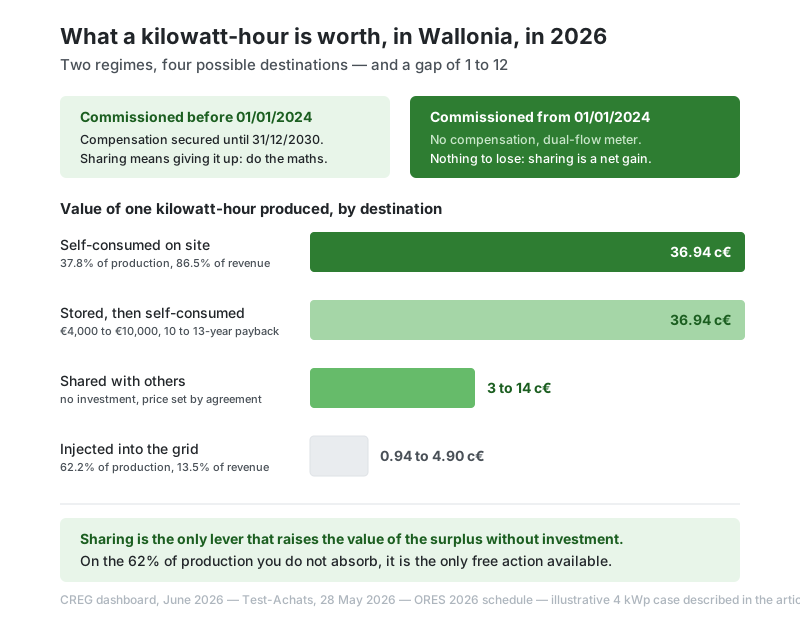
This is not a technology or hardware-price problem: modules have never been cheaper, and Belgium passed 12.8 GWp at the end of 2025, with more than 10 TWh generated, about 13% of national electricity consumption according to ELIA. It is a business-model problem. Since 1 January 2024 a new Walloon system no longer benefits from compensation; there is no longer any direct regional premium, nor any green certificate for residential systems. And above all, a kilowatt-hour you consume yourself earns you about 37 cents, while the same kilowatt-hour injected into the grid earns you 3.
That factor of twelve is the whole story. It explains why two identical systems on neighbouring roofs can have paybacks five years apart. It also explains why the real question is no longer “what do panels cost?” but “what becomes of the electricity I do not consume?”. And on that precise ground, energy sharing is the only available lever that requires no building work, no battery and no additional capital.
With one caveat nobody states clearly, and it changes everything: sharing does not present itself in the same way depending on whether your system predates or postdates 1 January 2024. For one group it is a net gain. For the other it is a trade-off — and one that usually loses before 2031.
This article does not re-explain what an energy community is, nor what separates a REC from a CEC: that is covered in “Energy communities in Belgium: CER, CEC, CEL”. Nor does it detail the ten Walloon savings levers, handled in “Reduce your electricity bill: Wallonia 2026”, or the regional availability of sharing, analysed in “Cheaper electricity without switching supplier”. It answers a single question, with figures: is a Walloon solar installation still profitable in 2026 — and by how much does sharing move the answer.
What disappeared, and what did not
Let us clear the ground first, because confusion on this point is costing thousands of Walloon households money.
The fault line of 1 January 2024
Wallonia did not abolish compensation as a budget decision: it was compelled to. A European directive forbids granting any right to compensation beyond 31 December 2023. The consequence, as the Walloon Region words it, is unambiguous: any solar installation commissioned from 1 January 2024 onwards no longer benefits from compensation.
Those systems must be paired with a dual-flow meter, which measures withdrawals and injections separately. What goes onto the grid can be sold to the supplier at the injection tariffs it publishes.
What survives for earlier systems
Systems commissioned before 1 January 2024 keep compensation until 31 December 2030. The right survives even a modification, provided it adds no more than 1 electrical kW to the grid and stays under the 10 kW ceiling in total.
Two nuances matter, and they are the source of the confusion:
- The prosumer tariff did not disappear with compensation. It is still due, and since 2024 the Region no longer covers part of it. On the ORES 2026 schedule approved by CWaPE on 18 December 2025, it stands at €80.98/kWe excluding VAT, i.e. €85.84/kWe including VAT — which incidentally explains why commercial websites and official documents appear to contradict each other: they quote the same amount, one before tax, the other after.
- The form of the tariff depends on the meter. On an electromechanical meter it is a flat charge, calculated on the net deliverable capacity of the system — the inverter’s, not the panels’. On a communicating meter it becomes proportional to actual withdrawal, and ORES automatically applies whichever of the two formulas is cheaper. Installing a communicating meter therefore does not forfeit compensation.
What is gone entirely
There is no direct regional premium and no green certificate left for a new residential solar installation in Wallonia. What remains fits in three lines:
| Scheme | What it is | Conditions |
|---|---|---|
| 6% VAT | Instead of 21% | Dwelling at least 10 years old, supply and installation by the contractor, certificate signed by the customer. A sale without installation stays at 21%. |
| Rénoprêt | Zero-interest loan, up to €60,000 | Through the SWCS, subject to income and works conditions |
| Injection tariff | Payment for the surplus | Unregulated, set freely by each supplier |
| Municipal premiums | Variable, often a few hundred euros | To be checked case by case with your municipality |
In other words: the profitability of a Walloon installation in 2026 no longer depends on any meaningful public support. It depends entirely on what you do with your production.
This article is about households. Above 10 kW the picture changes: green certificates still exist, under the CPMA regime, and a farm holding can add regional investment aid on top — but only on the share it self-consumes. The case of a large professional roof is covered in “Farm roofs: the energy-sharing guide”.
The 2026 profitability calculation, line by line
Take a concrete case. It is illustrative: your roof, your consumption and your quote will give other figures. It is there to show where profitability is actually decided.
The assumptions
| Parameter | Value used | Origin |
|---|---|---|
| Installed capacity | 4 kWp | Common residential size |
| All-in cost | €6,000 incl. VAT | Test-Achats puts the best offers below €1,250/kWp; the real market range runs from €1,250 to €1,800/kWp |
| Yield | 950 kWh/kWp/year → 3,800 kWh/year | Due south, 35°, unshaded — assumptions of the Walloon simulator by Énergie Commune |
| Self-consumption rate | 37.76% → 1,435 kWh | Default value of the same simulator; Test-Achats gives 30 to 50% without a battery |
| Surplus injected | 2,365 kWh | The balance |
| Electricity price avoided | 36.94 c€/kWh all-in | CREG dashboard, June 2026, residential profile of 3,500 kWh/year |
| Injection tariff | 3.5 c€/kWh | Average reported by Test-Achats on 28 May 2026 (range 0.94 to 4.90) |
| Commissioning | 2026 | Therefore without compensation, with a dual-flow meter |
The result
| Item | Volume | Unit value | Annual gain |
|---|---|---|---|
| Electricity self-consumed | 1,435 kWh | 36.94 c€ | €530 |
| Surplus injected | 2,365 kWh | 3.5 c€ | €83 |
| Total | 3,800 kWh | €613 |
Simple payback: 6,000 / 613 ≈ 9.8 years. Compare that with the six years the Walloon Region put forward in October 2023 for a system at 40% self-consumption — a gap that comes mostly from the collapse in the value of the surplus since then.
The calculation is deliberately simple: it ignores electricity price inflation (2.5%/year in the Walloon simulator’s assumptions), module degradation (0.5%/year), inverter replacement around year twelve, and maintenance. These items partly offset one another and do not change the conclusion.
The conclusion is the imbalance in the second column.
That 37.76% rate is a regulatory average. A household whose house is empty during the day sits closer to 30%, because 85.8% of annual output lands between 09:00 and 17:00. What that profile can recover, and where it hits a ceiling, is quantified in “Solar panels: nobody home during the day”.
The real problem is not the price of panels — it is the fate of the surplus
Look at the table above again, but in percentages. This is the most important figure in this article.
| Share of production | Share of revenue | |
|---|---|---|
| What you consume yourself | 37.8% | 86.5% |
| What you inject | 62.2% | 13.5% |
Nearly two-thirds of your production earns you one-eighth of your gains. This is not a quirk of our illustrative case, it is the very structure of residential solar without compensation: a roof produces at midday, a household consumes in the morning and the evening, and the mismatch cannot be removed without intervention.
Three practical consequences follow, and they overturn the usual advice.
Haggling over the quote pays less than you think. Saving €500 on the installation shortens payback by 0.8 years. Lifting the self-consumption rate from 37.8% to 50% earns €156 a year and shortens payback by two years — without spending a single euro more.
Oversizing is counterproductive. Every kilowatt-hour produced beyond what you can absorb leaves at the injection tariff. A system twice as large does not double the gains; mostly it doubles the volume worth 3 cents.
The injection tariff is not a variable you control. It is regulated nowhere in Belgium, it varies by a factor of five between suppliers, and it tracks the wholesale market. It is even worse for dynamic contracts: as we noted in “Which electricity tariff to choose in Belgium?”, 99% of households with panels paid more on a dynamic contract, with a median increase of 20%, precisely because their surplus arrives when prices collapse.
The whole question of a Walloon solar installation’s profitability in 2026 therefore reduces to this one: what do you do with the 62%?
The three destinations of a surplus kilowatt-hour
There are only three possible answers, and it is worth setting them side by side, because public debate usually remembers only one.
| Inject | Store | Share | |
|---|---|---|---|
| What it does | Sell to the supplier | Shift consumption in time | Transfer to other participants in a sharing operation |
| Value per kWh | 0.94 to 4.90 c€ | ≈ 36.94 c€ (deferred self-consumption) | 3 to 14 c€ |
| Investment | €0 | €4,250 to €7,250 for 5 to 10 kWh | €0 |
| Walloon support | none | no storage premium | none, but −80% on the proportional term within a building |
| Own payback | — | close to fifteen years | immediate |
| Available everywhere | yes | yes | no — see below |
| On our case | €83/year | +€473/year, less amortisation | €142 to €237/year |
Three readings, and they do not go the way you usually hear.
The battery is effective but expensive
This is the dominant answer from comparison sites and installers, and it is not wrong: a battery lifts the self-consumption rate from 30-40% to 70-80%. On our case, going from 37.76% to 75% adds 1,415 kWh of self-consumption, worth +€473 a year, net of the injection revenue forgone on those kilowatt-hours.
But €7,000 to earn €473 a year is a near-fifteen-year payback on the battery alone — roughly its service life, and while Wallonia pays no storage premium, unlike Flanders until 2023. The 10 to 13 years often quoted assume a larger surplus than ours, or arbitrage between the Impact tariff bands: charging in the ECO band at 2.71 c€/kWh to discharge in the PEAK band at 13.54 c€/kWh on the ORES 2026 schedule. The calculation also improves if you are out during the day.
Injection is free but derisory
This is the default option, the one that applies if you do nothing. It costs nothing and requires no step beyond the injection contract. It earns €83 a year on our case, and that amount falls structurally as the Belgian solar fleet grows: the more roofs inject at the same moment, the less that energy is worth.
Sharing is free and pays two to four times more
This is the option nobody mentions, and it is the only one that raises the value of the surplus without investment. We come to it now.
These three options are not mutually exclusive, and that matters: a battery converts surplus into deferred self-consumption, sharing monetises what remains, injection picks up the rest. The rational order is: shift your usage, then share, then consider a battery if the residual surplus still justifies one. The appliance-by-appliance detail — hot-water tank, car charging, battery — and the ranking in euros invested per kilowatt-hour absorbed are set out in “Solar surplus: the 5 options compared”.
What sharing actually changes in the calculation
Energy sharing means allocating, quarter-hour by quarter-hour, a share of your production to other participants — neighbours in the same building, members of an energy community — at a price agreed between you. The electrons do not change path; the accounting does.
The number that matters: the internal transfer price
We devoted a whole article to setting it, “Internal transfer price in an energy community”. What matters here fits in two bounds:
- The floor is the injection tariff — 0.94 to 4.90 c€/kWh. Below it, no producer has any reason to share rather than sell to their supplier.
- The ceiling is the energy component the consumer already pays, around 14 c€/kWh. Above it, no consumer has any reason to take part.
The defensible band is therefore 3 to 14 c€/kWh. The documented Belgian case of Énergie Solidaire du Balai in Brussels put the price paid to the producer at 6 c€/kWh, and Renouvelle reports internal prices of the same order.
The effect on the illustrative case
Take our 2,365 kWh of surplus again.
| Destination of the surplus | Unit price | Surplus revenue | Total annual gain | Payback |
|---|---|---|---|---|
| Injection to the supplier | 3.5 c€ | €83 | €613 | 9.8 years |
| Sharing at 6 c€ | 6 c€ | €142 | €672 | 8.9 years |
| Sharing at 10 c€ | 10 c€ | €237 | €767 | 7.8 years |
Sharing multiplies the value of the surplus by two to three and takes one to two years off the payback, without a euro of extra investment. The share of revenue coming from the surplus rises from 13.5% to 21%, or even 31%.
Is that spectacular? No, and it would be dishonest to claim otherwise. Is it the best return per euro invested available to a Walloon prosumer? Yes, because the denominator is zero.
What sharing does not do
Three limits, worth knowing before committing.
Network costs and taxes remain due on shared kilowatt-hours — they did travel across the public grid. CWaPE is explicit: there is no general tariff reduction for sharing within an energy community. The only exception is sharing within a single building, which enjoys an 80% reduction on the proportional term under the ORES 2026 schedule, and nothing else does.
The shareable volume depends on simultaneity. Sharing is computed in fifteen-minute slots: your midday production can only be allocated to participants consuming at midday. In practice, the Flemish experience shows that about 20% of injection is actually shared, against 40% hoped for.
Walloon supply is thin. The CWaPE evaluation relayed in March 2025 counted 4 sharing operations within a single building and 3 within an energy community, for a region of 3.6 million people; eight communities were listed in February 2026. And peer-to-peer sharing — the simplest form, the one that would let you pass your surplus to the neighbour across the street — remains inoperative in Wallonia for lack of an implementing decree, although the decree has provided for it since 2022. A Walloon Government order of 5 February 2026 did amend the framework, but it dealt with the definition of “local authority” after an annulment by the Council of State: it unblocks nothing for a prosumer.
What nobody tells you: you may have something to lose
Here is the point that genuinely separates the two populations of Walloon prosumers, and it is almost always omitted.
Taking part in energy sharing requires giving up compensation. CWaPE makes participation conditional on two requirements: having an electronic communicating or AMR meter, and renouncing the benefit of compensation. ORES confirms it from the grid operator side: if you sell your injection or join a sharing operation, you give up compensation and switch automatically to the injection marketing regime. The reason is logical: compensation is an annual mechanism, sharing a quarter-hourly one. The two cannot coexist on the same supply point.
For a system installed after 2024, this costs nothing: there is nothing to give up. For an earlier system it is a real, quantifiable trade-off whose outcome hangs on a single parameter.
The trade-off in figures
Take our household again, but this time with a 2022 system that keeps compensation until 31 December 2030. It consumes 3,500 kWh a year and produces 3,800 kWh.
| Stay on compensation | Give it up and share at 6 c€ | |
|---|---|---|
| Electricity valued at the full price | 3,500 kWh (annual compensation) | 1,435 kWh (actual self-consumption) |
| Corresponding gain | €1,293 | €530 |
| Surplus valued | 300 kWh unpaid | 2,365 kWh × 6 c€ = €142 |
| Prosumer tariff | − €343 (4 kWe × €85.84 incl. VAT) | folded into gross withdrawal |
| Net annual gain | ≈ €950 | ≈ €672 |
Giving up would cost this household about €278 a year, close to €1,200 by the end of 2030. The conclusion is clear: do not give it up.
Unless your system is oversized
And here comes the reversal nobody publishes. Compensation only values your production up to the level of your own annual consumption. Everything you produce beyond that is not paid for: it goes to the grid, free of charge.
So take a second profile, very common among households that installed generously in 2022-2023: 6 kWp, 5,700 kWh produced, 2,500 kWh consumed.
| Stay on compensation | Give it up and share at 6 c€ | |
|---|---|---|
| Electricity valued at the full price | 2,500 kWh (capped by consumption) | ≈ 1,425 kWh (25% self-consumption) |
| Corresponding gain | €924 | €526 |
| Surplus valued | 3,200 kWh lost | 4,275 kWh × 6 c€ = €257 |
| Prosumer tariff | − €515 (6 kWe × €85.84 incl. VAT) | folded into gross withdrawal |
| Net annual gain | ≈ €409 | ≈ €783 |
The sign flips: giving up would earn about €374 a year here. The prosumer tariff, calculated on capacity rather than use, penalises oversized systems twice over — it costs most precisely where compensation pays least.
The decision rule
It fits in one comparison, to be made on your annual statement:
- Annual production clearly below your consumption → compensation values every kilowatt-hour at the full price. Do not give it up before 2031.
- Production ≈ consumption → the trade-off is tight and depends entirely on the internal price you can obtain. Do the sum with the price the operation actually offers, not with an average.
- Production clearly above your consumption → you already lose the excess every year, and you pay a prosumer tariff proportional to a capacity that compensation does not value. Sharing can already win today.
In every case, the 31 December 2030 deadline is structural: on that day the first population joins the second, and the trade-off vanishes. Only the sharing question will remain.
Where to start, depending on your situation
I do not have panels yet
Size for your consumption, not for your roof. Get at least three quotes, insist on 6% VAT if your dwelling is ten years old or more, and check that RGIE certification is included. Before signing, look for a sharing operation accessible near you: it can justify a few hundred extra watt-peak.
My system dates from 2024 or later
You have nothing to lose and everything to gain from sharing. Your priority: shift your usage towards production hours, then look for a sharing operation. Conditions and steps are detailed in “Join an energy community in Wallonia”.
My system predates 2024
Give up nothing before running the calculation in the previous section on your annual statement. If your production clearly exceeds your consumption, sharing deserves study right now. Otherwise, note the 31 December 2030 deadline and identify existing operations today: they take months to set up.
I am a tenant, or live in a flat
You probably cannot install, but you can receive. Sharing within a single building is Wallonia’s most favourable configuration and requires no legal entity: a co-ownership roof is enough. The mechanism, from the consumer’s side, is described in “Energy self-consumption in Belgium”.
Since 17 April 2025 you can also generate a little yourself: a portable photovoltaic kit plugged into an ordinary socket is now legal in Belgium, and it moves house with you. The full calculation — and what a balcony’s orientation does to it — is in “Renting: the no-roof guide to solar”.
Key takeaways
- Yes, it is still profitable — around ten years’ payback on an illustrative 4 kWp system at €6,000, against the six years announced in 2023. The gap comes almost entirely from the collapse in the value of the surplus.
- 62% of production earns only 13.5% of the revenue. That, and nothing else, is where the profitability of a Walloon installation is decided in 2026.
- The injection tariff is unregulated and beyond your control: from 0.94 to 4.90 c€/kWh depending on the supplier, 3 to 4 cents on average, and structurally trending down.
- Sharing multiplies the value of the surplus by two to three and takes one to two years off the payback, without investment. It is the only free lever that acts on the 62%.
- A battery pays more but costs €4,250 to €7,250, with no Walloon premium, for a payback of its own beyond ten years — close to fifteen on our case. It complements sharing rather than competing with it.
- Taking part in sharing means definitively giving up compensation. For a post-2024 system that costs nothing. For an earlier one it can cost about €278 a year — or earn €374 if the system is oversized.
- 31 December 2030 puts everyone in the same position. On that date compensation disappears for all, and the surplus question becomes the only one that counts.
What not to expect from it: energy sharing does not turn a bad installation into a good investment, and it replaces neither self-consumption nor a supply contract. What it does, and what no other option does at zero cost, is take your surplus kilowatt-hours out of a market where they are worth 3 cents and place them in an agreement where they are worth 6 to 14. On the 62% of production that escapes your own consumption, it is the only thing you can do without reaching for your chequebook.
Join or launch your energy sharing with OptimCE
An open-source platform built for Belgian energy communities: members, meters, allocation keys and sharing operations in one place — right through to generating invoices, credit notes and statements as PDFs from your official allocation data.
FAQ
Are solar panels still profitable in Wallonia in 2026?
Yes, but with a longer payback than in the compensation era and far more sensitivity to your consumption profile. On an illustrative 4 kWp system costing €6,000 including VAT, producing 3,800 kWh a year at a 37.76% self-consumption rate, the annual gain lands around €613 — of which €530 comes from electricity you no longer pay for and only €83 from selling the surplus. That gives a payback of roughly ten years, against the six years the Walloon Region quoted in 2023 for a system at 40% self-consumption. The difference between a good and a bad installation is no longer the price on the quote, but the share of production you consume yourself.
What happens to my system after 31 December 2030?
If your system was commissioned before 1 January 2024, you keep compensation until 31 December 2030. On that date it ends and your system moves into the common regime: withdrawals and injections counted separately, billing on gross withdrawal, and surplus sold at your supplier’s injection tariff. In practice, the value of each surplus kilowatt-hour drops from about 37 cents to about 3. That is why energy sharing, which is not urgent for you today, becomes mechanically relevant on that date. It is worth knowing now which sharing operations exist near you.
Do you have to give up compensation to take part in energy sharing?
Yes, and this is the least understood point in the whole file. CWaPE makes participation in an energy sharing operation conditional on two requirements: having an electronic communicating or AMR meter, and renouncing the benefit of compensation. ORES confirms it from the grid operator side: selling your injection or joining a sharing operation automatically switches you to the injection marketing regime. The annual compensation regime is simply incompatible with sharing, which relies on an instantaneous comparison between production and consumption, quarter-hour by quarter-hour. For a system commissioned from 2024 onwards the question does not arise: there is nothing to give up.
How much is my solar surplus worth if I do not share it?
Very little. According to the Test-Achats comparison of 28 May 2026, the injection tariff in Flanders and Wallonia ranges from 0.94 c€/kWh at Mega Zen Fixed to 4.90 c€/kWh at Energy Knights and Eneco, averaging 3 to 4 cents. On 2,500 kWh injected, the gap between the best and worst contract is worth €23 to €122 a year. None of these tariffs is regulated in Belgium, and several track the wholesale market — which exposes dynamic contracts to zero or even negative prices precisely in the hours when your roof produces most.
Battery or energy sharing: which one for your surplus?
They are not competitors; they act in different places. A battery converts surplus into deferred self-consumption and lifts the self-consumption rate from 30-40% to 70-80%, worth several hundred euros a year — but it costs €4,250 to €7,250 for 5 to 10 kWh, Wallonia pays no storage premium, and its own payback runs close to fifteen years. Energy sharing yields less but costs no capital: it monetises what remains after self-consumption at a negotiated 3 to 14 c€/kWh instead of the injection tariff. The logical order is therefore to shift your usage first, share second, and only then consider a battery if the residual surplus still justifies one. The price grid per kilowatt-hour installed, and the declaration obligation that can break a pre-2024 compensation, are covered in “Home battery: the price and the alternative”.
Can I share my electricity if I installed my panels after 2024?
Yes, and this is the most favourable case. A system commissioned from 1 January 2024 already has a dual-flow meter and enjoys no compensation, so you have nothing to give up to join a sharing operation. The only obstacle is supply, and it is thin in Wallonia — the CWaPE evaluation relayed in March 2025 counted 4 sharing operations within a single building and 3 within an energy community, and peer-to-peer sharing remains inoperative for lack of an implementing decree. The two open routes are sharing within a single building, which enjoys an 80% reduction on the proportional term under the ORES 2026 schedule, and joining an existing community.
Sources
- Wallonie — Solar panels: the end of the meter that runs backwards — official communication of 12 October 2023: end of compensation for any system commissioned from 1 January 2024, retention until 31 December 2030 for existing systems, 1 kW modification tolerance within a 10 kW ceiling, dual-flow meter requirement, and an estimated six-year payback at 40% self-consumption.
- ORES — Compensation for systems installed before 01/01/2024 — the grid operator’s billing rules: automatic compensation until 31/12/2030 unless the system is modified or joins a sharing operation, flat prosumer tariff on an electromechanical meter and proportional on a communicating meter with automatic application of the cheaper formula, end of regional coverage from 2024, and automatic switch to the injection marketing regime on renunciation.
- CWaPE — Conditions for taking part in energy sharing — page updated on 28 October 2024: requirement to hold an electronic communicating or AMR meter and to renounce the benefit of compensation, for consumers and producers alike, plus renunciation of the social tariff on the shared share of electricity for residential customers.
- CWaPE — The prosumer tariff — definition of the tariff, entry into force on 1 January 2020, default application to prosumers without a dual-flow meter, and exemption for protected customers on the social tariff.
- CWaPE — Energy sharing — page updated on 20 November 2025: forms of sharing available in Wallonia, notification or authorisation procedure, computation of shared volumes per quarter-hour and admissible allocation keys; list of authorised operations.
- CWaPE — ORES, periodic withdrawal tariffs 2026 — schedule approved on 18 December 2025 and valid from 1 January to 31 December 2026: prosumer term of €80.9813336/kWe excluding VAT, Impact tariff bands ECO at 2.71 c€/kWh and PEAK at 13.54 c€/kWh, and the 80% reduction on the proportional term reserved for sharing within a single building.
- Test-Achats — The value of solar electricity injected into the grid — comparison of 28 May 2026: injection tariffs from 0.94 c€/kWh (Mega Zen Fixed) to 4.90 c€/kWh (Energy Knights, Eneco) in Flanders and Wallonia, an average of 3 to 4 cents, a €23 to €122 annual spread on 2,500 kWh injected, and a warning about variable contracts that may charge for disposing of the surplus.
- Test-Achats — Solar panels: still worthwhile? — source of the price orders of magnitude (best offers below €1,250/kWp all-in) and of the 30 to 50% self-consumption rate without storage.
- Renouvelle — Solar in Belgium 2025: ambitions to revive — review of 16 February 2026: about 900 MWp added in Belgium and only 100 MWp in Wallonia in 2025, a Walloon target of 5,100 GWh/year or roughly 6 GWp by 2030, a required pace of 500 to 600 MWp a year, and an explicit link between the slowdown and the end of public support.
- Renouvelle — Solar observatory — Belgian fleet of 12.8 GWp at the end of 2025, more than 10 TWh generated according to ELIA, about 13% of national electricity consumption.
- Énergie Commune — Walloon solar financial simulator — tool developed by Énergie Commune (formerly APERe) with the support of the Walloon Region: assumptions of about 1,000 kWh/kWp/year yield, an 85% performance ratio, 0.5%/year degradation, a 25-year lifetime, inverter replacement at year twelve, and the default 37.76% self-consumption rate used in our illustrative case.
- CREG — Monthly dashboard — all-in price of 36.94 c€/kWh for a residential profile of 3,500 kWh/year on a single tariff, and a 38.5 / 29.7 / 26.1 / 5.7% split between energy, network, taxes and VAT (June 2026 edition used here).
- Renouvelle — Sharing and energy communities in Wallonia: CWaPE’s opinion — evaluation of 18 March 2025: 4 sharing operations within a single building and 3 within an energy community, six obstacles identified by the regulator, and the conclusion that the objectives of the European directives are not being met.
- UVCW — Energy communities: the Walloon Government widens the notion of “local authority” — the actual subject of the Walloon Government order of 5 February 2026, published in the Moniteur belge on 25 February 2026: restoration of Article 4 of the order of 17 March 2023 annulled by the Council of State on 28 March 2025, with no effect on peer-to-peer sharing.