
Home battery: the price and the alternative
A 5 kWh home battery costs 850 € per kilowatt-hour installed. A 15 kWh battery costs 600. That is the grid published by Test-Achats on 10 July 2025 — to our knowledge the only Belgian range issued by an organisation that sells neither panels nor batteries.
Translated into euros, it puts a 5 kWh battery at around 4,250 €, a 10 kWh one at around 7,250 €, a 15 kWh one at around 9,000 €. And none of the three Belgian regions pays a single cent of subsidy to buy them.
This article does not redo what is already written elsewhere on this site. “Solar surplus: the 5 options compared” ranks the five outlets for a surplus by euro invested and puts the battery last; “Solar panels 2026: still worth it in Wallonia?” establishes the costed reference case we reuse here; “Solar panels: nobody home during the day” shows that the battery reflex is most often a mistaken diagnosis of simultaneity; “Local electricity: the short-circuit guide” sets out the quarter-hour rule that governs everything else; “Internal transfer price in an energy community” explains where the 3 to 14 c€/kWh band comes from; “Reduce your electricity bill: Wallonia 2026” details the ORES 2026 grid and the Impact tariff.
The question asked here is different: what does the cheque you sign actually buy back, what administrative obligation does it trigger, and what happens to its return if you already take part in energy sharing?
The answer comes down to a price grid, a regulator’s document published on 26 March 2026, and a subtraction nobody performs.
This article covers residential storage connected in Wallonia, coupled to a photovoltaic installation of 10 kVA or less. The network amounts quoted are those of the ORES 2026 grid. Flanders and Brussels have their own grids, and their case is covered at the end. Off-grid storage and commercial installations are out of scope.
What a battery really costs in 2026
Let us start with the figure you came for, because it is almost always given without its denominator.
| Stated capacity | Price per kWh installed | Order of magnitude, fitting and VAT included |
|---|---|---|
| 5 kWh | 850 € | ≈ 4,250 € |
| 10 kWh | ≈ 725 € (interpolated) | ≈ 7,250 € |
| 15 kWh | 600 € | ≈ 9,000 € |
Assumptions: the two figures in bold are those published by Test-Achats on 10 July 2025; the 10 kWh line is a linear interpolation between them, flagged as such and not observed on the market. The absolute amounts are capacity times unit price, rounded. Our profitability calculations then use 7,000 € for a 10 kWh battery, that is the bottom of this range, for consistency with the reference case in our article of 11 August.
The price per kilowatt-hour falls as capacity rises, and this is not a volume discount: the inverter, the fitting, the wiring and the electrical inspection barely depend on the size of the pack. Doubling capacity does not double the bill. It is the only place in this file where oversizing works in your favour.
The kilowatt-hour on the quotation is not the one you will use
Three successive deductions separate the datasheet from reality, and none appears on a quotation.
Depth of discharge. Manufacturers reserve a margin to preserve the cells. Usable capacity is lower than nominal capacity, in a proportion that varies by model and must be asked for explicitly.
Round-trip efficiency. It sits between 90 and 95%. In other words, 5 to 10% of what you store never comes back out. On 1,415 kWh stored over a year, that is 70 to 140 kWh evaporated as heat.
Ageing. The typical manufacturer warranty covers ten years at 60 or 80% residual capacity. A battery that delivers exactly on its promises will therefore have lost a fifth to two fifths of its capacity by the time it leaves warranty.
No subsidy, in any region
There is nothing to expect from the public purse. None of the three Belgian regions pays a home-storage subsidy in 2026. Flanders scrapped its own on 31 March 2023, Wallonia never created one, Brussels neither.
The logic is consistent with the rest of the support framework: a subsidy rewards a reduction in consumption. A battery reduces nothing — it shifts in time a volume already consumed. So it falls into none of the categories the regional schemes fund.
The only real tax advantage is the 6% VAT rate instead of 21%, and it is not automatic: it requires a dwelling ten years old or more and a supply operation with fitting by the contractor. A battery bought on its own, delivered on a pallet, stays taxed at 21%.
On this point, treat what you read elsewhere with caution. Several commercial pages advertise a battery subsidy in Wallonia which, once the link is followed, turns out to be the home-automation grant or a Habitation scheme covering other equipment. Check the exact name on the SPW Énergie website before writing it into a budget.
What it returns, on our reference case
We reuse here, unchanged, the four parameters of the case established in “Solar panels 2026: still worth it in Wallonia?” and used across the whole corpus, so that the figures on this site stay comparable with one another.
| Parameter | Value |
|---|---|
| Installed capacity | 4 kWp, that is 3,800 kWh produced per year |
| Self-consumption rate without battery | 37.76%, that is 1,435 kWh |
| Retail price avoided | 36.94 c€/kWh |
| Injection payment | 3.5 c€/kWh |
Assumptions: yield of 950 kWh per kilowatt-peak, due south at 35°, no shading. The 37.76% figure is the value used by the SPW to calculate the prosumer tariff. The retail price is the CREG reading of June 2026 for a residential profile of 3,500 kWh single-rate; the injection payment is the average recorded by Test-Achats on 28 May 2026. All four are reused unchanged from our previous articles.
A properly sized battery lifts the self-consumption rate from 37.76% to around 75%. That represents 1,415 kWh more consumed on site, leaving 950 kWh to inject.
Why it must be counted net of the injection given up
This is the most common calculation error in the sector, and it inflates the result by a tenth.
Those 1,415 kWh do not come from nowhere: they were already sold to the grid, at 3.5 c€. The gain is therefore not the full retail price, but the gap between what you avoid paying and what you give up collecting.
36.94 c€ − 3.5 c€ = 33.44 c€ per kilowatt-hour displaced
Counting 36.94 c€ instead of 33.44 overstates the gain by 10.5%. Counting total production rather than the volume actually displaced overstates it far more — that is how you arrive at the seven-year paybacks some commercial simulators display.
| Without battery | With battery | |
|---|---|---|
| Self-consumed | 1,435 kWh × 36.94 c€ = 530 € | 2,850 kWh × 36.94 c€ = 1,053 € |
| Injected | 2,365 kWh × 3.5 c€ = 83 € | 950 kWh × 3.5 c€ = 33 € |
| Annual total | 613 € | 1,086 € |
| Gain | — | +473 € |
Assumptions: same four parameters as above, self-consumption rate raised to 75% with a battery. Excluding round-trip efficiency losses, capacity degradation, electricity price inflation and inverter replacement.
7,000 € for 473 € a year is a 14.8-year payback. The manufacturer warranty covers ten. Expressed in the metric we set out on 18 August — investment per kilowatt-hour of surplus absorbed each year — that gives 4.95 €, against 0.65 € for a controlled hot-water tank. Seven times more expensive, for a comparable service.
A second model, independent of ours
We are not the only ones to have run this calculation, and it is only fair to quote the one that gives the harsher result.
Énergie Commune modelled, in May 2024, a smaller case: 3,000 kWh consumed, 3,000 kWh produced, a 3 kWh battery at 4,200 €. The result: 815 kWh stored over the year, 164 kWh lost to efficiency, a net gain of 187 € a year and a payback of 22 years for a service life of 15. The conclusion there is stated bluntly: a battery does not pay for itself on a residential domestic installation.
The gap with our 14.8 years comes from sizing — a 3 kWh battery on a small installation stores proportionally less — and from the prices of the time, which have fallen since. But both calculations land on the same side of the line: payback exceeds service life or brushes against it, never the reverse.
The prosumer tariff does not move a cent — unless you have the right meter
Here is the point where almost every commercial page gets it wrong, and it is worth a few hundred euros a year.
The Walloon prosumer tariff exists in two versions, and a battery has entirely different effects on each.
On the capacity-based tariff — the one that applies by default, the CWaPE writes that the flat fee “takes no account of the presence of home batteries” and that “a prosumer who stays on that default tariff will therefore pay the same amount, with or without batteries”. The regulator says it again in 2025, resting on article 81, § 1 of its tariff methodology:
The presence or absence of a storage installation therefore has no influence on the level of the prosumer tariff the prosumer is subject to.
The reason is mechanical: the prosumer tariff applies to the net developable power of the production installation, expressed in kWe — in practice the inverter’s power. Not to what you draw, not to what you inject. A battery changes none of those quantities. At ORES in 2026 that comes to 80.98 €/kWe excluding VAT, or 85.84 € including VAT, and those euros remain payable in full.
On the proportional tariff — which requires a dual-flow or smart meter, everything changes. The tariff then follows actual offtake, and the CWaPE notes that a prosumer with a battery will see “offtake from the distribution network […] lower than before” and will pay “correspondingly less for network costs”.
The same investment, in the same house, therefore saves network costs or strictly nothing, depending on a line that appears on no quotation. Before comparing battery offers, check which meter you have and which prosumer regime applies to you.
One corollary applies to Wallonia in particular: the residential capacity term there is set at 0 €/kW for the 2026-2029 period. Shaving your power peak earns nothing there. That is exactly the opposite of Flanders, and we return to it below.
The trap: declaring your battery can break your compensation
This is the part of the file no price page mentions, and it can cost more than the gap between two quotations.
Declaring is an obligation, not an option
Article 35octies, § 8 of the Walloon electricity decree is explicit:
Any active customer with an electricity production or storage installation of a capacity less than or equal to ten kVA shall declare it, before it is commissioned, directly or through their installer, to their grid operator in accordance with the arrangements laid down in the technical regulation.
In Wallonia, this obligation runs through the UP10 form, originally designed for production units alone and which today includes a section dedicated to the use of storage batteries. And that form, the CWaPE writes, “requires the taking and transmission of a detailed meter reading as part of an electrical inspection linked to the installation of a battery”. Those readings are then passed on by the grid operator to the supplier.
What the supplier does with them
This is where the mechanism closes. The regulator describes what follows without softening it:
When the readings are passed on by the grid operator to the supplier, the latter may consider them “final” and issue an interim settlement invoice based on gross offtake at the time of the electrical inspection, with no obligation to treat them as informative or indicative readings. The supplier has no economic interest in treating those readings as informative.
For a prosumer still under compensation, the annual cycle is broken. And the moment it breaks decides the size of the loss: the CWaPE cites the case of a settlement falling “after a winter period of heavy offtake and before the summer season”, that is precisely when the meter is at its least favourable. The following summer’s production will no longer offset the preceding winter.
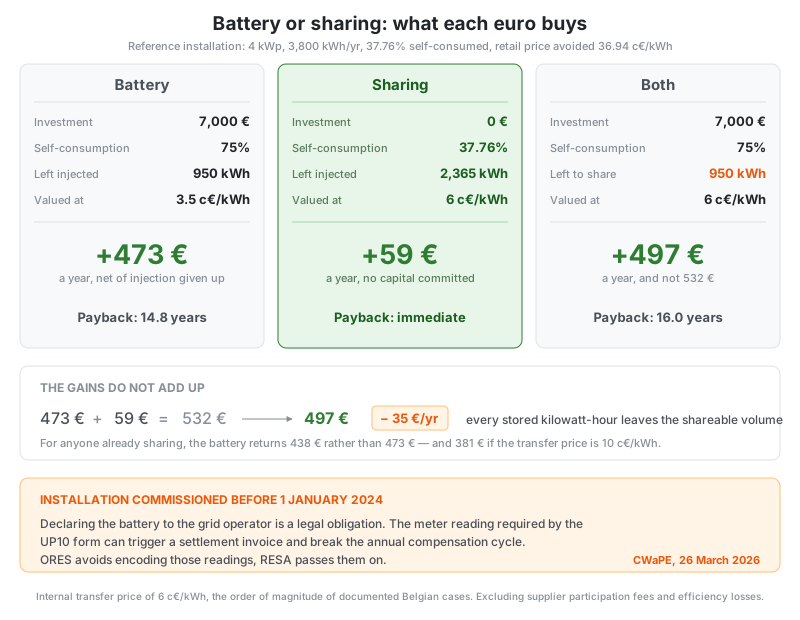
This concerns only installations commissioned before 1 January 2024, which keep compensation until 31 December 2030. For a later installation, there is no cycle to break.
The same act, two outcomes, depending on your grid operator
The most disconcerting part is that the risk depends on your postcode, and the regulator documents it in black and white.
ORES states that it adapted its procedure several years ago, after complaints: when a customer with panels adds a battery, the operator “avoids entering the readings so as to avoid sending them to the market”. A dedicated form exists on myORES; readings are requested there but are not encoded in the market systems. ORES acknowledges, however, that the process is not automated and that individual cases may have slipped through.
RESA applies the UP10 form and considers that any addition of an asset entails sending a MIG message to the supplier, accompanied by readings. The operator explicitly admits that “the associated supplier invoice may indeed disrupt […] the compensation cycle”, and justifies this choice by traceability and by securing the file in the event of a dispute.
The CWaPE came down in favour of an informative status for these readings and tasked RESA with assessing its feasibility. As at 26 March 2026, RESA had not yet delivered its analysis. FEBEG, the suppliers’ federation, declared itself in favour of only the information “presence of a battery” reaching the market, without billable readings.
In other words: the problem is identified, the regulator, the suppliers and one of the two grid operators agree on the solution, and it is not yet in force.
The second mechanism, rarer but more radical
RESA flags another risk, of a different nature: adding a battery to an existing installation can, “in certain configurations, be enough to raise the net developable power by more than 1 kWe and therefore cause the customer to lose compensation”.
The safeguard is technical and it has a name. To keep “small installation” status, an installation combining photovoltaics and storage must be fitted with a power-control system fed by an EnFluRi sensor — or an equivalent solution using the P1 port of the smart meter — which limits injection to the declared photovoltaic power alone. On that condition, the storage capacity is not added to the production capacity. The CWaPE notes that modern so-called smart batteries generally include this sensor.
It is a question to put to the installer before signing, and the answer must be written on the quotation.
What to do, in practice
If your installation dates from after 1 January 2024, none of this concerns you: move to the next section.
If it is earlier, three precautions. Ask your grid operator, in writing, whether declaring your battery will result in readings being sent to the market. Use the dedicated form where one exists, rather than the generic UP10. And check the quotation for an EnFluRi sensor or equivalent.
The CWaPE itself stresses that the subject goes beyond batteries: a simple request to increase meter capacity produces the same effect, and the regulator expects such requests to become more frequent “in the last five years of the compensation regime”.
Energy sharing: zero investment
On the other side, the alternative way of valuing a surplus requires no capital at all.
Energy sharing means allocating your injected production to other supply points — neighbours, a school, a shop, a condominium — that consume at the same moment. You change neither supplier, nor production meter, nor installation — which is the whole point of “Cheaper electricity without switching supplier”. You negotiate an internal transfer price.
That price sits in a defensible band of 3 to 14 c€/kWh: the floor is the injection tariff, below which no producer has any interest in sharing; the ceiling is the energy component the consumer already pays. Documented Belgian cases sit around 6 c€/kWh.
On our reference case, the 2,365 kWh of surplus therefore move from 83 € in injection to 142 € in sharing: +59 € a year, for zero euros invested.
That is little. We prefer to say so rather than dress it up: sharing does not replace self-consumption, it values what remains after it.
Three limits must be stated honestly.
Simultaneity. Sharing is calculated in fifteen-minute slots: your midday production can only be allocated to participants consuming at midday. The Flemish experience shows that around 20% of injection is actually shared, against the 40% hoped for. Building the group from daytime profiles — a shop, a school, a self-employed person working from home — changes everything, and that is the subject of our short-circuit guide.
Supplier fees. Some charge for participation in a sharing scheme, from zero to around 150 € a year per supply point. On a gain of 59 €, that is enough to wipe out the operation. It is the first thing to check in your terms and conditions.
The 80% reduction is not for everyone. The ORES 2026 grid cuts the proportional term on shared energy by 80% only within the same building. For sharing within an energy community, the CWaPE is explicit: there is no tariff reduction. The three Belgian statuses and their respective perimeters are set out in “Energy communities in Belgium: CER, CEC, CEL”.
What remains is the essential point: sharing has no capacity ceiling and costs nothing to set up. A battery has the capacity you paid for.
The two are not exclusive — but they do not add up
The title of this article poses an “or”. Walloon law poses an “and”.
The legal definition of sharing, from the decree of 5 May 2022 and the Walloon Government order of 17 March 2023, covers:
all or part of the energy produced, and where applicable stored, within the same building or by the energy community, injected into the local distribution or transmission network and consumed within the same quarter-hour.
“And where applicable stored”: electricity coming out of a battery can be shared. This is not a tolerance, it is written into the definition. The CWaPE also publishes a dedicated annex — a sworn declaration on the use of a storage installation — among the notification forms for a sharing operation, as we noted in our inventory of administrative documents.
The question is therefore not which to choose. It is what the combination actually returns.
The subtraction nobody performs
Every kilowatt-hour the battery absorbs is a kilowatt-hour removed from the shareable volume. Both devices draw on the same pool: your surplus. So they cannot add their gains together.
| Scenario | Self-consumed | Left injected | Annual revenue | Gain |
|---|---|---|---|---|
| Neither | 1,435 kWh | 2,365 kWh at 3.5 c€ | 613 € | — |
| Sharing only | 1,435 kWh | 2,365 kWh at 6 c€ | 672 € | +59 € |
| Battery only | 2,850 kWh | 950 kWh at 3.5 c€ | 1,086 € | +473 € |
| Both | 2,850 kWh | 950 kWh at 6 c€ | 1,110 € | +497 € |
Assumptions: same four parameters as above, internal transfer price of 6 c€/kWh matching the order of magnitude of documented Belgian cases. Excluding any supplier participation fees and battery efficiency losses.
59 € plus 473 € makes 532 €. The combination returns only 497. Thirty-five euros disappear every year — not because either device malfunctions, but because the second has little left to work with once the first has been served.
The consequence, for anyone already sharing
Turn the calculation around and it becomes far more concrete.
If you already take part in sharing at 6 c€/kWh, your annual revenue is 672 €. Adding a battery takes it to 1,110 €. The battery therefore returns not 473 € but 438 € — and its payback moves from 14.8 to 16.0 years.
And the better your transfer price, the wider the gap. At 10 c€/kWh, sharing alone returns 767 € and the combination 1,148 €: the battery now returns only 381 €, for a payback of 18.4 years.
The better your sharing price, the weaker the case for your battery.
It is counter-intuitive, and yet it is the exact mechanics of two devices competing for the same surplus. No battery profitability simulator we have consulted includes this parameter — because none asks whether you share.
The case where a battery genuinely helps sharing
It exists. A battery does not only subtract volume: it shifts the hour of injection.
If your sharing group consumes in the evening — a residential building, for instance — your midday surplus is of no use to it, the quarter-hour rule being what it is. A battery discharging to the grid at 7 pm turns an unusable volume into a shareable one.
Two caveats, and they matter. This configuration assumes your installation is set up to inject from the battery, which is not the default setting — a home battery is normally configured to maximise your own self-consumption. And the CWaPE points out that using storage to draw and then reinject onto the markets requires moving to a commercial injection service, which means giving up compensation.
We know of no documented Walloon residential case using this arrangement in 2026. We flag it as a theoretically open avenue, not as a recommendation.
When a battery is justified anyway
Everything above is a criticism of the battery as an investment. It is not a criticism of batteries.
Arbitrage between tariff bands. This is the only financial argument that holds, and it is costed by the regulator itself. On the ORES 2025 grid, the CWaPE calculates that a dual-rate customer saves 45 €/MWh in network costs by drawing during off-peak hours to consume during peak hours, on top of roughly 35 €/MWh on the commodity — that is, of the order of 80 €/MWh, or 8 c€/kWh. The Walloon Impact tariff, with its ECO band at 2.71 c€/kWh and PIC band at 13.54 c€/kWh, widens the gap further.
One warning is needed, however, for prosumers under compensation: the CWaPE explains that the network-cost capping mechanism “quickly” moves anyone practising this arbitrage onto billing based on net offtake plus the flat prosumer tariff. The optimisation cancels itself out. The regulator calls it “limited to certain situations and, moreover, complex to understand and implement”.
Autonomy during an outage. Wanting to hold out for a few hours without the grid is a legitimate need. It is simply not a profitability calculation, and it should be budgeted as insurance: nobody asks an insurance policy to pay for itself. Note, however, that not all batteries support islanded operation — it is an option, and often a paid one.
A very large shiftable load. Heat pump, electric vehicle charged at home, swimming pool: beyond a certain volume, the surplus pool becomes wide enough for a battery to work at full capacity all year. The calculation changes, and it must be redone with your own figures rather than ours.
What is not an argument. Replacing an undersized connection, peak shaving in Wallonia — where the residential capacity term is 0 €/kW — or the idea that a battery would exempt you from the prosumer tariff. None of the three holds.
What Test-Achats recommends instead
It is rare for a consumer organisation to take such a clear position, and the fact deserves reporting as it stands.
In an analysis published on 11 September 2025, Test-Achats explains that it is not in favour of individual storage, on two grounds: insufficient profitability, with a payback that “remains close to or exceeds 10 years”, and a resource argument — the lithium mobilised would be better used in electric vehicles, while recycling is not yet economic.
The alternatives the organisation puts forward are, in order: increasing self-consumption by shifting usage and heating water during the day, investing in equipment that consumes the surplus — heat-pump water heater, electric vehicle — and collective sharing through energy communities.
We have an obvious interest in relaying that last recommendation, and we prefer to write it down. It remains the view of a body that sells neither batteries, nor panels, nor membership of an energy community.
Brussels and Flanders
Everything above describes Wallonia. The other two regions change part of the calculation, and one of them changes it a great deal.
In Flanders, a battery has a second revenue stream. The capaciteitstarief charges 53.39 €/kW per year excluding VAT on the average of the last twelve monthly quarter-hourly peaks, with a floor of 2.5 kW. Shaving a 2 kW peak therefore returns more than 100 € a year — revenue that exists nowhere else in Belgium, and which mechanically cuts several years off the payback. It is the only Belgian region where a battery makes its case on two fronts. Flanders has also allowed person-to-person electricity sales since 2022, which widens the sharing options accordingly.
In Brussels there is likewise no subsidy, and the capacity term of the Sibelga grid is not calculated like the Flemish one. Sharing is possible within a building, between buildings and within an energy community, with proximity tariffs of types A to D, the most favourable of which remove the proportional term. The competent regulator is Brugel, and that is where we point: the Brussels grid operator’s site refuses automated checks, and we do not cite a source we have not been able to open.
Key takeaways
- The price is read per kilowatt-hour, and it falls with capacity. 850 €/kWh at 5 kWh, 600 €/kWh at 15 kWh according to Test-Achats. A 10 kWh battery sits at around 7,000 to 7,250 €, fitting and VAT included. Oversizing is the only lever working in your favour.
- None of the three regions pays a storage subsidy in 2026, and Wallonia never created one. The only tax advantage is 6% VAT, which requires a dwelling ten years old or more and a supply with fitting.
- On our reference case, a battery returns 473 € a year for 7,000 €, that is 14.8 years. The gain must be counted net of the injection payment given up — 33.44 c€, not 36.94 — on pain of overstating it by 10.5%. Énergie Commune, on a smaller case, gets 22 years for a 15-year service life.
- The prosumer tariff does not move. On the default capacity-based tariff, the CWaPE writes that the presence of a battery has “no influence” on its level: 80.98 €/kWe excluding VAT remain due at ORES. This holds only on that regime — with a smart meter and the proportional tariff, a battery does genuinely lower network costs.
- Declaring the battery is a legal obligation, and that declaration is the trap. For a pre-2024 installation still under compensation, the meter reading required by the UP10 form can trigger an interim settlement invoice and break the annual cycle. ORES avoids encoding those readings, RESA passes them on. The CWaPE proposed a fix on 26 March 2026; it is not yet in force.
- A battery and sharing combine legally, but their gains do not add up. Walloon law covers “energy produced, and where applicable stored”. On our case, 59 € + 473 € gives 497 € and not 532: 35 € a year evaporate because both devices compete for the same surplus.
- For anyone already sharing, the battery returns 438 € and not 473 — and 381 € if the transfer price is 10 c€. Its payback then moves from 14.8 to 16.0 and then 18.4 years. The right sequence remains the one we have defended since “Solar surplus: the 5 options compared”: shift your usage, then share, then and only then consider a battery.
Start with what costs nothing
OptimCE is an open source platform built for Belgian energy communities: participant register, quarter-hourly allocation key, statements and invoicing. Before investing 7,000 € to absorb your surplus, check what your neighbours could consume of it — it is free, and it can be measured.
FAQ
How much does a home battery cost in Belgium in 2026?
Test-Achats publishes a grid per kilowatt-hour installed: around 850 € per kWh for a 5 kWh battery, around 600 € per kWh for a 15 kWh one. That puts a 5 kWh battery at around 4,250 €, a 10 kWh one at around 7,250 €, a 15 kWh one at around 9,000 €, fitting and VAT included.
Two qualifications matter more than the range. The kilowatt-hour on the datasheet is not the usable kilowatt-hour: you must deduct the depth-of-discharge margin, then 5 to 10% of round-trip efficiency. And 6% VAT is not automatic — it requires a dwelling ten years old or more and a supply with fitting by the contractor.
Is a home battery profitable in Wallonia?
On our 4 kWp reference case, it lifts self-consumption from 37.76% to 75%, that is 1,415 kWh displaced worth 473 € a year net of the injection given up. For 7,000 €, payback is 14.8 years, beyond the manufacturer warranty.
Énergie Commune, on a smaller case, gets 22 years for a 15-year service life. Both models converge: a battery on its own does not pay for itself over its lifetime under Walloon 2026 conditions. Only arbitrage between tariff bands improves the case, and it partly neutralises itself for prosumers under compensation.
Is there a subsidy for a home battery in Wallonia?
No, and there never has been. Wallonia never created a home-storage subsidy, Brussels neither, and Flanders scrapped its own on 31 March 2023.
The logic is consistent: regional subsidies reward a reduction in consumption, and a battery reduces nothing — it shifts in time a volume already consumed. Be wary of pages advertising a battery subsidy: they generally recycle the home-automation grant or a Habitation scheme covering other equipment.
Does installing a battery lower the prosumer tariff?
On the capacity-based tariff, which applies by default, no. The CWaPE writes that the flat fee takes no account of the presence of batteries and that the prosumer will pay the same amount either way. The tariff applies to the inverter’s net developable power, which the battery does not change.
On the proportional tariff, which requires a dual-flow or smart meter, yes: it follows actual offtake, which the battery does genuinely reduce. So check your meter and your regime before comparing quotations.
Can a battery make me lose compensation?
The risk applies only to installations from before 1 January 2024. Declaring a battery is a legal obligation, and in Wallonia the UP10 form requires a meter reading passed on to the supplier, which may issue an interim settlement invoice and break the annual cycle.
The CWaPE recorded the problem on 26 March 2026 and found that handling differs by operator: ORES avoids encoding those readings, RESA passes them on. A second, rarer mechanism exists: without an EnFluRi sensor, adding a battery can raise net developable power by more than 1 kWe and cause the loss of compensation.
Do you have to choose between a battery and energy sharing?
No: Walloon law provides for combining them, the legal definition covering “energy produced, and where applicable stored”. But the gains do not add up, because every stored kilowatt-hour is removed from the shareable volume.
On our case, sharing alone returns 59 €, the battery alone 473 €, and the two together 497 € — not 532. For someone already sharing at 6 c€/kWh, the battery returns only 438 €, and its payback moves from 14.8 to 16.0 years. At 10 c€ it reaches 18.4 years.
Sources
- Test-Achats — How much does a battery to store your electricity cost? — sole source of the price grid per kilowatt-hour installed: 850 €/kWh for a 5 kWh battery, 600 €/kWh for a 15 kWh one, updated 10 July 2025. A consumer organisation with no equipment sales business, which makes it the only non-commercial Belgian reference on this point. Most of the file is members-only: only these two values are publicly visible, and we quote no others. The 10 kWh line in our table is an interpolation of our own, flagged as such. Consulted on 22 September 2026.
- Test-Achats — Solar panels and batteries: what are the alternatives for storing your electricity? — the organisation’s position, published 11 September 2025, unfavourable to individual storage on grounds of profitability (“remains close to or exceeds 10 years”) and resources, and putting forward three alternatives including collective sharing in energy communities. Freely accessible. We have a direct interest in relaying that last recommendation and say so in the body of the article. Consulted on 22 September 2026.
- CWaPE — Initiative proposal on the risk of interruption of the compensation cycle following the commissioning of a storage installation (CD-26c26-CWaPE-0974) — the central document of this article, dated 26 March 2026 and issued under article 43bis, § 1 of the decree of 12 April 2001. Source of the quotation of article 35octies, § 8 on the declaration obligation, of the description of the UP10 form and the meter reading it requires, of the collateral effect on interim settlement invoicing, of the diverging positions of ORES and RESA, of FEBEG’s position, and of RESA’s warning about net developable power rising by more than 1 kWe. It contains as an annex the information note of 12 September 2025 addressed to the Energy Minister, which is the source of the sentence on storage having no influence on the prosumer tariff, of the costing of the dual-rate arbitrage at 45 €/MWh of network and 35 €/MWh of commodity, and of the analysis of the network-cost cap that neutralises that optimisation. Consulted on 22 September 2026.
- CWaPE — Explanatory note: prosumer tariff — question 19, source of the two sentences contrasting the capacity-based prosumer tariff, a flat fee insensitive to the presence of a battery, with the proportional prosumer tariff, a function of actual offtake, as well as of the obligation to report the installation of batteries to the grid operator. Also the source of the definition of net developable electrical power and its worked examples. Document dated 18 April 2023: we reuse its principles, not its amounts, which are superseded by the ORES 2026 grid. Consulted on 22 September 2026.
- CWaPE — Energy sharing — source of the legal definition of sharing quoted as a block, and in particular of the words “and where applicable stored” which underpin the battery-plus-sharing combination, as well as of the same-quarter-hour rule. Refers to the decree of 5 May 2022 amending the decree of 12 April 2001 and to the Walloon Government order of 17 March 2023. The regulator’s page also gathers the notification forms and their annexes, including the one on storage installations. Consulted on 22 September 2026.
- Renouvelle — The home battery, a profitability mirage? — independent model published on 16 May 2024 by Olivier Boveroux for Énergie Commune: 3,000 kWh consumed, 3,000 kWh produced, 3 kWh battery at 4,200 €, 815 kWh stored, 164 kWh lost, net gain of 187 € a year, payback of 22 years for a service life of 15. This is the second estimate we set against our own, and the harsher of the two. Its price parameters date from late 2023 and have fallen since, which we flag. Consulted on 22 September 2026.
- Renouvelle — Is a battery a profitable system? 7 myths that sell us a dream — article by Benjamin Wilkin of 23 October 2023, source of the order of magnitude of efficiency losses, of the 10 to 15-year service life, and of the removal of the Flemish subsidy on 31 March 2023. Also the source of the statement that profitability is reached in none of the residential domestic scenarios tested. Consulted on 22 September 2026.
- BeProsumer — Home battery, compensation and administrative chaos — chronology of the report that led to the CWaPE’s initiative proposal, and account of the Walloon Parliament Energy Committee session of 21 April 2026. An association defending prosumers’ interests, not a regulator: its positions are cited as such, and the facts we take from this page are those the CWaPE confirms in its own document. Consulted on 22 September 2026.
- CWaPE — ORES 2026 periodic offtake tariff grid — source of the prosumer tariff of 80.98 €/kWe excluding VAT, of the Impact tariff bands (ECO 2.71 c€/kWh, PIC 13.54 c€/kWh), of the residential capacity term set at 0 €/kW for 2026-2029 and of the 80% reduction of the proportional term reserved for sharing within the same building. Grid approved on 18 December 2025 and valid from 1 January to 31 December 2026. Consulted on 22 September 2026.
- CREG — Monthly electricity market dashboard — source of the all-in retail price of 36.94 c€/kWh including VAT used across all our articles, recorded in June 2026 for a residential profile of 3,500 kWh single-rate. Consulted on 22 September 2026.
- Test-Achats — Comparison of injection tariffs — source of the injection value of 3.5 c€/kWh used in all our calculations, the average of the comparison of 28 May 2026 whose full range runs from 0.94 to 4.90 c€/kWh in Flanders and Wallonia. Consulted on 22 September 2026.
- SPW Énergie — Understanding the compensation mechanism — page of the administration competent for compensation since the transfer of the CWaPE’s non-regulatory powers on 1 May 2019. Source of the retention of compensation until 31 December 2030 for installations of 10 kW or less commissioned before 1 January 2024. It is also the page the CWaPE asks to have updated in order to reassure prosumers wishing to add storage. Consulted on 22 September 2026.
- SPW Énergie — Grants and incentives — reference used to verify the absence of any Walloon scheme covering home storage. We point the reader to this page rather than to a dated range, since the Habitation grant regime changes during the year. Consulted on 22 September 2026.
- Synergrid — Technical prescription C10/11 — the prescription referred to by the Walloon technical regulation and by the decree: it treats storage systems as production units for connection requirements, provides the simplified notification procedure for small installations, and sets the EnFluRi sensor condition that allows storage capacity not to be added to production capacity. Consulted on 22 September 2026.