
Local electricity: the short-circuit guide
In 2020, 3,478 Walloon farms sold their produce through a short supply chain. That is 27 % of the region’s farms, up from 1,232 farms and 8 % a decade earlier — a 182 % increase in ten years, and markedly faster than in Flanders, which stayed at 19 %.
In August 2026, CWaPE lists 13 energy communities notified across Walloon territory, and a June 2026 mapping exercise puts at roughly 126 the number of people actually taking part in an electricity sharing operation. Over the same period the Brussels-Capital Region — three times less populated — counted 1,417.
Same region, same people, same watchword: consume local, short, known. A mass success on one side, a near-standstill on the other. The tempting explanation is cultural — food speaks to people, energy is too abstract. It is wrong. The difference is mechanical, and it fits in one sentence: a box of vegetables waits in the fridge, an unconsumed kilowatt-hour vanishes in fifteen minutes. Everything else follows from that, including how you go about building one.
This article does not redo the region-by-region availability test or the calculation of what a shared kilowatt-hour earns, both covered in “Cheaper electricity without switching supplier”. It does not revisit surplus valuation from the producer’s side, compared device by device in “Solar surplus: the 5 options compared” and costed in “Solar panels 2026: still worth it in Wallonia?”. It does not redefine collective self-consumption, set out in “Energy self-consumption in Belgium”, nor the boundary between CER, CEC and CEL, drawn in “Energy communities in Belgium: CER, CEC, CEL”, nor the method for setting the price, developed in “Internal transfer price in an energy community”. It also extends the argument opened in “Green electricity in Belgium: really green?”, which established that sharing is the only verifiable short circuit in Belgian law — without saying how one is assembled.
It answers a question those articles do not ask: with whom, exactly, does an energy short circuit work — and why this is not a question of convictions.
The Walloon definition of a short supply chain, and why electricity cannot meet it
Wallonia has an administrative definition of the short supply chain, and it is remarkably precise. The Walloon agriculture portal defines it as “a way of marketing agricultural and horticultural products, raw or processed, in which at most one intermediary stands between the producer and the consumer”.
At most one intermediary. That is a threshold, not an intention. It allows farm-gate sales (zero intermediaries), producer markets (zero), common purchasing groups (zero, since the group does not buy in order to resell), cooperative shops and vegetable-box drops (one). It excludes the conventional chain, where at minimum a collection cooperative, a processor and a purchasing centre are interposed.
Applied to electricity, this definition is unreachable. Not difficult: unreachable.
The toll you never bypass
Between a panel on the school roof and the socket of the baker across the road, there is always at least one actor that no legal arrangement makes disappear: the distribution system operator. ORES, RESA and AIEG own and run the cable. They do not sell electricity — they carry it — but they are an intermediary in the full sense: they stand in between, they measure, and they charge.
That is the structural difference with the tomato. A market gardener can decide to deliver the crates personally and cut out wholesale logistics entirely. An electricity producer has no way of delivering electrons directly: the road is a regulated monopoly, and it is a toll road.
The consequence is blunt and best stated up front: the energy short circuit is not a physical circuit, it is an accounting circuit. The electrons do not change path — they take the shortest route physics imposes, as always. What changes is attribution: who is deemed to have consumed which volume, and who they pay for it.
What is genuinely shortened, and what never will be
CWaPE leaves no ambiguity here: “for electricity travelling through the network, all network charges (transmission and distribution), together with the related taxes and levies, are due on shared electricity”.
In other words, the energy short circuit acts on a single component of your bill: the energy itself. Transmission, distribution, taxes, levies and VAT remain payable in full. The detailed breakdown of those blocks is set out in “Why your electricity bill stays high in Belgium”; what matters here is that the share a short circuit can bite into is a minority of the total.
One exception exists, and it is narrow:
| Form of sharing | Network tariff treatment |
|---|---|
| Within a single building | 80 % reduction on the proportional terms, since 1 January 2025 |
| Within an energy community | No reduction — full tariff |
| Peer-to-peer | Not applicable: the regime does not yet exist in Wallonia |
This asymmetry is not an administrative detail. It explains much of the real geography of Walloon sharing: the only form that enjoys a tariff advantage is also the only one that needs neither a legal entity nor an authorisation. Which is to say, the smallest one.
The four degrees of the short circuit, from the veg box to the cooperative shop
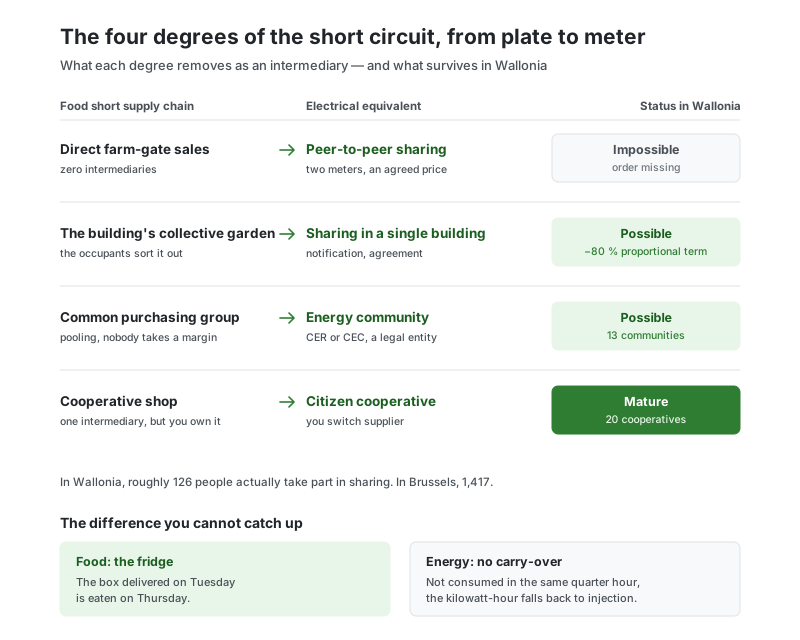
The food analogy is not decorative: it is structurally exact, provided you follow it all the way. There is no such thing as the short supply chain, on either the food or the energy side. There are four, from shortest to longest, and they demand neither the same effort nor the same infrastructure.
| Food short supply chain | Electrical equivalent | Status in Wallonia, August 2026 |
|---|---|---|
| Direct farm-gate sales — zero intermediaries | Peer-to-peer sharing | Impossible — implementing order missing |
| The building’s collective garden | Sharing within a single building | Possible — notification, −80 % proportional term |
| The common purchasing group | The energy community (CER or CEC) | Possible — CWaPE authorisation, 13 communities |
| The cooperative shop | The citizen cooperative and its supplier | Mature — 20 cooperatives, 23,000 members |
Degree 1 — Farm-gate sales: peer-to-peer
This is the pure form: one producer, one consumer, a price agreed between them. On the food side it is the dominant channel in Wallonia — 93 % of short-supply-chain farms sell directly at the farm.
On the electrical side, this is exactly what most people picture when you talk to them about consuming their neighbourhood’s electricity: I buy the surplus from the neighbour with panels. Two meters, an agreement, nothing else.
And it is precisely the form that does not exist in Wallonia. The decree of 5 May 2022 provides for it; the implementing order that would make it operational was never adopted. ORES puts it in black and white: “it is not yet currently possible to share your energy peer to peer”, and “the legislative framework for peer-to-peer energy sharing is not yet finalised”. The detail of that blockage and its cost is covered in “Cheaper electricity without switching supplier”.
Note simply the irony: the simplest degree of the food short supply chain is the one forbidden degree of the energy short circuit.
Degree 2 — The building’s garden: sharing within a single building
An apartment block that installs planters on its roof does not create a legal entity: the occupants agree, divide up the beds, and nobody applies for anything.
Sharing within a single building works the same way, and it is the lightest form in the Walloon scheme. CWaPE sums it up: “there is no need to set up a legal entity, but an agreement must be concluded”. The production installations and the participants must simply be located in or on the same building, the shared electricity must be renewable in origin, and a notification must be sent to the network operator.
In return for that lightness, it is the only form that benefits from the 80 % reduction on the proportional terms of the network tariff. It is also, logically, the configuration in which the word “neighbourhood” shrinks to a stairwell.
Degree 3 — The purchasing group: the energy community
The common purchasing group is the Walloon short-supply-chain institution par excellence: a group of households meets, picks its producers, orders together, and runs a distribution rota. Nobody takes a margin. The group does not buy in order to resell — it pools.
The energy community is an almost literal transposition of it, with one heavy difference: it requires a legal entity and an authorisation. Where a purchasing group forms around a kitchen table, a renewable or citizen energy community must be incorporated, notified to CWaPE — which has ten working days to check that the file is complete — then authorised to carry out a sharing activity, following the technical opinion of the network operator or operators concerned.
The full procedure is detailed in “Create an energy community in Wallonia” and, from the prospective participant’s side, in “Join an energy community in Wallonia”.
The count itself is quickly done. On 25 August 2026, CWaPE’s public list held 13 communities with a complete file, spread from Aubange to Rixensart, from Gesves to Tournai. The oldest, Soleil d’Aubange, was notified in May 2024. A June 2026 mapping exercise counted 8 sharing operations actually running, carried by 5 communities only, the others not having started yet.
Degree 4 — The cooperative shop: the citizen cooperative
The last degree, and the only one where energy Wallonia bears comparison with Wallonia on the plate. A cooperative food shop has one intermediary — the shop — but that shop belongs to its customers.
This is exactly the model of the citizen energy cooperative. At the end of 2024, the REScoop Wallonie federation gathered 20 citizen cooperatives, some 23,000 cooperative members, 31.6 million euros of capital and 102 MW installed across wind, solar, hydroelectricity and biomethane — for an output of 196 million kWh, the equivalent of the electricity consumption of 56,000 households.
Those cooperatives jointly own their own supplier, Cociter, which buys their output and resells it to customers who are, by construction, members of one of them. Cociter explicitly claims the vocabulary of the short circuit and asks the question that sums it all up: “What if your electricity came from your neighbours?” Entry is through a cooperative share, from 250 €.
The confusion to avoid: sharing is not sourcing
The first three degrees and the fourth are not variants of a single thing, and conflating them leads to predictable disappointment.
| Degrees 1 to 3 — sharing | Degree 4 — the cooperative | |
|---|---|---|
| Your supplier | Unchanged | You switch |
| What you receive | A share of local output, quarter hour by quarter hour | A conventional supply contract |
| Number of invoices | Two | One |
| What is short | The attribution of the kilowatt-hour | The value chain and the ownership |
| What you become | A participant | A member, therefore a co-owner |
Sharing does not replace your contract: ORES is categorical, “each participant keeps their contract with their respective supplier”. You will receive two invoices — the supplier’s for residual energy and network charges, the sharing representative’s for the volumes received. The mechanics of that double invoicing are detailed in “Invoicing shared electricity in Belgium”.
Good news: the two logics stack. Nothing prevents you from being a cooperative member, a Cociter customer, and a participant in an energy community.
The difference that changes everything: this short circuit has no fridge
We now reach the heart of the matter, and the reason transposing purchasing-group recipes without adapting them leads straight into a wall.
Simultaneity is written into the law
Walloon regulation — decree of 5 May 2022, Walloon Government order of 17 March 2023, amended by that of 5 February 2026 — defines sharing as the activity of allocating among participants all or part of the energy produced within a single building or by the energy community, injected into the local network and consumed within the same quarter hour.
Those last four words are not a technical modality. They are the definition. It is the communicating meter, read in fifteen-minute slices, that lets the network operator calculate, slot by slot, what was injected and what each participant drew — and then apply the agreed allocation key.
The unclaimed box is not carried over, it is dumped
In a purchasing group, if you cannot make it on Tuesday, your neighbour takes your crate and you collect it on Thursday. The fridge, the pantry and goodwill absorb the gap between the moment the producer delivers and the moment the product is eaten.
There is no equivalent in energy sharing. What a participant does not consume between 12:00 and 12:15 is not carried over to the next slot, nor set aside, nor credited. That volume simply leaves the sharing arrangement: it becomes ordinary injection again, which the producer sells to their supplier at the injection tariff. ORES puts it without hedging: “energy not consumed within the energy sharing community (injection surplus) is resold by the producers to their supplier”.
The value gap between those two fates is considerable — it is costed in “Solar surplus: the 5 options compared”. What matters here is simpler: every quarter hour is a market that opens and closes, and nothing survives its closing.
One nuance deserves stating, because it is often misread: batteries do not remove this constraint, they move it. Storage installed at the producer’s site or in the building allows the moment of injection to be shifted, and therefore the sharing to be moved to a more favourable slot. But the quarter-hour rule itself does not budge: stored energy must still be injected and consumed within the same slot to be shared. The fridge exists, it is expensive, and it is not inside the scheme — it sits upstream of it.
Consequence: you assemble by timetable, not by affinity
From this mechanism follows the most important practical rule in this article, and it is counter-intuitive.
A purchasing group is assembled by affinity. You gather people who share a sensibility, you adjust orders at the margin, and the group works because its members want it to work.
An energy short circuit is assembled by timetable. Twenty convinced, committed neighbours, willing to pay a little more for local — but who all leave for work at 8 am and get home at 6:30 pm — will share almost nothing. Their enthusiasm does not enter the network operator’s calculation. Their meters do.
Conversely, a bakery that has never heard of the energy transition, but whose ovens and cold rooms run from 5 am to 7 pm, is a first-rate participant.
It is an uncomfortable idea for a citizen project, and it is better owned up front: motivation recruits, the timetable performs. Both are necessary, but they are not the same people you go and find, nor the same arguments you use.
Assembling your neighbourhood: who to recruit, and in what order
Here, concretely, is how a perimeter that holds gets built.
Start with the roof, but do not stop there
The producer is rarely the hard part. An available roof can be found: municipal school, sports hall, care home, industrial-estate SME, farm building, recent apartment block, council depot. These buildings have surface area, an identifiable owner and, often, a direct budgetary interest.
The Walloon textbook case makes the point: Soleil d’Aubange, the first renewable energy community recognised in Wallonia, was built around installations carried by the municipality, with the support of a local action group and a specialist non-profit.
The classic mistake is to stop there — to size the installation on the roof’s potential rather than on the group’s daytime absorption capacity. An oversized roof facing a group that sleeps through the day does not produce a short circuit: it produces injection.
Daytime absorbers, in order of usefulness
This is the list the brochures never give. Ranked by capacity to consume during solar production hours:
| Profile | Why it counts | Watch out for |
|---|---|---|
| Food shop, bakery, butcher | Refrigeration and baking run continuously, morning to evening | Often already on a professional tariff |
| School, nursery, after-school care | Strong, predictable daytime consumption | Deep trough in July and August, at the solar peak |
| Care home, medical practice | Near-flat consumption, seven days a week | Institutional decision, therefore slow |
| Self-employed at home, liberal profession | Present during the day, residential meter | Modest volumes |
| Regular remote worker | Two to three days of presence per week | Irregular, hard to model |
| Retired person, parent at home | Daily presence, laundry and cooking can be shifted | Price-sensitive, discourse-insensitive |
| Charging point | The largest available tank | Only counts if the vehicle is plugged in between 11 am and 5 pm |
| Commuter household | Adds mass, brings legitimacy | Absorbs very little during the day |
The useful reading of this table is not “take the first ones and drop the last”. A project needs commuter households: they are its social base, they vote at the general meeting, they carry the thing. But if the group is made up of nothing else, there is no short circuit, there is an association.
What the 2026 tariff reform changes in your favour
One piece of context now works in the right direction, and it is recent. Since 1 January 2026, the Walloon dual-rate tariff bands have been redrawn: peak hours run 7 am – 11 am and 5 pm – 10 pm, off-peak hours 11 am – 5 pm and 10 pm – 7 am, and this seven days a week — the weekend distinction has gone.
The midday solar slot, previously peak on weekdays, has therefore moved into off-peak. Since network charges remain due on shared electricity, sharing at midday now costs less in distribution tariff than it did in 2025. Off-peak hours now amount to 15 hours a day, against 9 peak hours.
This is not a revolution, and it changes nothing about the quarter-hour rule. But it is a rare alignment between tariff logic and short-circuit logic, and it is worth pointing out to hesitant participants. The other Walloon levers are detailed in “Reduce your electricity bill: Wallonia 2026”.
The allocation key: how you split the box when there is not enough to go round
A last parallel, and the most faithful one. In a purchasing group, when the harvest is short, someone has to decide who gets what: equal shares, pro rata to the order, priority to large families. It is a question of rule, not of quantity.
In energy sharing, that rule is called the allocation key. The network operator applies, quarter hour by quarter hour, the key the participants chose in advance, and CWaPE has defined a set of standard keys. It can be changed later, through the sharing representative.
It is the most structuring decision in a project, because it determines who actually benefits from the production. The comparison of key types recognised by the three Belgian regulators is in “Allocation key in Belgium: the 3 regions”, and how to test a key on your own data before validating it is in “Simulate an allocation key: test your scenarios”.
A method tip: simulate before you recruit. A key tested on real load curves tells you immediately whether the intended group absorbs the production or not — and therefore whether you should go and find a school before you go and find ten households.
What the purchasing group teaches you and the brochure does not
Anyone who has run a purchasing group knows the concept is simple and the execution thankless. Energy sharing is no exception, and here are the real burdens.
Someone has to run the rota
In a purchasing group there is always one person who centralises the orders, chases the latecomers and opens the premises on Tuesday evening. Without them, the group dies within six months.
Energy sharing has its formal equivalent: the sharing representative. They sign the agreement with the network operator, hold the allocation key, invoice the volumes received to participants and follow up payments. This is not an honorary role: it is recurring administrative work, most often voluntary. The engagement and governance tools that lighten that load are described in “Engaging energy community members”.
Supplier fees can eat the gain
This is the most important point of this section, and the least often displayed.
Several suppliers charge administrative fees to customers taking part in a sharing operation. ENGIE, for instance, states that it charges 121 € including VAT (100 € excluding VAT) for any contract taking part in a form of energy sharing located in Wallonia or Flanders — with no pro rata: the amount is due in full whether you share for six months or twelve.
Set against the expected gain of a modest residential participant — of the order of a hundred euros a year for a few hundred shared kilowatt-hours, as detailed in “Cheaper electricity without switching supplier” — this amount is not friction: it is potentially the entire benefit.
The Belgian consumer organisation Test-Achats drew a severe conclusion as early as September 2024, writing that given these fees, “we no longer recommend energy sharing in Flanders and Wallonia for the time being”. And the magazine Renouvelle noted in October 2025 that the federal regulator CREG has no grip on these surcharges, because they fall within the liberalised part of the bill — it can therefore police neither their proportionality nor their abuse.
The practical consequence is simple, and it belongs in the first information meeting of any project: check each supplier’s sharing fees before recruiting a participant. Amounts vary widely from one supplier to another, some charge nothing, and a participant whose supplier levies 121 € must either change contract or absorb enough volume for the operation to still make sense.
The meter is an entry condition
Without a communicating meter or a remotely read quarter-hourly dual-flow meter, sharing is simply impossible. ORES is categorical: “each participant will have to be equipped with a remotely read quarter-hourly dual-flow meter or a communicating meter”.
A corollary for Walloon producers: sharing is incompatible with annual netting, the mechanism that makes the meter run backwards. One reasons in years, the other in quarter hours; the two cannot coexist on the same supply point. The costed trade-off is set out in “Solar panels 2026: still worth it in Wallonia?”, and it does not always favour sharing.
The calendar does not stop at go-live
An energy community is not a form you fill in once. Each year, by 1 September, it must send CWaPE an update and annual reporting form. Since 25 June 2026, both the notification and the annual reporting are done online through the Mon Espace forms. A file left incomplete for six months lapses.
The full inventory of these obligations is in “Energy community: CWaPE documents and deadlines”.
Why Wallonia succeeded at one and not the other
Back to the opening paradox. 3,478 farms in the food short supply chain, 13 energy communities. The answer now lies in a comparison of entry tickets.
| To launch a purchasing group | To launch an energy community |
|---|---|
| Willing people | Willing people whose meter consumes during the day |
| A room and a rota | A sharing representative, a DSO agreement, an invoicing process |
| A verbal agreement with the producer | An incorporated legal entity |
| Nothing to declare | A notification then an authorisation from CWaPE, after the DSO’s technical opinion |
| No equipment | A communicating meter at every participant |
| No third-party fees | Up to 121 € a year in administrative fees at some suppliers |
| Free carry-over from one week to the next | No carry-over: the quarter hour or nothing |
CWaPE says nothing different. In its opinion delivered in spring 2025, when the region still counted only four in-building sharing operations and three in communities, the regulator found that “these new arrangements are not meeting the expected success” and that the directive’s accessibility objectives “are not being met”. The obstacles it listed are administrative before they are technical: cumbersome procedures, a complex legal framework, a restrictive status for production installations, ill-suited market processes. Its recommendations include finalising the peer-to-peer framework, administrative simplification and appointing a dedicated facilitator.
The regional contrast confirms the diagnosis. In Brussels, where sharing benefits from public facilitation, automated data exchange and more favourable tariff treatment, Brugel had authorised more than forty energy communities by mid-2026, for roughly 1,417 participants — against 126 in Wallonia, on a territory three times more populated.
So this is neither a lack of appetite nor a problem of local culture. Wallonia has demonstrated, with its farms, that it knows how to do short supply chains at scale. What it does not yet have is the framework that makes an energy short circuit as easy to build as a purchasing group.
Key takeaways
- The energy short circuit is an accounting one, never a physical one. The network operator is an unavoidable intermediary and its toll remains due: the Walloon definition of a short supply chain, “at most one intermediary”, is unreachable in electricity.
- It acts only on the energy component of the bill. Network charges, taxes, levies and VAT remain payable in full on shared kilowatt-hours. The one exception is an 80 % reduction on the proportional terms, reserved to sharing within a single building since 1 January 2025.
- There are four degrees, not one. Peer-to-peer, single building, energy community, citizen cooperative. The first three let you keep your supplier; the fourth makes you switch. The first is legally impossible in Wallonia in August 2026.
- This short circuit has no fridge. Only energy consumed in the same quarter hour as its injection is shared. What is not absorbed in the slot is not carried over: it falls back to injection and resells for a few cents.
- You assemble a neighbourhood by timetable, not by affinity. Twenty motivated but daytime-absent neighbours share almost nothing. A bakery indifferent to the subject is a better participant. Motivation recruits, the timetable performs.
- Suppliers’ administrative fees can cancel the gain. ENGIE charges 121 € including VAT per participating contract in Wallonia and Flanders, with no pro rata. Check supplier by supplier before recruiting.
- The gap with food is not cultural, it is regulatory. 27 % of Walloon farms sell through a short supply chain; 13 energy communities exist. Between the two sit a legal entity, an authorisation, a communicating meter and a simultaneity constraint.
Assemble your short circuit with OptimCE
Open-source platform built for Belgian energy communities: members, meters, allocation keys and sharing operations in one place — right through to simulating the volume the group you are putting together can actually absorb, quarter hour by quarter hour.
FAQ
Can I buy electricity from the neighbour across the street in Wallonia?
No, not in August 2026. This form of exchange is called peer-to-peer and it is the simplest of the four: two meters, an agreed price, nothing else. It is provided for by the Walloon decree of 5 May 2022, but it remains inoperative because the implementing order was never adopted. ORES states it plainly on its dedicated page: “it is not yet currently possible to share your energy peer to peer”, and “the legislative framework […] is not yet finalised”. What a Walloon can do today is share within a single building, or join an energy community set up as a legal entity and authorised by CWaPE. In practice, the word “neighbourhood” therefore means either your own building or an association someone has created — not the house opposite.
Do I have to switch supplier to take part in an energy short circuit?
It depends which degree you place yourself at, and this is the most common confusion. Energy sharing, in all three of its forms, does not touch your contract: every participant keeps their own supplier, and ORES confirms this explicitly. You simply receive two invoices instead of one — your supplier’s for residual energy and network charges, the sharing representative’s for the kilowatt-hours received from other participants. Buying from a citizen cooperative such as Cociter, by contrast, is a full change of supplier. The two approaches are compatible and can be combined, but they are not the same object — and that is the source of much of the confusion around the subject.
What happens to shared electricity that nobody consumes at the right moment?
It is not shared at all, and this is the least understood constraint of the scheme. Walloon regulation defines sharing as the allocation of energy produced, injected into the local network and consumed within the same quarter hour. There is no carry-over from one slot to the next: whatever participants fail to absorb between 12:00 and 12:15 is lost to sharing. That volume falls back to plain injection and the producer sells it to their supplier at the injection tariff, a few cents per kilowatt-hour. A food short supply chain has a fridge that absorbs the gap between delivery and the meal; an energy short circuit has none. A battery moves the problem upstream, it does not remove it.
Which neighbours should you recruit for energy sharing to actually work?
The ones whose meter is awake when the sun is high — and this has nothing to do with their convictions. Because sharing is only valued inside the quarter hour of production, a group of twenty motivated neighbours who all leave for work at 8 am will absorb very little. The genuinely useful profiles are those consuming during the day: a food shop, a school, a nursery, a care home, a sports club, a self-employed person working from home, a regular remote worker, a retired person, or a charging point plugged in between 11 am and 5 pm. The right question to ask a candidate is therefore not “does the project appeal to you?” but “what time do you consume?”. Commuter households remain useful — they are the project’s social base — but a group made up of nothing else would not produce a short circuit.
Does a short circuit remove network charges from my bill?
No, and this is the structural limit of the scheme. CWaPE is explicit: “for electricity travelling through the network, all network charges (transmission and distribution), together with the related taxes and levies, are due on shared electricity”. One exception exists in Wallonia: an 80 % reduction on the proportional terms of the network tariff, applicable since 1 January 2025 to sharing within a single building only. There is no tariff reduction for sharing within an energy community. An energy short circuit therefore shortens only the energy component of the bill: the network toll remains payable, because the network is genuinely used — which is precisely what distinguishes an accounting short circuit from a physical one.
How does a citizen cooperative differ from an energy community?
They are two distinct legal and economic objects, often confused because they share the same local and citizen vocabulary. An energy community is a legal entity recognised by the decree, which organises the quarter-hourly allocation of local production among its participants, who keep their own suppliers. A citizen cooperative is a producer: it finances and operates wind turbines, rooftops or hydroelectric plants with the money of its members. In Wallonia, the REScoop federation gathered twenty cooperatives, some 23,000 members and 31.6 million euros of capital at the end of 2024, for an output of 196 million kWh — the equivalent of 56,000 households’ consumption. Those cooperatives jointly own the supplier Cociter, from which anyone can take a conventional contract, starting from a 250 € share.
Sources
- Walloon agriculture portal — Short supply chains, direct farm sales — the Walloon administrative definition of the short supply chain, “at most one intermediary […] between the producer and the consumer”, and the list of recognised channels: farm sales, markets, purchasing groups, vegetable-box drops, cooperative shops, institutional catering. Page dated 21 June 2017.
- State of Walloon Agriculture — Key diversification figures, indicator sheet EAW-C7a — source of the 1,232 farms in short supply chains in 2010, or 8 % of farms, and the 3,478 in 2020, or 27 %, a 182 % increase over ten years; the 93 % share selling directly at the farm; the Wallonia 27 % versus Flanders 19 % comparison. Data from the 2020 agricultural census, sheet updated 22 October 2025.
- APAQ-W — Short supply chains — typology of short-supply-chain channels in Wallonia and stated consumer motivations, used here to draw the parallel with the four degrees of the energy short circuit.
- CWaPE — Energy communities — the public list of Walloon energy communities with a complete file, source of the count of 13 communities from Aubange to Rixensart, of the regulator’s ten working days, of the lapsing of an incomplete file after six months, of the annual reporting obligation by 1 September and of the move to online forms on 25 June 2026. List consulted on 25 August 2026.
- CWaPE — Energy sharing — the regulatory definition of sharing, namely energy produced, injected into the local network and consumed within the same quarter hour; the legal basis, the decree of 5 May 2022 and the Walloon Government order of 17 March 2023 as amended by that of 5 February 2026; the list of authorised sharing operations.
- CWaPE — Are network charges payable on shared energy? — direct quotation on the retention of network charges, taxes and levies on shared electricity, and on the 80 % reduction of the proportional terms reserved to sharing within a single building since 2025.
- CWaPE — Difference between sharing within a single building and within a community — no obligation to form a legal entity and the need for an agreement for in-building sharing, the requirement of a CWaPE authorisation for community sharing, the renewable-origin constraint and the definition of the building perimeter.
- ORES — Energy sharing, frequently asked questions — the requirement for a remotely read quarter-hourly dual-flow meter or a communicating meter, the retention of each participant’s supply contract, double invoicing, the role of the allocation key and the resale of injection surplus by the producer to their supplier.
- ORES — Peer-to-peer energy exchange — source of the quotations establishing that peer-to-peer energy sharing is not yet possible in Wallonia and that the legislative framework is not finalised. Page consulted on 25 August 2026.
- ORES — The dual-rate tariff changes hours — the new bands in force since 1 January 2026: peak hours from 7 am to 11 am and from 5 pm to 10 pm, off-peak hours from 11 am to 5 pm and from 10 pm to 7 am, seven days a week, giving 15 off-peak hours a day against 9 peak hours.
- ENGIE — Do I need to budget for administrative costs for my energy sharing? — source of the 121 € including VAT, or 100 € excluding VAT, charged per contract taking part in energy sharing in Wallonia or Flanders, of the absence of pro rata and of the billing rule beyond two EAN codes.
- Test-Achats — What fees do suppliers charge for energy sharing? — survey of administrative fees charged by Belgian suppliers and the consumer organisation’s recommendation no longer to recommend energy sharing in Flanders and Wallonia. Published 18 September 2024; amounts have moved since and remain to be rechecked supplier by supplier.
- Renouvelle — Supplier surcharges: a brake on energy sharing? — the justification advanced by suppliers, namely manual processing of sharing data and balancing; the wide variation between suppliers; and CREG’s lack of control over fees that fall within the liberalised part of the bill. Article of 27 October 2025.
- Renouvelle — Sharing and energy communities in Wallonia: CWaPE’s opinion — the regulator’s finding that “these new arrangements are not meeting the expected success”, the count of four in-building operations and three in communities at that date, the list of obstacles identified and the recommendations on the peer-to-peer framework, administrative simplification and a dedicated facilitator. Article of 18 March 2025.
- GAL Condruses — Mapping of energy communities in Wallonia — source of the estimate of roughly 126 sharing participants in Wallonia and 1,417 in Brussels, and of the count of eight active operations carried by five communities. Survey of 17 June 2026; this is an association’s mapping exercise, not an official regulator’s return.
- Brugel — Authorised communities — the register of energy communities authorised in the Brussels-Capital Region, whose count exceeded forty by mid-2026, used here for the regional contrast.
- REScoop Wallonie — the federation’s figures as at the end of 2024: 20 citizen cooperatives, some 23,000 members, 31.6 million euros of capital, 102 MW installed and 196 million kWh produced, the equivalent of the electricity consumption of 56,000 households.
- Cociter — Our energy short circuit — the model of a supplier owned by Walloon citizen cooperatives, the line “What if your electricity came from your neighbours?” and the 250 € entry amount to become a cooperative member.
- Gaume Nature Park — Energy community in Aubange — the first renewable energy community recognised in Wallonia, built around installations carried by the municipality with the support of a local action group and a specialist non-profit, cited here as the textbook case of starting from a public roof.