
Green electricity in Belgium: really green?
In 2024, suppliers active in Wallonia declared a supply mix made up of 49.38 % renewable energy, across a total volume of 19,949,085 MWh. That same year, the Belgian residual mix — what is left in the common pool once every guarantee of origin has been claimed by someone — stood at 18.07 % renewable, against 27.85 % fossil and 54.08 % nuclear.
Both figures are accurate. Both are official. Both are published by CWaPE. And the gap between them is neither a rounding error nor a fraud: it is the system working exactly as it was designed to work.
Understanding why means understanding what you actually buy when you sign up for a “100 % green” offer in Belgium. The answer fits in one sentence: you buy an administrative title, called a guarantee of origin, which proves that one megawatt-hour of renewable electricity was produced somewhere in the European Economic Area and that nobody else is claiming it. It is a legal, useful and auditable mechanism. It simply is not a description of what enters your home — and the distinction stops being theoretical on 27 September 2026, the date European Directive 2024/825 makes unproven generic environmental claims unlawful.
This article does not re-explain the structure of an electricity bill, decoded line by line in “Read your Belgian electricity bill line by line” — but it picks up precisely where that bill displays the “product energy mix” without saying what backs it. It does not redefine what an energy community is, nor the boundary between a CER and a CEC, set out in “Energy communities in Belgium: CER, CEC, CEL”, nor the mechanics of self-consumption, developed in “Energy self-consumption in Belgium”, nor the regional availability test for sharing, run in “Cheaper electricity without switching supplier”. It answers a question those articles do not ask: what evidence exists behind the word “green”, who produces it, who checks it, and what it is worth.
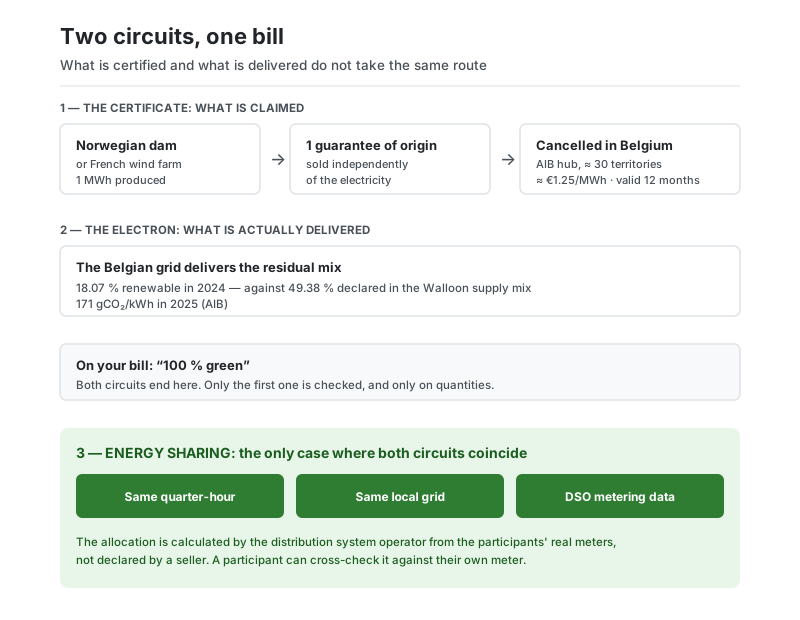
What a guarantee of origin proves — and what it does not
The starting point is a physical fact nobody disputes: once on the grid, electrons carry no label. Power from a wind turbine and power from a gas plant are strictly indistinguishable, and the Belgian grid is a single plate where everything mixes. A parallel accounting system therefore had to be invented so that a consumer could support renewables. That accounting system is the guarantee of origin.
The mechanism, in four steps
Issuance. Every time a renewable installation produces one megawatt-hour, the competent authority issues it an electronic certificate. Belgium has four issuing bodies, which is already unusual: SPW Énergie for Wallonia, VREG for Flanders, Brugel for Brussels, and CREG for the federal offshore wind farms. The certificate carries the technology, the production date and the site.
Circulation. The certificate can be sold separately from the electricity. This is the decisive point, and the Walloon energy administration states it without hedging: guarantees of origin “can be sold by the producer independently of the electricity or gas produced”. A Norwegian producer can therefore sell the power to a Norwegian industrial user and the certificate to a Belgian supplier. Certificates trade through the Association of Issuing Bodies hub, which links around thirty European territories under the EECS standard and the European standard CEN EN 16325.
Cancellation. To sell a kilowatt-hour as green, the supplier must “cancel” — permanently withdraw from the registry — an equivalent quantity of certificates. Brugel sums up the rule: suppliers “must purchase guarantees of origin in quantities equivalent to the green electricity they sell”. Cancellation is what prevents double counting.
Control. In Wallonia, CWaPE receives two monthly data flows: suppliers declare, EAN code by EAN code, the green percentage of each customer, and grid operators declare actual consumption. CWaPE derives from this the volume of certificates each supplier must justify. The control is therefore real, and it bears on quantities.
The three things the certificate does not say
This is where the misunderstanding begins, because the control bears on quantities and never on the coincidence between certified production and your consumption.
| What a guarantee of origin guarantees | What it does not guarantee |
|---|---|
| That one renewable MWh really was produced | That it was produced when you consume |
| That it was produced in the EEA, at an identified site | That it was produced near you, or even in Belgium |
| That nobody else is claiming it | That the matching electron was delivered to you |
| That the volume sold is covered, MWh for MWh | That a new installation was financed thanks to you |
| That the technology and date are traced | That your supplier produces or buys renewable power |
The two missing parameters are time and place. A guarantee of origin is valid for twelve months: a certificate issued in February can cover consumption in November. And the Union requires every member state to recognise certificates issued elsewhere in the Union, as well as in Iceland and Norway under the European Economic Area Agreement. A Norwegian dam built in 1974 can therefore green a Liège radiator in 2026.
These two properties are not implementation flaws. They are deliberate: they are what makes the market liquid and the scheme workable at European scale. But they come at a price, and that price shows up in the national arithmetic.
The arithmetic that gives the system away: the residual mix
The residual mix is the concept the general public does not know and which explains everything. Its definition is simple: it is the composition of the electricity that nobody explicitly claims, once every holder of guarantees of origin has withdrawn theirs from the common pool.
It is the mix assigned, by construction, to any customer without a green offer. And it is far dirtier than the country’s production mix, precisely because the green attributes have been subtracted from it.
The Belgian figures
| Indicator, 2024 | Renewable | Fossil | Nuclear |
|---|---|---|---|
| Declared supply mix in Wallonia | 49.38 % | 17.21 % | 33.41 % |
| Belgian residual mix | 18.07 % | 27.85 % | 54.08 % |
The gap of more than thirty-one points does not measure cheating. It measures the volume of green attributes bought and claimed, a large share of which comes from abroad. For the 2025 exercise, the AIB — the European body that calculates these residual mixes, and whose final results were published on 26 May 2026 — puts Belgium’s carbon intensity at 171.01 gCO₂/kWh. Across the continent, the average renewable share of residual mixes stands at 21 %, for 435 gCO₂/kWh.
The plausibility test
There is a very simple way to measure the distance between the narrative and the physics: compare what a supplier sells as green with what the country produces as renewable.
In 2023, Engie supplied 28.5 TWh of electricity in Belgium. Total Belgian renewable production that same year was 21.5 TWh. A single supplier therefore sells more electricity than the entire country produces from renewables — all technologies, all producers, all customers combined. No large-scale green offer can be backed by domestic production: importing certificates is not an accident, it is an arithmetical necessity.
The supplier-level figures reported by La Libre in February 2025 confirm this:
| Supplier | Share of Belgian guarantees of origin | Trend |
|---|---|---|
| Engie | 34 % in 2024 | foreign share up from 37 % in 2023 to 66 % in 2024 |
| Luminus | 62 % in 2024 | rising, from 54 % in 2023 |
| TotalEnergies | 81 % residential, 13 % business | very wide gap between segments |
| Eneco | 86 % | backed by North Sea wind stakes |
Two readings follow. First, half of the guarantees of origin used by Belgian suppliers came from abroad in 2023, and the trend at the market’s largest player is deteriorating fast. Second, the TotalEnergies gap between 81 % residential and 13 % business shows that the “Belgian-ness” of an offer is a commercial parameter, tuned segment by segment — not a physical constraint.
Three decouplings: time, place, money
Time — what hourly matching reveals
This is the best-documented flaw scientifically, and the most counter-intuitive.
A study published in Nature Communications on 20 October 2025 by Hanna F. Scholta and Maximilian J. Blaschke took European certificate and electricity market data across twenty-four countries of the AIB hub, then recalculated green claims by progressively tightening the time resolution: quarter, month, week, day, hour.
The result is stark. Under annual matching — today’s rule — coverage is 100 % by construction. Under hourly matching, it falls to 95.7 % in 2021, against 99.8 % in 2016. In other words, the real quality of green claims is degrading as solar and wind grow, because their output is increasingly concentrated in slots where demand is not.
The most telling figure is hourly. At the fifth hour of the day in 2021, 66.8 % of intervals were covered by no actual renewable generation, for a volumetric shortfall of 11.4 %. At five in the morning, the “green” electricity billed to two European households out of three simply did not exist at the moment it was consumed.
The authors recommend a two-phase transition: move in the short term to quarterly or monthly matching, which existing registries can already handle, then to hourly matching. They conclude that “in the long term, we perceive hourly matching as essential to achieve temporally transparent and reliable claims”.
Remember the unit of measurement, because it will come back: the international scientific debate on the credibility of green claims is about moving from the year to the hour. Belgian energy sharing already works at the quarter-hour.
Place — where the certificates actually come from
For Brussels, the most recent detailed exercise available, the geographic breakdown of guarantees of origin cancelled in 2023 was: France 25.58 %, the Belgian federal entity and North Sea wind farms 19.13 %, Flanders 15.38 %, Norway 12.05 %. Northern Europe — Norway, Denmark, Sweden, Iceland, Finland — accounts for around 19 % on its own.
A Brussels “green” offer is therefore, on average, mostly backed by generation located outside Belgium. This is not illegal, it is not hidden, and Brugel says so explicitly: the guarantees of origin used “may come from their own or other installations, located in the Brussels-Capital Region or in other European regions”. But it empties out the intuitive idea a reader forms of “local” electricity.
The system has already shown its limits on this front. Iceland was temporarily barred from exporting certificates after producers resold abroad guarantees corresponding to electricity already presented as renewable on the domestic market — a manual case of double counting, since corrected, but a reminder that the scheme rests on the discipline of heterogeneous national registries.
Money — why the certificate funds almost nothing
That leaves the argument most often used to defend the system: even decoupled, buying a guarantee of origin would send a price signal favourable to renewables. The figures say otherwise.
In early 2025, a European guarantee of origin traded at around €1.25/MWh, against roughly €3.25/MWh for a Belgian one. On a residential consumption of 3,500 kWh a year, the European guarantee therefore represents about €4.40 over the year — less than two tenths of one per cent of an annual bill. The Walloon energy administration even notes that “a significant number of guarantees of origin trade at zero or unstated prices”, buried in bundled contracts.
These amounts do not finance wind farms. They mostly remunerate a stock of Nordic dams written off since the 1970s, whose output would exist anyway.
This is exactly the reasoning that led Greenpeace Belgium to change the methodology of the supplier ranking published on monelectriciteverte.be. Guarantees of origin still appear there, but no longer earn any points. The justification is blunt: “Years after the system was introduced, it is clear that guarantees of origin contribute little to electricity market transparency and are not a catalyst for investment in renewable energy.”
The ranking now rests on investments (45 %), electricity supplied in the sense of own capacity and direct purchases (35 %) and green heat initiatives (20 %). Structural consequence: a pure trader that does not invest is capped at 14/20, whatever volume of certificates it buys.
The latest ranking leaves no room for ambiguity:
| Supplier | Score | Profile |
|---|---|---|
| Cociter (Wallonia) | 20/20 | citizen cooperative |
| Ecopower (Flanders) | 20/20 | citizen cooperative |
| Wase Wind (Flanders) | 20/20 | citizen cooperative |
| Luminus | 7/20 | — |
| Mega | 5/20 | — |
| TotalEnergies | 4/20 | — |
| Engie-Electrabel | 3/20 | the country’s largest supplier |
The contrast between a supplier scored 3/20 and a cooperative scored 20/20 is not about compliance — both obey the law and cancel their certificates. It is about what is actually produced and invested, as opposed to what is declared.
What changes on 27 September 2026
Everything above is criticism. From 27 September 2026, part of it becomes law.
Directive (EU) 2024/825, known as “Empowering Consumers for the Green Transition”, becomes applicable that day across the twenty-seven member states. It does not create a standalone regime: it amends the Unfair Commercial Practices Directive and the Consumer Rights Directive, which in Belgian law translate into Books I and VI of the Code of Economic Law, notably articles VI.93 to VI.100 on misleading practices.
Three prohibitions bear directly on the electricity market.
Generic environmental claims without proof. The words “green”, “ecological”, “environmentally friendly”, “climate neutral” used on their own, without demonstrating recognised environmental performance, become prohibited commercial practices. An offer named “100 % green” will have to be able to explain what makes it so.
Self-certified sustainability labels. A sustainability label not based on a public or approved certification scheme — typically an in-house label created by the seller itself — becomes prohibited. Guarantees of origin do rest on a public framework: the point is not their validity, but the fact that they can no longer underwrite any wording whatsoever.
Climate neutrality based on offsetting. A neutrality claim resting on the purchase of offset credits rather than on actual reductions becomes prohibited.
A word on the state of Belgian transposition, because it matters to the reader. Belgium was due to transpose the text by 27 March 2026 and is, alongside nineteen other member states, subject to an infringement procedure opened by the Commission for failing to communicate full transposition. This does not push back the application date, and it does not leave consumers without recourse: the FPS Economy already publishes guidelines on environmental claims that interpret those same articles VI.93 to VI.100 and expressly target greenwashing, defined as a claim that is “false, presented in a misleading way, or that cannot be verified”.
In practice, this means the question this article asks — what backs your “green” claim? — stops being a matter of curiosity and becomes a question a seller must be able to answer.
Checking your own electricity, region by region
Enough theory. Here is how to check your own supply, using official tools. The level of detail varies sharply from one region to another, and Flanders is by far the best served.
Flanders — the VREG Groencheck
This is the most precise tool in the country, and the only one that goes down to the individual connection point: you enter your electricity EAN code, and it tells you how green your electricity actually was.
The key word is the verb. The Groencheck lets you check whether your supplier actually submitted guarantees of origin for your meter. It is not a brochure, it is a verification. The Flemish rule is explicit: if you signed a green electricity contract, your supplier must file the matching guarantees with the VREG every month — one per 1,000 kWh of green electricity consumed — and thereby prove that the power delivered to you did come from renewable sources: water, sun, wind, biogas, biomass.
Brussels — the Brugel Greencheck
Brugel provides an equivalent tool in principle: “every Brussels consumer can verify the green percentage of their supply”. The regulator also publishes the annual breakdown of cancelled guarantees by technology and country of origin, which lets you place your own offer in the regional context.
Wallonia — the CWaPE fuel mix
Wallonia offers no individualised per-meter view. CWaPE does, however, publish the fuel mix per supplier as well as the Belgian residual mix, which lets you compare your supplier’s disclosure with the market average — and measure the gap against the residual mix.
The five questions to ask your supplier
Whatever the regional tool, the decisive check comes down to five questions. The right-hand column gives the answer that should worry you.
| Question | Answer that should worry you |
|---|---|
| What share of your guarantees of origin is Belgian? | “We do not disclose that detail”, or an unacknowledged foreign majority |
| Which countries do the rest come from? | A vague answer along the lines of “from Europe” |
| Which technology — hydro, wind, solar, biomass? | A dominant hydro share with no location: likely old Nordic dams |
| How much renewable capacity have you commissioned in the last two years? | None, or a pointer to undated projects |
| Do you buy directly from producers, or only certificates? | “We buy guarantees of origin”, with no direct purchasing: that is the definition of a trader |
The fifth question is the most discriminating, and it is the one Greenpeace’s methodology placed at the heart of its ranking. A supplier that produces or buys directly commits capital; a supplier that buys certificates commits €1.25 per megawatt-hour.
Energy sharing: the only verifiable short circuit in Belgian law
Belgian law contains one mechanism where the green claim is not declared but calculated. It is not a commercial offer, it is a regulatory scheme: energy sharing.
The definition already contains the answer
The Walloon decree of 5 May 2022 and the Walloon Government order of 17 March 2023 — amended by the order of 5 February 2026 — define sharing as the operation of distributing among participants all or part of the energy produced within the same building or by the energy community, injected into the local distribution or transmission grid and consumed within the same quarter-hour.
Three constraints are therefore written into the definition itself:
- A time constraint — the same quarter-hour. Not the same year, not the same month: the same quarter-hour. Whatever is not consumed within that slot is not shared.
- A geographic constraint — the local grid, or the building. Not the European Economic Area.
- A metering constraint — a remotely read quarter-hourly bidirectional meter, or a smart meter. The annual compensation regime, the famous “meter running backwards”, is explicitly incompatible with sharing, precisely because it cannot timestamp exchanges.
Who produces the proof
This is the second decisive point. In a conventional green offer, the proof is produced by the seller and checked after the fact on quantities. In sharing, the allocation is calculated by the distribution system operator, which applies the allocation key chosen by participants, transmits the metering data and allocates the volumes. The sharing representative and the DSO sign an agreement setting out how data is transmitted, the start date and the applicable key.
A participant therefore does not receive a declaration: they receive an official allocation, based on their own readings, which they can cross-check against their meter.
CWaPE goes further. In its opinion on sharing, the regulator describes these volumes as energy “guaranteed 100 % renewable (and local) in origin” — and relies on that quality to challenge the green certificate quota obligation still weighing on them, holding that “it seems unreasonable to impose this obligation” on volumes that no longer receive support. It is the regulator itself that treats shared energy as intrinsically local and renewable, where it never does so for an offer backed by certificates.
The comparison, criterion by criterion
| Criterion | Green offer backed by guarantees of origin | Energy sharing |
|---|---|---|
| Time resolution | the year; certificate valid 12 months | the quarter-hour |
| Geographic perimeter | the European Economic Area | the building or the local grid |
| Source of the proof | supplier declaration, purchased certificates | real metering data |
| Who calculates | the supplier, checked on quantities | the distribution system operator |
| Additionality | around €1.25/MWh, no established leverage effect | the shared installation exists and generates near you |
| What you can verify yourself | the displayed percentage, via the regional tool | your shared volumes, quarter-hour by quarter-hour |
The irony is real: the international scientific debate calls for moving from annual to hourly matching to make green claims credible. Belgian energy sharing already runs at the quarter-hour, four times finer than what the literature treats as the long-term objective.
Adoption is following, slowly but genuinely. The Brugel observatory counted 1,009 participants across 129 projects and 6.63 MWp shared in Brussels in October 2024, against 397 participants at the previous count.
What sharing does not solve
An article that denounced the declarative nature of guarantees of origin only to replace it with an equally unverifiable promise would be worth no more. So here, honestly, are the limits.
Sharing proves time and place, not legal title. This is the most important nuance in this article. The guarantee of origin remains attached to the production unit, and it can be sold separately, including by a producer who shares their kilowatt-hours. Nothing technically prevents a producer from sharing their energy and selling the matching certificates. You would then have physical proximity and simultaneity — but the green attribute itself would have been sold to somebody else.
The question to put to your community is therefore simple, and it deserves a place in the sharing agreement: what happens to the guarantees of origin of the shared production unit? Three answers are acceptable — they are cancelled for the benefit of participants, they are not issued at all, or their proceeds go to the community and it says so. A fourth is not: “we have never looked into it.”
Sharing covers only part of your consumption. By construction, it only applies in quarter-hours when local generation exists. The rest — residual energy — continues to be billed by your supplier at your contract rate, with its own mix and its own guarantees of origin. Sharing moves the boundary, it does not remove it.
It requires a suitable meter. Without a smart meter or a remotely read quarter-hourly bidirectional meter, sharing is simply impossible. That is an entry condition, and it still excludes part of the Belgian stock.
The framework remains uneven across regions. The practical availability of the various forms of sharing varies sharply between regions, and peer-to-peer sharing between two private individuals remains inoperative in Wallonia for want of an implementing order — a topic covered in detail in “Cheaper electricity without switching supplier”.
Finally, sharing has a cost. Grid fees, excise duties, the green certificate quota levy and VAT remain due on shared kilowatt-hours. Sharing acts only on the energy component, and how to price it is a subject in its own right, developed in “Internal transfer price in an energy community”.
Key takeaways
- A guarantee of origin proves that a renewable megawatt-hour was produced, not that it was delivered to you. It is sold independently of the electricity, stays valid for twelve months and circulates across roughly thirty European territories. All three properties are deliberate, not accidental.
- The gap between 49.38 % and 18.07 % is the exact measure of the phenomenon. The first figure is the declared supply mix in Wallonia in 2024, the second the Belgian residual mix that same year. Both are official; their difference is the volume of green attributes claimed, largely imported.
- One supplier alone sells more electricity than Belgium produces from renewables. Engie supplied 28.5 TWh in 2023 against 21.5 TWh of national renewable production. Importing certificates is not a commercial choice, it is an arithmetical necessity.
- The temporal quality of green claims is degrading. Under hourly matching, European coverage fell from 99.8 % in 2016 to 95.7 % in 2021, and at five in the morning, 66.8 % of intervals were covered by no actual renewable generation.
- The price signal is far too weak to finance anything. At €1.25/MWh for a European guarantee, the purchase weighs around €4.40 a year on a residential consumption. Greenpeace Belgium has stopped awarding a single point to guarantees of origin in its supplier ranking.
- On 27 September 2026, Directive 2024/825 makes unproven generic green claims unlawful, along with self-certified labels and neutrality by offsetting. Belgium is late transposing it, but the European application date does not move.
- Energy sharing is the only Belgian mechanism where the claim is calculated rather than declared — at the quarter-hour, within a bounded perimeter, by the distribution system operator, from real metering data. It does not, however, settle the fate of the shared unit’s guarantee of origin: ask the question, and have the answer written into the agreement.
Verify your local energy with OptimCE
Open source platform built for Belgian energy communities: members, meters, allocation keys and sharing operations in one place — through to quarter-hourly tracking of the volumes actually shared and their traceability, from grid operator data all the way to the invoice.
FAQ
Does a guarantee of origin prove that the electricity I consume is renewable?
No, and that is not what it is for. A guarantee of origin proves that one megawatt-hour of renewable electricity was produced somewhere in the European Economic Area, at some point in time, and that nobody other than you is claiming it. It proves nothing about the electrons entering your home, for three cumulative reasons. It is sold independently of the electricity itself, as the Walloon energy administration puts it plainly: a producer may sell the power to one buyer and the certificate to another. It stays valid for twelve months, which allows a certificate issued in February to green a November consumption. And it circulates across roughly thirty European territories, which allows a Norwegian dam to green a radiator in Liège. The green label on your bill is therefore a valid accounting title, not a physical description of your supply.
Why is the Belgian residual mix so different from the mix my supplier displays?
Because they measure two different things. The mix your supplier displays is a contractual mix: it describes the certificates it cancelled to cover your kilowatt-hours. The residual mix describes what is left in the common pool once every certificate has been withdrawn by whoever bought it. In 2024, the declared supply mix in Wallonia reached 49.38 % renewable, while the Belgian residual mix fell to 18.07 %. The gap measures exactly the volume of green attributes imported and claimed. This is why a customer without a green contract is assigned the residual mix rather than the national production average: the country’s green attributes have already been sold, often abroad.
Do guarantees of origin fund the construction of new wind farms?
Only marginally, and that is the central criticism levelled at them. A European guarantee of origin traded at around €1.25/MWh in early 2025, against roughly €3.25/MWh for a Belgian one, and the Walloon energy administration notes that a significant number of them change hands at zero or unstated prices. Set against the cost of a wind farm, that revenue is negligible, all the more so because most certificates come from Nordic dams written off since the 1970s. Greenpeace Belgium drew the consequence in its supplier ranking: guarantees of origin no longer earn any points at all, on the grounds that they contribute little to electricity market transparency and are not a catalyst for renewable investment. Real support for the sector runs through green certificates and direct purchase agreements, not through guarantees of origin.
What changes on 27 September 2026 for green electricity offers?
European Directive 2024/825 on empowering consumers for the green transition becomes applicable across all twenty-seven member states. It bans three practices that are directly present on the Belgian energy market: generic environmental claims without proof of recognised environmental performance, meaning the words “green”, “ecological” or “environmentally friendly” used on their own; sustainability labels not based on a public or approved certification scheme, which targets in-house labels created by sellers themselves; and climate neutrality claims based on offsetting. Belgium was due to transpose the text by 27 March 2026 and is subject to an infringement procedure for failing to communicate its transposition, but the European application date does not move as a result.
How do I actually check where the green electricity I pay for comes from?
Each region has a tool, and they do not offer the same level of detail. In Flanders, the VREG Groencheck is the most precise in the country: it goes down to your own EAN code and tells you whether your supplier really filed with the regulator the guarantees of origin matching your consumption. In Brussels, the Brugel Greencheck lets every consumer verify the green percentage of their supply. In Wallonia, the fuel mix published by CWaPE gives the mix per supplier and the Belgian residual mix, but no individualised view per meter. In all three regions, the ranking published on monelectriciteverte.be usefully completes the picture, because it scores what a supplier actually produces and invests, not what it declares.
Why is energy sharing more verifiable than a conventional green offer?
Because the nature of the proof changes. A conventional green offer rests on an annual declaration by the supplier, backed by certificates bought elsewhere and sometimes much later. Energy sharing rests on an allocation calculated by the distribution system operator, quarter-hour by quarter-hour, from the participants’ real metering data, within a bounded grid perimeter. The rule is explicit in the Walloon decree: only energy produced, injected into the local grid and consumed within the same quarter-hour is shared. CWaPE itself describes these volumes as energy “guaranteed 100 % renewable (and local) in origin”. A participant can cross-check their own shared volumes against their meter readings, which no holder of a green offer can do with Norwegian certificates.
Sources
- CWaPE — Fuel Mix — primary source for the 2024 Walloon supply mix at 49.38 % renewable, 17.21 % fossil and 33.41 % nuclear across 19,949,085 MWh, for the 2024 Belgian residual mix at 18.07 % renewable, and for the monthly control procedure cross-checking supplier declarations by EAN code against consumption reported by grid operators.
- SPW Énergie — Guarantees of origin for electricity and gas — sale of guarantees of origin independently of the electricity produced, the GO élec-SER, GO gaz-SER and GO CHP categories, the EECS framework and CEN EN 16325 standard, trading via the AIB hub, and the observation that a significant number of guarantees trade at zero or unstated prices.
- Association of Issuing Bodies — European Residual Mix 2025 — final results published on 26 May 2026: Belgian residual mix carbon intensity at 171.01 gCO₂/kWh, average renewable share of 21 % across European residual mixes and an average of 435 gCO₂/kWh. Definition of the residual mix as consumption not explicitly tracked by guarantees of origin.
- Brugel — Green energy supply — obligation on suppliers to purchase guarantees of origin equivalent to the green electricity sold, the possibility that these guarantees come from installations located in other European regions, the Greencheck consumer verification tool, and the 2023 breakdown of cancelled guarantees: France 25.58 %, federal entity and North Sea 19.13 %, Flanders 15.38 %, Norway 12.05 %.
- VREG — Guarantees of origin: what they are and how they work (NL) — the nature of a guarantee of origin, the obligation to file one monthly per 1,000 kWh of green electricity consumed, and recognition of guarantees issued across the European Economic Area.
- VREG — Groencheck (NL) — verification tool based on the EAN code: lets a Flemish customer check whether their supplier actually filed, month after month, the guarantees of origin covering their consumption, and for which renewable technologies.
- Hanna F. Scholta and Maximilian J. Blaschke — Temporal matching as an accounting principle for green electricity claims, Nature Communications 16, 20 October 2025 — reference study across 24 countries of the AIB hub: demand coverage falling from 99.8 % under hourly matching in 2016 to 95.7 % in 2021, a peak of 66.8 % of uncovered intervals at the fifth hour of the day with a volumetric shortfall of 11.4 %, and the recommendation of a two-phase transition to monthly then hourly matching. DOI 10.1038/s41467-025-65125-z.
- Greenpeace Belgium — My green electricity, supplier ranking methodology — removal of all points awarded to guarantees of origin and the explicit justification; weighting of 45 % for investments, 35 % for electricity supplied and 20 % for green heat initiatives; cap of 14/20 for a supplier that does not invest.
- Greenpeace Belgium — My green electricity, supplier ranking — scores from the latest ranking: Cociter, Ecopower and Wase Wind at 20/20, Luminus at 7/20, Mega at 5/20, TotalEnergies at 4/20 and Engie-Electrabel at 3/20.
- La Libre — Where does your supplier’s green electricity really come from?, 12 February 2025 — foreign share of Engie’s guarantees of origin rising from 37 % in 2023 to 66 % in 2024, Belgian share of 62 % at Luminus, the 81 % residential versus 13 % business gap at TotalEnergies, 86 % at Eneco; prices of €1.25/MWh for a European guarantee against €3.25/MWh for a Belgian one; Engie’s 28.5 TWh supplied in 2023 against 21.5 TWh of Belgian renewable production; half of the guarantees used coming from abroad in 2023; Iceland’s temporary exclusion after a double counting case.
- EUR-Lex — Directive (EU) 2024/825 of 28 February 2024 as regards empowering consumers for the green transition — reference text: prohibition of unsubstantiated generic environmental claims, of sustainability labels not based on a certification scheme, and of climate neutrality claims relying on offsetting; transposition due 27 March 2026 and application from 27 September 2026.
- FPS Economy — Writing reliable environmental claims — interpretation of articles VI.93 to VI.100 of the Code of Economic Law applied to greenwashing, the definition of a misleading claim, and the criteria for information that is “reliable, clear, relevant, comparable and verifiable”, applicable independently of the state of transposition of Directive 2024/825. Updated 29 July 2024.
- CWaPE — Energy sharing — definition of sharing as energy injected into the local grid and consumed within the same quarter-hour, the role of the grid operator in applying the allocation key and transmitting metering data, the content of the agreement with the DSO, the requirement for a remotely read quarter-hourly bidirectional meter and the incompatibility of annual compensation; decree of 5 May 2022 and Walloon Government order of 17 March 2023.
- Renouvelle — Energy sharing and communities in Wallonia: CWaPE’s opinion, 18 March 2025 — CWaPE’s description of shared energy as “guaranteed 100 % renewable (and local) in origin” and its challenge to the green certificate quota obligation on those volumes.
- Brugel — New statistical set on energy sharing in Brussels — the energy-sharing observatory for the Brussels-Capital Region, announced on 14 October 2024: number of projects, number of participants and shared installed capacity. Source for the 1,009 participants across 129 projects and 6.63 MWp shared.
- OptimCE — platform source code — source for every product claim in this article: quarter-hourly tracking of shared volumes, allocation keys, traceability from grid operator data through to the invoice.