
Cheaper electricity without switching supplier
Every guide to cutting your electricity bill ends with the same sentence. Compare offers, check your contract, and switch supplier. It is sound advice. It is also advice that can only act on a fraction of what you pay: according to the CREG dashboard of June 2026, the energy component accounts for just 38.5 % of a Belgian residential bill. The remaining 61.5 % — network, taxes, VAT — is identical whatever name appears on your invoice.
There is, however, a mechanism that lowers the bill without touching the contract. Not a promotion, not a referral scheme, not a group purchase: a legal arrangement, regulated by the country’s three regulators, which routes part of a local producer’s output to your meter at a price agreed between you. This is energy sharing, and it has been legal everywhere in Belgium since 2022.
So the interesting question is not “does it exist?”. It is: is it available where I live? And that is where the country splits in three. Two numbers frame the problem: as of 5 August 2026, Brugel listed 38 authorised energy communities in the Brussels-Capital Region, the most recent authorisation dated 29 May 2026. In Wallonia, there were 8 in February 2026, and the CWaPE assessment of March 2025 counted seven sharing operations in total across the territory.
This article does not re-explain what an energy community is, or what separates a REC from a CEC — that is covered in “Energy communities in Belgium: REC, CEC, LEC”. Nor does it detail the two-invoice mechanics, described in “Who invoices shared electricity in Belgium”, or the comparison with the social tariff and dynamic contracts, handled in “Which electricity tariff should you choose in Belgium?”. It answers a more down-to-earth question: is energy sharing a real option for you, today, where you live — and if so, in which form.
What “without switching supplier” actually means
Let us clear up the ambiguity first, because the phrase is used loosely across energy marketing.
Energy sharing is an administrative and tariff operation, not a physical one. The electrons do not change path: they keep flowing across the public grid exactly as before. What changes is the accounting. Every fifteen minutes, your distribution system operator compares what a local producer injected with what each participant drew at that same moment, then allocates each of them a share of that output according to an allocation key agreed in advance. That share is billed to you at the price set in the sharing agreement, not at your supplier’s price. That same distinction between the administrative circuit and the physical one is exactly what makes a “green” offer unverifiable and sharing verifiable: the analysis is in “Green electricity in Belgium: really green?”.
Three practical consequences, and they explain why the promise holds.
Your supply contract keeps running. There is nothing to cancel, no notice period to serve, no termination fee. Your supplier remains your supplier.
You install nothing. A pure consumer — a tenant, a flat with no roof, a household with no capital to invest — can take part without owning a single panel. It is one of the very few energy-saving arrangements that requires no upfront investment at all.
You still cannot do without a supplier. This is the structural limit, and it is absolute: sharing only covers the quarter-hours when local production exists. At night, in winter, at evening peaks, there is nothing to share. The remainder — residual energy — is still bought from your supplier at your contract price. So you receive two documents: your usual bill, lightened by the shared volume, and a statement for the shared energy issued by the sharing representative.
And one caveat worth stating up front, because it is the first disappointment for newcomers: sharing only acts on the energy component. Network costs and taxes remain due on the shared kilowatt-hours, since they did travel across the public grid. The theoretical ceiling of the scheme is therefore that 38.5 % of the bill — and in practice, the fraction of those 38.5 % that your allocation key actually assigns to you. Two regions make an exception on the network side, in specific configurations we cost out below.
The three forms of sharing, from simplest to heaviest
This is the most misunderstood point in the whole file. “Energy sharing” and “energy community” are not synonyms: the community is only one of three ways to share, and it is the heaviest of them. The other two are considerably more accessible, and far less well known.
Peer-to-peer: two meters, nothing else
This is the minimal form. Two supply points, two people, a sharing contract between them. A panel owner passes their surplus to their neighbour, their child, their tenant. No legal entity to create, no general assembly, no notification to the regulator in the terms a community requires.
It is also, in Brussels, the most widespread form by project count: Brugel’s October 2024 survey recorded 47 peer-to-peer projects for 94 participants — mechanically two people per project. Remember that ratio: peer-to-peer is numerous but small, whereas a community concentrates many people into few projects.
Its limitation is obvious: it produces no economies of scale and assumes you already know someone who generates. Its strength is equally clear: it is by far the cheapest entry point in terms of paperwork.
Same-building sharing
Second form: several occupants of one building split the output of a shared installation, typically a jointly-owned roof. The legal framework is that of “active customers acting jointly” — here too, with no obligation to create a legal entity.
This is the most financially attractive configuration, because it is the only one regulators reward on the network side. In Wallonia, the ORES 2026 grid applies an 80 % reduction of the proportional term to volumes shared within one building, and to those alone. In Brussels, the equivalent perimeter removes that term entirely. We detail both regimes in the costed section below.
By participant count it is in fact the dominant form in Brussels: 72 projects for 533 participants in October 2024, more than half of all Brussels participants.
The energy community
Third form, the most visible and the heaviest. A legal entity — cooperative, non-profit — brings together participants spread across several buildings, with governance, articles of association, a notification or authorisation from the regulator, and an agreement with the network operator. It enables sharing at district scale and lets SMEs or local authorities join.
In Brussels in October 2024: 10 projects for 382 participants. Few projects, many people in each.
The balance between the three forms comes down to this: peer-to-peer is the simplest to set up, same-building is the most profitable, and the community is the most powerful but demands a real structure. If you are looking to cut your bill without switching supplier, start by looking at the first two — and it is precisely one of those that is blocked in Wallonia.
The three-region test
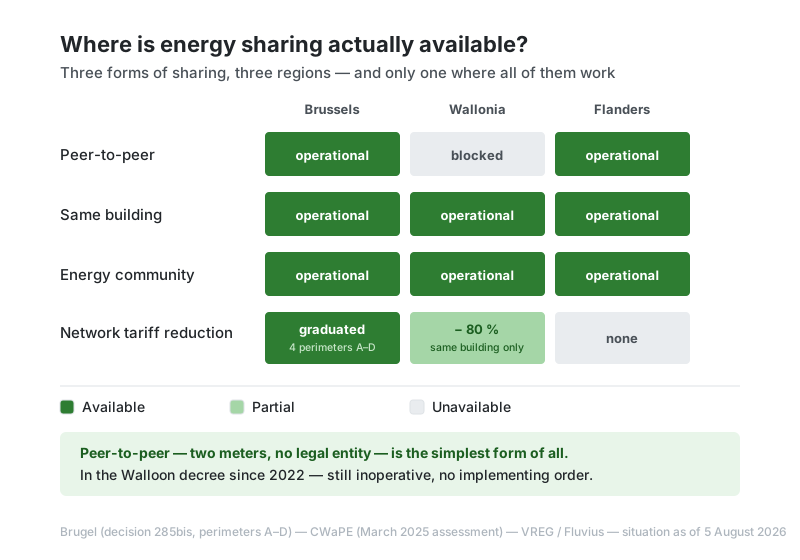
Here is the heart of the matter. The table below summarises the real availability of each form, as of 5 August 2026.
| Brussels | Wallonia | Flanders | |
|---|---|---|---|
| Regulator / DSO | Brugel / Sibelga | CWaPE / ORES, RESA, AIEG | VREG / Fluvius |
| Peer-to-peer | operational | blocked — 2022 decree, implementing order missing | operational |
| Same building | operational | operational | operational |
| Community | operational | operational | operational |
| Network tariff reduction | graduated across 4 perimeters | −80 % of the proportional term, same building only | none |
| Smart meter | mandatory, replacement free | mandatory (communicating or AMR) | mandatory |
| Measured take-up | 38 authorised communities; 1,009 participants / 129 projects (Oct. 2024) | 8 communities (Feb. 2026); 7 sharing operations (Mar. 2025) | 7,779 access points (Dec. 2023), i.e. 0.2 % |
Three readings, and they do not run in the expected direction.
Brussels: the only region where all three forms genuinely work
Brussels is ahead, and the gap is widening. Sharing has been legal there since May 2022, all three forms are operational, and the tariff regime is the country’s most favourable.
The take-up figures come from two distinct counters, which should not be added together. Brugel’s observatory, relayed in October 2024, recorded 1,009 participants across 129 projects and 6.63 MWp shared, against 397 participants the previous year. Sibelga, for its part, announced in June 2025 1,280 participants in 2024 against 454 in 2023, on a base of 93,702 smart meters installed. Perimeters and dates differ; what converges is the slope — the number of participants more than doubled in a year according to both sources.
The list of authorised communities, maintained by Brugel, gives the measure of the movement: from the first authorisation on 16 May 2023 — Illuminons notre quartier — to the most recent on 29 May 2026, there are 38 authorised communities, including Brupower, authorised on 17 April 2024. Authorisations are accelerating: a handful in 2023, around fifteen in 2025.
Two infrastructure elements partly explain this lead. First, replacing your meter with a smart meter is free for sharing participants. Second, since June 2026 the BEST platform — Brussels Energy Sharing Tool, developed by the non-profit Simply Energy with support from Bruxelles Environnement — has automated the administrative management and invoicing of sharing. On top of that comes a free “Energy Sharing and Communities” facilitator, available to any Brussels resident. Another change on 1 January 2026: the notice period for leaving an energy community has been cut to 24 hours, which materially lowers the perceived risk of joining.
Wallonia: legal on paper, almost non-existent in practice
The contrast is stark, and it deserves to be stated plainly because it conditions every decision a Walloon reader might make.
The CWaPE assessment, relayed in March 2025, counted 4 same-building sharing operations and 3 within an energy community. Seven in total, for a region of 3.6 million inhabitants. The regulator does not attempt to soften it: it concludes that “the objectives pursued by the European directives […] are not being met” and lists six obstacles — cumbersome procedures, legal complexity, restrictive status for production installations, limited participation for large companies, unsuitable market processes, unattractive business model.
Above all, peer-to-peer — the simplest form, the one that accounts for 47 projects in Brussels — is legally impossible in Wallonia. It has been provided for by decree since 2022, but remains inoperative for lack of an implementing order setting out the arrangements and the authorisation procedure. Four years. The association BeProsumer, which defends small Walloon photovoltaic producers, was still pointing this out in an action plan sent to the Walloon energy minister and the CWaPE on 23 June 2026. Note that BeProsumer is a stakeholder rather than a neutral observer — but on this factual point, its finding matches the regulator’s.
The framework is nonetheless moving: a Walloon Government order of 5 February 2026 amended the 2023 order on energy communities and sharing, and eight communities were listed in February 2026 against three operations a year earlier.
What a Walloon can do today, concretely: same-building sharing, which requires no legal entity and earns the 80 % reduction of the proportional term — by far the best option — or joining one of the existing communities. Sharing with the neighbour across the street, on the other hand, is not possible. Eligibility conditions and procedures are detailed in “Joining an energy community in Wallonia”; setting up a structure in “Creating an energy community in Wallonia”.
Flanders: open to all, with no network advantage whatsoever
Flanders presents the mirror image of Wallonia: the framework is open — sharing and selling between individuals are possible, peer-to-peer included — but the tariff incentive is nil.
In December 2023, 7,779 access points took part in energy sharing or selling, i.e. 0.2 % of Flemish access points, according to Fluvius data published by the VREG. Two important qualifications on that figure: it aggregates sharing and selling, and it is dated. The VREG publishes a dashboard updated monthly (latest update recorded: 27 July 2026) — if you are preparing a decision, go and take this month’s value rather than relying on this one.
The second Flemish lesson is more useful still, because it tempers expectations everywhere: participants only manage to share about 20 % of the injection among themselves, where initial theoretical estimates assumed 40 %. In other words, half the potential is lost to the timing gap between generation and consumption. That is a strong argument for a well-built allocation key, a subject covered in “Allocation keys in Belgium: the 3 regions”.
Finally, since January 2023 the Flemish distribution tariff has been based on peak power rather than energy drawn: there is therefore no network tariff reduction on shared energy, in any configuration. The gain is strictly limited to the gap between the internal price and your supplier’s price. The VREG also flags that some suppliers charge extra fees to customers taking part in sharing — worth checking before committing, because on small volumes those fees wipe out the benefit.
What it is worth, and on exactly what
The structural ceiling, to be set before any figure
Let us return to the breakdown of the Belgian bill, as the CREG publishes it for a residential profile of 3,500 kWh/year on a single-rate meter (June 2026 dashboard): 38.5 % energy, 29.7 % network, 26.1 % taxes and levies, 5.7 % VAT, on an all-in price of 36.94 c€/kWh.
Sharing acts on the first block. Not on the other three — except in the specific perimeters below. And it acts on that block only for the kilowatt-hours actually shared, that is, the fraction the allocation key assigns to you, quarter-hour by quarter-hour. A participant whose key assigns them 15 % of their annual consumption therefore sees the saving apply to 15 % of 38.5 % of their bill.
This is why you should be wary of any percentage quoted without its denominator. “20 % savings” means nothing until you know whether the percentage applies to the total bill, to the energy component, or to the shared volume alone.
The documented order of magnitude, on the other hand, is stable: for a consumer receiving 500 kWh of shared energy per year, the case costed by Énergie Commune under Interreg Europe puts the saving at around €145 per year at the standard tariff, and around €70 for a household already on the social tariff — the gap being explained by the fact that the social tariff already caps the energy component at a low level. The levers making up that amount are broken down in “Reducing your electricity bill in an energy community”, and the way to set the internal price in “The internal transfer price in an energy community”.
The four Brussels perimeters: the nuance everyone misses
This is the country’s most generous regime, and it is finer than the “100 % / 50 % / nothing” usually reported — including, until this update, on our own pages.
Brugel decision 285bis of 4 November 2024, applicable from 1 January 2025 to 31 December 2029, defines four perimeters according to the electrical proximity of participants:
| A — same building | B — same LV cabin | C — same Elia substation | D — different substations | |
|---|---|---|---|---|
| Proportional term for network use | reduced to €0 | −50 % | unchanged | unchanged |
| Fixed term (LV ≤ 56 kVA) | not charged | not charged | not charged | not charged |
| Power drawn term | €0 | €0 | applicable | applicable |
| Transport re-invoicing | €0 | €0 | €0 | applicable |
Two points deserve emphasis, because they are counter-intuitive.
A tariff advantage survives even without immediate proximity. In perimeter C — participants connected to the same Elia substation, which can span several neighbourhoods — the fixed term is not charged and transport re-invoicing is zero. That is not “no reduction”: it is a more modest reduction, on different terms. Even in perimeter D, the fixed term remains uncharged.
A mixed sharing operation is classified on its least local participant. The order is A < B < C < D: bringing in one distant participant tips the entire operation into their perimeter. That is a major design constraint for anyone setting up a community — two coherent operations are better than one diluted one.
The Walloon same-building case
In Wallonia the logic is the same but the scope far narrower: the 80 % reduction of the proportional term on the ORES 2026 grid applies to sharing within a single building, and to that alone. The CWaPE is explicit: there is no tariff reduction for sharing within an energy community.
Hence a very practical conclusion for a Walloon reader: if you live in a co-ownership with a usable roof, you are in the best configuration in the country after Brussels — no legal entity to create, and 80 % off the proportional term on shared volumes. In Wallonia, it is the only arrangement that combines administrative simplicity with a network advantage.
The general meeting still has to be able to decide. That is where the file changes nature: the ownership structure chosen sets the majority to reach — two thirds or four fifths — and the association of co-owners may not own the panels itself. That path is set out in “Energy sharing in a condominium: the guide”.
What is blocking Wallonia, and what might unblock it
It would be dishonest to present sharing as a universal solution when one Walloon reader in two will close this article with no workable option. Better to name the obstacles.
The six barriers listed by the CWaPE come down, for a private individual, to three realities.
The procedure is disproportionate to the gain. Creating a community means a legal entity, articles of association, a notification, an agreement with the DSO and a validated allocation key — for a saving of the order of €145 per participant per year. The effort/benefit ratio only holds if someone carries the project voluntarily, or if the structure already exists.
Peer-to-peer, which would sidestep exactly that problem, is blocked. This is the most frustrating point in the Walloon file: the form that requires neither articles of association nor governance, the one that accounts for more than a third of Brussels projects, has been waiting for its implementing order since 2022.
The business model remains unattractive as long as the tariff reduction is reserved for same-building sharing. A Walloon district-scale operation bears the full network costs, which squeezes the negotiable internal price between the injection tariff as a floor and the energy component as a ceiling — a narrow band, as our article on the internal transfer price shows.
What is moving: the order of 5 February 2026 amended the 2023 framework, the number of communities more than doubled in a year, and pressure from practitioners is now formalised. None of that unblocks peer-to-peer to date. If that is your configuration, the honest answer is: not yet.
Where to start, region by region
If you live in Brussels. Contact the “Energy Sharing and Communities” facilitator at Bruxelles Environnement — the service is free. Check the map of ongoing projects on Brugel’s site to see whether an operation already exists in your neighbourhood, and confirm with Sibelga that your smart meter is in place: replacement is free for participants. If you are in a co-ownership with a roof, look at perimeter A before anything else: it is the most advantageous regime in the country.
If you live in Wallonia. First check whether your building allows same-building sharing — the only configuration combining no legal entity with the 80 % reduction of the proportional term. Failing that, look for an open sharing operation nearby; OptimCE’s public register and the SPW facilitator both list them. Do not wait for peer-to-peer before acting: no timetable has been announced.
If you live in Flanders. Sharing and selling are open, including between individuals, but with no network advantage: the entire gain comes from the price gap. Two checks before signing — the VREG dashboard for this month’s figures, and above all your supplier’s tariff sheet, since some charge participants extra fees that wipe out the benefit on small volumes.
In all three cases, one question precedes every other: how many kilowatt-hours will the allocation key actually assign to you? The Flemish experience — 20 % of injection effectively shared against 40 % hoped for — shows that this is where the outcome is decided, far more than in negotiating the price.
Once the form is chosen, the most concrete question remains: with whom. Because sharing only counts inside the quarter hour of production, a perimeter is assembled by timetable rather than by affinity — the subject of “Local electricity: the short-circuit guide”.
Key takeaways
- Yes, you can pay less for electricity without switching supplier — but the saving only applies to the energy component of shared kWh, a fraction of 38.5 % of the bill.
- “Energy sharing” is not a synonym for “energy community”. There are three forms, and the two simplest — peer-to-peer and same-building — require no legal entity.
- The most profitable configuration is same-building sharing: proportional term removed in Brussels, cut by 80 % in Wallonia.
- Brussels is the only region where all three forms work: 38 authorised communities, participants more than doubled in a year, free smart meter, the BEST platform and a public facilitator.
- In Wallonia, peer-to-peer has been legally provided for since 2022 but is still inoperative for lack of an implementing order. Seven sharing operations counted by the CWaPE in March 2025.
- In Flanders the framework is open but the network advantage is nil, and some suppliers charge participants extra fees.
- A percentage without its perimeter, region and date is worthless — including in this article, where every figure carries its source and its vintage.
What not to expect from it: energy sharing does not halve a bill and does not replace a supply contract. What it does, and what no change of supplier does, is take part of your consumption out of the market and replace it with a price negotiated between neighbours. On the 61.5 % of the bill that escapes competition, it can do nothing. On the rest, it is the only option that requires no works, no investment and no cancellation.
Join or launch your energy sharing with OptimCE
Open source platform designed for Belgian energy communities: members, meters, allocation keys and sharing operations in one place — right through to generating invoices, credit notes and statements as PDFs from your official allocation data.
FAQ
Can you pay less for electricity without switching supplier?
Yes, through energy sharing. Part of your consumption is supplied by a local producer — a neighbouring roof, a district installation — at a price agreed between participants, while your usual supplier keeps billing the rest. Your contract is not cancelled, your meter does not move and you install nothing at home. The limit worth knowing: the saving only applies to the energy component of the kilowatt-hours actually shared, roughly 38.5 % of the bill according to the CREG dashboard of June 2026. Network costs and taxes remain due, except in specific configurations in Brussels and Wallonia.
Does energy sharing require cancelling your supply contract?
No, and it would in fact be impossible. Sharing never covers your entire consumption: it only works during the quarter-hours when local production exists. Everything not covered — at night, in winter, at peak times — remains residual energy that your supplier bills normally. You must therefore keep a supply contract, and you receive two documents: your usual bill, reduced by the shared volume, plus a statement for the shared energy issued by the sharing representative. The full mechanics are set out in “Who invoices shared electricity in Belgium”.
Can you share electricity with your neighbour in Belgium?
It depends on your region, and that is the main surprise here. In Brussels, yes: peer-to-peer sharing between two supply points is operational and accounted for 47 projects and 94 participants in Brugel’s October 2024 count. In Flanders, sharing and selling between individuals are also possible. In Wallonia, no: peer-to-peer has been provided for by decree since 2022 but remains inoperative for lack of an implementing order, as both the CWaPE and the association BeProsumer were still pointing out in June 2026. A Walloon who wants to share with a neighbour must go through same-building sharing or an energy community.
Is energy sharing possible in Wallonia in 2026?
Yes, but in two configurations only, and take-up remains very low. The CWaPE assessment relayed in March 2025 counted 4 same-building sharing operations and 3 within an energy community, for 8 communities listed in February 2026. The regulator itself concludes that the objectives of the European directives are not being met, and points to six obstacles: cumbersome procedures, legal complexity, restrictive status for production installations, limited participation for large companies, unsuitable market processes and an unattractive business model. The most interesting configuration remains same-building sharing, which benefits from an 80 % reduction of the proportional term on the ORES 2026 grid and requires no legal entity.
Do you need a smart meter to take part in energy sharing?
Yes, without exception, in all three regions. Sharing relies on comparing every participant’s meter readings in fifteen-minute intervals: without quarter-hourly metering, there is no way to know how much energy was injected and consumed at the same moment. In Brussels, replacing your meter with a smart meter is free for energy sharing participants, as confirmed by the non-periodic tariff grid approved by Brugel. In Wallonia, the CWaPE requires a communicating electronic meter or an AMR meter, and participation means giving up the benefit of compensation — a point that concerns prosumers equipped before 2024. That trade-off is quantified in “Solar panels 2026: still worth it in Wallonia?”.
How much can you save with energy sharing?
The documented order of magnitude is around €145 per year for a consumer receiving 500 kWh of shared energy at the standard tariff, and around €70 for a household already on the social tariff, according to the case costed by Énergie Commune under Interreg Europe. These amounts depend entirely on three variables: the volume the allocation key assigns to you, the internal price set in the sharing agreement, and your tariff perimeter. In Brussels, same-building sharing removes the proportional network term on local volumes, which changes the calculation markedly; in Wallonia, the same configuration earns an 80 % reduction of that term. Be wary of any percentage quoted without its perimeter, region and date.
Sources
- Brugel — Network tariffs applicable to energy sharing — source for the four perimeters A, B, C and D and the treatment of each tariff term, from decision 285bis of 4 November 2024 applicable from 1 January 2025 to 31 December 2029; also states the rule classifying a mixed sharing operation on its least local participant, and the free meter replacement for participants.
- Brugel — Authorised communities — named and dated list of energy communities authorised in the Brussels-Capital Region, from “Illuminons notre quartier” on 16 May 2023 to the authorisations of 29 May 2026; 38 communities in total as consulted on 5 August 2026.
- Brugel — New statistical set on energy sharing in Brussels — presentation of the regional observatory: number of projects, participants and shared installed capacity, with a municipality-by-municipality map.
- Renouvelle — Energy sharing in Brussels: more than 1,000 participants! — survey of 16 October 2024: 1,009 participants, 129 projects and 6.63 MWp shared since 2022, against 397 participants the previous year, with the breakdown by form of sharing (same building 72 projects / 533 participants, peer-to-peer 47 / 94, communities 10 / 382).
- La DH — Energy sharing between users has almost tripled in a year in Brussels — Sibelga count of 29 June 2025, distinct from Brugel’s: 1,280 participants in 2024 against 454 in 2023, on 93,702 smart meters installed.
- Renouvelle — Energy sharing and communities in Wallonia: the CWaPE’s opinion — assessment of 18 March 2025: 4 same-building sharing operations and 3 within a community, six obstacles identified, and the regulator’s conclusion that the objectives of the European directives are not being met.
- CWaPE — Energy sharing — Walloon framework: definition of sharing, available forms (same building and community), appointment of a representative, agreement with the network operator and admissible allocation keys.
- CWaPE — Conditions for taking part in energy sharing — conditions applying to Walloon consumers: communicating electronic or AMR meter, waiver of the benefit of compensation, and waiver of the social tariff on the shared electricity portion for residential customers.
- BeProsumer — Action plan on the blockages to sharing in Wallonia — file of 23 June 2026 sent to the Walloon energy minister and the CWaPE, source of the wording “provided for by decree since 2022 but still inoperative for lack of an implementing order”. An association defending small Walloon photovoltaic producers: a stakeholder, not a neutral source.
- Bruxelles Environnement — Energy sharing and communities — Brussels citizen portal: the three sharing configurations and the free “Energy Sharing and Communities” facilitator.
- Bruxelles Environnement — Energy sharing has never been so simple — announcement of 2 June 2026 of the BEST platform (Brussels Energy Sharing Tool), developed by the non-profit Simply Energy with support from Bruxelles Environnement.
- Sibelga — Energy sharing — operational workings on the Brussels network operator’s side: the three forms of sharing, the smart meter requirement for every participant and the analysis of meter readings in fifteen-minute intervals.
- VREG — “Energy shared and sold” dashboard — Fluvius data updated monthly (latest update recorded: 27 July 2026) on the number of groups and participants, shared volumes, and suppliers charging extra fees to participants.
- Futech — How many Flemish people take part in energy sharing? — relay of VREG and Fluvius figures: 7,779 access points taking part in sharing or selling in December 2023, i.e. 0.2 % of Flemish access points, and around 20 % of injection effectively shared against 40 % expected.
- CREG — Monthly dashboard — all-in price of 36.94 c€/kWh and the 38.5 / 29.7 / 26.1 / 5.7 % split for a residential profile of 3,500 kWh/year on a single-rate meter (June 2026 edition used here).
- Énergie Commune / Interreg Europe — Business model of energy sharing — documented case costing the saving of a consumer receiving 500 kWh shared per year at around €145 at the standard tariff, against around €70 for a household already on the social tariff.
- CWaPE — ORES, periodic offtake tariffs 2026 — grid approved on 18 December 2025, source of the 80 % reduction of the proportional term reserved for sharing within a single building.