
Which electricity tariff to choose in Belgium?
A protected household pays 24.927 cents for its kilowatt-hour on a single rate this quarter. Its neighbour, on the same meter, in the same street, pays 36.94 on the Belgian average. And a third, on a dynamic contract, paid nothing at all for a few hours in June — then triple that on a windless weekday evening.
Three prices, one electricity, and three tariff logics with almost nothing in common. The question “which tariff should I choose?” therefore has no general answer: it has an answer per household, and it depends far less on the supplier than on three things nobody ever asks you about — your welfare status, your region, and your real ability to move a washing machine.
This article does not re-explain why the Belgian bill is high: we broke it down in euros in “Why your electricity bill stays high in Belgium”. Nor does it set out how to read the document, decoded line by line in “Read your Belgian electricity bill line by line”, nor the full list of Walloon levers, costed in “Reduce your electricity bill: Wallonia 2026”. It answers the question that comes immediately afterwards: between the social tariff, the night rate and the dynamic contract, which one concerns you — and why there is a fourth route no comparison tool lists.
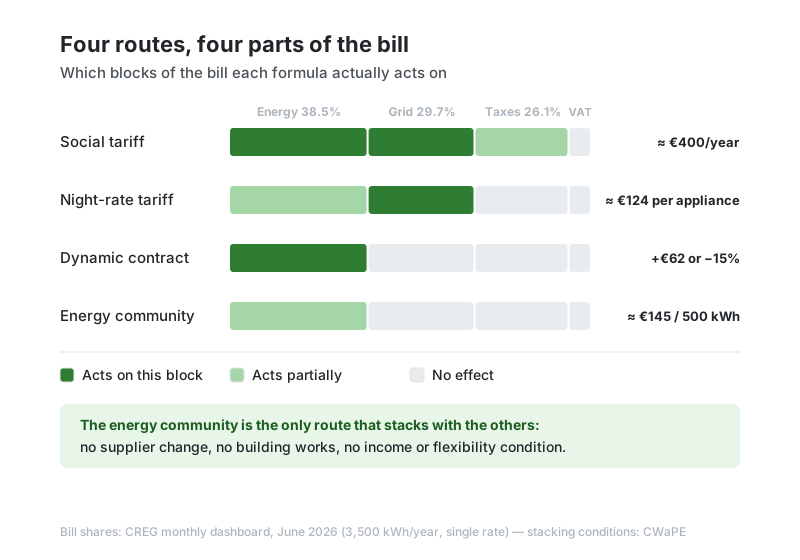
The four routes at a glance
| Route | What it acts on | Access condition | Order of magnitude | Stackable? |
|---|---|---|---|---|
| Social tariff | energy and grid, plus levy exemptions | being a protected customer | ≈ €400/year | partly with route 4 |
| Night rate | the grid tariff, and the supplier’s day/night price | a dual-rate meter — and the right region | ≈ €100 to €125 per large appliance shifted | yes |
| Dynamic contract | the energy component alone | smart meter + SMR3 regime | +€62 to −15 % depending on profile | yes |
| Energy community | the energy component of shared kWh | an accessible sharing operation | ≈ €145/year for 500 kWh shared | yes, with routes 2 and 3 |
Two reading precautions, and they matter as much as the table.
The gains do not add up, and two of these routes are not even choices. The social tariff absorbs much of what comparing offers would yield and halves the benefit of sharing; the night rate and the dynamic contract are both calculated on shifted kWh, often the same ones. Above all, the social tariff is a status — you are entitled to it or you are not — and the night rate depends on a regional grid schedule over which you have no say. Strictly speaking, only two genuinely free decisions remain: the contract formula and taking part in a sharing operation.
The table compares orders of magnitude, not identical perimeters. The amounts come from different sources, on different profiles, and are dated in the sections that follow. Read them as a ranking, not as a sum.
What each formula really touches on your bill
This is the point conventional comparisons pass over in silence, and yet it determines everything else. A Belgian bill breaks down into four blocks. According to the CREG monthly dashboard for June 2026, for a residential profile of 3,500 kWh a year on a single rate, the Belgian average splits as follows: 38.5 % energy, 29.7 % grid costs, 26.1 % taxes and levies, 5.7 % VAT, on an all-in price of 36.94 c€/kWh.
Yet the four routes do not attack the same blocks:
| Route | Energy (38.5 %) | Grid (29.7 %) | Taxes (26.1 %) |
|---|---|---|---|
| Social tariff | capped price | capped price | partial exemptions |
| Night rate | depending on the contract | yes, in Wallonia and Brussels | no |
| Dynamic contract | yes, exclusively | no | no |
| Energy community | yes, on shared kWh | no, except within one building | no |
Three direct consequences, and they save time.
A dynamic contract cannot act on more than 38.5 % of your bill, because it only touches the price of energy. A promise of 20 % savings on the total bill through a dynamic contract is therefore arithmetically implausible; on the energy component alone it becomes plausible again. Always check which percentage you are being quoted.
The night rate acts first on the grid, that is on a block that competition between suppliers never touches. That is what makes it worthwhile even without changing contract — but also what makes it dependent on your grid operator, and therefore on your region.
The social tariff is the only one that acts on the first three blocks at once. That is why it dwarfs every other lever in amount, and why the first question to ask is not “which contract?” but “am I entitled to the social tariff?”.
Route 1 — The social tariff: an entitlement, not a choice
What it is worth exactly
The social tariff is a maximum price set by the CREG every quarter and published in the Belgian Official Gazette. It is identical across every supplier: switching operator changes nothing, and no commercial offer may legally beat it.
For the third quarter of 2026, that is from 1 July to 30 September 2026 (CREG, electricity social tariffs Q3 2026):
| Formula | Energy component (excl. VAT) | Grid component (excl. VAT) | Total incl. 6 % VAT |
|---|---|---|---|
| Single rate | 12.453 c€/kWh | 11.063 c€/kWh | 24.927 c€/kWh |
| Dual rate — day | 14.217 c€/kWh | 11.063 c€/kWh | 26.797 c€/kWh |
| Dual rate — night | 10.944 c€/kWh | 11.063 c€/kWh | 23.328 c€/kWh |
| Exclusive night | 10.944 c€/kWh | 8.108 c€/kWh | 20.195 c€/kWh |
Two readings of this table, one of them counter-intuitive.
The first: set against the average all-in price of 36.94 c€/kWh in June 2026, the gap represents in the order of €400 a year for a household consuming 3,500 kWh. (Order of magnitude: the two prices do not cover exactly the same perimeter of levies — see below.)
The second, subtler: the social tariff also has a dual rate, and its day hour is more expensive than the single rate. 26.797 against 24.927 c€/kWh. A protected household that switches to a dual rate without genuinely consuming at night loses out. The question of shifting hours therefore arises within the social tariff too — it does not disappear with the status.
What these amounts do not include, and it is written in black and white in the CREG document: the energy contribution, the special excise duty, the connection charge in Wallonia and the energy fund contribution in Flanders. In return, protected customers are exempt from the energy contribution and from the Flemish energy fund contribution. This is why the comparison with an all-in price remains an order of magnitude: the two figures are not built the same way.
Who is entitled, and the misconception to correct
The social tariff is for protected customers: recipients of certain forms of public welfare assistance, of certain allowances from the Federal Pension Service, of disability-related allowances, as well as tenants of social housing heated by a collective installation. For most of these categories, the grant is automatic — the FPS Economy matches data from the paying bodies and the suppliers, and the tariff applies without any step being taken.
Here is the misconception to correct, and it is still widely repeated: increased-reimbursement status alone no longer opens entitlement to the social tariff. The temporary extension introduced during the energy crisis came to an end on 1 July 2023; it covered 522,125 households in the first quarter of 2023, more than the 452,910 households falling under the permanent categories (CREG). If you hold that status without falling into one of the permanent categories, you are not on the social tariff, even if you were in 2022.
Alongside the federal scheme there is a regional protected customer status, which does not work the same way: you must obtain a certificate from your public welfare centre or your debt mediator, and pass it to your grid operator. Nothing is automatic.
The useful reflex: if your situation has changed — job loss, separation, an allowance taking effect, moving into social housing — the tariff does not always trigger by itself. A call to your local welfare service or to your supplier costs ten minutes and can be worth several hundred euros. And if the social tariff is not enough, it sits within a wider safety net — MEBAR, the Social Heating Fund, the energy tutor, the Local Energy Commission — detailed in “Energy poverty in Wallonia: available support”.
Route 2 — The night rate: the answer depends on your region
This is where generic articles become misleading, because they treat “the dual rate” as if it were a national scheme. It is not. Since 2023, the three regions have diverged to the point that the same question calls for three different answers.
| Region | Grid off-peak hours in 2026 | What changed |
|---|---|---|
| Wallonia | 11:00 – 17:00 and 22:00 – 07:00, every day | bands redrawn in 2026, plus an optional three-band Impact tariff |
| Brussels | 22:00 – 07:00, plus weekends and public holidays | nothing — historic split maintained across the whole 2025-2029 period |
| Flanders | not applicable on distribution | the distribution tariff has depended on peak power since January 2023 |
In Wallonia: the lever has grown stronger
Off-peak hours now cover 15 hours out of 24, that is 62.5 % of the time, against 55 % under the old split, and the middle of the day — the window when photovoltaics produce most — has moved to the off-peak side. On the ORES 2026 schedule, the proportional distribution term is 4.88 c€/kWh in off-peak hours against 10.43 in peak hours.
To this is added the Impact tariff, optional and reversible, which cuts the day into three bands: ECO at 2.71 c€/kWh from 11:00 to 17:00 and from 01:00 to 07:00, MEDIUM at 8.13, PEAK at 13.54 from 17:00 to 22:00. A ratio of one to five. The detail, the access conditions and the appliance-by-appliance calculation are set out in our Walloon guide — note here that a 1,800 kWh water heater shifted from the single rate into the ECO band represents about €124 including VAT a year on the distribution term alone.
In Brussels: stable, and that is information in itself
The Brussels split has remained the one everyone knows: off-peak from 22:00 to 07:00, plus the whole of weekends and public holidays. Brugel has confirmed that this definition, applicable across the entire 2025-2029 tariff period, has not changed from the previous methodology. Alignment on the Walloon model is mooted for after 2028, but nothing is settled.
The practical consequence is simple: in Brussels, the middle of the day stays in peak hours. Programming your dishwasher for 14:00, a move that has become profitable in Wallonia, brings nothing on the grid side in Brussels. The weekend, on the other hand, is entirely off-peak — an advantage Wallonia has partly lost by making its bands uniform across seven days.
In Flanders: the question has changed in nature
This is the deepest divergence, and the most widely misunderstood. Since January 2023, the Flemish distribution tariff has been based on peak power — the capacity tariff — and no longer on the hour of consumption. The day/night distinction has vanished from this part of the bill.
Two figures for scale: the average peak recorded by the VREG is around 3.15 kW, and a minimum of 2.5 kW is billed even if your actual peak is lower. The annual cost of the capacity term commonly falls between €150 and €250 depending on the municipality and consumption.
A Flemish supplier may still offer a day/night price, but only on the energy component, and fewer and fewer do. The profitable move in Flanders is therefore no longer “consume at night” but “do not run everything at the same time”: spreading the washing machine, the oven and the vehicle charge across the evening rather than stacking them, which shaves the monthly peak used as the basis for the calculation.
The break-even threshold, and why to treat it with caution
The rule of thumb you read everywhere — “you need to consume at least half your electricity at night” — comes from analyses by comparison sites and consumer associations, and it was formulated at a time when the bands and the schedules were different. It no longer holds universally in 2026: it is too severe for Wallonia, where off-peak covers 62.5 % of the time, and beside the point in Flanders on the grid side.
The right method is less elegant but it is exact: take your annual statement, note the real day/night split of your meter readings, then apply both schedules. If you do not have a dual-rate meter, your grid operator charges for the switch — check the amount first, it pays back slowly on small consumptions.
Route 3 — The dynamic contract: the best and the worst
What it is, and what it demands
A dynamic price contract passes hourly — even quarter-hourly — wholesale market prices straight through to your bill. You no longer pay a smoothed average price, you pay the price of the hour in which you consume.
Two technical conditions, both non-negotiable. A smart meter, first. Then, and this is the one people forget, activation by your grid operator of the SMR3 metering regime, which transmits your data to the supplier every fifteen minutes. Without that second setting, the meter is not enough.
Availability is recent in the south of the country: dynamic offers appeared in Wallonia and Brussels during 2025, on a rollout calendar staggered from June to November depending on the supplier, whereas Flanders already had a fuller range. At the end of 2025, these contracts still represented only 0.40 % of the Belgian residential market.
For whom it pays — and for whom it is a trap
The favourable side is real. Over the year 2025 and for a consumption of 3,500 kWh, Test-Achats put the saving from a dynamic contract at about €62 against a variable contract and €193 against a fixed contract (Test-Achats, 9 June 2026). The winning profile is identifiable: a household with an electric vehicle, a heat pump or a water heater that are programmable, able to concentrate its large withdrawals in the middle of the day and at night.
The reverse is documented, and severe.
- The CREG has warned from the outset. Without a change in consumption behaviour, these contracts can raise the energy component by around 15 % for a household with ordinary habits. The regulator supports their development, but sets an explicit condition: active monitoring of your consumption.
- One household in five would lose out. The simulations run before the Walloon and Brussels markets opened showed that 20 % of households would have seen their bill rise by 5 to 17 % (Renouvelle, June 2025).
- And if you have solar panels the statistic is overwhelming: 99 % of photovoltaic households paid more, with a median increase of 20 %. The mechanics are relentless — the dynamic price works both ways, and your surplus goes onto the grid at exactly the hours when everyone is producing and prices collapse, sometimes into negative territory.
- The standing charge is still due. It averaged €70 a year on these contracts in May 2026, with cases at €130. Against an annual saving of €62, that is the kind of line that overturns a calculation.
A point of honesty, in the register that is ours on this blog: the Test-Achats savings figures cover the completed year 2025, that is a market price configuration that will not repeat identically. They describe what happened, not what will happen to you. The warnings from the CREG and from Renouvelle, by contrast, bear on structural mechanisms — they will age more slowly.
The dynamic contract is therefore not a bet on future prices. It is a transfer of risk onto you, paid for with a discount. If you have neither a controllable load, nor a smart meter activated in SMR3, nor the appetite to watch a price curve, the answer is no, and it is simple.
Route 4 — The energy community: the one no comparison tool lists
The first three routes have one thing in common: they are all played out between you and your supplier. The fourth changes axis. Energy sharing consists of passing part of a producer’s local output — a roof, a wind turbine, a neighbourhood installation — to other supply points, at a price agreed between participants. What this means in practice, and it has no equivalent in the other three routes: you do not change supplier, you install nothing at home, and your current contract keeps running. You receive your usual bill, plus a statement for the shared energy. The full mechanism and the division of roles are set out in “Invoicing shared electricity in Belgium”, and the three Belgian legal forms in “Energy communities in Belgium”.
What it is worth, and what it does not do
Let us start with what sharing does not do: it reduces neither grid costs nor taxes, which remain due on shared electricity since it travels through the public grid. It acts on the energy component, and on that alone — 38.5 % of the bill, no more.
One notable exception in Wallonia: the ORES 2026 tariff schedule applies an 80 % reduction on the proportional term to energy shared within a single building. A co-ownership with a solar roof is therefore in a particularly favourable position, and that configuration requires no legal entity at all.
In euros: for a consumer receiving 500 kWh of shared energy a year, the documented saving comes to around €145 a year on the standard tariff. An order of magnitude comparable to switching to the Impact tariff, obtained without works or equipment.
Stacking with the other three routes — the part to read carefully
This is where the “fourth route” thesis holds up, but not uniformly.
With the night rate and the dynamic contract: stacking without friction. Those two formulas bear on your relationship with the supplier and the grid operator; sharing bears on kWh that reach you from elsewhere. A household can perfectly well be on a Walloon dual rate, take part in a sharing operation, and pay for its residual kWh on the tariff of its choice.
With the social tariff: partial stacking, and the nuance is decisive. Among the conditions for taking part in a sharing operation, the CWaPE lists the obligation, for residential customers, to give up the social tariff on the shared electricity portion (CWaPE). You keep the social tariff on your residual electricity, but the shared kWh are billed to you at the agreement price.
Let us do the arithmetic, because it is simple and it settles the matter. The energy component of the social tariff is 12.453 c€/kWh excluding VAT on a single rate this quarter — 10.944 in night hours. For a protected household to gain anything from sharing, the agreed internal price must fall below that ceiling. It is low: the market energy component runs at around 14.2 c€/kWh. This is exactly why the documented gain from sharing drops from about €145 to about €70 a year for a household already on the social tariff.
The practical conclusion is not “sharing is worthless on the social tariff” — it is still worth in the order of €70 a year. It is more precise than that: on the social tariff, sharing is only decided after seeing the internal price. The five methods for calculating that price, and the range within which it is negotiated, are set out in “Internal transfer price in an energy community”.
Two further conditions to check before committing, applicable to everyone: you must have an electronic meter — smart or AMR — and give up the benefit of compensation, which concerns prosumers equipped before 2024. And check whether your supplier charges fees linked to your participation: on small shared volumes, they wipe out the gain.
The right order of questions
Four questions, in this order. Each one only arises once the previous one has an answer.
1. Am I entitled to the social tariff? It is the only lever that acts on three blocks of the bill at once. If the answer is yes, questions 2 and 3 change in nature: your price is capped, comparing offers becomes pointless, and only the dual-rate question remains — bearing in mind that the day rate of the social tariff is more expensive than its single rate.
2. Is my current contract still competitive? Before choosing an exotic formula, check the one you have. It is the best effort-to-gain move on this whole list, and it takes six clicks.
3. Do my region and my hours justify a time-based formula? In Wallonia, if you can shift a water heater, a washing machine or a charge, yes. In Brussels, only if you genuinely consume after 22:00 or at the weekend. In Flanders the question becomes: can I avoid running everything at once?
4. Do I have real flexibility and a smart meter activated in SMR3? If either answer is no, the dynamic contract does not warrant a simulation. And if you have solar panels, have your injection curve simulated before anything else.
Taking part in an energy sharing operation, by contrast, depends on none of these four answers — except for calibrating the internal price if you are on the social tariff. That is what makes it a distinct route and not a fifth contract: it replaces nothing, it is added.
Where to compare: four public tools, zero commission
| Tool | Authority | What makes it distinctive |
|---|---|---|
| CREG Scan | CREG (federal) | compares the contract you actually signed, including a dormant product |
| CompaCWaPE | CWaPE (Wallonia) | offers available in the Walloon Region |
| BruSim | Brugel (Brussels) | offers available in the Brussels Region |
| V-test | VREG (Flanders) | offers available in the Flemish Region, dynamic contracts included |
The CREG Scan deserves a separate mention, because it answers a question the others do not ask. Conventional comparison tools list currently marketed offers. Yet many households are on a dormant product: a contract signed years ago, no longer offered to new customers, and which therefore appears in no comparison. The CREG Scan displays it and places it, in six questions.
On commercial comparison sites — there are many, often well made — a reminder that is not an accusation but a description of their model: they earn commissions from suppliers, and therefore only list those they have an agreement with. A supplier absent from the list is not necessarily more expensive: it may simply not pay a commission. Use them for a first pass, never to decide.
Three traps to avoid
Confusing two time schedules. In Wallonia, the dual-rate bands and the Impact tariff bands are different: the 22:00–01:00 window is an off-peak hour on the dual rate, but a MEDIUM band on Impact. Programming an appliance on the wrong schedule cancels out the benefit.
Paying the standing charge twice. When you change supplier mid-year, the outgoing one may bill its charge over a longer period than the one actually elapsed, and the new one bills it in turn. Check the pro rata on your closing invoice — the mechanics and the remedy are set out in our bill-reading guide.
Accepting a percentage without its denominator. “Up to 20 % savings” means nothing until you know whether the percentage bears on the total bill, on the energy component, or on the distribution term alone — and on which consumption profile, in which region, at which date. It is the quickest test of how serious a source is, including this one: every figure in this article is dated and tied to its perimeter.
Key takeaways
- Start with the status, not the contract. The social tariff is worth in the order of €400 a year and dwarfs every other lever. It is automatic for most of those entitled — but increased-reimbursement status alone has not conferred entitlement since 1 July 2023.
- Check your current contract before looking for another, with the CREG Scan, which sees the dormant products comparison tools ignore.
- The night-rate question has no Belgian answer, only regional ones. Wallonia: lever strengthened in 2026. Brussels: unchanged, 22:00–07:00 and weekends. Flanders: replaced by the capacity tariff, where the peak counts, not the hour.
- The dynamic contract only touches 38.5 % of your bill and requires a smart meter in SMR3 plus genuine flexibility. One household in five would lose out; with solar panels, 99 % lost out in the simulations.
- A percentage without its denominator, its region and its date is worth nothing.
- The energy community is the only route that is added to the others: no supplier change, no building works, no income or flexibility condition.
- Except on the social tariff, where stacking is partial: you must give up the social tariff on the shared kWh, which is only worthwhile if the internal price falls below 12.453 c€/kWh excluding VAT.
What not to expect from this exercise: an average household, with no entitlement to the social tariff, no flexibility and no sharing operation nearby, will not halve its bill by changing formula. The first three routes redistribute a few tens to a few hundred euros inside a cost structure of which 61.5 % lies entirely beyond competition. That is precisely what makes the fourth route interesting: it is the only one that does not consist of negotiating a bill better, but of taking part of it out of the equation.
If this reading leads you to want to act on the “energy” line rather than endure it, “Join an energy community in Wallonia” sets out the eligibility conditions, where to find an open operation and the timescale to expect. And if none exists near you, “Reduce your electricity bill: energy communities” costs out what creating one would bring. That still assumes sharing is available in your region: “Cheaper electricity without switching supplier” runs the three-region test, take-up figures in hand.
Join or launch your energy sharing with OptimCE
Open source platform built for Belgian energy communities: members, meters, allocation keys and sharing operations in one place — right through to generating invoices, credit notes and statements as PDFs from your official allocation data.
FAQ
Which electricity tariff is the most advantageous in Belgium in 2026?
There is no single answer, because the formulas do not act on the same lines of the bill. The social tariff is by far the most advantageous for those entitled to it: 24.927 c€/kWh including VAT on a single rate in the third quarter of 2026, against an average all-in price of 36.94 c€/kWh recorded by the CREG in June 2026 — but it is a status, not a choice. For everyone else the order is this: check your entitlement to the social tariff, compare your current contract against the market, choose the grid tariff formula that matches your hours, and only consider a dynamic contract if you have genuine flexibility. Energy sharing is added on top, without changing supplier.
Who is entitled to the social tariff and how do you obtain it?
The social tariff is for protected customers: recipients of certain forms of public welfare assistance, of certain allowances from the Federal Pension Service, of disability-related allowances, as well as tenants of social housing with collective heating. For most of these categories the grant is automatic, through data matching between the FPS Economy, the paying bodies and the suppliers: there is nothing to apply for. Beware of one persistent misconception: increased-reimbursement status alone no longer opens entitlement to the social tariff, since 1 July 2023, when the temporary extension introduced during the crisis came to an end. Regional protected customers, for their part, must obtain a certificate from their public welfare centre and pass it to their grid operator.
Is the night rate still worthwhile in 2026?
It depends entirely on your region, and that is the point generic articles miss. In Wallonia, yes: the time bands were redrawn in 2026 and off-peak hours now cover 15 hours out of 24, weekends included, from 11:00 to 17:00 and from 22:00 to 07:00. In Brussels the historic split remains in force — off-peak from 22:00 to 07:00, plus weekends and public holidays — and Brugel does not plan to change it before the end of the 2025-2029 tariff period. In Flanders the question no longer arises in the same terms: since January 2023 the distribution tariff has been based on peak power rather than on the hour of consumption. A Flemish supplier may still offer a day/night price, but only on the energy component.
Is a dynamic contract worthwhile if I have solar panels?
The available simulations call for real caution. In the analysis relayed by Renouvelle ahead of the launch of dynamic offers in Wallonia and Brussels, 99 % of households equipped with photovoltaic panels paid more under dynamic pricing, with a median increase of 20 %. The reason is mechanical: the dynamic price applies in both directions, and your surplus is injected precisely at the hours when solar is producing everywhere and market prices collapse, sometimes into negative territory. A dynamic contract rewards the ability to shift a withdrawal, not the ability to produce. If you have panels, have your actual curve simulated before switching.
Can you combine the social tariff with energy sharing?
Partly, and this is an explicit condition of the Walloon scheme. Among the conditions for taking part in a sharing operation, the CWaPE lists the obligation, for residential customers, to give up the social tariff on the shared electricity portion. You therefore keep the social tariff on your residual electricity — the electricity you continue to buy from your supplier — but the shared kWh are billed to you at the price set in the sharing agreement. In practice the operation is only worthwhile for a household on the social tariff if the agreed internal price falls below the energy component of the social tariff, that is 12.453 c€/kWh excluding VAT on a single rate in the third quarter of 2026. That is a low ceiling, and it must be checked before signing.
Where can you compare electricity offers in Belgium for free?
Four public tools, all free and commission-free. The CREG Scan, from the federal regulator, is the only one that compares the contract you actually signed — including a dormant product, that is an old contract no longer marketed and which therefore appears in no comparison tool. For the offers available today, each region has its own: the CompaCWaPE in Wallonia, BruSim in Brussels, the V-test in Flanders. Commercial comparison sites, by contrast, earn commissions from suppliers and only list those they have an agreement with: they are useful for a first pass, never sufficient for a decision.
Sources
- CREG — Electricity social tariffs, Q3 2026 — primary source for the four social tariffs used here (single rate, dual rate day and night, exclusive night), with the energy/grid breakdown, the mention of 6 % VAT and the explicit list of what these tariffs do not include: energy contribution, special excise duty, connection charge in Wallonia, energy fund contribution in Flanders.
- CREG — Social tariff for energy — principle of a maximum price recalculated every quarter, identical across every supplier, and made up of three elements (energy, distribution, transmission).
- CREG — Ninth monitoring report on the extension of social tariffs to increased-reimbursement beneficiaries — report (RA)2556 of 15 May 2023, source of the figures on the extension: on FPS Economy data, 522,125 households were on the social tariff by virtue of increased-reimbursement status in the first quarter of 2023, against 452,910 households falling under the permanent categories, for a total cost estimated at 1,663 million euros from February 2021 to June 2023.
- CREG — Monthly dashboard — all-in price of 36.94 c€/kWh and the 38.5 / 29.7 / 26.1 / 5.7 % split for a residential profile of 3,500 kWh/year on a single rate (June 2026 edition used here).
- CREG — What is the CREG Scan? — free federal tool comparing the contract actually signed, including the dormant products that “do not appear in the results of energy comparison tools either”.
- CREG — Dynamic price contracts — the regulator’s position: access restricted to holders of a digital meter, the consumer profile targeted, and the quantified risk of a roughly 15 % increase in the energy component in the absence of behavioural change.
- FPS Economy — Social tariff for energy — official portal for the categories of entitled persons and the automatic granting procedure through data matching.
- CWaPE — What are the conditions for taking part in energy sharing? — list of conditions applicable to Walloon consumers: electronic smart or AMR meter, waiver of the benefit of compensation, and “for residential customers, give up the social tariff on the shared electricity portion”.
- CWaPE — The social tariff — distinction between federal protected customers, for whom the grant is generally automatic, and regional protected customers, who must produce a certificate to their grid operator.
- CWaPE — ORES, periodic withdrawal tariffs 2026 — schedule approved on 18 December 2025: proportional terms of the dual rate and of the three Impact tariff bands, and the 80 % reduction on the proportional term for energy shared within a single building.
- ORES — The dual rate changes its hours — new Walloon bands applicable seven days a week since 2026: off-peak from 11:00 to 17:00 and from 22:00 to 07:00.
- Brugel — Distribution tariffs 2025-2029 — Brussels tariff methodology: definition of peak and off-peak hours unchanged from the 2020-2024 period, off-peak from 22:00 to 07:00 as well as weekends and public holidays.
- VREG — Capacity tariff — Flemish distribution tariff based on peak power since January 2023, average peak of around 3.15 kW and a billed minimum of 2.5 kW.
- Renouvelle — Electricity: dynamic price contracts in Wallonia and Brussels — rollout calendar from June to November 2025, requirement of a smart meter and activation of the SMR3 regime, and simulation results: 20 % of households up by 5 to 17 %, 99 % of photovoltaic households losing out with a median increase of 20 % (June 2025).
- Test-Achats — Dynamic energy contracts — market share of 0.40 % at end-2025, saving observed over 2025 of about €62 against variable and €193 against fixed for 3,500 kWh, and average standing charge of €70/year recorded in May 2026, up to €130 (9 June 2026).
- Énergie Commune / Interreg Europe — Business model for energy sharing — documented case putting the saving for a consumer receiving 500 kWh shared a year at around €145 on the standard tariff, against about €70 for a household already on the social tariff.
- CWaPE — CompaCWaPE, Brugel — BruSim and VREG — V-test — the three official comparison tools of the regional regulators, free and free of supplier commission.