
Energy poverty in Wallonia: available support
In Belgium, roughly one household in five is in energy poverty. In Wallonia it is closer to one in three: 29.2% of households, according to the 2024 Energy Poverty Barometer published by the King Baudouin Foundation on SILC-BE data from 2022. That is the highest rate in the country — ahead of Brussels (28.2%) and far ahead of Flanders (16.4%).
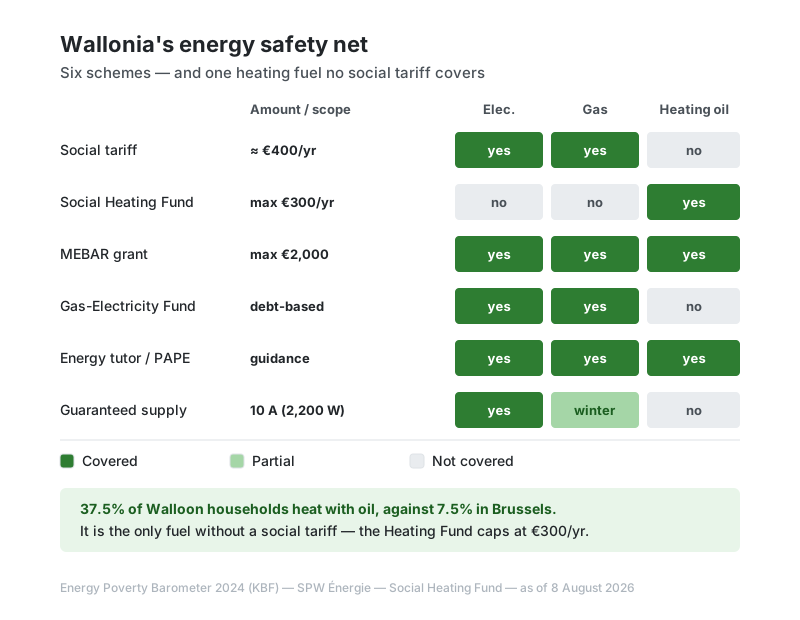
Support exists. There is a lot of it: social tariff, MEBAR, Social Heating Fund, Gas-Electricity Fund, energy tutor, guaranteed minimum supply. But it is split between the federal state, the Region and the municipality, no two schemes share a counter, and none of them activates by itself — with one exception.
Above all, there is a mismatch few guides state out loud: the fuel that heats 37.5% of Walloon households is precisely the one no social tariff covers. The most exposed Walloon household is also the one the flagship measure protects least.
This article does not re-explain the structure of the bill — that is covered in “Why your electricity bill stays high in Belgium” — nor the full list of savings actions, costed in “Reduce your electricity bill: Wallonia 2026”. Nor does it repeat how the social tariff works, treated in “Which electricity tariff to choose in Belgium?”. It answers a different, more social question: when the bill becomes unpayable, what exists, who opens it, and what is done collectively?
What “energy poverty” means, and how it is counted
The reference definition is the one used by the Barometer: “a situation in which a person or household faces particular difficulty in their home in meeting their basic energy needs”. Its causes are multiple — low income, energy prices, building quality, usage patterns.
Since the Royal Decree of 19 April 2024, Belgium has three official indicators, computed on Statbel’s SILC survey. They do not measure the same thing, and that matters.
Measured energy poverty covers households whose share of disposable income spent on energy bills exceeds twice the median ratio across all households. It is the indicator of financial burden.
Hidden energy poverty covers the opposite case: households whose energy spending falls below half that of comparable households. They are not overspending, they are restricting themselves — heating a single room, or cutting hot water. This is the poverty that never shows up on a bill.
Perceived energy poverty rests on the household’s own declaration: does it report financial difficulty keeping its home adequately warm in winter?
In 2025 the FPS Economy put these three indicators at 14.6%, 3.3% and 3.9% respectively, for a total risk of 19.9% — roughly one Belgian household in five (page updated 1 July 2026).
A word of caution applies here, and to everything that follows. The FPS Economy’s 19.9% and the Barometer’s 21.8% for Belgium do not contradict each other: they are two exercises with different vintages and perimeters. The 2024 Barometer works on SILC-BE data from 2022 — the year prices peaked — on a sample of 6,727 households, 2,395 of them Walloon. The FPS indicators cover 2025. Never add them together and never compare them term by term. In this article, every regional breakdown comes from the Barometer, for want of a regional equivalent in the federal indicators.
Why Wallonia is the worst-affected region
The gap with Flanders — 29.2% against 16.4% — is too wide to rest on a single cause. At least three compound, and the first is the least discussed.
Heating fuel
This is the most discriminating variable. On SILC-BE 2022 data, 42.4% of Walloon households heat mainly with natural gas and 37.5% with heating oil. In Brussels the split is 86.0% gas and 7.5% oil; in Flanders, 71.2% and 14.7%. The reason is structural: the gas distribution network is markedly less developed in Wallonia, a larger and less dense territory.
And heating fuel strongly predicts energy poverty: 19.1% of households heating with gas are in energy poverty, against 27.8% of those heating with oil and 26.9% of those heating with electricity.
Housing quality
31.5% of households living in a dwelling with a quality defect are in energy poverty, against 19.5% of others. And the Barometer notes that households at risk of poverty more often occupy that kind of dwelling — disadvantage compounds.
Tenure
This is the sharpest figure in the file, and the one that should steer any local policy: 45.5% of social tenants and 33.0% of private-sector tenants are in energy poverty, against 15% of owners. A tenant decides neither the insulation nor the heating system: they inherit a building they have no control over and no incentive to finance.
Two further findings complete the picture, and they break the received idea that energy poverty only touches benefit recipients. 40.3% of households with no earned income are in energy poverty — but so are 15.8% of households with a single earned income, and 43.0% of “lower” middle-class households. Having a job is not protection.
That does not leave a tenant without leverage. What they can undertake without owning their home — and what waiving the social tariff on the shared portion costs a protected customer — is costed in “Renting: the no-roof guide to solar”.
The blind spot: heating oil
Here is the heart of the Walloon problem, and it is rarely put this bluntly.
The social tariff is the most powerful scheme in the country: it aligns the price per kWh with the cheapest commercial rate on the market, it is recalculated every quarter by CREG, and it is worth in the order of €400 a year on electricity alone. In July 2026 it stood at 24.927 c€/kWh for electricity and 5.458 c€/kWh for gas.
But it covers natural gas and electricity only. The Barometer says so in black and white: “there is a social tariff for gas and electricity but not for other fuels”.
Put the two facts side by side:
| Wallonia | Brussels | Flanders | |
|---|---|---|---|
| Households heating with gas | 42.4% | 86.0% | 71.2% |
| Households heating with oil | 37.5% | 7.5% | 14.7% |
| Energy poverty rate | 29.2% | 28.2% | 16.4% |
More than one Walloon household in three heats with the fuel most correlated with energy poverty, and it is the only one the flagship measure does not cover. The contrast with Brussels is striking: a region where 86% of households run on gas is mechanically far better covered by the social tariff, at a comparable poverty rate.
The only equivalent for heating oil is the Social Heating Fund, and comparing the amounts settles the matter. In 2026 the allowance runs between €0.14 and €0.20 per litre, within a limit of 1,500 litres per heating period per family, for a maximum of €300 per year. For small quantities bought at the pump the intervention is a flat rate: €210 per calendar year, a single receipt being enough to claim it. The Fund also covers bulk propane and type-c kerosene.
€300 capped once a year against roughly €400 a year on electricity alone, on top of gas. The gap is not a scale detail: it is the structural reason why the same level of poverty produces more energy poverty in Wallonia than in Brussels.
One point of honesty nonetheless: oil prices do not track gas prices, and tank storage allows buying at the right moment — two identical households can face very different bills. The Barometer notes that the average heating oil price paid by households at the end of 2022 was about 45% higher than in 2020, whereas gas had risen almost fourfold since December 2020. Heating oil is less well protected, but it did not suffer the same shock either.
Individual support, and who opens it
The practical difficulty is not that support is missing: it is that it spans three levels of government and two counters. Here is the map.
| Scheme | Amount / scope | Who opens it | Main condition |
|---|---|---|---|
| Social tariff | ≈ €400/yr (electricity) | Automatic, or CPAS certificate | Qualifying benefit category |
| Social Heating Fund | max €300/yr, or €210 flat | CPAS | Heating oil, bulk propane or kerosene |
| MEBAR grant | max €2,000, doubleable | CPAS, forwarded to SPW | Income ≤ integration income + 30% |
| Gas-Electricity Fund | Depends on the debt | CPAS | Payment difficulties |
| Energy tutor / PAPE | Free guidance | CPAS | None, depends on the local plan |
| Guaranteed minimum supply | 10 A (2,200 W) | CPAS, then the CLE | Protected customer, budget meter |
The social tariff and protected customer status
The federal social tariff is the only scheme that activates automatically for most entitled households: the FPS Economy cross-checks data with social security bodies and applies it with no formality. It is the exception that proves the rule — everything else requires a file.
Alongside it sits Walloon regional protected customer status, which extends the social tariff to further categories. It implies two things that are often overlooked: you must be supplied by your distribution system operator, not by a commercial supplier, and you must file a certificate with that operator every year. The status is not acquired once and for all.
The detail of categories, quarterly amounts and the interplay between federal and regional status is set out in “Which electricity tariff to choose in Belgium?”.
The MEBAR grant
This is the most substantial piece of Walloon support, and the least known among the households it targets. Since 13 June 2022 the maximum is €2,000, doubleable under certain conditions tied to the type of works.
It funds concrete work: replacing window frames or external doors, insulation, installing a stove, lining a chimney, fitting a boiler or a water heater. Income ceilings correspond to the social integration income raised by 30%, that is €2,308.89/month for a household, €1,708.46 for a single person and €1,138.97 for a cohabitant.
Two procedural points decide whether a file succeeds. First, you never apply directly: the CPAS gathers the documents, checks admissibility and forwards the file to the Public Service of Wallonia. Second, a minimum of five years separates two applications, which must cover different investments — so it is worth not spending it on the first item that comes along.
MEBAR is the natural complement to the standard Habitation grants, which require fronting the money and passing an audit: the corresponding levers are detailed in the Walloon ten-lever guide.
The Gas-Electricity Fund
It steps in downstream, once debt has built up. Managed by the CPAS, it clears unpaid bills, negotiates repayment plans and funds small energy-saving works. It also finances social energy guidance — supporting the household over time, not just settling a one-off bill.
The energy tutor and the PAPE
Since a Walloon Government decision of 28 August 2008, CPAS can be subsidised to employ an energy tutor: an adviser who visits, reads the bills with the household, spots costly usage and activates the support it is entitled to without knowing.
Funding largely runs through the preventive energy action plans (PAPE), open to Walloon CPAS since 2004. The budget allocated to a CPAS whose plan is accepted is €250 per social integration income beneficiary, capped at €50,000 per CPAS. The current application cycle covers 2027-2028, with proposals due to the Energy Department by 31 May 2026.
That is the point to retain for anyone working in a CPAS: the PAPE is the budget vehicle for almost all local collective action on energy.
The Local Energy Commission and guaranteed minimum supply
The last safety net, the one that trips before disconnection. Every Walloon municipality has a Local Energy Commission, convened at the request of the network operator or the customer. It brings together representatives of the social welfare council, the network operator, the CPAS social energy guidance service, and the customer or their representative.
It rules notably on lifting guaranteed minimum supply, debt relief, heating oil vouchers during winter, supply suspension and meter reopening. Decisions are taken by majority, and an appeal remains open before the justice of the peace.
One practical point often decides the outcome: attending the hearing is strongly advised, because your presence markedly improves the chances of a favourable decision. Turning up counts for more than the quality of the written file.
Upstream, a protected customer with a budget meter can ask their CPAS to activate guaranteed minimum supply: a power limiter of 10 amperes, or 2,200 watts, which keeps the home supplied even without topping up. For gas, the network operator can issue supply cards to get through the winter period.
These schemes are under-used relative to need. The Barometer noted that in 2022 — a crisis year, when access to support had been widened — 12.0% of Belgian households had received social support for energy or drinking water, against 7.7% in 2021. Compare that with the 21.8% of households in energy poverty that same year.
The collective solutions that already work
The word “collective” spontaneously evokes energy communities. In Wallonia, in 2026, that would be a misreading: the collective schemes that actually reach low-income households are social and educational, not energy-related. They have been running for fifteen years, without a single solar panel.
The Eco Watchers groups
Since 2007, the non-profit Empreintes — a youth organisation based in Namur, which also runs the Namur CRIE — has been facilitating groups of adults in energy and water poverty, under the Eco Watchers project, co-created with the Namur CPAS.
The principle is not top-down advice but building agency: the groups, set up locally with municipalities, CPAS or neighbourhood services, act as a place of exchange and support between users of social services. Empreintes has since worked to spread its methodologies to other professionals, so a municipality or a CPAS can pick up the format without starting from scratch.
OSER and the Réno WaTT’chers
The non-profit Objectif 2050, based in Mons, runs the OSER project, an energy renovation support pathway designed for fragile households. Its stated premise is that energy renovation can reach the most fragile households provided it is carried out by the right people with the right tools.
The Réno WaTT’chers strand is its field arm: energy guidance and workshops run in partnership with municipalities, associations and CPAS, to cut consumption and bills durably.
Local energy renovation platforms
The PLRE act as a local information and support counter for renovation work, with particular attention to low-income households. They complement the Guichets Énergie Wallonie — 16 offices, some forty advisers, free and neutral, reachable on the freephone number 1718 — whose role is described in the tenth lever of the Walloon guide.
Can energy sharing serve low-income households?
This is the question closest to our own field, and it deserves an honest answer rather than a pitch.
What the SOCCER pilot showed
The SOCCER project — for socio-economics of renewable energy communities — was run by the University of Mons with Walloon Region funding, across three deliberately different sites: Verviers (24 citizens involved), Ans (the tenants of a social housing estate) and Chapelle-lez-Herlaimont (at the scale of the municipality’s 14,900 inhabitants).
The Ans site is the most instructive for our purposes. The setup pairs a photovoltaic installation of roughly 1 MWp on a municipal depot with some 350 nearby social housing units, adding public buildings and small local businesses to smooth consumption profiles.
The main lesson is not technical, it is social. The Société de Logements du Plateau carried out explicit fieldwork — door-to-door visits, leaflets, collective information sessions, then individual meetings to address anxieties. As Ahmed Rassili summed it up in Renouvelle in December 2021: “We did door-to-door visits and distributed information folders.” The project also meant teaching tenants to shift consumption towards the middle of the day, when solar output peaks — the opposite of the habit formed under night rates.
The equity caveat, rarely stated
Two limits must be set out, and they are serious.
Deployment remains marginal. Eight energy communities were listed in Wallonia in February 2026, and the CWaPE evaluation reported in March 2025 recorded only seven sharing operations across the whole territory. We documented that blockage, obstacles included, in “Cheaper electricity without switching supplier”.
And above all: energy sharing pays least to those who need it most. CWaPE requires residential customers to waive the social tariff on the share of electricity shared with them. The regulatory logic is understandable — you do not stack two preferential prices on the same kilowatt-hour — but the effect is regressive. For 500 kWh shared over a year, the case costed by Énergie Commune for Interreg Europe puts the gain at around €145 for a household on the standard tariff, but only €70 for one already on the social tariff.
In other words, a low-income household gains roughly half as much as its better-off neighbour from the same operation. That is a design constraint, not a fatality: it is steered through the allocation key and the internal transfer price, whose defensible range is analysed in “Internal transfer price in an energy community”. A community that wants to include low-income households must build this into the agreement, not discover it at the first statement.
For those who want to go ahead anyway, Walloon access conditions are detailed in “Join an energy community in Wallonia”, and the real savings levers in “Reduce your electricity bill: energy communities”.
What a CPAS or a municipality can set in motion
This section addresses professionals rather than households. Five levers, from quickest to most structural.
Apply for a PAPE. It is the base funding for any collective action: €250 per social integration income beneficiary, capped at €50,000 per CPAS. The cycle is biennial, which means planning a year ahead.
Hire or retain an energy tutor. The scheme has been subsidised since 2008. It is the function that turns a theoretical right into effective support — the gap between 21.8% of households in energy poverty and 12.0% receiving help plays out largely here.
Systematise MEBAR processing. The grant is substantial (up to €2,000, doubleable) and its only entry point is the CPAS. A household unaware of it will never claim it, since it cannot claim it alone.
Reuse an existing collective format rather than inventing one. Empreintes explicitly spreads the Eco Watchers methodology, and Objectif 2050 supports local authorities on Réno WaTT’chers. The tools are written, tested and transferable.
Put energy sharing at the end of the sequence, not the start. The setup requires smart meters, an agreement and an allocation key, and it pays less to households on the social tariff. It makes sense where a public roof or a social housing stock exists — the Ans case — but it is not the entry point of an energy poverty policy. The setup seen from the municipality’s side, including the arithmetic of what the social tariff loses on shared kilowatt-hours, is detailed in “Energy communities: a guide for municipalities”.
Key takeaways
- Wallonia is the worst-affected Belgian region: 29.2% of households in energy poverty against 16.4% in Flanders, on the SILC-BE 2022 data of the 2024 Barometer.
- Energy poverty is measured three ways since the Royal Decree of 19 April 2024 — measured, hidden, perceived — and the hidden form, that of households restricting themselves, appears on no bill.
- Heating oil is the blind spot of the system. It heats 37.5% of Walloon households, it carries an energy poverty rate of 27.8%, and it is the only fuel the social tariff does not cover.
- The Social Heating Fund caps at €300 a year in 2026, against roughly €400 a year for the electricity social tariff alone. The gap is structural, not cyclical.
- The CPAS is the counter for nearly everything: MEBAR, Social Heating Fund, Gas-Electricity Fund, protected customer certificate, guaranteed minimum supply. Only the federal social tariff applies automatically.
- The collective solutions that work today are social, not energy-related: Eco Watchers since 2007, Réno WaTT’chers, the PLRE. They wait for no new regulatory framework.
- Energy sharing pays roughly half as much to a household on the social tariff — €70 against €145 for 500 kWh shared — because it requires waiving it on the shared portion. Build this into the agreement if inclusion is a goal.
One closing caveat. None of these schemes addresses the dominant cause: poor-quality building stock, occupied by tenants who have neither the control nor the incentive to renovate it. Support cushions, renovation alone resolves — which is precisely why a grant like MEBAR, which funds works rather than bills, deserves to be claimed before all the others.
Design energy sharing that genuinely includes
Open-source platform built for Belgian energy communities: members, meters, allocation keys and sharing operations in one place — simulate the effect of a key on each participant before validating it, and generate invoices, credit notes and statements as PDFs from your official allocation data.
FAQ
What is energy poverty and how is it measured in Belgium?
It describes a household that faces particular difficulty meeting its basic energy needs at home. Since the Royal Decree of 19 April 2024, Belgium uses three official indicators, computed on Statbel’s SILC survey. Measured energy poverty covers households whose share of income spent on energy exceeds twice the median ratio. Hidden energy poverty covers those whose energy spending falls below half the median of comparable households: they are restricting themselves. Perceived energy poverty rests on the household’s own declaration. In 2025 the FPS Economy put these at 14.6%, 3.3% and 3.9% respectively, or 19.9% in total — roughly one Belgian household in five.
Why is Wallonia the region worst affected by energy poverty?
The 2024 Energy Poverty Barometer published by the King Baudouin Foundation, based on SILC-BE 2022 data, puts Wallonia at 29.2% of households affected, ahead of Brussels at 28.2% and far ahead of Flanders at 16.4%. Three factors compound. Heating fuel first: 37.5% of Walloon households heat with oil, against 7.5% in Brussels, and heating oil carries an energy poverty rate of 27.8% against 19.1% for gas. Building quality next: 31.5% of households living in dwellings with a quality defect are in energy poverty, against 19.5% of others. Tenure last: 45.5% of social tenants and 33.0% of private-sector tenants are affected, against 15% of owners.
Which energy support can you claim from your CPAS in Wallonia?
The CPAS is the single counter for most schemes. It processes the MEBAR grant, a Walloon subsidy of up to €2,000 for energy-saving works in your main dwelling, doubleable in some cases. It pays the Social Heating Fund allowance, which covers heating oil, bulk propane and kerosene. It draws on the Gas-Electricity Fund to clear unpaid bills and negotiate payment plans. It issues the certificate that opens regional protected customer status. It activates guaranteed minimum supply on a budget meter. And many CPAS employ an energy tutor, an adviser dedicated to energy guidance.
How much is the MEBAR grant worth and who can get it?
Since 13 June 2022 the maximum MEBAR subsidy is €2,000, and it can be doubled under certain conditions tied to the type of works. It funds replacement of window frames or external doors, insulation work, installation of a stove, chimney lining, or fitting a boiler or water heater. The income condition is the social integration income raised by 30%, that is €2,308.89 per month for a household, €1,708.46 for a single person and €1,138.97 for a cohabitant. You never apply directly: your municipal CPAS assembles the file and forwards it to the Public Service of Wallonia. A minimum of five years must separate two applications, which must cover different investments.
Does the social tariff cover heating oil?
No, and this is the blind spot of the Belgian system. The social tariff is a reduced rate on natural gas and electricity only; the Energy Poverty Barometer states this explicitly. Yet 37.5% of Walloon households heat mainly with oil, against 7.5% in Brussels and 14.7% in Flanders — the gas distribution network being markedly less developed in Wallonia. The only equivalent scheme is the Social Heating Fund, whose intervention is far more modest: between €0.14 and €0.20 per litre, capped at 1,500 litres and at €300 per year in 2026, or €210 flat for purchases at the pump. Compare that with the roughly €400 a year the social tariff is worth on electricity alone.
Does energy sharing really help low-income households in Wallonia?
Not yet, and that deserves to be said plainly. Energy sharing is legal in Wallonia but barely deployed: eight energy communities listed in February 2026, and seven sharing operations recorded by CWaPE in its March 2025 evaluation. Above all there is an equity caveat that is rarely stated: CWaPE requires residential customers to waive the social tariff on the share of electricity that is shared with them. A household already on the social tariff therefore gains far less from taking part than one on the standard tariff — around €70 a year against €145 for 500 kWh shared, according to the case costed by Énergie Commune for Interreg Europe. The SOCCER pilot, run by UMONS in Ans, Verviers and Chapelle-lez-Herlaimont, explores precisely how to include social tenants despite this constraint.
Sources
- King Baudouin Foundation — Energy Poverty Barometer 2024 — tenth edition, based on BE-SILC 2022 data (6,727 households, 2,395 of them Walloon). Source of all regional rates (Wallonia 29.2%, Brussels 28.2%, Flanders 16.4%, Belgium 21.8%), heating fuels (Wallonia 42.4% gas and 37.5% oil), rates by fuel (gas 19.1%, oil 27.8%, electricity 26.9%), tenure (social tenants 45.5%, private tenants 33.0%, owners 15%), housing quality (31.5% against 19.5%), the 12.0% of households supported in 2022, and the statement that no social tariff exists for other fuels.
- FPS Economy — Energy poverty indicators — the three official indicators defined by the Royal Decree of 19 April 2024 and their definitions, computed on Statbel’s SILC survey: 14.6% measured, 3.3% hidden and 3.9% perceived energy poverty in 2025, for 19.9% in total. Page consulted in its version updated 1 July 2026.
- Wallonie.be — Apply for an energy subsidy as a modest-income household (Prime Mebar) — official procedure sheet: maximum of €2,000 since 13 June 2022, possible doubling, income ceilings (€2,308.89 / €1,708.46 / €1,138.97), list of eligible works, compulsory routing through the CPAS and five-year interval between two applications. Page updated 23 July 2026.
- Social Heating Fund — What is the amount of the allowance? — 2026 scale: allowance of €0.14 to €0.20 per litre, cap of 1,500 litres per heating period per family, maximum of €300 per year, flat rate of €210 per calendar year for purchases at the pump, and the list of covered fuels (heating gasoil, bulk propane, type-c kerosene).
- Energie Info Wallonie — Local Energy Commissions — composition and powers of the CLE, matters it rules on (lifting guaranteed minimum supply, debt relief, heating oil vouchers, suspension, reopening), majority rule, appeal before the justice of the peace, and the recommendation to attend the hearing.
- CWaPE — The protected customer — distinction between federal and regional protected customer, the requirement to be supplied by the distribution system operator for regional status, the annual certificate, and guaranteed minimum supply at 10 amperes (2,200 watts) activated on request through the CPAS, with supply cards for gas during winter.
- SPW Énergie — Preventive energy action plans (PAPE) — framework of the PAPE scheme open to Walloon CPAS.
- UVCW — Social energy: PAPE call for applications — reference portal of the Union of Cities and Municipalities of Wallonia for CPAS. Source of the €250 per social integration income beneficiary capped at €50,000 per CPAS, of the scheme’s existence since 2004, and of the 2027-2028 cycle timetable (applications by 31 May 2026).
- Walloon Social Action Portal — Energy tutors in CPAS — the energy tutor subsidy scheme, stemming from the Walloon Government decision of 28 August 2008, and the tutor’s role with households.
- CREG — Social tariff for energy — quarterly calculation method for the social tariff and July 2026 values (24.927 c€/kWh for electricity, 5.458 c€/kWh for natural gas).
- Empreintes ASBL — Poverty & environment — the Eco Watchers project, co-created with the Namur CPAS and running since 2007 with groups of adults in energy and water poverty, and the effort to spread its methodologies to other professionals.
- Objectif 2050 — OSER project and Réno WaTT’chers — energy renovation support pathway for fragile households, run from Mons in partnership with municipalities, associations and CPAS.
- Renouvelle — Energy community and social cohesion: “We did fieldwork to include tenants” — article of 22 December 2021 on the SOCCER project: the three sites (Ans, Verviers, Chapelle-lez-Herlaimont), the roughly 1 MWp installation on a municipal depot serving some 350 social housing units, the tenant inclusion method used by the Société de Logements du Plateau and the quotation from Ahmed Rassili.
- UMONS / FPSE — SocCER factors social inclusion into renewable energy communities — presentation of the research project funded by the Walloon Region, its duration and the respective scale of the three sites (24 citizens in Verviers, the tenants of an estate in Ans, the 14,900 inhabitants of Chapelle-lez-Herlaimont).
- CWaPE — Conditions for taking part in energy sharing — conditions applicable to Walloon consumers, including waiving the social tariff on the shared share of electricity for residential customers: this is the source of the equity caveat developed in this article.
- Énergie Commune / Interreg Europe — Business model for energy sharing — documented case costing the saving of a consumer receiving 500 kWh shared per year at around €145 on the standard tariff, against around €70 for a household already on the social tariff.
- Renouvelle — Sharing and energy communities in Wallonia: CWaPE’s opinion — evaluation of 18 March 2025: seven sharing operations recorded in Wallonia, and obstacles identified by the regulator.
- RWADE — Walloon network for sustainable access to energy — association network documenting disconnections, prepayment meters and energy access in Wallonia, with the “Ma vie sans énergie” series. An advocacy actor and stakeholder, not a neutral source: no figure in this article is drawn from it.