
Energy communities: a guide for municipalities
Wallonia has 262 municipalities. As of 30 August 2026, the CWaPE lists thirteen energy communities whose file has been declared complete — and only five of them hold at least one authorised sharing activity. Eight have a legal entity, articles of association, an acknowledgement of receipt, and not a single shared kilowatt-hour.
Now read their names: Soleil d’Aubange, DURBUY 1, LASNENERGIE, Soleil de Rixensart, Courants de Gaume, Communauté d’énergie partagée by BEP. These are not start-up names. They are the names of territories. The Walloon energy-community movement is, in practice, a movement of local authorities — but it currently involves one municipality in twenty.
This article does not repeat what is already written elsewhere on this site: the difference between the three Belgian statuses is covered in “Energy communities in Belgium: CER, CEC, CEL”, the general creation procedure in “Create an energy community in Wallonia”, the regulator’s documents and deadlines in “Energy community: CWaPE documents and deadlines”, internal pricing in “Internal transfer price in an energy community”, allocation keys in “Allocation key in Belgium: the 3 regions”, and the degrees of the local short circuit in “Local electricity: the short-circuit guide”.
It answers a question those articles do not ask: what is it, in Walloon law, that makes the municipality the default scale of an energy community — and what does that change for an executive that has to arbitrate a climate plan with no budget?
The answer sits in one sentence from the regulator that almost nobody quotes, and it has very concrete consequences.
The perimeter of a Walloon energy community is already your territory
A renewable energy community cannot share anywhere with anyone. The decree imposes a proximity condition: the generation installations whose electricity is shared and the participants who receive it must sit inside the same perimeter. It is this condition that, elsewhere, discourages half the projects — because it requires proving something nobody knows.
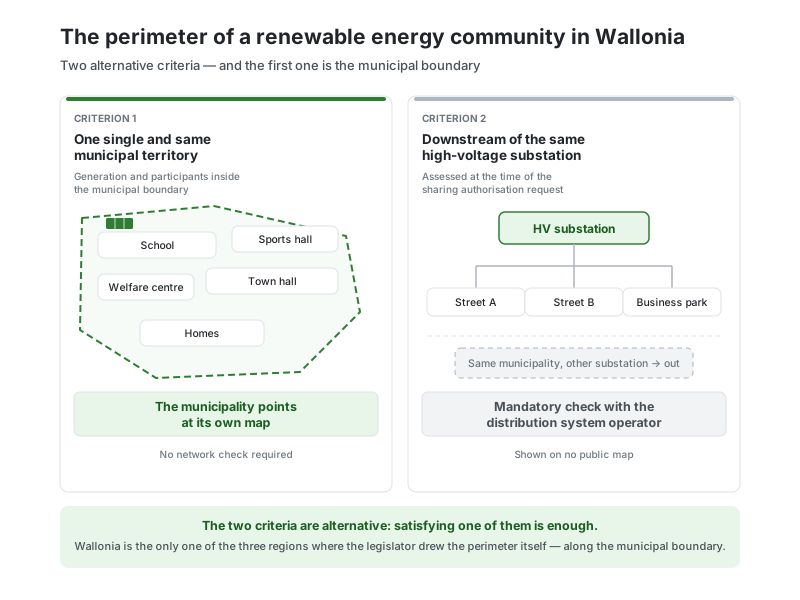
The Walloon public service states the rule as follows: the perimeter must satisfy one of the two criteria. First criterion: all generation installations used for the sharing and all participants in the sharing sit within the territory of one single and same municipality. Second criterion: the connection points of the participants and those of the generation installations sit downstream of the same high-voltage substation of the local transmission network operator, assessed at the time of the authorisation request.
Read the first criterion again. The Walloon legislator did not define the perimeter of an energy community by a distance in kilometres, nor by a capacity, nor by a number of participants. It defined it, as the first option, by the municipal boundary.
Criterion 1 says “one single and same municipality”
The practical consequence is asymmetric, and it is underestimated.
A citizens’ collective, a cooperative or a developer wanting to build an energy community across a district straddling two municipalities cannot invoke the first criterion. They must fall back on the second, and therefore establish that all their connection points hang off the same high-voltage substation. That information appears on no public map: it has to be requested from the network operator, it can cut a street in two, and it can invalidate a perimeter carefully drawn on a cadastral plan. It is an investigation, and it arrives late in the project.
A municipality has nothing to demonstrate. Its administrative perimeter is the legal perimeter. It already knows where it starts and ends, it owns the cartography, and no network configuration can take it away — including where its territory is served by several high-voltage substations, a common case in large rural municipalities, which would make the second criterion unusable.
The municipality is not one possible participant among others. It is the scale the legislator retained by default.
The converse deserves to be stated plainly: as soon as a municipal project wants to spill over into the neighbouring municipality — pooling with a neighbouring entity, including an inter-municipal business park, supplying a building on the other side of the boundary — it falls back on the second criterion and inherits all of its complexity. The good news of the first criterion is also its frontier.
Criterion 2 forces everyone else to walk back up the network
There is an honest technical reason behind that second criterion: energy sharing is an accounting operation on a physical network, and the regulator’s logic is to keep the shared flows inside a coherent portion of that network. The high-voltage substation is the point where the local transmission network becomes the distribution network; downstream of it, you are on the same electrical “tree”.
So it is not an arbitrary constraint. But it is a constraint whose verification belongs to the network operator, not to the project developer — and that is precisely what makes it costly for everyone except a municipality.
What if your municipality is in Brussels or Flanders
The first criterion is a Walloon peculiarity. It is worth measuring, because it explains why this guide is written for Wallonia.
| Who defines the perimeter? | What the municipality must do | |
|---|---|---|
| Wallonia (CWaPE) | The regulator, through two alternative criteria: territory of one single and same municipality or downstream of the same high-voltage substation | It points at its perimeter |
| Brussels (Brugel) | The members themselves, in the articles of association (article 28tredecies of the electricity ordinance); activities take place on the regional territory; the Brugel authorisation runs for 10 renewable years | It justifies its perimeter |
| Flanders (VREG / Fluvius) | The community, on the basis of “technical or geographical” proximity linked to its objectives and activities; registration with the VREG within 30 days of incorporation | It justifies its perimeter |
Neither the European directives nor the Brussels ordinance define proximity: in Brussels, it is the members of the community who must set the criteria in their own articles of association. Flanders proceeds comparably, tying the perimeter to the community’s objectives. Wallonia is the only one of the three regions where the legislator drew the perimeter itself, and where it drew it along the municipal boundary.
The full regional detail is in “Energy communities in Belgium: CER, CEC, CEL” and, for keys, in “Allocation key in Belgium: the 3 regions”; there is no point repeating it here. One clarification about the tool, to be plain: OptimCE’s document management module only knows the CWaPE today. A Brussels or Flemish municipality can use the platform to manage members, meters and keys, but not to produce its regulatory documents.
Three reasons to do it that have nothing to do with ecology
The perimeter explains why the municipality is the natural scale. It does not say why it would have an interest in using it. The three arguments below hold without invoking the climate once — which is useful when you have to convince a finance director.
Your roofs generate when your buildings are empty
This is the structural anomaly of municipal property, and it works in favour of sharing.
A school generates its photovoltaic maximum in July and August, that is, during the two months when it is empty. A town hall generates on Saturday and Sunday, when nobody works there. A sports hall consumes mostly in the evening, when generation is over. The mismatch is not accidental: it is written into the very nature of public buildings, whose occupancy follows a school or administrative calendar that the sun ignores.
The Aubange figures give the measure. The municipal installation of 45.36 kWp on the roofs of the works depot generates around 41 MWh per year, of which 70 % is self-consumed by the department itself. Yet the works depot is one of the municipal buildings with the most favourable profile: it runs Monday to Friday, in daytime, all year round. A school would do markedly worse.
Those 70 % are therefore an optimistic ceiling, not an average. And what remains — the remaining third — has only two possible destinations: the network, or somebody else.
| Municipal building | When it consumes | What becomes of the solar surplus |
|---|---|---|
| Works depot, workshop | Monday-Friday, daytime, all year | The best case: high self-consumption, surplus concentrated on weekends |
| Town hall, administration | Monday-Friday, office hours | Systematic surplus on Saturday and Sunday |
| School | Monday-Friday outside school holidays | Massive surplus in July-August, at peak generation |
| Sports hall, multi-purpose room | Evenings and weekends | Almost complete anti-correlation with generation |
| Public lighting | At night | No self-consumption possible at all |
This table is a reason to hope, not to give up: the worse the building’s profile, the more value sharing has to create. A sports hall whose roof generates all day for an empty building is exactly the case where an energy community serves a purpose.
The remaining third is worth twice as much shared as injected
Injected into the network with no further step, a kilowatt-hour of surplus currently earns between 0.94 and 4.90 cents depending on the supplier — a factor of five, for a tariff regulated nowhere in Belgium. Shared, the same kilowatt-hour trades in a defensible band of 3 to 14 cents, whose floor is precisely the injection tariff (below it, the producer has no interest in sharing) and whose ceiling is the energy component the participant already pays to their supplier.
The full reasoning, with its five options compared, is in “Solar surplus: the 5 options compared”, and the pricing method in “Internal transfer price in an energy community”. For a municipality, the order of magnitude is enough: sharing doubles the value of the surplus, for zero additional investment.
We will see below what that represents in real euros. Let us say straight away that it is not what will pay for the roof.
You already have the inventory, the plan and the legitimacy
The third argument is the least spectacular and the most decisive: a municipality that has signed the Covenant of Mayors has already done, for other reasons, half the preparatory work of an energy community.
It has an inventory of its consumption and its emissions. It has an action plan approved by its council. It has an officer following these matters. It has the list of its buildings, their meters and their profiles. It has the legitimacy to call a public meeting and to be believed when it invites its residents to take part. No other actor on the territory combines those five conditions.
230 Walloon cities and municipalities had signed the Covenant of Mayors by mid-September 2024, out of 262. The raw material therefore exists almost everywhere.
The climate-plan angle: the only action that needs no subsidy
This is where precision matters, because the temptation would be to sell a subsidy — and that would be a scheduling error.
Where the POLLEC programme stands in 2026
POLLEC — Politique locale Énergie Climat — has supported Walloon municipalities since 2012. The programme is coordinated by APERe with the support of the Walloon Air and Climate Agency and of the Union of Walloon Cities and Municipalities; Wallonia has been the regional coordinator of the Covenant of Mayors since 2017. Historically, POLLEC funds an energy-climate coordinator, part of the external support needed to draw up the plan, and, depending on the wave, investments.
The carbon neutrality decree, adopted on 24 October 2023 and in force since 1 January 2024, anchors the targets of −55 % emissions by 2030 and neutrality by 2050, updates the Air Climate Energy Plan, and provides for POLLEC to move from annual calls for projects to a drawing right — optional, to be activated by the Government, and required to fund at least one climate action plan coordinator per municipality or per association of municipalities.
“Optional” and “to be activated” are the two words to remember. Add the budgetary context: the Region’s 2026 budget conclave led the Union of Walloon Cities and Municipalities to publicly warn about the losses borne by local authorities. An action plan whose funding rests on a mechanism not yet activated is a fragile plan.
Hence the argument, which is the opposite of the usual one: the energy community deserves to be carried precisely because it does not depend on a subsidy. The investment is the photovoltaic roof — which the municipality will install anyway, for its own building, with a payback calculated on its self-consumption. The energy community does not add to that spending: it decides what is done with the surplus once the roof is up. It is an organisational decision, not a budget line.
What an energy community brings to a climate action plan
A sustainable energy and climate action plan is organised around three families of objectives: energy efficiency and sufficiency, renewable energy generation, and shifts between energy carriers. The plan must be submitted within two years of the council’s decision to join, and it rests on an emissions inventory.
An energy community feeds the second family directly. But its own interest lies elsewhere, and it fits in one sentence: it is the action that mobilises roofs the municipality does not own. A municipal insulation grant acts on private buildings and hopes somebody applies. An energy community gives a private owner an economic reason to invest in their own roof, since it offers an outlet at 3-14 cents for a surplus that earns them 1-5 cents. The leverage leaves the municipal estate, which is rare.
It also ticks, in the same movement, a social box and a citizen-participation box — the two chapters that climate plans usually fill with awareness campaigns.
The support that actually exists
Three concrete mechanisms, with no promises attached:
- The Walloon public service facilitator for energy sharing and energy communities answers free of charge, to public and private project developers alike, and gives tailored legal or technical advice. It is the first call to make, before paying a consultant.
- The European Energy Communities Facility grants a flat €45,000 for the business model, governance, legal structuring, financial strategy and operational organisation — not for hardware. The 2026 call closed on 5 July 2026; since the scheme proceeds through successive calls, its status has to be checked before building a timetable on it.
- POLLEC, in its current form, launched a 2025-2026 call to support a maximum of twenty municipalities in the concrete implementation of their climate action plan. Twenty out of 262: that is coaching, not mass funding.
Aubange, for the record, self-financed its installation: €71,390 including VAT, for an estimated payback of seven years. No subsidy in the equation.
What the municipality is allowed to be — and the eleven months when it stood alone
There is a recent legal episode every executive should know about before deliberating, because it explains why some projects stalled in 2025 and why they can restart.
The list of “local authorities”, its annulment, its restoration
A renewable energy community must be effectively controlled by its participants, and the decree reserves that participant status to three categories: natural persons, SMEs for which it is not the main activity, and local authorities. Article 4 of the Walloon Government decree of 17 March 2023 established the list of entities recognised as local authorities.
By judgment no. 262,782 of 28 March 2025, the Council of State annulled that article 4. The action was brought by the interregional cooperative company Vivaqua: the list restricted participation to inter-municipal companies falling under the competence of the Walloon Region, thereby excluding interregional inter-municipal companies without any basis — neither the special law of 8 August 1980 nor the cooperation agreement of 13 February 2014 — authorising that exclusion. The Council of State held the restriction contrary to European law, and it did not maintain the effects of the annulled provision.
The immediate result: no more list. Only the municipality, designated directly as a local authority by the electricity decree itself, remained eligible. For eleven months, a public welfare centre, an autonomous municipal utility, a province or an inter-municipal company could no longer join an energy community in that capacity.
What followed is worth recounting, because it is documented. The Energy Minister submitted a corrective draft decree to the CWaPE by letter of 17 September 2025, under the benefit of urgency, with a five-working-day deadline. In its opinion of 10 October 2025, the CWaPE notes that the request reached it more than five months after the judgment and that the urgency invoked could therefore not be justified — while offering of its own accord to deliver its opinion ahead of the ordinary deadline, given the need to fill the legal vacuum caused by the annulment and to allow the development of energy communities carried by local public authorities.
The Walloon Government decree of 5 February 2026, in force since 26 February 2026, restored the list and widened it: interregional inter-municipal companies to which at least one Walloon municipality is affiliated, inter-municipal companies made up solely of German-speaking municipalities, autonomous municipal utilities located in the German-speaking region, any legal person controlled by those entities, and an authorisation allowing the Minister to complete the list. The last two German-speaking categories come directly from the CWaPE’s opinion, which had found them omitted and that omission unjustifiably discriminatory.
What to take from this for 2026: the framework is repaired, and it is broader than before the annulment. What else to take from it: it took eleven months to repair, and the scheme is still moving. A municipal project has to be designed to survive a regulatory change, which argues for sober articles of association and a revisable sharing agreement.
Effective control and autonomy: the line not to cross
Three conditions frame what the municipality can be inside the community, and they combine into a single practical limit.
The community must have a legal personality distinct from its members. It must be effectively controlled by participants located nearby — in the plural. It must remain autonomous from its members, with participation free and voluntary. And its purpose must be to provide environmental, economic or social benefits to its participants or to the territory, rather than to seek profit.
In other words: a municipality may initiate, fund the generation, chair, host the registered office and hold a board seat. It may not turn the community into a municipal department under another name. The line is crossed without noticing, particularly when the municipality is the sole provider of capital and the sole decision-maker. The Aubange arrangement — the non-profit association brings together the City and six founding citizen members — is a good benchmark for what satisfies the condition.
One more thing the regulator states explicitly: a structure may not call itself an “energy community” before receiving the CWaPE’s acknowledgement of receipt. The term is protected, and using it prematurely in municipal communications is an easy mistake to avoid.
Why all thirteen Walloon communities are non-profit associations
The law imposes no legal form. The CWaPE’s table, on the other hand, is unambiguous: thirteen registered communities, thirteen non-profit associations. Zero cooperatives, zero companies, zero utilities.
That is no accident. The non-profit association requires no capital, its disinterested purpose sits naturally with the non-profit condition, its governance is light and its incorporation cost modest. For a municipality it has one further advantage: it makes it legible, both to the supervisory authority and to citizens, that the structure pursues no profit motive.
The two alternatives nonetheless have their domain. The cooperative company is the right answer when the project wants to raise citizen capital, remunerate shares and bring residents in as shareholders rather than as members — the model of citizen energy cooperatives. The autonomous municipal utility suits a municipality that wants to operate an energy asset alone; it does appear in the list of local authorities, but it does not, by itself, solve the condition of control by a plurality of participants.
The Aubange best-practice sheet notes that the non-profit form was chosen there with the possibility of moving later to a cooperative. Starting light does not preclude growing, and that is probably the right order.
The seven decisions, in order
What follows is not a timetable — it depends too much on the procurement procedure — but a sequence of decisions. Each one conditions the next, and taking them out of order is the most frequent cause of projects that bog down.
| # | Decision | Who decides | Where it happens |
|---|---|---|---|
| 1 | The perimeter: municipal territory (criterion 1) or downstream of a HV substation (criterion 2) | Executive | In-house; criterion 2 requires a check with the network operator |
| 2 | The participants: which municipal buildings, the welfare centre, which residents, which SMEs | Executive, then council | On the basis of consumption profiles, not goodwill |
| 3 | The legal form and governance | Municipal council | Resolution + supervision; a non-profit association in all thirteen Walloon cases |
| 4 | Notification of the community to the CWaPE | Community representative | Online forms on monespace.wallonie.be |
| 5 | The sharing authorisation and the agreement with the network operator | Sharing representative | CWaPE, then the standard agreement with ORES, RESA or AIEG |
| 6 | The allocation key and the internal price | General meeting of the community | CWaPE standard keys or a bespoke key |
| 7 | Annual reporting | Community representative | Every year, by 1 September |
A few clarifications that save time:
On decision 2. The selection criterion for participants is not enthusiasm, it is the consumption profile. Sharing is computed per fifteen-minute period: a kilowatt-hour generated at noon can only be allocated to a participant consuming at noon. A shop, a nursery, a home-based self-employed person or a care home absorb a great deal; a household whose two adults work away absorbs almost nothing on weekdays. Assembling the group before simulating what it actually absorbs is a guaranteed route to a disappointing key.
On decision 4. Since 25 June 2026, notification of the creation of an energy community, its modifications and its annual reporting go through online forms hosted on monespace.wallonie.be. The CWaPE has ten working days to confirm the file is complete, and an incomplete file can be completed within six months. The detail of the documents required is covered in “Energy community: CWaPE documents and deadlines”.
On decision 7. Annual reporting falls on 1 September, every year, for all communities. It is not a rolling deadline pegged to the incorporation date: it is a fixed date, and it is the obligation young structures forget most readily.
What it really earns — and the four traps
Let us move to euros, with explicit and verifiable assumptions.
The calculation on the Aubange figures
Take the Aubange municipal installation again: 45.36 kWp, ≈ 41 MWh per year, 70 % self-consumed. The surplus available for sharing is therefore around 12.3 MWh per year.
| Destination of the surplus | Unit price used | Annual revenue for the municipality |
|---|---|---|
| Injection, prudent assumption | 3.5 c€/kWh | ≈ €430 |
| Injection, actual market range | 0.94 to 4.90 c€/kWh | €116 to €603 |
| Sharing, documented order of magnitude | 6 c€/kWh | ≈ €740 |
| Sharing, defensible band | 3 to 14 c€/kWh | €369 to €1,722 |
Assumptions: a prudent injection tariff of 3.5 c€/kWh and the market range recorded by Test-Achats on 28 May 2026; an internal price band of 3 to 14 c€/kWh, with 6 c€ as the order of magnitude of documented Belgian cases. These are the assumptions already used in our articles on solar surplus and internal pricing, so that the three texts remain additive.
Sharing therefore earns roughly double what injection earns. And it must be said immediately what that double means: around €310 of additional annual revenue on a €71,390 installation.
The energy community does not pay for the roof. It is self-consumption — the 70 % — that pays for it, and that produces the seven-year payback announced by Aubange. The energy community only decides the fate of the remaining third. Framing the problem otherwise means promising the executive a return that does not exist, and losing your credibility at the finance director’s first spreadsheet.
What is at stake on that remaining third is not financial, it is political — and that is good news, because it is precisely the kind of arbitration an executive knows how to make. At 6 cents, the municipality captures €740 instead of €430. But it can equally choose to set the price low, near the 3-cent floor: it then gives up part of those €310 to transfer the value to participants on its territory. The real return of a municipal energy community is measured in residents’ pockets, not in the municipal budget — and the order of magnitude at stake on the municipal side, a few hundred euros a year per installation, makes that generosity affordable without looking like largesse.
Across a fleet of ten municipal roofs, however, the arithmetic changes in nature. And that is where a simulation tool becomes useful before the resolution rather than after it.
Trap no. 1: no network tariff reduction for a community
This is the most frequent disappointment, and it is structural.
Since 2025, an 80 % reduction of the proportional term of the network tariff applies to shared electricity — but only within one and the same building, under globalisation codes E216 in distribution and E526 in transmission. There is no reduction at all for sharing organised within an energy community.
Yet two distinct municipal buildings do not form one same building. The school and the sports hall, the town hall and the works depot: sharing between them necessarily falls under an energy community, and bears the full network charges, excise duties, federal levies and VAT — exactly like kilowatt-hours bought from a supplier.
The consequence is clear-cut: the only component on which an energy community creates value is the energy component. That is real, but it is bounded, and it explains why the defensible price band tops out at 14 cents and not at 37.
A useful corollary: if a municipal building has several meters — a school complex, a block of municipal housing — sharing inside that building falls under the same-building regime, with no legal entity and no authorisation, and with the 80 % reduction. It is often the first operation to set up, before even thinking about a community. The mechanism is described in “Energy sharing in a condominium: the guide”.
Trap no. 2: the social tariff is lost on shared kilowatt-hours
This one is counter-intuitive, and it hits exactly the population a municipality would want to help first.
A household benefiting from the social tariff keeps that tariff on the electricity it continues to buy from its supplier. It loses it on the kilowatt-hours allocated to it through sharing. Since the social tariff is, by construction, one of the lowest prices on the market, replacing a social-tariff kilowatt-hour with a shared one can impoverish the household rather than relieve it.
The most obvious social target of a municipality is therefore precisely the one not to enter into the allocation key without doing the arithmetic first. The CWaPE has identified that loss as one of the obstacles to the scheme’s development.
Three routes remain open, and they are better:
- Bring in the welfare centre’s own buildings — care home, nursery, administrative premises — rather than the households it supports. The social benefit then flows through lower charges for the institution, and those buildings have excellent consumption profiles.
- Target households in difficulty that do not benefit from the social tariff, a large and poorly covered population.
- Treat sharing as a complement to the social tariff, on the time slots where the household consumes anyway, sizing its share of the key so as not to erode the social advantage.
The overview of existing support and the welfare centre’s role as gateway are detailed in “Energy poverty in Wallonia: available support”; the arbitrations between tariffs, including the social tariff, in “Which electricity tariff to choose in Belgium?”.
Trap no. 3: the municipality becomes a seller of electricity
Sharing electricity for consideration means selling a good. That triggers obligations which resolutions regularly overlook.
The energy community is exempt from most VAT obligations — it does not charge VAT to its participants — but it must nonetheless obtain a VAT number; below €25,000 of annual turnover, the exemption regime is available. On the generation side, anyone with installations of a cumulative capacity above 10 kVA must register for VAT on the sale of their injection: a municipality equipping several roofs crosses that threshold very quickly. Excise duties and federal levies, finally, remain payable by the final consumer, at the same amount as for electricity bought from a conventional supplier.
A sharing agreement between participants is also required, setting the allocation key, the cost of the shared electricity, the installations made available and the invoicing arrangements handled by the sharing representative. The invoicing mechanics — two coexisting invoices, mandatory mentions, VAT treatment — are covered in “Invoicing shared electricity in Belgium”. The Aubange sheet explicitly lists fiscal and administrative integration (VAT, excise duties, agreements) among the project’s challenges: it is not an end-of-process detail.
Trap no. 4: public procurement and supervision
Three distinct operations, three different regimes, and a frequent confusion.
Buying the photovoltaic installation is a public contract for supplies and works. It is the heaviest part of the project and the one that dictates the real timetable — not the procedure before the regulator.
Setting up the legal entity and the municipality’s participation fall under the Code of local democracy and decentralisation: a council resolution, the designation of representatives, administrative supervision.
The sharing agreement is not a public contract: it is an agreement on how a produced volume is allocated, at a freely set price.
The exact classification depends on the arrangement. It is a question to put to the municipality’s legal department or to the Union of Walloon Cities and Municipalities before the resolution. The Walloon public service facilitator, free of charge, is the right first port of call to clear the ground.
What to remember
-
The legal perimeter of a Walloon renewable energy community is, as a first option, the municipal territory. Every other project developer must demonstrate that they hang off the same high-voltage substation; a municipality points at its own map. Wallonia is the only one of the three regions where the legislator drew the perimeter itself.
-
Municipal property generates when it is empty. Schools in July-August, the town hall at weekends, the sports hall all day long: the mismatch between generation and occupancy is structural. The worse the building’s profile, the more value sharing has to create.
-
The legal framework is repaired, and broader than before. Judgment no. 262,782 of 28 March 2025 had annulled the list of local authorities, leaving only the municipality itself eligible. The decree of 5 February 2026, in force since 26 February 2026, restored and extended it. Welfare centres, provinces, inter-municipal companies and autonomous municipal utilities are eligible again.
-
Thirteen Walloon communities, thirteen non-profit associations. The law imposes nothing; practice has decided. The cooperative is justified for raising citizen capital, the autonomous municipal utility for operating alone — and nothing prevents starting as a non-profit and switching later, as Aubange has planned.
-
Bring in the welfare centre’s buildings, not the social-tariff households. The latter lose the social tariff on shared kilowatt-hours: the most obvious social target is the one demanding the most care in the allocation key.
-
It is the climate action that needs no subsidy. The investment is the roof, which the municipality will install anyway for its own building. The energy community only decides the fate of the surplus. Given the state of the POLLEC drawing right and of local finances in 2026, that is an argument, not a fallback.
-
What not to expect from it: the energy community does not pay for the roof. On the Aubange figures, it brings in around €310 of additional annual revenue on a €71,390 installation. No network tariff reduction applies to sharing within a community — the 80 % is reserved for the same building — and shared kilowatt-hours bear the full network charges, excise duties and VAT. The real return is measured in residents’ pockets, not in the municipal budget.
Set up your municipality’s energy community with OptimCE
Open-source platform built for Belgian energy communities: members, meters, allocation keys and sharing operations in one place — right down to simulating the volume your municipal buildings will actually absorb within the quarter-hour, before it goes to the executive.
FAQ
Can a municipality create an energy community on its own?
No. The community is a distinct legal entity, which must be controlled by a plurality of nearby participants and remain autonomous from them. A structure in which the municipality is the sole member and the sole decision-maker would be a municipal department in disguise.
The municipality can, however, take the initiative, fund the generation, make its roofs available and sit on the board. That is the Aubange arrangement: the City plus six founding citizen members.
Does joining an energy community require a public procurement procedure?
Three operations, three regimes. Buying the photovoltaic installation is a public contract for supplies and works — the heavy part. Setting up the legal entity and the municipality’s participation fall under the Code of local democracy, so under a resolution and supervision. The sharing agreement is not a contract award: it is an allocation agreement at a freely set price.
The classification depends on the chosen arrangement and is validated with the legal department or the Union of Walloon Cities and Municipalities before the resolution.
Can the public welfare centre join the municipality’s energy community?
Yes, since the list of local authorities was restored by the decree of 5 February 2026.
But distinguish two things: bringing in the welfare centre as an institution, with its buildings and meters, is simple and effective. Bringing social-tariff households into the key requires prior arithmetic, since they lose that tariff on the shared share.
Which legal form should be chosen?
The law imposes none: it requires a distinct legal personality, autonomy, effective control by nearby participants and a non-profit purpose. In practice, the thirteen communities registered with the CWaPE as of 30 August 2026 are all non-profit associations.
The cooperative is the answer for raising citizen capital and remunerating shares; the autonomous municipal utility for operating an asset alone. Starting as a non-profit and planning the transition is a documented strategy.
Does sharing between two municipal buildings qualify for the 80 % reduction?
No. That reduction of the proportional term — codes E216 and E526 — is reserved for sharing within one and the same building. Two distinct municipal buildings fall under the energy community, where no reduction applies.
By contrast, if a single municipal building has several meters, sharing inside that building benefits from the same-building regime, with no legal entity and no authorisation. It is often the first operation to set up.
How long between the council decision and the first shared kilowatt-hour?
Years rather than months, and the regulator is not the bottleneck: the CWaPE has ten working days to confirm a file is complete, and six months are given to complete an incomplete one.
What takes time comes earlier: deciding the perimeter and the participants, getting the council to deliberate, running the public procurement, installing and connecting the system, obtaining the communicating meters, then the sharing authorisation and the agreement with the network operator.
Sources
- CWaPE — Energy communities — source of the table of notified energy communities whose file has been declared complete, thirteen as of 30 August 2026, all incorporated as non-profit associations, with their acknowledgement dates and their number of authorised sharing activities; also the source of the conditions applying to renewable and citizen energy communities (distinct legal personality, effective control by nearby participants, autonomy, purpose of environmental, economic or social benefits), of the move of the forms to
monespace.wallonie.besince 25 June 2026, of the ten-working-day deadline for the completeness confirmation, of the six-month deadline to complete a file, and of the annual reporting deadline of 1 September. Accessed on 30 August 2026. - CWaPE — Energy sharing — source of the fifteen-minute simultaneity principle, of the existence of a list of standard allocation keys automatically accepted by the network operator, and of the standard agreement concluded between the sharing representative and each Walloon distribution system operator. Accessed on 30 August 2026.
- CWaPE — Opinion CD-25j10-CWaPE-0965 of 10 October 2025 on the draft decree amending the AGW of 17 March 2023 — primary source of the exact reference of the Council of State judgment (no. 262,782 of 28 March 2025) and of its subject matter, of the chronology of the corrective draft (ministerial letter of 17 September 2025, request received on 23 September, urgency sought on a five-working-day basis), of the CWaPE’s finding that urgency could not be justified since the request came more than five months after the judgment, and of the categories added to the list of local authorities, including inter-municipal companies made up solely of German-speaking municipalities and autonomous municipal utilities located in the German-speaking region.
- CWaPE — Evaluation report on the framework for energy communities, energy sharing and self-consumption, 20 February 2025 — source of the numerical starting point (three energy communities and a very small number of sharing operations in February 2025) and of the identification of the obstacles to the scheme’s development, including the loss of the social tariff on shared volumes and the complexity of the procedures.
- CWaPE — Are network charges payable in the case of energy sharing? — source of the 80 % reduction of the proportional term reserved for sharing within one and the same building, of globalisation codes E216 in distribution and E526 in transmission, and of the absence of any reduction for sharing organised within an energy community. Accessed on 30 August 2026.
- Walloon public service — Questions on energy communities: what is proximity? — source of the two alternative proximity criteria applying to a renewable energy community: the territory of one single and same municipality, or downstream of the same high-voltage substation of the local transmission network operator, assessed at the time of the authorisation request. Accessed on 30 August 2026.
- Walloon public service — Energy sharing and energy community facilitators — source of the existence of a regional facilitator answering free of charge, to public and private project developers alike, and providing tailored legal or technical advice. Accessed on 30 August 2026.
- Walloon public service — POLLEC, local energy and climate policy — source of the programme’s history since 2012, of its coordination by APERe with the support of the Walloon Air and Climate Agency and of the Union of Walloon Cities and Municipalities, of Wallonia’s role as regional coordinator of the Covenant of Mayors since 2017, and of the nature of the support provided (energy-climate coordinator, external support for drawing up the plan). Accessed on 30 August 2026.
- Union of Walloon Cities and Municipalities — The Covenant of Mayors — source of the count of 230 Walloon cities and municipalities that had signed by mid-September 2024, of the objective of reducing greenhouse gas emissions by at least 55 % by 2030 for signatories since 2021, and of the two-year deadline to submit the climate action plan after the council’s decision to join. Accessed on 30 August 2026.
- Union of Walloon Cities and Municipalities — Energy communities: the Walloon Government widens the notion of “local authority” following a Council of State judgment — source of the entry into force of the Walloon Government decree of 5 February 2026, set at 26 February 2026, and of the content of the restored list: interregional inter-municipal companies, inter-municipal companies made up solely of German-speaking municipalities, autonomous municipal utilities in the German-speaking region, legal persons controlled by those entities, and a ministerial authorisation. Accessed on 30 August 2026.
- Union of Walloon Cities and Municipalities — Partial annulment of the Walloon Government decree of 17 March 2023 on energy communities and energy sharing — source of the identity of the applicant before the Council of State (the interregional cooperative company Vivaqua), of the ground of annulment (restriction to inter-municipal companies falling under the Walloon Region, held contrary to European law and authorised neither by the special law of 8 August 1980 nor by the cooperation agreement of 13 February 2014), of the absence of maintenance of effects, and of the practical consequence that only municipalities, designated directly by the electricity decree, remained eligible as local authorities. Accessed on 30 August 2026.
- Union of Walloon Cities and Municipalities — Aubange: a best practice for creating a municipal renewable energy community — best-practice sheet published on 1 May 2025 noting that the City of Aubange has been, since 2024, the first in Wallonia to be part of a renewable energy community. Accessed on 30 August 2026.
- Union of Walloon Cities and Municipalities — The European Energy Communities Facility: financial support for emerging energy communities — source of the €45,000 flat grant, of its scope (business model, governance, legal structuring, financial strategy and operational organisation, excluding hardware investment), of the eligibility conditions open to Walloon municipalities, and of the 2026 call closing date of 5 July 2026. Accessed on 30 August 2026.
- Réseau wallon PAC — Best-practice sheet: Soleil d’Aubange, the first renewable energy community in Wallonia — source of all the Aubange figures: municipal photovoltaic installation of 45.36 kWp on the roofs of the works depot, generation of about 41 MWh per year of which 70 % self-consumed, investment of €71,390 including VAT self-financed by the municipality, estimated payback of seven years, a non-profit association bringing together the City and six founding citizen members, an initiative of the Gaume Nature Park and the Pays de Gaume local action group with technical and legal support from Energie Commune, the explicit challenge of fiscal and administrative integration (VAT, excise duties, sharing agreements), and the planned possibility of a later move to a cooperative.
- CWaPE — Energy sharing activity authorised for the renewable energy community Soleil d’Aubange (CERSA) — source of the date on which Wallonia’s first sharing activity was authorised, 11 July 2024, on the territory of the City of Aubange. Accessed on 30 August 2026.
- GAL Condruses — Mapping of energy communities in Wallonia — source of the order of magnitude of the number of participants in Walloon energy communities, about 126 as of 17 June 2026, and of the Brussels comparison point of 1,417 participants. The count of communities used by that mapping differs from the CWaPE’s, whose methodology and update date govern in this article. Accessed on 30 August 2026.
- TWEED — Carbon neutrality decree adopted on 24 October 2023, in force on 1 January 2024 — source of the adoption and entry into force dates of the decree, of the anchoring of the −55 % by 2030 and carbon neutrality by 2050 targets, and of the update of the Air Climate Energy Plan. Accessed on 30 August 2026.
- Union of Walloon Cities and Municipalities — Draft carbon neutrality decree: the Union’s opinion — source of the planned evolution of the POLLEC calls for projects towards a drawing right, of its optional character to be activated by the Government, and of the minimum funding of one climate action plan coordinator per municipality or association of municipalities. Accessed on 30 August 2026.
- Union of Walloon Cities and Municipalities — The Union reacts to the savings measures of the 2026 Walloon budget conclave — source of the budgetary context of Walloon local authorities in 2026 and of the Union’s public warning about the losses borne by cities and municipalities. Accessed on 30 August 2026.
- Brugel — Interpretation guide on authorisations granted to energy communities — source of the Brussels regime: absence of a legal definition of proximity, referral by article 28tredecies of the electricity ordinance to the criteria members set in their articles of association, exercise of the activities on the regional territory, and authorisation granted by Brugel for ten renewable years.
- Fluvius — Renewable energy community — source of the Flemish regime: perimeter defined on the basis of technical or geographical proximity in the light of the community’s objectives and activities, requirement of legal personality, registration with the Crossroads Bank for Enterprises and registration with the VREG within thirty days of incorporation. Accessed on 30 August 2026.
- Test-Achats — Survey of injection tariffs, 28 May 2026 — source of the range of injection tariffs applied in Belgium, from 0.94 to 4.90 c€/kWh depending on the supplier, used here to stay consistent with our articles on solar surplus and internal transfer pricing. Accessed on 30 August 2026.