
Solar surplus: the 5 options compared
A 4 kWp residential solar installation generates about 3,800 kWh a year in Belgium. A household with panels spontaneously uses a little over a third of it. The rest — around 2,400 kWh — leaves the house at exactly the moment nobody wants it: midday, on a weekday, when the house is empty and every roof in the street is producing at once.
Those 2,400 kWh are the real subject. Exported with no further arrangement, they earn between 0.94 and 4.90 cents per kilowatt-hour depending on the supplier, according to the Test-Achats survey of 28 May 2026. Consumed on site, the same kilowatt-hours are worth around 37. The ratio is one to thirty-nine, and it depends on no technology whatsoever: it depends solely on the hour at which the electron is used.
Five options exist to act on that mismatch: export, heat domestic water, charge the car, store in a battery, share. They are almost always presented as a choice, when in fact they stack — and above all, they only make sense if your meter rewards them. Before comparing anything, you therefore need to know which metering regime you are in, because there are still tens of thousands of Belgian households for whom the right answer is: change nothing.
This article does not redo the profitability calculation of a solar installation, covered in “Solar panels 2026: still worth it in Wallonia?”. It does not re-explain self-consumption, defined in “Energy self-consumption in Belgium”, nor how to set a price between participants, developed in “Internal transfer price in an energy community”. Nor does it replay the regional availability test for sharing, carried out in “Cheaper electricity without switching supplier”, or the detail of the Walloon time bands, documented in “Reduce your electricity bill: Wallonia 2026”. It does one thing those articles do not: it compares the five possible destinations of the surplus appliance by appliance, in euros invested per kilowatt-hour absorbed.
Before choosing: which metering regime are you in?
The question sounds administrative. It is in fact decisive, because in one of the four cases below your surplus is already paid at full price and any money spent to absorb it is money lost.
Wallonia, commissioned before 1 January 2024
You keep annual compensation until 31 December 2030, as ORES confirms: over the year, what you export cancels out against what you draw, up to the level of your consumption. In exchange you pay the prosumer tariff, set for 2026 at €80.98 per kWe excluding VAT on the ORES schedule approved by the CWaPE on 18 December 2025, or about €86 including VAT, applied to the net developable capacity of the installation.
Two calculation modes coexist. The capacity-based mode is the default; it rests on the assumption that you self-consume 37.76 % of your generation and is computed purely on installed capacity. The proportional mode requires a smart meter and is computed on your actual offtake; it is capped at the capacity-based amount, and ORES automatically applies whichever of the two is cheaper.
The consequence is counter-intuitive. On the capacity-based tariff, raising your self-consumption changes nothing on your bill: compensation is annual, and the prosumer contribution is levied on the inverter. A solar diverter or a battery would earn you nothing. On the proportional tariff a gain does exist, but it is bounded by the capacity-based cap. The only case where all five options regain their full meaning is an oversized installation, generating more than the household consumes over the year: that excess is paid for nowhere.
Wallonia, commissioned since 1 January 2024
No more compensation, and — this is less widely known — no more prosumer tariff either. ORES is explicit: your bill is based solely on the electricity you draw. The smart meter is mandatory and measures offtake and injection separately. It is up to you to sign an injection contract with a supplier, or to join a sharing operation.
This is the regime in which the arbitrage between the five options arises in its sharpest form, and where every kilowatt-hour absorbed on site is worth twelve times what it fetches exported.
Brussels
Pure and simple compensation has been abolished since 2021 and there is no Brussels prosumer tariff. In exchange, the Region maintains green certificates, which sets it clearly apart from the other two. Since 1 April 2026 the award rate is unchanged for residential installations up to 5 kWp, falls by 11 % from 5 to 36 kWp, by 45 % from 36 to 100 kWp, and disappears above 100 kWp. Since 1 January 2026, any new installation of at most 5 kWp must obtain a RESCert PV certificate to qualify.
Read this carefully: green certificates are earned on total generation, not on the surplus. They improve the overall profitability of the installation; they change nothing in the arbitrage between the five options.
Flanders
The digital meter has ended the spinning-back meter, and the prosumententarief disappears along with it: you only pay network charges on what you actually draw. Fluvius has also set a clear deadline: since 1 April 2026, the balance accumulated on a spinning-back meter is no longer automatically compensated when the digital meter is fitted.
Flanders adds a parameter absent from the other two regions: the capaciteitstarief, billed on the average of the last twelve monthly quarter-hourly peaks, with a 2.5 kW floor, and priced for 2026 at about €53.39 per kW per year excluding VAT. It is the only Belgian region where shaving a peak directly earns money — which changes the case for a battery, as we shall see. In Wallonia, by contrast, the residential capacity term is set at €0 per kW for the 2026-2029 period.
| Wallonia before 2024 | Wallonia since 2024 | Brussels | Flanders | |
|---|---|---|---|---|
| Annual compensation | yes, until 31/12/2030 | no | no, since 2021 | no |
| Prosumer tariff | yes, €80.98/kWe excl. VAT | none | none | removed with the digital meter |
| Capacity term | €0/kW (2026-2029) | €0/kW (2026-2029) | — | €53.39/kW/year excl. VAT |
| Generation support | none | none | green certificates | none |
| What the surplus is worth by default | full retail price, capped at your consumption | the injection tariff | the injection tariff | the injection tariff |
If you are in the first column and your installation is not oversized, you can stop here. For everyone else, the comparison starts now.
The reference case
So that the five options are comparable, everything below rests on a single household: 4 kWp, 3,800 kWh generated a year, 37.76 % self-consumed spontaneously, meaning 1,435 kWh used on site and 2,365 kWh of surplus. The retail price used is 36.94 c€/kWh including VAT, and the prudent injection tariff 3.5 c€/kWh. These are exactly the assumptions of our profitability article, so that the two texts remain additive.
Two metrics are used, and the second is the one that really settles the question:
- the value of a kilowatt-hour of surplus under the option considered, in cents;
- the investment per kilowatt-hour absorbed each year, in euros — that is, what it costs to durably capture one more annual kilowatt-hour.
Option 1 — Export: the floor
This is the default option, the one that applies if you do nothing beyond signing an injection contract.
On our 2,365 kWh, at 3.5 c€, it earns €83 a year. Depending on the supplier, the real range runs from €22 to €116: in May 2026 Test-Achats recorded rates from 0.94 c€/kWh at the lowest to 4.90 c€/kWh at the highest in Flanders and Wallonia, and from 1.40 to 4.81 c€/kWh in Brussels. A factor of five between suppliers, for a rate that is regulated nowhere in Belgium.
Three points worth knowing before switching contract for this reason alone.
The injection rate is usually variable, indexed to the wholesale market. A few suppliers offer fixed remuneration, but a fixed consumption price never guarantees a fixed injection price: they are two distinct lines on the tariff sheet, and injection generally sits on the second page.
The consumption rate always weighs more than the injection rate. Choosing a supplier on its injection rate alone is almost always an arithmetic mistake: the €94 of maximum spread on injection is wiped out by a few tenths of a cent on the 3,500 kWh you draw.
The value of export is falling structurally. The larger the Belgian solar fleet grows, the more abundant midday electricity becomes at precisely the moment it is least in demand. No reasonable scenario has this rate recovering durably.
Export nevertheless remains indispensable: it collects the remainder, whatever else you do. Here it serves as the floor, and the four options that follow are measured against it.
Option 2 — The hot-water tank: the best ratio, by far
This is the least-cited and most profitable option, for a simple physical reason: you already own the storage.
What a tank can actually take
A 200-litre tank raised from 16 °C — the average annual cold-water temperature in Belgium — to 60 °C stores 200 × 4.186 × 44 / 3600, or about 10.2 kWh. That is the order of magnitude of an entry-level home battery, in an appliance you have already paid for.
On the demand side, the Belgian reference from Énergie+ puts hot-water use at 35 to 40 litres per person per day at 60 °C. A four-person household therefore uses in the order of 150 litres a day, about 7.7 kWh of useful energy daily and close to 2,800 kWh of useful energy over the year — plus the standing losses of a resistive tank.
None of that can come entirely from the sun, of course. Belgian generation is concentrated between April and September, and the tank can only take one charge a day. In practice, sound control captures 800 to 1,400 kWh of surplus a year, a good third to more than half of the 2,365 kWh available.
The equipment: a diverter, not a battery
A solar diverter continuously measures what is heading for the grid and modulates the tank’s element to absorb exactly that surplus, watt by watt. Installed, it costs in the order of €400 to €900. On 1,000 kWh absorbed a year valued at around 30 c€, it pays for itself in one to three years, and it has nothing that wears out in the way a battery does.
Against our second metric: about €0.65 of investment per kilowatt-hour absorbed each year. No other equipped option comes close.
The heat-pump water heater trap
Here is the point comparisons almost always miss. A heat-pump water heater has a coefficient of performance of 2.5 to 3.5: it returns three kilowatt-hours of heat for one kilowatt-hour drawn. Excellent news for your bill — bad news for your surplus. For the same 2,800 kWh of useful energy, it draws only around 930 kWh of electricity, against close to 3,000 for a resistive tank.
Put differently: for identical hot water, a heat-pump water heater absorbs roughly three times less surplus than a controlled resistive tank. The two logics only converge if your tank is at the end of its life anyway; in that case the heat-pump model remains the right purchase, and surplus control comes on top.
A tariff nuance that trims the gain
If your tank already runs on off-peak hours, the gain is not 37 cents but the difference between the peak and off-peak price. In Wallonia, since 1 January 2026, an off-peak band runs from 11 a.m. to 5 p.m. — precisely the solar hours — and the optional Impact tariff places its ECO band there. A tank already programmed on that band is therefore already drawing the cheapest electricity on the grid: absorbing the surplus now only saves it the energy component, levies and VAT, in the order of 20 to 24 c€/kWh. Payback then moves from one-to-two years to two-to-three. It is still the best of the lot.
On support schemes, Wallonia backs heat-pump water heaters through the Primes Habitation, subject to a prior housing audit, but the current regime closes on 30 September 2026: a new scheme will apply beyond that date. Flanders covers the appliance under Mijn VerbouwPremie, reformed on 1 March 2026. Brussels no longer has an operational premium: the Renolution portal states that as things stand there is no government decision on any new form of financial support for renovation. A solar diverter, for its part, is subsidised nowhere — and does not need to be.
Option 3 — The electric car: the biggest tank, the biggest lock
An electric car carries 50 to 75 kWh, five to seven times a home battery, in a vehicle you bought in order to drive. On paper it is the ideal absorber.
The arithmetic of the need
Fifteen thousand kilometres a year, at 18 kWh per hundred kilometres including charging losses, comes to about 2,700 kWh of annual charging. That is more than the entire surplus of our 4 kWp installation. The need is therefore never the limiting factor.
The lock is the clock, not the technology
Solar surplus exists between 11 a.m. and 5 p.m. That is exactly the window in which the car is most often away. The volume actually absorbed therefore depends almost entirely on one lifestyle parameter:
| Profile | Days present during the day | Surplus absorbed |
|---|---|---|
| Commuter, car away on weekdays | ~100 a year | ~300 kWh |
| Working from home two days a week | ~200 a year | ~830 kWh |
| Retiree, home-based self-employed, second car | ~300 a year | 1,200 to 1,500 kWh |
The same equipment, depending on the household’s diary, absorbs anywhere from one to five times as much.
What kind of charge point you need
A solar-modulating charge point follows generation continuously and calls on the grid only for what is missing, or not at all in “100 % solar” mode. Installed it costs €1,200 to €2,500 including VAT, with 6 % VAT in a dwelling over ten years old, and no regional premium supports it in 2026. A charge point without modulation, or a plain domestic cable, charges on an all-or-nothing basis: the moment a cloud passes, the difference is taken from the grid at full price.
Two technical limits are worth knowing. In single phase, the modulation floor is 6 amps, or about 1.4 kW: below that threshold of excess generation, charging stops. And a 4 kWp installation tops out at 2 to 3 kW of instantaneous surplus, enough for slow charging but not for fast charging.
Against our metric: about €2.17 of investment per kilowatt-hour absorbed each year in the work-from-home profile — and €0 if a controllable charge point is already installed, which is the most common case and then makes this the best option in the ranking.
V2H and V2G: not yet
Using the car’s battery to power the house, or even to export to the grid, would solve the problem in one move. In Belgium in 2026 this is not a consumer option: bidirectional charge points cost €4,000 to €8,000, very few vehicle models are compatible, the connection standards framework is not settled and deployments remain pilot projects. Do not buy a car or a charge point today for that function.
Option 4 — The home battery: effective, expensive, and poorly supported
This is the answer most installers propose, and it is not wrong — it is simply expensive.
A 10 kWh battery costs €7,000 to €9,000 including VAT installed, or €700 to €900 per usable kilowatt-hour, with 6 % VAT if fitted at the same time as the panels, by the same contractor, in a dwelling over ten years old. Its round-trip efficiency is 90 to 95 %, its life 6,000 to 10,000 cycles, and the typical manufacturer warranty covers ten years at 60 or 80 % residual capacity.
The effect is real: the self-consumption rate rises from 37.76 % to around 75 %, meaning 1,415 additional kilowatt-hours self-consumed and about €473 a year, net of the injection revenue forgone on those kilowatt-hours. But €8,000 for €473 a year is close to fifteen years of payback, more than the warranty.
Against our metric: about €5.65 of investment per kilowatt-hour absorbed each year. Almost nine times the ratio of a hot-water tank.
And there is nothing to expect from support schemes: no Belgian region pays a home-storage premium in 2026. Flanders ended its own on 31 March 2023, Wallonia never created one, and neither did Brussels. The price grid per kilowatt-hour installed, and the declaration obligation that can break a pre-2024 compensation, are covered in “Home battery: the price and the alternative”.
Three situations nevertheless straighten out the calculation, and they need naming precisely.
Flanders and its capaciteitstarief. At €53.39 per kW per year excluding VAT on the average of the last twelve monthly peaks, shaving a 2 kW peak earns more than €100 a year that exists nowhere else in Belgium. It is the only region where a battery has a second revenue stream.
The Walloon Impact tariff. Charging the battery in the ECO band to discharge it in the PIC band creates an arbitrage on the distribution term. But caution: we noted in “Which electricity tariff to choose in Belgium?” that 99 % of households with solar panels paid more under a dynamic contract, with a median increase of 20 %, precisely because their surplus arrives when prices collapse.
The need for autonomy. Wanting to keep the lights on during an outage is a legitimate need. It is simply not a profitability calculation, and it should be budgeted as such.
Option 5 — Energy sharing: the only one without a ceiling
The four previous options have a physical ceiling: a tank stores only 10 kWh, a car is only there on some days, a battery has the capacity you paid for. Sharing, by contrast, has no capacity ceiling and costs nothing to set up.
Its price sits in a defensible band of 3 to 14 c€/kWh: the floor is the injection tariff, below which no producer has any interest in sharing; the ceiling is the energy component the consumer already pays. At 6 c€ — the order of magnitude of documented Belgian cases — our 2,365 kWh earn €142 a year, against €83 from export. Twice as much, for zero investment.
Its limit is not capacity but simultaneity. Sharing is computed in fifteen-minute slices: your midday generation can only be allocated to participants consuming at midday. Flemish experience shows about 20 % of injection is actually shared, against the 40 % that was hoped for. A group of participants with daytime consumption — a shop, a school, a home-based professional — therefore absorbs far more than a single neighbour who works away.
Availability, meanwhile, depends entirely on your region.
| What is possible in 2026 | Conditions | |
|---|---|---|
| Wallonia | same building, or energy community (CER/CEC) — peer-to-peer remains inoperative | smart meter, waiver of compensation, 80 % reduction of the proportional term within the same building |
| Flanders | person-to-person selling since 2022, building sharing, community, sharing with yourself | digital meter, quarter-hourly metering regime, both points in the Flemish Region, possible annual supplier fee per access point |
| Brussels | building sharing, between buildings, energy community | declaration to Sibelga for any sharing, Brugel authorisation for communities only, proximity tariff types A to D, exit notice cut to 24 hours since 1 January 2026 |
In all three regions, one rule does not move: network charges, levies and VAT remain due on shared kilowatt-hours, since they did travel across the public grid. Sharing replaces the energy component, nothing else. The only Walloon tariff exception is sharing within the same building, which enjoys an 80 % reduction of the proportional term on the 2026 ORES schedule.
The ranking, in two tables
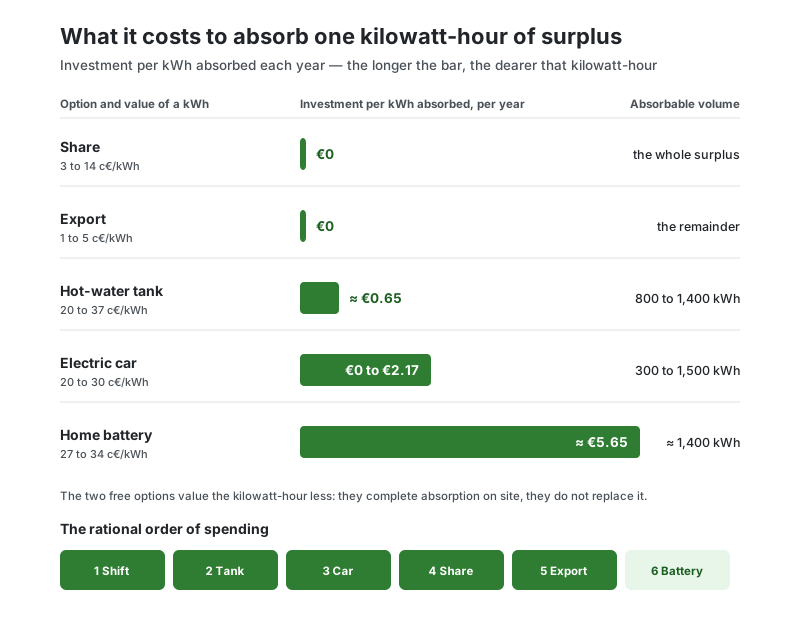
The first table compares what a kilowatt-hour earns. The second compares what it costs to be able to absorb one more of them, every year — and that is the one that changes decisions.
| Option | Value of a kWh of surplus | Volume absorbable per year | Investment |
|---|---|---|---|
| Export | 0.94 to 4.90 c€ | the entire remainder | €0 |
| Share | 3 to 14 c€ | everything, bounded by simultaneity | €0 |
| Hot-water tank | 20 to 37 c€ | 800 to 1,400 kWh | €400 to €900 |
| Electric car | 20 to 30 c€ | 300 to 1,500 kWh | €0 to €2,500 |
| Home battery | 27 to 34 c€ | ~1,400 kWh | €7,000 to €9,000 |
| Option | Investment per kWh absorbed per year | Payback | Lifetime |
|---|---|---|---|
| Share | €0 | immediate | unlimited |
| Export | €0 | immediate | unlimited |
| Hot-water tank | ≈ €0.65 | 1 to 3 years | > 15 years |
| Electric car | €0 to €2.17 | 0 to 8 years | > 10 years |
| Home battery | ≈ €5.65 | ≈ 15 years | 10 to 15 years |
Two readings emerge, and they cut against what is usually written.
The two free options win on capital, not on value. Sharing and export cost nothing but value the kilowatt-hour at 3 to 14 cents, against 37 for self-consumption. They therefore never replace absorption on site — they complete it.
The battery is the most expensive per kilowatt-hour absorbed, by a wide margin. It costs close to nine times the ratio of a controlled hot-water tank for a comparable service. That is not an argument against batteries, it is an argument about the order in which you spend.
This ranking assumes somebody can trigger the loads. For a household away from 08:00 to 18:00, the binding constraint is no longer price but time: 85.8% of output lands during the absence, and scheduling hits a ceiling that can be computed. That is the subject of “Solar panels: nobody home during the day”.
The right answer is a stack, not a choice
The five options do not exclude one another. A tank absorbs the middle of the day, a car absorbs the days you are home, sharing takes what is left quarter-hour by quarter-hour, export collects the remainder. The rational order of spending is therefore this.
- Shift the loads you already have, for zero euros. A washing machine, dishwasher and tumble dryer programmed between 11 a.m. and 5 p.m. gain a few points of self-consumption without a cent of investment.
- Control the hot-water tank. The best ratio in the ranking, payback in one to three years, no maintenance.
- Control the car’s charging, if it is at home during the day. Free if a controllable charge point is already there, worth assessing otherwise.
- Share the remainder. Zero euros, two to four times the value of export, provided your region and your neighbourhood allow it.
- Export what is left. Having compared injection rates, but without switching supplier for that line alone.
- Consider a battery last, and only if the Flemish capaciteitstarief, a tariff arbitrage or a need for autonomy are added to the calculation.
Three profiles show what that order looks like in practice.
The Walloon commuter, 2025 installation. Car away on weekdays, house empty in the daytime. The controlled tank is his only profitable equipped option: about 1,000 kWh absorbed for €600 invested. Sharing, if he can access it, doubles the value of the rest. A battery makes no sense for him.
The Flemish home worker, 2023 installation. Two days at home, an electric car, a controllable charge point already fitted. He stacks tank and car for about 1,800 kWh absorbed at near-zero marginal cost, sells the rest to his neighbour through person-to-person selling, and a battery is only justified for him by shaving the capaciteitstarief.
The Walloon prosumer of 2021. Compensation secured until 2030, consumption above generation. His surplus is already paid at full price. The right decision is to buy nothing and revisit the question in 2030 — unless his installation is oversized, in which case only the excess above his annual consumption deserves attention.
Key takeaways
- The first question is not “which option” but “which metering regime”. A Walloon installation predating 2024 keeps compensation until 31 December 2030: its surplus is already valued at full price, and four of the five options would earn it nothing.
- An exported kilowatt-hour is worth 0.94 to 4.90 cents; the same kilowatt-hour self-consumed is worth around 37. The whole subject sits in that gap, and it depends only on the hour of use.
- The hot-water tank is the best ratio in the ranking. A €400 to €900 solar diverter absorbs 800 to 1,400 kWh a year and pays for itself in one to three years, about €0.65 of investment per kilowatt-hour absorbed annually.
- A heat-pump water heater absorbs roughly three times less surplus than a controlled resistive tank, precisely because its coefficient of performance is three times better. Excellent appliance, poor surplus absorber.
- The electric car has the biggest tank and the biggest lock: 2,700 kWh of annual need, but only 300 kWh absorbed for a commuter against 1,500 for a household present during the day. V2H and V2G are not a consumer option in 2026.
- The battery costs close to nine times the tank’s ratio per kilowatt-hour absorbed, receives no premium in any Belgian region in 2026, and only recovers in Flanders thanks to the capaciteitstarief, or for an autonomy need owned as such.
- Sharing is the only zero-investment option that multiplies the value of the surplus by two to four — but it remains unequal by region: open person-to-person in Flanders since 2022, declaratory in Brussels, limited to the same building or an energy community in Wallonia.
Make more of your solar surplus with OptimCE
An open-source platform built for Belgian energy communities: members, meters, allocation keys and sharing operations in one place — right through to simulating how much is genuinely shareable quarter-hour by quarter-hour, and invoicing the energy transferred.
FAQ
Which option delivers the most per euro invested for a solar surplus?
Controlling the hot-water tank, with no serious competition. A solar diverter fitted to an existing electric tank costs €400 to €900, absorbs 800 to 1,400 kWh of surplus a year and pays for itself in one to three years. Measured against the volume it handles, that is roughly €0.65 of investment per kilowatt-hour absorbed each year, against roughly €5.65 for a home battery. The two zero-investment options, energy sharing and export, cannot be compared on that ground because their denominator is zero: they compete on unit value instead, 3 to 14 c€ for sharing against 0.94 to 4.90 c€ for export. The right strategy is therefore not to choose but to stack: absorb at full retail value whatever your appliances can take, share next, export the remainder.
Should you install a home battery in 2026 for your solar surplus?
Not for the surplus alone. A 10 kWh battery costs €7,000 to €9,000 including VAT, lifts a self-consumption rate from 37.76 to 75 % and returns around €473 a year on a 4 kWp case, which is a payback of about fifteen years while the manufacturer warranty covers ten years at 60 to 80 % residual capacity. No Belgian region pays a home-storage premium in 2026: Flanders ended its own on 31 March 2023, and Wallonia and Brussels never had one. The calculation only recovers in three situations: in Flanders, where the capaciteitstarief bills the quarter-hourly peak and shaving that peak genuinely pays; in Wallonia under the Impact tariff, where the gap between the ECO and PIC bands opens an arbitrage; and if what you actually want is autonomy during an outage, which is a legitimate need but is not a profitability calculation.
Is a heat-pump water heater a good way to absorb solar surplus?
It is an excellent appliance and a poor surplus absorber, and both statements are true at once. A heat-pump water heater has a coefficient of performance of 2.5 to 3.5: it delivers three kilowatt-hours of heat for one kilowatt-hour of electricity drawn. For the same hot-water need it therefore consumes about three times less electricity than a resistive tank — and absorbs about three times less surplus. If your goal is to cut your overall bill, it is the right choice. If your goal is to absorb 2,400 kWh of surplus currently leaving at 3 cents, a simple solar diverter on an existing resistive tank absorbs far more, for ten times less money. The two logics only converge if your tank needs replacing anyway.
Can I charge my electric car on solar surplus alone?
Almost never in full, and the constraint is not technical but a matter of timing. Fifteen thousand kilometres a year is around 2,700 kWh of charging, which already exceeds the annual surplus of a 4 kWp installation. More to the point, the car has to be plugged in between 11 a.m. and 5 p.m., precisely the hours when most people are at work. A typical commuter absorbs only around 300 kWh of surplus a year, a household working from home two days a week around 830, a retiree or a two-car household can exceed 1,200. You also need a charge point that modulates its power continuously: a charger delivering 3.7 kW on an all-or-nothing basis draws from the grid the moment a cloud passes. The single-phase modulation floor is 6 amps, roughly 1.4 kW, below which charging stops.
My Walloon installation predates 2024: what should I do with my surplus?
Most often, nothing — and it is the least published piece of advice. A Walloon installation commissioned before 1 January 2024 keeps annual compensation until 31 December 2030. Your surplus is therefore already valued at full retail price, up to the level of your annual consumption. Raising your self-consumption then earns you nothing extra if you are on the capacity-based prosumer tariff, because that tariff is computed on your inverter rating rather than on your actual flows. A gain only appears in two situations: if you are on the proportional prosumer tariff thanks to a smart meter, where cutting your offtake cuts the contribution, and if your installation is oversized, meaning you generate more than you consume over the year, because that excess is paid for nowhere. The full arbitrage is set out in “Solar panels 2026: still worth it in Wallonia?”.
Is energy sharing available where I live, to make more of my surplus?
It depends entirely on your region, and this is the main Belgian inequality on the subject. In Flanders, person-to-person selling has been open since 2022: you can sell your surplus to a neighbour, a friend or a family member, at a price you agree between you, provided both supply points are in the Flemish Region and fitted with a digital meter. In Brussels, every sharing arrangement is declared to Sibelga and only energy communities additionally need a Brugel authorisation. In Wallonia, sharing today only exists between active customers of the same building or within an energy community: peer-to-peer sharing between two private individuals remains inoperative for want of an implementing order. In all three regions, network charges, levies and VAT remain due on shared kilowatt-hours: sharing only replaces the energy component.
Sources
- CWaPE — Periodic electricity distribution tariffs, low-voltage offtake, ORES ASSETS, period 01.01.2026 to 31.12.2026 — primary source for the capacity-based prosumer tariff of €80.9813336/kWe, the residential capacity term set at €0/kW for 2026-2029, the Impact tariff bands and the 80 % reduction of the proportional term on energy shared within the same building. Approved 18 December 2025.
- CWaPE — The prosumer tariff — nature of the tariff, default application to prosumers without a dual-flow or smart meter, exemption for protected customers.
- SPW Économie — Solar PV: understanding the prosumer tariff — official self-consumption assumption of 37.76 %, distinction between the capacity-based and proportional calculations, and the cap of the proportional at the capacity-based amount. Updated 27 May 2026.
- ORES — Solar installations commissioned before 1 January 2024 — annual compensation maintained until 31 December 2030 and automatic application of the more favourable tariff formula.
- ORES — Solar installation commissioned from 1 January 2024 — end of compensation, mandatory smart meter, separate measurement of offtake and injection, absence of a prosumer tariff and the need for an injection contract.
- ORES — Impact, a new tariff for flexible consumers — the three ECO, MEDIUM and PIC time bands, access conditions and strictly optional nature.
- CWaPE — Press release: 2026 changes to distribution tariffs for all users of the Walloon low-voltage grid — new off-peak band from 11 a.m. to 5 p.m. and from 10 p.m. to 7 a.m., seven days a week, since 1 January 2026.
- Test-Achats — How to find the best injection tariff for your solar surplus — survey of 28 May 2026: 0.94 to 4.90 c€/kWh in Flanders and Wallonia, 1.40 to 4.81 c€/kWh in Brussels, the largely variable nature of these rates and the primacy of the consumption rate when choosing a contract.
- Énergie+ — Domestic hot water consumption — reference of 35 to 40 litres at 60 °C per person per day, used to size the volume of surplus a tank can absorb.
- Fluvius — Digital meter FAQ — end of automatic compensation of a spinning-back meter balance for any switch to the digital meter since 1 April 2026.
- Vlaamse Nutsregulator — Capaciteitstarief — calculation on the average of the last twelve monthly quarter-hourly peaks, 2.5 kW floor and average cost of about €53.39 per kW per year excluding VAT for 2026.
- Vlaamse Nutsregulator — Energy sharing and energy selling — the forms of sharing and selling allowed in Flanders, the digital meter and quarter-hourly metering requirements, and the restriction to the Flemish Region.
- Fluvius — What does energy sharing bring? — sharing and person-to-person selling affect only the energy component; network charges, levies and taxes remain due, and some suppliers charge an annual fee per access point.
- Brugel — Energy Sharing FAQ — declaration of any sharing to Sibelga, Brugel authorisation reserved for energy communities, proximity tariff types A to D and the reduction of the exit notice to 24 hours on 1 January 2026.
- Brussels Environment — Solar panels: new green certificate measures in 2026 — award coefficients applying to installations commissioned since 1 April 2026 and the RESCert PV certificate requirement since 1 January 2026.
- CWaPE — Energy sharing — definition of sharing, the same-quarter-hour rule, freedom to choose an allocation key and the CWaPE’s authorisation role.
- SPW Énergie — Energy communities and sharing within the same building — forms of sharing recognised in Wallonia, the requirement for a remotely read quarter-hourly dual-flow meter and the fact that network charges and levies remain due on shared electricity.
- SPW Logement — The Primes Habitation, temporary support regime 14/02/2025 to 30/09/2026 — application deadline and the role of the prior housing audit.
- Renolution — the Brussels renovation portal — absence of any government decision on new forms of financial support for renovation in Brussels.
- Vlaanderen — Mijn VerbouwPremie — reform of the scheme on 1 March 2026, with its main effect on owner-occupiers in the two highest income categories.
- CREG — Household energy prices, April 2026 findings — the weight of the energy component in the total electricity bill, used to estimate the marginal saving of a kilowatt-hour absorbed rather than exported.