
Solar panels: nobody home during the day
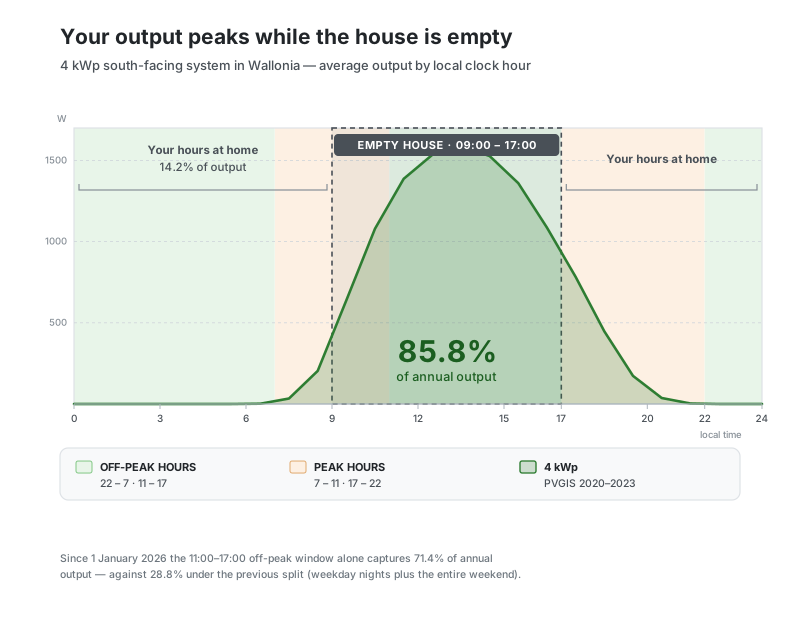
On a Walloon 4 kilowatt-peak system facing due south, 85.8% of annual output lands between 09:00 and 17:00. We computed that figure from four years of hourly European Commission data, converted to Belgian local time. Outside that window only 14.2% of the year remains — of which 0.3% before 08:00.
That is exactly the stretch in which a two-income household is not at home.
The reflex, at this point, is to conclude that a battery is needed. That is the wrong diagnosis, and an expensive one. The problem of a house left empty during the day is neither production nor hardware: it is the calendar and the wiring. Since 1 January 2026 the Walloon grid has moved its off-peak hours into the middle of the day — the share of output falling inside an off-peak window has gone from 28.8% to 71.4%, an exactly reversed ratio. And the appliance that absorbs an empty home’s surplus best is already in your house: the hot-water tank. It is simply wired to heat at three in the morning.
This article does not redo what is already written elsewhere on this site. “Solar surplus: the 5 options compared” ranks the five possible destinations for surplus by euro invested; “Solar panels 2026: still worth it in Wallonia?” covers profitability and the divide between pre- and post-2024 installations; “Reduce your electricity bill: Wallonia 2026” sets out the new tariff grid and the Impact tariff; “Energy self-consumption in Belgium” lays down the definitions; “Local electricity: the short-circuit guide” explains how to build a group by overlaying load profiles; “Join an energy community in Wallonia” describes the administrative route.
The question asked here is a different one: when the house is empty from 08:00 to 18:00, what actually shifts without you, by how much, and where is the ceiling?
The answer rests on three measured figures, and it contradicts the advice the sector repeats most often.
This article covers grid-connected residential solar in Wallonia. The network amounts quoted are those of the ORES 2026 grid; Flanders and Brussels have their own grids and their own time windows.
What “not being there” actually costs
Let us start by measuring the problem, because it is almost always stated the wrong way round.
Nothing is “wasted”. What you do not consume goes onto the grid and is paid for. What is lost is a gap in value, and it is a wide one.
| Destination of a kilowatt-hour produced | What it is worth |
|---|---|
| Consumed at home the moment it is produced | 36.94 c€ — the retail price you did not pay |
| Exported to the grid | 3.5 c€ — the export payment |
| Gap | 33.44 c€, a ratio of more than ten to one |
Assumptions: all-in retail price including VAT as recorded by the CREG in June 2026, and average export payment recorded by Test-Achats on 28 May 2026, both carried over unchanged from our earlier articles so that figures across the site stay comparable.
Applied to the reference case we use throughout the corpus — a 4 kilowatt-peak system, 3,800 kWh produced a year, a self-consumption rate of 37.76% as used by the SPW to compute the prosumer tariff — that gives:
- 1,435 kWh self-consumed, worth 530 €;
- 2,365 kWh exported, earning 83 €;
- 613 € a year in total.
The imbalance is plain: 62% of the volume produced generates only 13.5% of the revenue.
And for an absent household it is worse than that. The Belgian readings available put the self-consumption rate of a household with nobody home during the day closer to 30% than to the 37.76% reference. Test-Achats, which followed 34 households with panels over a full year, puts it bluntly: the highest percentages were recorded in households where somebody stayed at home during the day, on several days of the week.
It is the only published Belgian field measurement on the subject. It dates from October 2018 to October 2019 — we shall come back to that, because its age bears on how its results should be read, but no more recent data replaces it.
The operational question is therefore: how many of those 2,365 exported kilowatt-hours can be moved to the 36.94 c€ side, without being there?
1 January 2026 moved the off-peak hours onto your output
An event that went largely unnoticed changes the picture, and it matters more to an absent prosumer than to anyone else.
Since 1 January 2026 the Walloon dual-rate windows are, word for word according to the ORES tariff grid approved by the CWaPE on 18 December 2025:
Peak hours: from 7h to 11h and from 17h to 22h, Monday to Sunday Off-peak hours: from 11h to 17h and from 22h to 7h, Monday to Sunday
A six-hour off-peak window has opened in the middle of the day, and the weekday/weekend distinction has disappeared.
What it does to your output: the ratio flips
Here is the figure nobody publishes. We took four years of hourly output simulated by PVGIS — the tool of the European Commission’s Joint Research Centre — for a 4 kilowatt-peak system tilted at 35° due south in Namur, converted every hour to Belgian local time including daylight-saving changes, and sorted every kilowatt-hour into its tariff register.
| Dual-rate split | Share of output counted as off-peak |
|---|---|
| Old, until 31 December 2025: weekday nights and the whole weekend | 28.8% |
| New, since 1 January 2026: 11:00–17:00 and 22:00–07:00 | 71.4% |
Assumptions: PVGIS v5.3, SARAH3 radiation database, years 2020 to 2023, 35° tilt, due-south azimuth, 14% system losses. These percentages describe the shape of a curve and do not depend on the yield assumed; they therefore hold for any correctly tilted south-facing system. They should not be confused with yield: PVGIS computes 1,085 kWh/kWp here, whereas our articles use the more conservative 950 kWh/kWp for every calculation in euros.
The ratio has been exactly reversed. This is a different piece of information from the one we published on 28 July, which concerned time: off-peak hours now cover 15 hours out of 24, or 62.5% of the time. The share of output, by contrast, reaches 71.4%, because the 11:00–17:00 window does not capture six arbitrary hours: it captures the six most productive hours of the day.
What it really changes — and what it does not
Three readings, depending on your situation.
If your system predates 1 January 2024 and still enjoys compensation, your meter nets register by register. Your midday output is therefore now set against the off-peak register, that is, against your night-time consumption. A car charging at 23:00, a tank heating at 05:00: those consumptions can now be cancelled by the previous midday’s output, which was impossible on weekdays before 2026. Compensation runs until 31 December 2030.
If your system is more recent, you pay for your actual withdrawals. The kilowatt-hour you nonetheless have to buy from the grid at midday — because the sky is overcast, because it is December — then costs you less:
| ORES 2026 proportional term, excluding VAT | Value |
|---|---|
| Peak hours | 10.43 c€/kWh |
| Off-peak hours | 4.88 c€/kWh |
| Gap | 5.55 c€/kWh |
Assumptions: ORES periodic tariff grid for low-voltage withdrawal, valid from 1 January to 31 December 2026, amounts excluding VAT. VAT on electricity is 6%, which brings the gap to 5.89 c€/kWh including VAT. The other Walloon grid operators apply their own amounts over the same time windows.
And here is the perspective nobody will offer you. That 5.55 c€/kWh gain is real, but it is six times smaller than the 33.44 c€ that self-consuming the same kilowatt-hour is worth. The reform makes the right move a little more rewarding; it does not replace it, and it creates no self-consumption by itself. A household that changes none of its habits gains nothing from the reform, except on the kilowatt-hours it was already buying at midday.
The downside: the weekend loses out
A point the official communications pass over. Before 2026 the weekend was entirely off-peak, 48 hours. It now follows the common regime: 15 off-peak hours a day, so 30 hours. The weekend loses 18 off-peak hours.
The weekly balance stays positive — ORES counts 105 off-peak hours a week against 93 before — but it is positive on weekdays, and negative on Saturday and Sunday. For a household away from Monday to Friday and at home at the weekend, which is precisely the profile this article addresses, part of the announced benefit does not materialise: your heavy Saturday-afternoon loads stay off-peak, but the Saturday-evening ones move to peak.
The ranking of levers, measured
Now to what works. And let us start with the awkward result, because it inverts the usual hierarchy of advice.
The Test-Achats study already cited is, as far as we know, the only one to have measured the effect of each move on a Belgian sample rather than estimating it. Here is what it gives, in self-consumption points gained:
| Lever | Measured gain | Volume shifted | Worth, on our reference case |
|---|---|---|---|
| Large appliances during the day | +3 points | ~126 kWh/yr | ≈ 38 €/yr |
| Electric water heater under control | +13 points | ~660 kWh/yr | ≈ 165 €/yr |
| Electric car on a controllable charging point | +10 to +40 points | variable | depends on presence |
| Home battery of 5 kWh | 28% → 44% | — | ≈ 473 €/yr for 7,000 to 8,000 € |
| Electric heating | no gain | — | — |
Assumptions: gains in self-consumption points measured by Test-Achats on 34 households with panels between October 2018 and October 2019, as part of a European project; the car figure corresponds to a 10 kWp system. The conversion into euros applies the 33.44 c€/kWh gap to our reference case of 3,800 kWh produced. The gains do not add up mechanically: each lever is measured on the margin left by the previous ones.
Two comments are needed before going further.
This study is seven years old. The appliance stock has changed, so have tariffs, and today’s systems are better instrumented. We cite it because nothing has replaced it in Belgium, and because the orders of magnitude it establishes — a ratio of more than four between the tank and the appliances — are robust to those changes. But the reader should know what they are reading.
The most repeated piece of advice is the weakest. “Run your dishwasher at midday” appears in every leaflet. It earns three points, some forty euros a year. It is free, you should do it, and you should not believe it settles anything.
The reason is purely arithmetic, and the section on the ceiling makes it visible.
Your hot-water tank is wired to the wrong hour
Here is the most actionable point in this article, and the one we have seen stated nowhere.
The electric water heater is by far the best surplus absorber in a home. It combines four properties no other appliance brings together: its domestic hot water consumption is large, it is daily, it is fully shiftable in time, and above all it is indifferent to your presence. Heating water at 13:00 for a shower at 19:00 asks nothing of anybody: it is thermal storage that does not call itself that, and it costs ten times less than a battery.
Yet across much of the Walloon housing stock, that tank is not wired to the ordinary circuit.
The day/night contactor, and the exclusive-night meter
Two legacy devices, often confused:
- The day/night contactor is a small consumer-unit device that closes the tank circuit when the meter switches to off-peak, and cuts it when it returns to peak.
- The exclusive-night meter is a second, separate meter with its own EAN code, which feeds the tank — or storage heaters — only during a night-time window. ORES states that the most common windows are 22:00–07:00, or 21:00–06:00, and that they vary with the substation.
That wiring was perfectly rational for forty years: it bought hot water at the cheapest rate on the grid. It no longer is, for two cumulative reasons.
The first is tariff-related, and it comes from ORES, which writes it on its own page:
Since 1 January 2026, the distribution rates for the exclusive-night meter and for the off-peak hours of the dual-rate tariff are now aligned.
The direct consequence, stated by the grid operator itself: if your main tariff is the dual-rate one, there is no longer any specific advantage in keeping an exclusive-night meter. The advantage survives only if your main tariff is the single-rate one, in which case the distribution charges on the exclusive-night meter remain lower than those on the main meter.
The second is solar, and it is decisive. At 03:00 your roof produces nothing. Every kilowatt-hour the tank draws at that hour is bought from the grid. The same kilowatt-hour drawn at 13:00 would be produced by your own panels, free. The gap is not 5.55 c€ of distribution: it is 33.44 c€, the full value of a self-consumed kilowatt-hour.
In other words: the best surplus absorber in your house is wired to a time signal that no longer pays, and that works against your panels.
What to do, concretely
ORES in fact recommends it explicitly, noting that regrouping onto the main meter after removing the exclusive-night meter “can help you increase your self-consumption”. The steps, in order:
- Identify your configuration. Open the consumer unit and look for a contactor marked “day/night”, “HC” or “off-peak”. Then check your bill for a second EAN code: that is the signature of an exclusive-night meter.
- If it is a day/night contactor and you are on the dual-rate tariff, the tank has already been heating partly within the new 11:00–17:00 off-peak window, automatically, since 1 January 2026. Simply check that this is the case: some contactors have a switch left in a forced position.
- If it is an exclusive-night meter, its removal and the transfer of the circuit onto the main meter are requested from the grid operator. This is an electrician’s job, not a do-it-yourself one: the circuit has to be taken up in the main consumer unit.
- Then control it on production, not on the clock. A plain time switch set to 11:00–16:00 already captures the essentials. A solar diverter, which modulates the element on the surplus actually available rather than on a fixed window, does better — budget 400 to 900 € installed according to Belgian resellers, a figure no regulator publishes and which should therefore be taken as an order of magnitude.
One health warning, which is not negotiable: whatever control scheme you choose, the tank must reach 60 °C regularly to prevent legionella. A scheme that heated only on surplus, on overcast winter days, must keep a scheduled temperature rise.
Note finally what this lever is not. A heat-pump water heater, often presented as the top of the range, is an excellent appliance but a poor surplus catcher: its three-times-better coefficient of performance makes it absorb roughly three times fewer kilowatt-hours for the same volume of hot water. If your aim is to swallow surplus, the old resistive element is your ally.
What scheduling will never absorb
Now suppose you have done everything: tank transferred and controlled, dishwasher and washing machine on delayed start. Where is the ceiling?
It can be computed. Take an average June day, and compare what the roof produces over the off-peak window with what the empty house can swallow.
| Item, between 11:00 and 17:00 | Runs with nobody there? | kWh |
|---|---|---|
| Base load: fridge, freezer, ventilation, standby, router | yes, continuously | 1.5 |
| Hot-water tank under control | yes | 3.8 |
| Dishwasher, delayed start | yes | 0.8 |
| Washing machine, delayed start | yes | 0.8 |
| Tumble dryer | no — somebody has to move the laundry | 0 |
| Cooking, ironing, vacuuming, power tools | no — these need a presence | 0 |
| Total absorbable | 6.9 kWh | |
| Produced between 11:00 and 17:00, average June day | 10.4 kWh | |
| Surplus exported anyway | 3.5 kWh |
Assumptions: PVGIS output of 11.86 kWh over the 11:00–17:00 window for an average June day, scaled back to 10.4 kWh at the 950 kWh/kWp yield used across our other articles. Base load estimated at 250 W continuous. Domestic hot water set on the 800 to 1,400 kWh a year absorbable range used in our 18 August article, so 3.8 kWh on the most favourable day. Appliance cycles on eco programmes. Cloudless day; an overcast day reverses the problem, and a December day removes it.
The result deserves to be stated plainly: an empty house, fully controlled, saturates at around 7 kWh over the production window, while the roof puts out more than 10. And it saturates on a single item — the tank alone accounts for 55% of the available absorption capacity.
The reason is structural. A home’s shiftable consumption is small and discrete: a few cycles of less than a kilowatt-hour each. Production is large and continuous: nearly 2 kW of average power for six hours. You cannot fill one with the other. A dishwasher cycle absorbs less than half an hour of June production; five and a half hours remain.
Scaled to the year, that puts the ceiling of scheduling at around 50 to 55% self-consumption for an absent household, against 30% at the outset. Taking the gains measured by Test-Achats — three points for appliances, thirteen for the tank — the reference case moves from 37.76% to 53.76%, that is 608 extra kilowatt-hours self-consumed and about 203 € a year.
That is a great deal for an outlay of between nothing and nine hundred euros. And it is a ceiling: beyond it you need either a very large shiftable consumer, or somebody else.
Orient the roof differently? The arithmetic says no
One objection comes up regularly: if the problem is that output is concentrated at midday, should the panels not be split east-west rather than due south, to produce earlier in the morning and later in the evening, when the household is there?
The idea is appealing and the reasoning is sound. The result is not. We redid the calculation at constant installed capacity: 4 kWp due south on one side, 2 kWp east plus 2 kWp west on the other, same tilt, same location, same years.
| At 4 kWp installed | Due south | East-west, 2 + 2 |
|---|---|---|
| Annual output | 4,342 kWh | 3,459 kWh |
| Share outside the 09:00–17:00 window | 14.2% | 21.6% |
| Output during your hours at home | 615 kWh | 747 kWh |
Assumptions: PVGIS v5.3, SARAH3, 2020-2023, 35° tilt, 14% losses, azimuths 0°, −90° and +90°. These absolute values serve only to compare two orientations with each other; they rest on the PVGIS yield of 1,085 kWh/kWp and not on the 950 kWh/kWp used for the site’s financial calculations.
East-west does indeed do better on the intended criterion: +132 kWh produced while you are at home. But it pays −883 kWh of total output for it. You trade seven kilowatt-hours of production for one better-placed kilowatt-hour. Even valuing the first at 3.5 c€ and the second at 36.94 c€, the trade still loses.
The practical conclusion: do not choose east-west for self-consumption. Choose it when the roof geometry requires it, when available area is not the constraint, or to limit inverter clipping — those are good reasons. Alignment with your timetable is not one.
The only lever that does not require being there
Every lever examined so far shares one limitation: it assumes that you shift a consumption. When the house is empty, the raw material is missing.
Energy sharing works the other way round. It does not shift your consumption: it borrows somebody else’s, whose load curve is full at the moment yours is flat. A neighbour working from home, a school, a shop, a doctor’s practice, a municipal administration: all of those profiles consume between 09:00 and 17:00, which is exactly where your 85.8% sits.
It is the only lever in this file that asks no change of habit from you, and that is why it suits an absent household particularly well.
The rule that decides everything: the quarter-hour
Sharing settles quarter-hour by quarter-hour. The CWaPE defines the operation as the distribution among participants of energy “injected into the local distribution or transmission network and consumed within the same quarter-hour”.
That rule has a consequence many discover too late: whatever is not absorbed at the instant it is produced goes to export, however many participants are signed up. Adding neighbours who, like you, are away during the day does not raise the shared volume by a single kilowatt-hour. It is not the number of participants that counts, it is the shape of their load curve. We set out this profile-overlay mechanism in “Local electricity: the short-circuit guide”.
The two routes genuinely open in Wallonia
Caution is called for here, because Walloon law is narrower than the sector’s communication suggests.
Sharing within a single building. It requires neither a legal entity, nor articles of association, nor authorisation from the regulator: a notification to the grid operator is enough. And it carries the most substantial tariff advantage in the scheme, written in full in the ORES 2026 grid: an 80% reduction on the proportional term for shared energy, under aggregation codes E216 in distribution and E526 in transmission. You still have to be in a building within the meaning of the order: a fixed, covered and closed construction comprising at least two parts used autonomously, or several constructions under a single co-ownership. A detached house does not qualify; a block of flats does — that is the subject of “Energy sharing in a condominium: the guide”.
The energy community. This is the route open to everybody else, and it requires a legal entity, articles of association and a CWaPE authorisation. It carries no tariff reduction: grid charges, taxes and surcharges remain due on shared electricity.
And one closed route, which must be named. Direct sharing between two neighbours who are neither in the same building nor in a community — peer-to-peer — has been provided for by Walloon decree since 2022, but it still lacks the implementing order that would make it operational. The CWaPE page devoted to sharing still opens, to this day, only the two routes above. Any content promising you that you can “sell your surplus to your neighbour” in Wallonia is describing a regime that does not yet exist. We documented that state of the law, region by region, in “Cheaper electricity without switching supplier”.
What it earns, without exaggeration
Take the reference case again after the tank and appliances are under control: 53.76% self-consumption, so 1,757 kWh still exported. Shared at an internal transfer price of 6 to 10 c€/kWh instead of 3.5 c€ of export:
| Internal transfer price | Annual gain on the exported remainder |
|---|---|
| 6 c€/kWh | ≈ 44 € |
| 10 c€/kWh | ≈ 114 € |
Assumptions: exported remainder after applying the Test-Achats gains to the reference case of 3,800 kWh. Internal transfer price range carried over from our 20 July article. Excluding any supplier administrative fees, which run from 0 to 150 € per EAN code depending on the player — a line to check before committing, because it can cancel the gain.
It is no miracle, and we prefer to say so. But it is a gain that costs no investment and no change of habit — the two resources an absent household is shortest of. On the ranking by euro invested we drew up on 18 August, that is what puts sharing at the top.
What not to do
Four false good ideas, in order of frequency.
Buying a battery first. It is the intuitive answer to the problem of absence, and it costs in the order of 7,000 to 8,000 € for a payback approaching fifteen years — longer than the usual warranty, and with no subsidy in any Belgian region in 2026. Storage is not absurd; it is simply the last step, not the first. The controlled tank does a good share of the work for a fraction of the price.
Switching to the Impact tariff without checking. The Walloon incentive tariff opens a one-to-five ratio between the ECO band and the PIC band, which is spectacular. But its windows are not those of the dual-rate tariff — 22:00–01:00 is off-peak under dual-rate and MEDIUM under Impact — and for a prosumer under compensation, how it meshes with compensation depends on the supplier’s commercial offer and can make the reckoning unreadable. If you are under compensation, the revised dual-rate tariff remains the default choice.
Moving to a dynamic contract because you have panels. This is the costliest misreading. We flagged it in “Which electricity tariff to choose in Belgium?”: 99% of households with panels paid more under dynamic pricing, with a median rise of 20%, precisely because their surplus arrives when market prices collapse.
Oversizing the system. Adding panels when you already self-consume little amounts to increasing the share sold at 3.5 c€. For an absent household, each additional kilowatt-peak has a lower marginal return than the last. The right order is to fill the curve before enlarging it.
What to take away
- 85.8% of the annual output of a south-facing system lands between 09:00 and 17:00, and only 0.3% before 08:00. A household away during the day does not have a production problem: it has a simultaneity problem.
- 1 January 2026 reversed the ratio. The share of output counted as off-peak goes from 28.8% to 71.4%. This is structural for systems under compensation, whose midday output is now set against night-time consumption.
- The reform does not replace self-consumption. It is worth 5.55 c€/kWh; self-consuming is worth 33.44 c€/kWh. A ratio of six.
- The most repeated advice is the weakest. Running appliances at midday earns three self-consumption points, some forty euros a year.
- The hot-water tank earns four times more — and it is wired wrong. Thirteen measured points, about 165 € a year. But across much of the stock it hangs off a contactor or an exclusive-night meter which ORES itself says has had no tariff advantage since 1 January 2026. That is the first thing to check in the consumer unit.
- Scheduling hits a ceiling, and the ceiling can be computed. A fully controlled empty house saturates at around 7 kWh over the 11:00–17:00 window, when the roof puts out more than 10 on a June day. That is about 53.76% self-consumption and 203 € a year better off.
- What not to expect from it. Beyond the ceiling, only a very large shiftable consumer or energy sharing gets past — and sharing, in Wallonia, is open only within a single building or an energy community, peer-to-peer remaining inoperative. On the exported remainder it is worth 44 to 114 € a year: real, free, and no more than that.
Let the people who are there consume your surplus
OptimCE is an open-source platform built for Belgian energy communities: quarter-hourly allocation key, participant register, statements and invoicing. If your house is empty at midday, your neighbour’s may not be.
FAQ
How much of my solar output is really wasted if I work away from home?
Nothing is wasted in the strict sense: whatever you do not consume is exported and paid for. What is lost is the gap in value. A self-consumed kilowatt-hour spares you buying at 36.94 c€; exported, it earns you about 3.5 c€. The gap is 33.44 c€, a ratio of more than ten to one.
On the reference case — 3,800 kWh produced, 37.76% self-consumed — that means 530 € of avoided purchase and 83 € of export, so 613 € a year: 62% of the volume generates only 13.5% of the revenue. An absent household sits closer to 30% self-consumption.
Does the off-peak change of 1 January 2026 help me if I have panels?
Yes, but less than announced. The share of output falling off-peak goes from 28.8% to 71.4%. For a system under compensation, midday output is now set against the off-peak register, and therefore against night-time consumption. For everyone else, the kilowatt-hour bought at midday costs 5.55 c€ less in distribution.
But that gain is six times smaller than the 33.44 c€ that self-consuming the same kilowatt-hour is worth. And the weekend, once entirely off-peak, loses 18 off-peak hours.
What does running the dishwasher and washing machine at midday actually change?
Three self-consumption points, around 126 kWh a year, so roughly 38 € — that is the Test-Achats field measurement on 34 households. It is free and you should do it, but it is the weakest lever in the file while being the most recommended.
The arithmetic explains it: one cycle uses less than a kilowatt-hour when the roof puts out more than 10 between 11:00 and 17:00 in June. And the tumble dryer, the largest of the three, is precisely the one you cannot schedule — somebody has to move the laundry.
Why is my hot-water tank the best lever, and what should I do about it?
Because it is the only appliance whose consumption is large, daily, fully shiftable and indifferent to your presence: thirteen measured points, 660 kWh a year, more than four times the appliances.
The obstacle is the wiring. Across much of the Walloon stock it hangs off a day/night contactor or an exclusive-night meter closed between 22:00 and 07:00. ORES writes that since 1 January 2026 the rates for the exclusive-night meter and dual-rate off-peak hours are aligned: there is therefore no advantage in keeping it if you are on the dual-rate tariff. Check the consumer unit, move the circuit onto the main meter, then control it over 11:00–16:00 — keeping a rise to 60 °C against legionella.
Do I need a home battery if I am away all day?
That is the intuitive answer, and almost always the wrong one. A battery lifts self-consumption from about 37.76% to about 75%, nearly 473 € a year net of the export forgone — for 7,000 to 8,000 € and a payback approaching fifteen years, longer than the warranty, with no subsidy in any Belgian region in 2026.
The rational order is: tank, then car if it is there, then sharing the remainder. The battery after that, or as a resilience purchase — which is a different question from profitability.
Does energy sharing work when you are never at home?
It is the only lever that asks nothing of you: it borrows somebody else’s consumption — a neighbour working from home, a school, a shop — instead of shifting yours. It settles quarter-hour by quarter-hour: only energy produced, injected and consumed within the same quarter-hour is shared.
Two caveats in Wallonia. Peer-to-peer between neighbours outside a building and outside a community still lacks its implementing order, so it is inoperative; the two open routes are sharing within a building, which carries an 80% reduction on the proportional term, and the energy community, which carries none. And the order of magnitude: on the exported remainder, sharing is worth 44 to 114 € a year.
Sources
- European Commission, Joint Research Centre — PVGIS 5.3 — the source of every hourly-distribution percentage in this article. Hourly series computed for Namur (50.4674; 4.8718), SARAH3 radiation database, years 2020 to 2023, 4 kWp, 35° tilt, 0° azimuth, 14% system losses, then each UTC hour converted to Belgian local time with daylight-saving changes applied. Accessed on 12 September 2026.
- CWaPE — ORES Assets, periodic electricity distribution tariffs, low-voltage withdrawal 2026 — primary source for the time windows and the amounts: peak hours from 7h to 11h and from 17h to 22h, off-peak hours from 11h to 17h and from 22h to 7h, Monday to Sunday; Impact bands PIC 17h-22h, MEDIUM 7h-11h and 22h-1h, ECO 11h-17h and 1h-7h; dual-rate proportional term of 0.1042868 and 0.0487574 €/kWh excluding VAT; 80% reduction on the proportional term for energy shared within a single building, aggregation codes E216 and E526. Approved on 18 December 2025, valid from 1 January to 31 December 2026. Accessed on 12 September 2026.
- ORES — The dual-rate tariff changes its schedule — confirmation of the new windows, alignment of the weekend on the weekday regime, and the count of 105 off-peak hours a week against 93 in 2025. Accessed on 12 September 2026.
- ORES — Everything about the exclusive-night meter — the source for the hot-water-tank section: alignment of the distribution rates for the exclusive-night meter and dual-rate off-peak hours since 1 January 2026, disappearance of the specific advantage for dual-rate customers, windows of 22:00–07:00 or 21:00–06:00 depending on the substation, and the recommendation to regroup onto the main meter to increase self-consumption. Accessed on 12 September 2026.
- ORES — Impact, a new tariff for flexible consumers — the three ECO, MEDIUM and PIC bands, their windows, access conditions, and the fact that keeping compensation depends on the supplier’s commercial offer. Accessed on 12 September 2026.
- Wallonia portal — On 1 January 2026, the dual-rate tariff changes its schedule — the official rationale for moving the off-peak hours: to encourage consumption at the moments when renewable electricity supply is most abundant. Published on 31 October 2025, accessed on 13 September 2026.
- CWaPE — Energy sharing — definition of sharing as the distribution of energy injected and consumed within the same quarter-hour, and the exhaustive listing of the two open routes: a group of active customers within a single building, or participants in an energy community. Source for the statement that peer-to-peer remains inoperative in Wallonia. Accessed on 12 September 2026.
- Test-Achats — How to increase self-consumption of photovoltaic electricity? — field study on 34 households with panels between October 2018 and October 2019, as part of a European project. Source of the measured gains: 3% for appliances shifted into the day, that is 126 kWh, 13% for a controlled electric water heater, that is 660 kWh, 10 to 40% for an electric car on a 10 kWp system, 28% to 44% with a 5 kWh battery, no gain for electric heating. Also the source of the finding that the highest rates occur in households where somebody stays at home during the day. Article updated on 24 July 2025, accessed on 13 September 2026.
- Test-Achats — How to find the best export tariff for your surplus solar electricity? — reading of 28 May 2026: from 0.94 to 4.90 c€/kWh in Flanders and Wallonia, and the predominantly variable nature of these tariffs. Source of the 3.5 c€/kWh export value used in all our calculations. Accessed on 12 September 2026.
- SPW Économie — Photovoltaics: information on the prosumer tariff — the official self-consumption assumption of 37.76% used as the basis for computing the prosumer tariff, and the distinction between capacity-based and proportional calculation. Updated on 27 May 2026, accessed on 13 September 2026.
- ORES — Photovoltaic systems commissioned before 1 January 2024 — retention of annual compensation until 31 December 2030 for systems certified before that date, and automatic application of the most favourable tariff formula. Accessed on 12 September 2026.
- CWaPE — Energy communities and energy sharing — the applicable framework, model agreements, freedom to choose the allocation key applied by the grid operator, and the absence of any tariff reduction for sharing within an energy community. Accessed on 12 September 2026.
- Union of Walloon Cities and Municipalities — CWaPE report on the evaluation of the framework for energy communities, energy sharing and self-consumption — the finding of development held back by a combination of legal, administrative and economic obstacles, and the absence of an independent facilitator for project holders. Report of February 2025, accessed on 13 September 2026.
- CREG — Energy price dashboard — the source of the all-in retail price of 36.94 c€/kWh including VAT used across all our articles since the June 2026 reading. Accessed on 12 September 2026.
- SPW Énergie — Incentive pricing — the official Walloon position on shifting consumption: favour the solar hours or the night-time troughs for energy-hungry appliances, and consume photovoltaic output at the moment it is generated. Accessed on 12 September 2026.