
Renting: the no-roof guide to solar
In Wallonia, 36.2% of dwellings are not occupied by their owner. For apartments alone, across the country, the figure is 69.4% — close to seven in ten. Both come from Statbel’s 2021 census, and they describe a population that every piece of solar content on this site has so far ignored.
Because everything we have published about photovoltaics assumes the same thing: a roof, and the right to touch it.
A tenant has neither. No access to grants, no signature on the quotes, no vote at the general meeting. The advice they get, when they get any, fits in one sentence: wait until you own. Since 17 April 2025, that sentence has been wrong. On that date, plug & play photovoltaic kits — one or two panels, a micro-inverter, a socket — became legal in Belgium, having been legal nowhere before. A tenant can now own a generating installation. Better still: it comes apart and leaves with them.
This article does not redo what is already written elsewhere on this site. “Join an energy community in Wallonia” describes the administrative procedure and already sets out the principle that sharing follows the EAN rather than the title deed; “Energy sharing in a condominium: the guide” covers the three Civil Code locks and the asymmetry between the person who votes and the person who consumes, but from the managing agent’s point of view; “Solar panels 2026: still worth it in Wallonia?” works out the economics of a 4 kilowatt-peak roof; “Cheaper electricity without switching supplier” compares how accessible sharing really is across the three regions; “Energy poverty in Wallonia: available support” documents why tenants are the most exposed; “Energy self-consumption in Belgium” lays down the definitions.
The question asked here is a different one: when you own neither the roof, nor the walls, nor the building, what exactly do you own — and what does Belgian law allow you to do with it?
The answer comes down to two objects and one scheduling constraint that nobody mentions.
This article covers residential renting in Wallonia. The network amounts quoted are those of the 2026 ORES grid, and the prices are carried over from our earlier articles so that the figures across the site stay comparable. One section is given over to Brussels and Flanders, whose rules differ on decisive points. We do not cover condominiums from the managing agent’s angle, nor how to set up an energy community; each has its own guide.
What you actually own
Let us start with the inventory, because it is shorter than people think — and more useful.
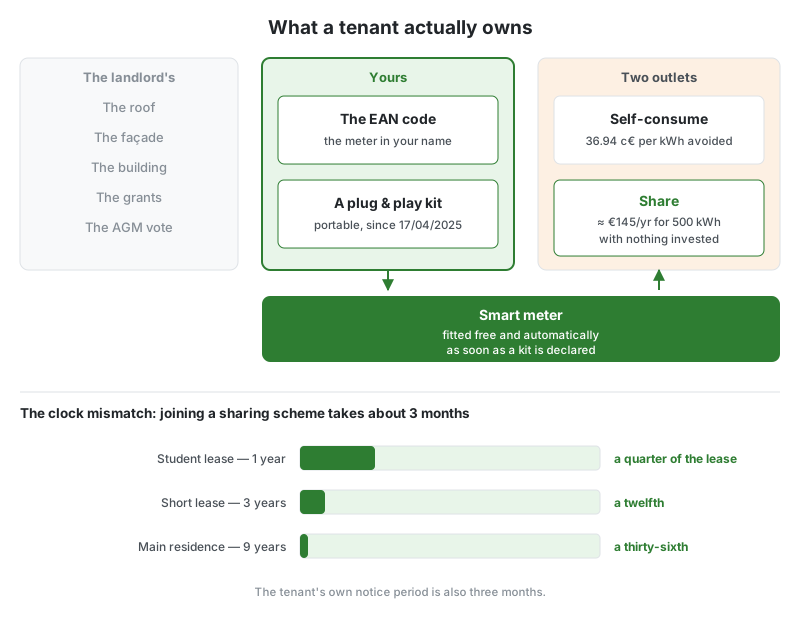
You do not own the roof. You do not own the façade. You have no claim on the regional investment grants, which go to whoever commissions the work. You do not sit on the general meeting that would decide to equip the building. On everything the industry calls “going solar”, you have no purchase at all.
You own two things.
The first is an EAN code: the supply point, the meter, the contract in your name. It is an administrative asset, it does not look like much, and yet it is the only object Belgian energy law looks at. The participant in a sharing scheme is not the owner of the wall, it is the holder of the supply point. That principle is already set out in our guide to joining an energy community; we take it here as a starting point, not as a conclusion.
The second is new, and it is what justifies this article: since 17 April 2025, you can own a generating installation that is not incorporated into the building. It is set down, plugged in, taken apart. Legally, it is movable property. Practically, it is the first time a Belgian tenant has been able to generate electricity without asking a wall for permission.
What follows examines both, in that order — then explains why the order is not the one you would expect.
The plug-in kit: what changed on 17 April 2025
The CWaPE defines a portable photovoltaic kit — “plug & play” in the regulator’s vocabulary — as an assembly of one or more photovoltaic panels, one or more micro-inverters, a mounting system and the necessary cabling, designed to be plugged into a standard socket. No fixed connection to the consumer unit, no certified installer, no electrical inspection.
The regulatory shift is dated and documented. Synergrid, the federation of network operators, published edition 2.3 of its C10/11 technical prescription on 17 October 2024, in which, in its own words, “the fixed connection requirement has been removed”. The CWaPE validated that change on 26 September 2024. The authorisation has been effective since 17 April 2025. The Walloon regulator puts it plainly in its communication of the same day:
Previously prohibited, their installation in the Walloon Region and in the country’s other Regions is authorised from 17 April 2025.
The words that matter are “previously prohibited”. For years, Belgium was the European exception on this point: what Germany, Austria and the Netherlands had long allowed was illegal here, because C10/11 required a fixed connection to the consumer unit. That sentence, and that sentence alone, is what changed.
The 800-watt ceiling does not exist
Let us dispose straight away of the most repeated claim on the subject, because it is false and it is everywhere.
Almost every Belgian commercial website announces a legal limit of 800 W per dwelling. No Walloon text sets that limit. The Walloon energy administration writes exactly the opposite:
Consideration is currently under way, at federal and regional level, with a view to possibly setting a power limit for this type of kit, in order to guarantee the safety of electrical installations and of users.
“With a view to possibly setting”: the limit is under study, it is not in force. The same page specifies that Brussels recommends not exceeding two panels, roughly 800 W, and that Flanders advises limiting inverter power to under 800 W. These are recommendations, they are regional, and neither of them is Walloon.
Synergrid, for its part, writes that the power of plug & play devices is “in principle limited to 2,600 W” and that “several authorities already recommend limiting the combined inverter power of plug & play devices to 600 W - 800 W for safety reasons”. And the CWaPE describes the typical kit as producing “on average between 400 and 800 W”, which describes a market, not a legal boundary.
We labour the point because it has a practical consequence that runs the other way from what people imagine: the real constraint is not regulatory, it is electrical, and it is more serious than any administrative ceiling. The CWaPE explains it in a sentence worth reading twice:
A circuit breaker protects this electrical circuit against current coming from the network, but it does not “see” the current injected directly onto the circuit by the plug & play photovoltaic kit if an appliance plugged into the same circuit is consuming it.
In other words: the kit can push current through the cable that the protection ignores. The regulator gives the example of a 2.5 mm² circuit protected by a 20 A breaker with a maximum of eight sockets, and concludes that there is a risk of overheating and then fire if the safety margin is exceeded. Two rules follow, and they are not negotiable: never a portable extension lead, and a wall socket in good condition on a circuit in good condition. Connection to a dedicated circuit is “strongly recommended”, but — the CWaPE says this too — “it is not required”. If in doubt, an electrician costs less than the kit.
Declaration is compulsory, and it has a decisive side effect
This is where the file becomes interesting, and it is the point nobody connects.
Declaring to the network operator is not optional. The CWaPE:
Any decentralised generation installation, with a fixed or mobile plug & play connection, must be declared to the DSO and must follow the commissioning procedure laid down in the specific technical prescriptions for connecting decentralised generation installations (C10/11).
In practice this goes through the UP10 form, available on the Walloon energy administration’s site and on the operators’ own — ORES, RESA, REW, AIESH or AIEG depending on your municipality. Failing to declare is not a mere oversight: the administration states that an active customer exposes themselves to a “retroactive calculation of the fees, taxes and surcharges owed”, and that the CWaPE may impose an administrative fine after a formal procedure with notification, a hearing and a right of appeal.
Now, that declaration triggers something else:
Since 1 January 2024, the installation and activation of the communicating function of a communicating meter takes place systematically when the network user commissions a new electricity generation installation with a power of 10 kVA or less.
And, two sentences further on:
replacing an electromechanical meter with a communicating meter, which is necessary in order to meet the obligation referred to above, is free of charge, in accordance with the DSO tariffs approved by the CWaPE.
Remember the sequence, because it is the backbone of this article. You plug in a kit. You declare it. A communicating meter is fitted, free of charge. And the communicating meter is precisely — we are coming to this — the only condition of access to energy sharing.
The prosumer tariff does not apply, and not for the reason people think
Many readers will stop here thinking they have just signed up for the prosumer tariff, which would sink the whole operation: on the 2026 grid, the capacity term runs at around €81 excluding VAT per kilowatt per year at ORES. On a 0.8 kW kit that would be about €65 — nearly as much as the kit earns.
That is not what happens, and the mechanism deserves to be set out properly because it is consistently garbled.
The “prosumer tariff” is not a tax on generating. It is, on the CWaPE’s own definition, the flat-rate charge billed to prosumers “whose gross withdrawals cannot be determined, because they do not (yet) have a two-way meter”. It is a metering fallback: we cannot measure, so we apply a flat rate. The regulator’s “Billing of network costs” page puts it in two branches that leave no room for doubt:
| Your situation | What is billed |
|---|---|
| You have a two-way or communicating meter | Proportional tariffs in €/kWh apply to the gross volume withdrawn |
| You do not | A capacity tariff in €/kWe, “known as the prosumer tariff”, applies to the net developable power |
Assumptions: both formulations are taken word for word from the CWaPE’s “Billing of network costs” page, consulted on 16 September 2026. The indicative figure of €81/kWe excluding VAT is the order of magnitude of the 2026 ORES grid already cited in our 11 August article, where we explain the gap between the amounts with and without VAT.
The consequence is mechanical. Declaring a kit gets a communicating meter fitted; the communicating meter makes gross withdrawal measurable; the capacity flat rate therefore no longer has any object. The kit does not escape the prosumer tariff by exemption: it leaves through the metering door.
The prosumer advocacy association BeProsumer has noticed the outcome and objects to it vigorously, holding that “a technical and regulatory discrimination exists between traditional installations and plug & play kits”, the former being subject to the prosumer tariff and to inspection and insurance obligations from which the latter are exempt. The observation is accurate. The cause, however, is not a favour granted to kits: it is that Wallonia has made the communicating meter systematic for all new generation since 2024, and that the flat rate only makes sense in the absence of measurement.
What the kit actually earns
Now to the euros. And let us say at once: this is where most of the available articles become fanciful, in both directions.
The value of a kilowatt-hour generated depends only on where it goes, and the gap is the one we use across the whole corpus:
| Where a kilowatt-hour goes | What it is worth |
|---|---|
| Consumed at home the moment it is generated | 36.94 c€ — the retail price you did not pay |
| Injected into the network | 3.5 c€ — the injection payment |
| Gap | 33.44 c€, a ratio of more than ten |
Assumptions: all-in retail price including VAT recorded by the CREG in June 2026 and average injection payment recorded by Test-Achats on 28 May 2026, carried over unchanged from our earlier articles.
For a kit, two variables and only two decide the outcome: where you can put it, and what share of it you consume directly.
On the first, the Walloon energy administration publishes a broad and honest range: from 200 to 1,038 kWh per kilowatt-peak per year, depending on orientation, tilt and shading. That fivefold spread is the central fact of the file for a tenant, because a tenant does not choose their exposure: they have the balcony they have.
On the second, a temptation has to be resisted. The 37.76% self-consumption rate that the administration uses to calculate the prosumer tariff, and that we use everywhere else on this site, applies to a 4 kilowatt-peak installation. It does not apply here, and applying it would understate the kit. At midday in June, an 800 W kit generates less than the continuous draw of a fridge, a router, a ventilation unit and the standby loads of an occupied home. In other words it stays most of the time below the household’s baseload, and is therefore absorbed in full. The CWaPE confirms this indirectly by writing that such a kit covers “about 10 to 20% of a household’s consumption”: set against a realistic yield, that implies a self-consumption rate well above that of a roof. What the small installation loses in volume, it gains in rate.
Here, then, is the calculation, for a 0.8 kWc kit bought for around €800 — the administration works with an order of magnitude of €1/Wc for this format, micro-inverters included:
| Where you can put it | Annual generation | Value at 40% self-consumed | Value at 70% self-consumed |
|---|---|---|---|
| Terrace or flat roof, tilted, due south | 760 kWh | €128 — payback 6.2 years | €204 — payback 3.9 years |
| Vertical balcony railing, due south | 532 kWh | €90 — payback 8.9 years | €143 — payback 5.6 years |
| Vertical railing, east or west | 380 kWh | €64 — payback 12.5 years | €102 — payback 7.8 years |
| Vertical railing, due north | 200 kWh | €34 — payback 23 years | €54 — payback 15 years |
Assumptions: a 0.8 kWc kit at €800 including VAT, the order of magnitude of €1/Wc published by the Walloon energy administration. The yields on the first three rows are interpolated within the 200 to 1,038 kWh/kWc range published by that administration; they do not come from a PVGIS simulation and should be read as orders of magnitude, not as measurements. Valued at 36.94 c€/kWh self-consumed and 3.5 c€/kWh injected. Excluding mounting hardware, labour, module degradation and any change in the price of electricity.
Two readings follow.
First, the administration itself publishes an estimate of 7 to 11 years payback for a 0.8 kWc installation, based on work by Renouvelle. Our figures are more favourable as soon as self-consumption exceeds 40%, and it is worth saying exactly why: that is the only differing assumption. The administration writes that self-consumption “should ideally exceed 40% for the installation to pay for itself” and reasons on that threshold; we take the view that a kit of this size does better, for the baseload reason set out above. If you keep only one figure, keep the regional regulator’s: 7 to 11 years. Ours is a more optimistic assumption, not a measurement.
Second, and more importantly: orientation decides everything, and it decides more than the price of the kit does. Between the first and last rows of the table, payback moves from four years to twenty-three. A tenant whose only outdoor space is a north-facing balcony does not have a weak case: they have no case. Better to know that before buying than to arrive at it through disappointment.
The dissenting voice, and why we quote it
BeProsumer, the association representing Walloon prosumers, explicitly advises against these kits. Its argument is not technical but precautionary: the association recalls that it was founded on the observation that regulatory texts can be amended after the fact to prosumers’ detriment, and considers that “there is not yet enough hindsight to measure the administrative consequences and the potential financial impact” of such a declaration.
We do not share that conclusion where a tenant is concerned — the association’s reasoning is aimed mainly at households already equipped and still benefiting from net metering, who therefore have something to lose. But the warning is well founded and we would rather pass it on than suppress it. It comes with an operational tip we are glad to repeat: do not declare your kit at the end of the generating season. Any administrative change can trigger a meter reading and an interim bill at an unfavourable moment.
A special case follows from this. If you rent a home already equipped with panels commissioned before 1 January 2024, and therefore still under net metering, the CWaPE specifies that an extension, “fixed or mobile of the plug & play type”, increasing power by at most 1 kW while staying under 10 kVA in total, does not forfeit the right to net metering. The margin is narrow: an 800 W kit passes, two kits do not.
The communicating meter opens the second door
Back to the sequence. You have declared a kit, a communicating meter has been fitted, free of charge. Without setting out to, you have just met the sole entry condition for energy sharing.
Because the condition of access to sharing is not about property, it is about metering. The Walloon energy administration puts it this way: “each participant must be equipped with a two-way meter with quarter-hourly remote reading or with a communicating meter”. Nowhere is it required that you own anything, that you have invested, or that you generate at all.
And the same site is explicit about who is meant. Sharing is open to everyone, “including to tenants and to households in precarity who are not in a position to invest on their own”.
It is worth weighing what that means. The scheme Wallonia designed for people who cannot invest requires equipment that Wallonia installs itself, free of charge, but as a priority for those who generate. A tenant who generates nothing depends instead on the general roll-out schedule, which ORES is running until the end of 2029. They can also ask their network operator to fit one directly, and it is free; but you have to know that is possible, and ask.
This is why we put the kit before sharing in this article, even though sharing earns more. Not because the kit is superior, but because it is the shortest and best-signposted route to the meter on which everything else depends. An €800 kit that earns you €143 a year and, along the way, gets you the meter that opens up sharing worth €145 a year, does not have the same balance sheet as a kit considered on its own.
Receiving without owning: what sharing is worth to a tenant
Energy sharing is the only Belgian energy-saving scheme that requires no upfront investment at all. You do not switch supplier, you cancel nothing, you install nothing. Part of the electricity you already consume is billed to you at an internal price, agreed in a sharing agreement, instead of your contract price.
The documented order of magnitude, which we carry over unchanged from our earlier articles, is around €145 a year for a consumer receiving 500 kWh of shared energy on the standard tariff, according to the case costed by Énergie Commune within the Interreg Europe programme.
Three caveats, all of them important for a tenant.
The social tariff changes the sum. For a household already on the social tariff, the same case falls to around €70 a year, because the social tariff already caps the energy component. And there is something more binding: the CWaPE requires residential participants to waive the social tariff on the shared portion of their electricity. Since tenants are over-represented among protected customers — our article on energy poverty records that 33.0% of private-sector tenants and 45.5% of social housing tenants are in energy precarity, against 15% of owners — this caveat concerns a large share of this article’s readership. It does not make sharing unattractive, but it does mean doing the sum before signing.
Administrative fees can swallow the gain. Depending on the supplier, they run from €0 to €150 per EAN code. Against a gain of €145, that is not a detail: it is the first figure to ask for.
Not every door is open in Wallonia. Sharing between neighbours — peer-to-peer — has been in the decree since 2022 but remains inoperative for want of an implementing order. Two routes remain: sharing within the same building, which requires no legal entity and carries an 80% reduction on the proportional distribution term, and joining an energy community. For a tenant in an apartment, the first is far better — but it presupposes that someone in the building has equipped the roof. For a tenant in a house, only the second exists.
And there a figure cools the enthusiasm: as at 16 September 2026, the CWaPE lists thirteen notified energy communities, of which only five have an authorised sharing operation. The most recent notification dates from 23 July 2026. The scheme is real, it is legal, it works — but it is still rare, and the odds of one existing at your address are slim. That is one more reason not to stake your whole strategy on sharing alone.
The clock mismatch
Here is the constraint we have seen stated nowhere, and which ought to be a tenant’s first decision criterion.
Joining a sharing scheme takes time, and that time is written into the regulations. Article 7 of the Walloon Government decree of 17 March 2023 sets out a cascade of notifications: ten working days for the acknowledgement of completeness, twenty for verification of the conditions and dispatch of the model agreement, ten for the return of the signed agreement, then a start on the twentieth working day that follows, with suppliers informed at least fifteen working days beforehand. That comes to, as we wrote in the condominium guide, about sixty working days if the file is complete first time — close to three calendar months.
Now set that delay against the length of your lease. The Walloon decree of 15 March 2018 on residential leases distinguishes three main forms:
| Form of lease | Term | Tenant’s notice | What three months of procedure represents |
|---|---|---|---|
| Student lease (art. 80) | One year, unless a shorter term is agreed | Own regime under chapter 5 | A quarter of the lease |
| Short lease (art. 55, § 6) | Three years maximum, extensions included | Three months before expiry | A twelfth of the lease |
| Main-residence lease (art. 55, § 1) | Nine years, extended in three-year periods | Three months before expiry | A thirty-sixth of the lease |
Assumptions: terms and notice periods read in the decree of 15 March 2018 on residential leases, version in force on 1 July 2024 published on Wallex. The sharing delay is taken from article 7 of the Walloon Government decree of 17 March 2023, already detailed in our condominium guide.
The symmetry is striking and nobody points it out: the time it takes to enter a sharing scheme is, near enough, the notice period for leaving your home. Three months on one side, three months on the other. On a nine-year lease, that symmetry does not matter at all. On a one-year student lease it decides everything: by the time sharing starts, half the academic year has gone.
From which follows a simple decision rule, one that reverses the usual order of questions:
- Main-residence lease, or a short lease you intend to extend: sharing is the better lever. No investment, around €145 a year, and the start-up time dissolves into the length of occupancy. Begin there.
- Student lease, or a stay of less than a year: sharing will not have time to take effect. The kit, by contrast, generates the day you plug it in — and it will follow you to the next address.
- You do not know how long you will stay: this is the most common case, and it is the strongest argument for the kit. It is the only one of the two whose value does not depend on how long you remain at this address.
One variable escapes both. If your home does not yet have a communicating meter and you do not install a kit, you depend on the ORES roll-out, scheduled until the end of 2029. You can ask for one to be fitted — it is free — but the request adds to the delay, it does not replace it.
When the landlord says no
The question has to be handled straight, because it is the one everyone asks and the available answers are evasive.
Start with what the regulator says. The CWaPE devotes one paragraph to the subject, and here it is in full:
Where a dwelling is rented, it is also recommended to contact the owner in order to inform them and obtain their agreement. The rental contract may contain specific provisions in this respect.
The verb is “recommended”, not “required”. The regulator does not make the landlord’s agreement a condition of your installation’s legality — it refers you to the lease, which is a different matter.
We read the Walloon decree of 15 March 2018 to find out what it says about improvements made by the tenant on their own account. It says nothing. The decree regulates the landlord’s works at length: article 21 obliges the tenant to put up with “energy-saving works, the list of which is drawn up by the Government”, article 55, § 3 lets the landlord terminate in order to rebuild or renovate, article 58 lets them obtain a rent review if works carried out at their expense have raised the rental value by at least ten per cent. Article 50 organises the renovation lease, but it targets works “incumbent on the landlord” — putting a panel on your balcony falls into none of these categories.
In other words, the question is settled neither in energy law nor in the lease decree: it is settled in the clauses of your own contract and in the general obligation to return the property in the state in which you received it. Which leads to three concrete recommendations, in order of effectiveness:
Place it, do not fix it. A kit weighted down on a terrace or balcony, with no drilling and no anchoring to the façade, does not alter the rented property and leaves no trace when you go. It is also what brings it within the planning exemption: the CWaPE writes that installation is “generally exempt from a planning permission application in so far as it does not alter the external appearance of the dwelling”. What is not screwed down is both simpler legally and simpler to take with you. Watch the wind loading, though: the absence of fixing calls for serious ballasting, and that responsibility remains yours.
Put it in writing, even though nothing obliges you to. An email stating the make, the power, the mounting method and the absence of drilling costs five minutes and turns a potential dispute into an established fact. It also serves for insurance: the CWaPE advises checking your home insurance contract, since some clauses impose a duty to notify when a generating system is installed.
If the answer is no, that is not the end. A refusal from the landlord closes off only the kit. It closes off neither the communicating meter — you remain the network user, the contract being in your name — nor energy sharing, which requires no installation at all. A landlord can refuse an object on their balcony; they cannot refuse to let you buy your electricity from an energy community.
Finally, a word on the reverse case, where the landlord is the one who would like to equip. This is the classic landlord-tenant dilemma: the person who pays for the installation is not the person who saves on the bill. Article 58 of the lease decree offers the landlord a way out — the rent review for works that have raised the rental value by at least ten per cent — and our condominium guide sets out the arrangement that makes value flow in both directions. If your building is at that stage, that is the reading to pass on.
Tenants in social housing
The case deserves its own section, because it concentrates both the greatest potential and the strongest caveats.
The potential is obvious: public service housing companies own whole estates of homogeneous buildings, with available roofs and a single owner — and therefore without the three Civil Code locks that block private condominiums. On paper, a social housing block is the ideal configuration for sharing within a single building: no general meeting to convene, no owners’ association barred from owning the panels, one decision-maker. That is the configuration explored by the SOCCER project, one of whose three sites is a social housing estate at Ans, and which we already cited in our article on energy poverty.
The caveats are of three kinds, and they are serious.
The first is the social tariff, already mentioned: a large share of social housing tenants are protected customers, and waiving the social tariff on the shared portion cuts the gain from around €145 to around €70 a year for 500 kWh. The sum stays positive, but it is no longer the same argument at all.
The second is collective heating. Tenants of social housing heated by a collective installation fall under a particular regime, notably for the automatic grant of the social tariff. Where energy is included in the service charges rather than billed on an individual meter, there is no EAN in the tenant’s name — and without an EAN in their name, the entire logic of this article collapses. It is the one case where a tenant genuinely owns neither of the two assets. So the question to ask is simple, and it comes first: is the meter in my name?
The third is that the decision is not yours. Unlike the kit, sharing across a social housing block is decided at the level of the housing company. A tenant’s leverage there is collective and political, not contractual.
Renting in Brussels or Flanders
The framework changes, and on points that matter precisely to a tenant.
In Brussels the situation is markedly more favourable, and logically so: with only 38.1% of dwellings owner-occupied at the 2021 census, the Region is majority-tenant. The electricity ordinance expressly opens building-level sharing to “all occupants of the building who wish it — natural or legal persons, owners or tenants”, and the installation may belong to an occupant or to a third party. Peer-to-peer works there, unlike in Wallonia. On kits, Brussels recommends not exceeding two panels, roughly 800 W — a recommendation, again, and not a Walloon rule. For everything to do with Brussels sharing, we refer systematically to Brugel, the regulator.
In Flanders, sharing between individuals also works, and Fluvius has rolled out digital meters far faster than Wallonia — which removes, for most Flemish tenants, the meter obstacle. The regional recommendation on kits concerns inverter power, to be kept under 800 W; notification is required only under certain conditions, whereas it is systematic in Wallonia and Brussels. On the other hand the Flemish capacity tariff bears on peak power drawn, which changes how the value of a small generator should be read.
The region-by-region detail — and above all the test of real accessibility, which does not map onto formal legality — is covered in “Cheaper electricity without switching supplier”. We do not redo it here.
Moving out: what follows you, what stays
This is the question that sets a tenant apart from every other profile we have covered, and it has a clear answer.
The kit follows you. That is its whole reason for being. It comes apart, it travels, it plugs back in. Two formalities go with it: reporting the end of operation at the old address, and filing a fresh UP10 declaration at the new one — with an operator that will not necessarily be the same, Wallonia having five. It is also the moment to check that the new home has a communicating meter, failing which installation will be triggered again, and again free of charge.
The sharing scheme does not follow you. Your participation is attached to the EAN code of the home you are leaving, and that EAN does not move: it stays on the wall and passes to the next occupant. Your exit must be notified to the network operator. If you join a scheme at your new address, the sixty-working-day clock starts again from zero.
The communicating meter stays, and that is good news for somebody else. The meter your declaration had fitted free of charge remains in the dwelling. The next tenant will therefore inherit, without knowing it, the condition of access to sharing — a modest side effect, but one that points the right way across a housing stock.
One last scheduling precaution, already given above but doubly relevant when moving: avoid administrative changes at the end of the generating season, on pain of a meter reading and an interim bill at the wrong moment.
Key takeaways
- In Wallonia, 36.2% of dwellings are not occupied by their owner, and nor are close to seven in ten Belgian apartments. That is the population all solar content, here and elsewhere, has so far left aside.
- A tenant owns two assets, and only two: an EAN code, and — since 17 April 2025 — the right to plug in a generator that is not incorporated into the building. Both are movable. That is what makes their case different from every other profile covered on this site.
- The 800 W legal ceiling does not exist in Wallonia. The administration writes that a limit is “under consideration”; Synergrid speaks of 2,600 W in principle and 600 to 800 W as a safety recommendation. The real constraint is electrical: never an extension lead, a wall socket on a sound circuit, and care with the current a breaker does not see.
- Declaring your kit gets a communicating meter fitted free of charge — and that is where the substance lies. That meter is the sole condition of access to energy sharing. It also takes the installation out of the prosumer tariff, not by exemption but because the €/kWe flat rate is reserved for those whose gross withdrawal cannot be measured.
- Orientation decides the kit’s economics, more than its price does. Between a south-facing terrace and a north-facing railing, payback moves from about four years to over twenty. The administration publishes 7 to 11 years for a 0.8 kWc kit; that is the reference figure, ours assumes higher self-consumption.
- Sharing earns more and costs nothing — around €145 a year for 500 kWh received — but it comes with three conditions. Waiving the social tariff on the shared portion, checking the supplier’s administrative fees which can reach €150 per EAN, and finding an existing operation: the CWaPE lists only thirteen notified communities, five of them with an authorised sharing operation.
- Look at the length of your lease before you look at the hardware. Joining a sharing scheme takes about three months, which is exactly the notice period for leaving a home. Over nine years that is negligible; over a one-year student lease it consumes a quarter of the contract. The kit, by contrast, generates the day you plug it in, and it moves with you.
The meter is in your name: that is all it takes
OptimCE is an open source platform built for Belgian energy communities: participant register, quarter-hourly allocation key, statements and invoicing. A tenant joins on exactly the same terms as an owner — sharing follows the supply point, not the title deed.
FAQ
Can a tenant install solar panels?
Not on the roof: it belongs to the landlord, and nothing in the Walloon decree of 15 March 2018 gives the tenant any right to touch it. But since 17 April 2025, a plug & play kit plugged into an ordinary socket has been legal in Belgium. Such a kit is not incorporated into the building: it is set down, it comes apart, and it leaves with you.
Three caveats. It must be declared to the network operator before commissioning, using the UP10 form. The CWaPE recommends — without making it a legal condition — that you inform the landlord. And the yield depends entirely on location: the administration publishes a range of 200 to 1,038 kWh per kilowatt-peak per year.
Do you have to own your home to take part in energy sharing?
No. Sharing follows the supply point, not the title deed: the participant is whoever has their name on the meter. The Walloon energy administration writes that the scheme is open “including to tenants and to households in precarity who are not in a position to invest on their own”. The only condition is a two-way meter with quarter-hourly remote reading, or a communicating meter.
One nuance matters if you are a protected customer: the CWaPE requires you to waive the social tariff on the shared portion. The gain then falls from around €145 to around €70 a year for 500 kWh received. The sum stays positive, but it has to be done before signing.
Does a plug & play kit trigger the prosumer tariff?
No, and the reason is not an exemption. The “prosumer tariff” is, on the CWaPE’s definition, the flat rate billed to prosumers “whose gross withdrawals cannot be determined, because they do not (yet) have a two-way meter”. It is a fallback for want of measurement.
Now, declaring a kit triggers the systematic and free installation of a communicating meter, compulsory since 1 January 2024 for any new generation of 10 kVA or less. Once that meter is in place, proportional tariffs apply to the gross volume withdrawn and the capacity flat rate has no object. BeProsumer objects to this difference in treatment; the observation is accurate, the cause is metrological.
Is the 800-watt ceiling a legal obligation in Wallonia?
No, and it is the most widespread error on the subject. No Walloon text sets that ceiling. The administration writes that “consideration is currently under way […] with a view to possibly setting a power limit”, and specifies that the 800 W is a Brussels recommendation and Flemish advice. Synergrid indicates a limit “in principle” of 2,600 W, with a safety recommendation of 600 to 800 W.
The real constraint is electrical: the breaker does not “see” the current injected by the kit if an appliance on the same circuit consumes it, hence a risk of overheating. Never a portable extension lead, and a wall socket on a circuit in good condition.
How long does it take to join an energy sharing scheme in Wallonia?
About sixty working days with a complete file, close to three calendar months. Article 7 of the decree of 17 March 2023 chains ten working days for the acknowledgement of completeness, twenty for verification, ten for the return of the signed agreement, then a start on the twentieth working day that follows.
That delay is almost exactly a tenant’s three-month notice period. On a student lease, deemed concluded for one year, the procedure consumes a quarter of the contract; on a nine-year lease it weighs nothing. It is the length of the lease, not the hardware, that should decide first.
What happens to my installation and my sharing scheme when I move?
The kit follows you — that is its distinguishing feature. Two formalities go with it: reporting the end of operation at the old address, and filing a fresh UP10 declaration with the network operator at the new one, which will not necessarily be the same.
The sharing scheme does not follow you: your participation is attached to the EAN of the home you are leaving, and that EAN stays put. Your exit must be notified to the network operator, and the clock starts again from zero at the new address. Avoid declaring or terminating at the end of the generating season, on pain of a meter reading and an interim bill at the wrong moment.
Sources
- CWaPE — Installation of plug & play photovoltaic kits in the Walloon Region — communication CD-25d17-CWaPE-0078 of 17 April 2025, the principal source for this article. Supplies the authorisation date and the words “previously prohibited”, the definition of a kit, the obligation to declare to the network operator under C10/11, the systematic and free installation of a communicating meter since 1 January 2024 for any generation of 10 kVA or less, the 1 kW extension threshold preserving net metering, the description of a typical kit as “between 400 and 800 W” covering 10 to 20% of a household’s consumption, the optional character of C10/26 homologation as against mandatory C10/11 conformity, the warning about the current a breaker does not “see”, the general planning exemption and paragraph 6.2 on condominiums and renting. Consulted on 16 September 2026.
- SPW Énergie — Mobile photovoltaic installation (plug & play) — source of the UP10 form and the list of operators concerned, of the penalties for failing to declare (retroactive calculation of fees, taxes and surcharges, administrative fine from the CWaPE), of the absence of any power ceiling in force and the phrase “with a view to possibly setting a limit”, of the Brussels and Flemish recommendations, of the 200 to 1,038 kWh/kWc yield range, of the indicative cost of €1/Wc, of the 40% self-consumption threshold and the 7 to 11 year payback estimate attributed to Renouvelle, and of the planning exemption in force since 1 May 2025 following the amendment of the CoDT. Consulted on 16 September 2026.
- CWaPE — Billing of network costs — source of the decisive distinction between the two regimes: with a two-way or communicating meter, proportional tariffs apply to the gross volume withdrawn; without one, a capacity tariff in €/kWe “known as the prosumer tariff” applies to net developable power. This is the basis of the demonstration that a declared kit leaves the prosumer flat rate through metering and not through exemption. Consulted on 16 September 2026.
- CWaPE — The prosumer tariff — definition of the prosumer tariff as the flat rate billed to prosumers “whose gross withdrawals cannot be determined, because they do not (yet) have a two-way meter”, its application by default whatever the technology, and the absence of any prosumer tariff for protected customers on the social tariff. Consulted on 16 September 2026.
- Synergrid — Plug & play homologation — source of the “in principle” limit of 2,600 W, of the 600 to 800 W safety recommendation attributed to several authorities, of the fact that only inverters are homologated and appear on a separate C10/26 list, and of the obligation to notify every device in Wallonia and Brussels. Consulted on 16 September 2026.
- Synergrid — From 17.04.2025 homologated plug & play devices may be connected in Belgium — the press release behind the shift: publication of edition 2.3 of C10/11 on 17 October 2024 and removal of the fixed connection requirement. Consulted on 16 September 2026.
- Statbel — Census 2021, type of ownership — source of the owner-occupied shares: 64.5% in Belgium against 65.6% in 2011, 63.8% in the Walloon Region, 69.8% in the Flemish Region, 38.1% in the Brussels-Capital Region, 82.1% for houses and 30.6% for apartments. The percentages of dwellings “not occupied by their owner” quoted in this article are the arithmetic complement. Consulted on 16 September 2026.
- Wallex — Decree of 15 March 2018 on residential leases — version in force on 1 July 2024. Source of the terms and notice periods: article 55, § 1 for the nine-year lease and the tenant’s three-month notice, article 55, § 6 for leases of three years or less that cannot be extended beyond that, article 80 for the student lease deemed concluded for one year. Also the source of article 21 on energy-saving works the tenant must put up with, of article 50 on the renovation lease covering works “incumbent on the landlord”, and of article 58 on rent review for works carried out at the landlord’s expense that have raised rental value by at least ten per cent. The decree contains no provision on removable equipment installed by the tenant on their own account: that finding of absence is ours, established by reading the full text. Consulted on 16 September 2026.
- SPW Énergie — Energy communities and energy sharing within the same building — source of the explicit opening of sharing “including to tenants and to households in precarity who are not in a position to invest on their own”, and of the equipment condition: “each participant must be equipped with a two-way meter with quarter-hourly remote reading or with a communicating meter”. Consulted on 16 September 2026.
- CWaPE — Energy communities — count of notified energy communities recorded on 16 September 2026: thirteen notifications, five of them with an authorised sharing operation, the most recent dated 23 July 2026. This count is consistent with those published in our articles of 3 and 10 September 2026. Consulted on 16 September 2026.
- CWaPE — Conditions for taking part in energy sharing — conditions applying to Walloon consumers: a communicating electronic meter or AMR, waiver of the benefit of net metering, and waiver of the social tariff on the shared portion of electricity for residential customers. Consulted on 16 September 2026.
- BeProsumer — FAQ: plug & play solar kits, what you need to know — the critical position of the prosumer advocacy association: denunciation of a “technical and regulatory discrimination” between traditional installations subject to the prosumer tariff and kits that are not, absence of hindsight on the administrative consequences, advice not to declare at the end of the generating season, and safety guidance on extension leads and on checking C10/26 homologation. An association defending prosumers’ interests, not a regulator: its positions are quoted as such. Consulted on 16 September 2026.
- Énergie Commune / Interreg Europe — Business model for energy sharing — documented case costing the saving of a consumer receiving 500 kWh shared per year at around €145 on the standard tariff, against around €70 for a household already on the social tariff. Carried over unchanged from our earlier articles so that the amounts stay comparable from one article to the next. Consulted on 16 September 2026.
- Walloon Government decree of 17 March 2023 on energy communities and energy sharing — source of the article 7 deadlines: ten working days for the acknowledgement of completeness, twenty for verification of the conditions, ten for the return of the signed agreement, start on the twentieth working day that follows, suppliers informed fifteen working days before the start, and lapse of the notification after six months. Consulted on 16 September 2026.
- ORES — Your communicating meter — timetable for the roll-out of communicating meters in Wallonia until the end of 2029, the free installation and the option of requesting one without waiting your turn. Consulted on 16 September 2026.
- CREG — Energy price dashboard — source of the all-in retail price of 36.94 c€/kWh including VAT used across all our articles since the June 2026 reading. Consulted on 16 September 2026.
- Test-Achats — How to find the best injection tariff for your surplus solar electricity — reading of 28 May 2026: from 0.94 to 4.90 c€/kWh in Flanders and Wallonia. Source of the injection value of 3.5 c€/kWh used in all our calculations. Consulted on 16 September 2026.