
Farm roofs: the energy-sharing guide
Wallonia has 12,381 farm holdings, working close to 732,000 hectares — a little under half the regional territory. Almost every one of them owns at least one shed. A farm shed commonly carries between 250 and 900 panels, for 100 to 350 kilowatt-peak. And modules mounted on a roof need no planning permission in Wallonia, whatever their power and whatever their surface — which is true neither of ground-mounted arrays nor of almost any other equipment on that scale.
Meanwhile, the Region needs to install 500 to 600 MWp a year to 2030 to meet its solar target. It installed around a hundred in 2025.
Here is the anomaly. Among the thirteen energy communities notified to the CWaPE as of 10 September 2026 you will find municipalities, economic development intermunicipal companies, citizen non-profits, neighbourhoods. Not one is anchored on a farm holding. The largest roof resource in rural Wallonia is absent from the only scheme designed to give value to what it produces in excess.
This is not indifference, and it is not an information problem. It is a contradiction written into the texts: two Walloon Government orders adopted three weeks apart, on 23 February and 17 March 2023, push in exactly opposite directions.
This article does not redo what is already written elsewhere on this site: the difference between the three Belgian statuses is covered in “Energy communities in Belgium: CER, CEC, CEL”, the setting-up procedure in “Create an energy community in Wallonia”, building a group by load profile in “Local electricity: the short-circuit guide”, the payback calculation for a household installation in “Solar panels 2026: still worth it in Wallonia?”, the ranking of outlets for surplus in “Solar surplus: the 5 options compared”, and the setting of the internal price in “Internal transfer price in an energy community”.
It answers a question those articles do not ask: why does the best-placed roof in rural Wallonia belong to the party that least needs what it produces, and what has to be done, in what order, for that surplus to be worth more than the injection tariff?
The answer starts with a joint reading of two orders that nobody reads together, and it ends with a surprise: for a farm, unlike a school or a neighbourhood condominium, the first operation worth doing is not in the village. It is in the yard.
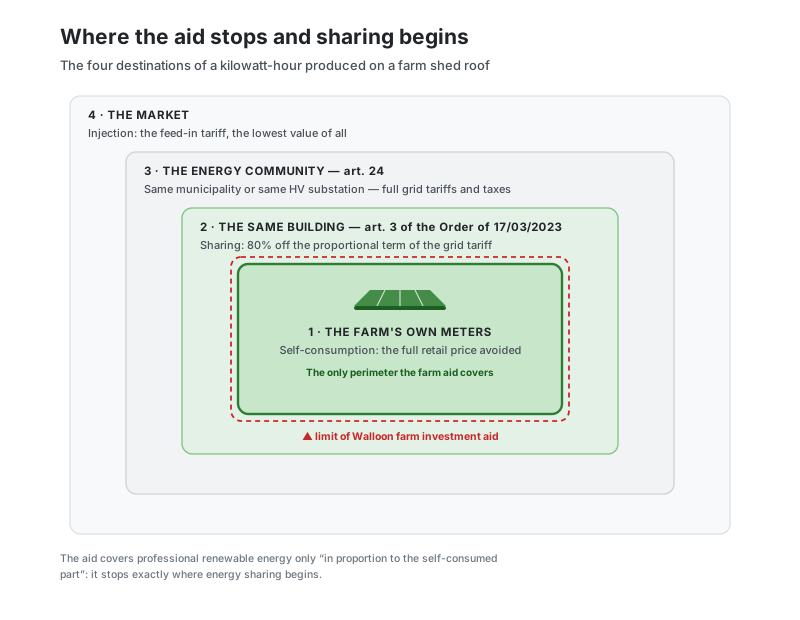
One point of scope before going further: this article is about roofs. Ground-mounted agrivoltaics — shade structures over pasture, raised arrays over market gardens — falls under an entirely separate legal regime: it is a derogation in agricultural zoning under the territorial development code, framed only by the circular of 14 March 2024, and still waiting for the order the sector is asking for. The two subjects do not travel together.
Two orders, three weeks apart, two opposite logics
On 23 February 2023, the Walloon Government adopted the order organising establishment and investment aid in the farming sector — the AII scheme, which replaced ADISA on 1 January 2023. On 17 March 2023, the same Government adopted the order on energy communities and energy sharing. Three weeks separate the two texts.
The second tells the farmer: produce, and share what you do not consume. The first says it will subsidise only what they do consume.
What the list of eligible investments actually says
The official description of the intervention lists among eligible investments:
the production of professional renewable energy in proportion to the self-consumed part (<=10 kW for biomethanation)
There is no interpreting to be done. The base of the aid is the fraction the holding consumes itself. Energy sharing is, by construction, what happens to the kilowatt-hours it does not consume: they are injected into the grid and allocated among participants within the same quarter-hour.
The rates, to measure what is at stake: the base rate is 10% of the simplified cost. It is topped up by 10 points for a young farmer, 4 points in an area facing specific natural constraints, 4 points for a grassland system, 6 points for polyculture, 5 points for full organic farming, 2.5 points below 60 hectares, and a handful of other items. The total may under no circumstances exceed 40%, and the amount paid to any one beneficiary over 2023-2027 is capped at €200,000.
In other words: up to 40% of the cost of the part of the roof that feeds the farm, and 0% of the part that would feed the village.
The second ceiling, the one nobody sees: the inverter
There is a second limit, more technical, pointing in exactly the same direction — and it is probably the least known point in the whole file.
AII aid is computed on a flat simplified cost per kWp. The number of kWp you declare is therefore not a detail. Interpretive note no. 2 from SPW Agriculture, devoted to investments of the “professional renewable energy: photovoltaic panels” type, settles the question:
the number of kWp to declare […] corresponds to the maximum kWp the inverter accepts at its input where the maximum output of the panels installed exceeds what the inverter is able to process
And in the opposite case, you declare the panel power. The note concludes bluntly: the retained value is the lower of the two. The figure is read from the inverter’s datasheet, on the line for maximum DC power or generator power; it is verified during the on-site inspection.
Take the measure of what this implies. Oversizing the panel array relative to the inverter — laying 130 kWp of modules behind a 100 kW inverter, say — is a standard and rational practice. It clips the summer midday peak slightly, and in exchange it lifts production in the morning, in the evening, in winter and on overcast days. It flattens the curve.
Flattening the curve is precisely what you want when sizing a roof for sharing. A participant consumes across the day, not in a two-hour spike; sharing settles quarter-hour by quarter-hour, and it is the shoulders of the curve that decide how much is actually absorbed. The technical move that makes a roof good at sharing is therefore exactly the one farm aid refuses to subsidise.
This is not financially neutral, and it is not only aid forgone: article 89 of the order of 13 July 2023 on controls and penalties provides for a penalty where the effective simplified cost of the investment falls at least 10% short of the cost declared in the application. Declaring panel kWp where the administration expects inverter kWp therefore exposes you to a reduction in the aid, not merely to a cap. The SPW did observe that many files submitted in 2023 had been filed in good faith on the basis of panel kWp — that was the convention under the old ADISA scheme — and waived the penalty for those. The tolerance was transitional.
The practical conclusion fits in one sentence: treat the self-consumed part and the shared part of the roof as two separate investment decisions, because the Region treats them that way.
The “same building” regime: narrow, but a farm is one of the rare cases where it opens
Now to what pays. And let us start with the counter-intuitive: for a farm holding, the first operation to set up is not in the village.
What is at stake: 80% of the proportional term
Energy sharing within one and the same building earns a reduction of 80% on the proportional term of the grid tariff, identified by globalisation codes E216 in distribution and E526 in transmission. It requires no legal entity, no articles of association and no authorisation from the regulator: a notification to the grid operator is enough.
Sharing organised within an energy community earns no reduction at all. The CWaPE says so without hedging: since the electricity transits the grid, all grid fees, taxes and surcharges are due on shared electricity just as on residual electricity, and “there is no tariff reduction for sharing within an energy community”.
That is a considerable difference, and it explains why commercial content promising “80% off your grid fees thanks to sharing” is wrong in very nearly every case where you read it. The reduction exists, but it does not cross the walls.
Why the traditional Walloon farmstead ticks the box
Article 3 of the order of 17 March 2023 defines a building as:
1° a fixed, covered and closed immovable construction comprising at least two parts intended to be used autonomously; 2° several fixed, covered and closed immovable constructions under one and the same co-ownership.
The second branch is closed from the outset: a farm holding is almost never a co-ownership. The first, by contrast, describes a configuration that Walloon rural architecture turned out in series for two centuries: the dwelling, the byre and the barn built in a single continuous range, the courtyard farm, the mixed home-and-holding building. Two parts intended for autonomous use under one covered and closed construction: the definition is met.
This is a situation that neither a school, nor a neighbourhood condominium, nor a municipality runs into anywhere near as often. “Schools: a guide to energy sharing” shows why two blocks separated by a playground remain two buildings; “Energy sharing in a condominium: the guide” sets out the co-ownership route, which does not open here. The farm, by contrast, falls regularly into the first case of article 3 — and nobody tells it so.
One caution, though: a steel shed erected forty metres away across the yard does not meet the condition, even on the same cadastral parcel, even under the same owner. Paragraph 2 of the same article does attach a building’s outbuildings to it — garages, gardens, car parks, land — on the same parcel or with shared access, but an outbuilding is not a second building: that provision serves siting, not the qualification of the sharing regime.
The check, in one hour
Pull the list of your EAN codes — you often have more of them than you think: the dwelling, the holding, sometimes a holiday let, a processing workshop, a tied cottage, the retired parent’s house. Then ask yourself three questions:
- Which of those supply points hang off one and the same covered and closed construction?
- Are those parts used autonomously — separate occupants, uses or billing?
- Does the consumption of those meters, during production hours, justify the operation?
If the answer to the first two is yes, that is the first operation to set up, before any energy community. It requires neither articles of association nor authorisation, and it carries the 80%. If the answer is no — a standalone shed, separate buildings — the route is the energy community, at full grid tariff. Better to know that before making promises to the neighbours.
The quarter-hour decides, not the neighbourhood
Let us leave the yard. Sharing settles quarter-hour by quarter-hour: only electricity produced, injected and consumed within the same quarter-hour can be shared. Whatever is not absorbed at the moment it is produced goes to injection, however many participants have signed up.
That is why sharing “with the village” almost always disappoints. A rural household consumes little between 10 am and 4 pm — nobody is home — and a great deal between 6 pm and 9 pm, when the roof has stopped producing. Adding twenty households to a sharing operation increases the number of agreements to manage, not the volume absorbed at midday.
Who actually absorbs a July midday in the countryside
| Partner | Daytime absorption | Summer | Verdict for a shed roof |
|---|---|---|---|
| The holding’s other meters | Varies by farming type | Varies | Handle first, and outside any community if same building |
| Pumping station, treatment plant, water tower | Excellent | Excellent | Daytime load, often shiftable, almost always municipal |
| Processing workshop, dairy, cheese room | Excellent | Excellent | Refrigeration and process by day: the best industrial neighbour |
| Agri-food SME, cold store | Excellent | Excellent | Cooling follows outdoor temperature, so it follows production |
| Another holding with a complementary profile | Good | Good | A pig or poultry unit facing an arable farm |
| The village school | Excellent | None | Perfect nine months out of twelve, absent at the peak |
| Campsite, tourist accommodation, rural hospitality | Good | Excellent | Fills precisely the school’s summer gap |
| Municipal offices, sports hall | Good | Weak to good | Solid on weekdays, empty at weekends |
| Village households | Weak | Weak | The social bedrock of the scheme, not its engine |
| Public charging points | Good | Good | Controllable, therefore adjustable to the profile |
Two rows deserve comment.
The school and the campsite complement each other; they do not compete. The school absorbs very well from September to June and vanishes for seven weeks in July and August — that is the whole subject of our schools guide. The campsite, tourist accommodation and rural hospitality do exactly the reverse. A well-composed rural sharing group holds both.
The pumping station is the most underrated partner in rural Wallonia. It consumes by day, all year round, with a load that is largely shiftable in time — filling a reservoir at 1 pm rather than 3 am costs nobody anything. And it is almost always run by the municipality or an intermunicipal company, which simplifies governance. “Energy communities: a guide for municipalities” covers the owning municipality’s point of view.
The general method — building a group by overlaying load profiles rather than by geographical proximity — is developed in “Local electricity: the short-circuit guide”. It applies here as elsewhere, with one nuance: the farm roof is the only rural producer large enough to feed several profiles at once.
The key that fits
A fixed key allocates each participant a constant percentage of production, regardless of what they actually consume. On a producer whose surplus varies by a factor of ten between a Tuesday in January and a Sunday in July, it sends kilowatt-hours to meters that do not want them, and those volumes fall back to injection.
The right reflex is a dynamic allocation key based on the consumption ratio, allocating each quarter-hour in proportion to what each participant is consuming at that moment. The key families recognised by the CWaPE and their counterparts in the other two regions are set out in “Allocation key in Belgium: the 3 regions”.
What your farming type changes — the profile, not the surface
A shed’s surface follows the holding’s storage needs, never its electricity needs. That is the origin of the problem: the bigger the shed, the bigger the roof, and the less able the farm is to absorb what it produces. But the starting point varies enormously from one type of farming to another.
| Farming type | Electricity load profile | Alignment with production | Priority |
|---|---|---|---|
| Dairy, milking robot and bulk tank | Two marked windows, roughly 6-10 am and 4-7 pm, all year | Partial: the windows bracket the solar peak without covering it | Shift cooling and water heating towards midday, then share |
| Pigs, poultry | Continuous ventilation, rising with outdoor temperature | The best alignment of all: the load follows the sun | Self-consume first, share the winter balance |
| Arable | Drying, ventilation, handling — strongly seasonal | Excellent at harvest, near nil the rest of the year | Share eleven months out of twelve |
| Storage shed only | Near nil | None | Sharing is the only outlet: it is all surplus |
Assumptions: qualitative profiles drawn from the technical references published by the French chambers of agriculture, for want of an equivalent published Walloon series; the time windows and the ranking of farming types are robust and physically transferable, the numerical self-consumption rates are not and are therefore not reproduced here. The only figure that counts is your own: it is read from your quarter-hourly meter data, not from a table.
The table reads simply. A pig or poultry unit has every interest in maximising self-consumption first, because summer ventilation is the best solar load that exists in farming. An arable farmer is in the opposite position: the consumption peak lasts a few weeks in summer and there is almost nothing to do with the output for the rest of the year. And a bare storage shed is a perfect limiting case — no load of its own, therefore no self-consumption base, therefore no farm aid at all on its solar.
Self-consumption, the self-consumption rate and collective self-consumption are set out in “Energy self-consumption in Belgium”.
You cannot do a deal with the neighbour across the road
That is the natural reflex, and it is a dead end. The decree of 5 May 2022 wrote peer-to-peer sharing into Walloon law, giving the CWaPE the task of authorising such activities and drawing up the standard contract. But it left the operational arrangements and the authorisation procedure to a Walloon Government order — and that order has never been adopted.
As of 10 September 2026, peer-to-peer trading is therefore not workable in the Walloon Region. The CWaPE makes it one of its priority recommendations: in its evaluation report of 20 February 2025, it places completing the peer-to-peer legal framework just behind the overhaul of market processes, among the levers to activate.
Two routes remain, and only two:
- sharing within one and the same building, covered above — a notification to the grid operator, no legal entity, an 80% reduction;
- sharing within an energy community, which presupposes a legal entity, articles of association, a notification to the CWaPE and an agreement with the grid operator, with no tariff reduction whatsoever.
The farmer’s exact place in a community
A renewable energy community admits only three categories of member: natural persons, local authorities, and small or medium-sized enterprises whose primary commercial or professional activity is not participation in one or more energy communities.
The farmer falls into the first or the third, depending on how the holding is structured. They may therefore be a member, and they may also take the initiative and exercise effective control of the community. But they do not get the school’s or the municipality’s shortcut: those are local authorities within the meaning of article 4 of the order of 17 March 2023 — widened on 5 February 2026 after the Council of State partly annulled the text — and so have nothing to demonstrate. The holding comes in through the SME door and must be able to show that energy is not its main business. For a dairy farm the demonstration is immediate. It deserves more attention the day the energy activity starts weighing heavily in turnover.
The proximity perimeter
Article 24 offers two alternative criteria, and meeting one is enough:
- all generating installations and all participants lie within the territory of one and the same municipality;
- or all connection points lie downstream of the same high-voltage substation of the grid operator.
The second criterion is often forgotten and it is precious in the countryside, where municipal boundaries rarely fall where the cables run. A farm on the edge of a municipality frequently shares its substation with the neighbouring hamlet, which belongs to another municipality. Ask the grid operator which substation feeds your connection: the answer sometimes widens the field of possible partners considerably.
The documents to produce and the associated deadlines are set out in “Energy community: CWaPE documents and deadlines”.
The grid can say no even when the law says yes
One obstacle remains that no text on sharing mentions, and that nevertheless decides the project: the physical capacity of the grid to absorb the injection.
Walloon distribution grids are approaching saturation, particularly at the substations between the transmission grid and the distribution grids. ORES’s 2026-2030 electricity adaptation plan provides for activating three kinds of flexibility in response: tariff-based, through incentive pricing from 2026; commercial, through local calls for tenders; and technical, through flexible connection and dynamic limitation.
Translated for a farmer planning 150 or 250 kWp on a shed: the grid operator may grant a connection carrying a limitation on injection during the hours when the local grid is constrained — that is, precisely the sunny summer middays.
And here is the point to have understood before signing anything: energy sharing is a contractual mechanism, settled after the fact on quarter-hourly meter data. It creates no physical path between your roof and your participants, and it exempts you from nothing. Shared electricity transits the public grid exactly like electricity bought from a supplier — which is precisely why it bears all the associated fees. An inverter clipped at midday does not produce, therefore does not inject, therefore does not share. No sharing agreement recovers that.
The practical consequence is an order of operations: put the question of hosting capacity to the grid operator before sizing the roof, not after. It is quick, it costs nothing, and it keeps you from building a financial plan on kilowatt-hours that will never come out.
What the kWh is really worth
| Destination of the kilowatt-hour | What it is worth | Farm aid applicable |
|---|---|---|
| Self-consumed on the holding | The full price avoided on the bill, all components included | Yes, up to 40% and the €200,000 cap |
| Shared within the same building | The agreed sharing price, with 80% off the proportional term of the grid tariff for the buyer | No |
| Shared within an energy community | The agreed sharing price, full grid tariffs, taxes and surcharges for the buyer | No |
| Injected into the grid | The injection tariff | No |
Assumptions: orders of magnitude carried over from our other articles to stay consistent from one text to the next — about 6 c€/kWh for sharing and 3.5 c€/kWh for injection, the sharing price being freely set between participants and the range observed in Belgium being appreciably wider. These values are not guaranteed market prices; they serve to compare orders of magnitude, not to build a financial plan. The internal transfer price is set using the method described in our dedicated article.
Three supports sit alongside this grid, and they need to be kept apart.
Green certificates. Photovoltaic installations above 10 kW remain eligible for Walloon support, under the levelised cost of production regime — the CPMA regime — applicable to any support application filed since 1 June 2024. The grant rate is set by ministerial order and revised every year in line with market prices; the most recent is the ministerial order of 1 October 2025. We do not reproduce a figure here: it would have changed before you read this page, and the only figure that counts is the one in the official table in force on the day you apply. Remember the mechanism and one consequence: green certificates are computed on the energy produced, not on the energy self-consumed, so sharing rather than injecting changes nothing there.
The investment deduction. Since 1 January 2025, the enhanced thematic deduction for the energy transition stands at 40% for the self-employed and SMEs — 30% for large companies. It covers photovoltaic installations. It is a federal tax advantage, independent of regional aid, and it knows nothing of the distinction between the self-consumed and the shared part. On the part of the roof the Region does not subsidise, it is the main lever left.
AII aid. Covered above: up to 40%, on the self-consumed proportion alone, capped at the kWp the inverter accepts at its input.
The reasoning that follows is this. As long as surplus is worth the injection tariff, every kilowatt-peak laid beyond the farm’s own needs pays back over a period nobody accepts, and the project stops dead at the self-consumed capacity — the very capacity the Region subsidises. Sharing does not make the shed pay: it makes financeable the half of the roof that self-consumption did not justify.
Four traps that hollow the project out
1. The third-party investor owns the output. In a third-party investment structure, the operator finances, installs and maintains the system, is paid out of the electricity produced, and then transfers the panels at the end of the contract — often after a decade or so. While they own the output, it is not the farmer who has the surplus at their disposal: the roof can feed no sharing scheme. This is the most expensive trap because it closes years before anyone thinks of it. Have the contract state who has the surplus at their disposal, on what terms it may be allocated to a sharing scheme, and what becomes of that right when the panels are transferred. A silent contract assigns the value to the operator, by default and for the whole term.
2. The building’s insurance. Insurers increasingly condition continued cover of an equipped farm building on preventive measures — accessible isolators, a suitable extinguisher nearby, periodic inspection, sometimes a fire-water reserve. Failing that, they may differentiate the premium, restrict certain cover, or refuse to insure larger installations. This is settled with the broker before ordering, not at the annual declaration.
3. The fibre-cement roof. A significant share of the Walloon shed stock is roofed in asbestos-bearing fibre cement. You do not lay solar on it: it must be stripped and re-covered first, and that cost comes before the energy investment rather than adding to it. It has to be built into the financing plan from the outset, on pain of discovering mid-project that the budget has doubled.
4. Passing the farm on. A solar installation is an asset with a twenty- to twenty-five-year life, and the aid scheme requires the investment to be maintained for several years after it is granted. A roof equipped on a building that will change hands, or a third-party investment contract running past the handover, is better negotiated when the question has been asked at signature than at succession.
What to remember
-
Walloon farm aid stops exactly where sharing begins. The intervention admits professional renewable generation only “in proportion to the self-consumed part”. Up to 40% for the part of the roof that feeds the farm, 0% for the part that would feed the village.
-
The second ceiling is the inverter, and it penalises the right technical move. The subsidised kWp are the lower of the panel figure and what the inverter accepts at its input. Yet oversizing the array is precisely what flattens the curve and makes a roof good at sharing.
-
Start in the yard, not in the village. The 80% reduction on the proportional term is reserved for sharing within one and the same building — and the farmstead built in a continuous range regularly meets the article 3 definition, where a school or a neighbourhood condominium almost never does. It is the only operation that requires neither articles of association nor authorisation.
-
Peer-to-peer does not exist in Wallonia. The implementing order provided for by the decree of 5 May 2022 has never been adopted. There are only two routes: same building, or energy community.
-
Build the group around the midday load, not around the map. Pumping station, processing workshop, cold store, campsite in summer, school nine months out of twelve. Twenty rural households add agreements, not absorbed kilowatt-hours.
-
Put the grid question before the sizing question. Flexible connection and dynamic limitation arrive with the 2026-2030 adaptation plan. Sharing is contractual: it creates no physical path and exempts you from no clipping.
-
What not to expect: neither the 80% reduction on sharing with the village, which does not exist; nor an income that changes a farm’s cash position, the gap between 6 c€ and 3.5 c€ remaining modest. What to expect is the shift in the optimal sizing — and, for the neighbours, a genuinely lower bill.
Build your holding’s energy community with OptimCE
Open-source platform built for Belgian energy communities: members, meters, allocation keys and sharing operations in one place — right down to simulating, quarter-hour by quarter-hour, the volume your partners will actually absorb at harvest time and in the depths of January, before committing the first euro to the roof.
FAQ
Can a farmer start their own energy community?
Yes, but without the school’s or the municipality’s shortcut. A renewable energy community admits only natural persons, local authorities and SMEs whose main activity is not participation in an energy community. The farmer falls into the first or the third category.
They may therefore be a member, take the initiative and exercise effective control. But where a school is a local authority and has nothing to demonstrate, the holding comes in through the SME door and must be able to show that energy is not its main business.
Does farm aid cover panels intended for sharing?
No. The list of eligible investments targets “the production of professional renewable energy in proportion to the self-consumed part”. The base of the aid is what the holding consumes itself; sharing concerns, by definition, what it does not consume.
The base rate is 10%, top-ups can raise it to 40% at most, and the total is capped at €200,000 per beneficiary over 2023-2027. Those percentages apply only to the self-consumed share.
Why do the subsidised kWp depend on the inverter?
Because the aid is computed on a flat rate per kWp and SPW Agriculture counts usable power. Interpretive note no. 2 specifies that the number of kWp to declare is the figure the inverter accepts at its input as soon as the panels exceed that capacity — so always the lower of the two values.
The perverse effect is real: oversizing the array relative to the inverter flattens the production curve and improves sharing, but shrinks the base of the aid. And article 89 of the order of 13 July 2023 provides for a penalty if the effective cost falls at least 10% short of the cost declared.
Does sharing between my buildings earn the 80% reduction?
Often, yes — more often than for any other profile. The reduction, codes E216 and E526, is reserved for sharing within one and the same building, defined as a fixed, covered and closed construction comprising at least two autonomous parts. The farmstead built in a continuous range, dwelling and byre under one construction, meets that definition.
A shed standing forty metres away does not, even on the same cadastral parcel. Pull the list of your EAN codes and see which hang off one construction: that is the first operation to set up, and it requires neither articles of association nor authorisation.
Can I sell my surplus directly to a neighbour?
No. The decree of 5 May 2022 wrote peer-to-peer sharing into Walloon law but left the arrangements to a Government order that has never been adopted. Peer-to-peer trading is not workable in Wallonia, and the CWaPE makes it one of its priority recommendations.
Two routes remain: sharing within one and the same building, on a simple notification to the grid operator, and sharing within an energy community, which presupposes a legal entity and a notification to the CWaPE.
How much does sharing earn on a shed roof?
On kilowatt-hours already produced, only the gap between the sharing price and the injection tariff — on the order of 2.5 c€ in our assumptions. On a 150 kWp roof, the order of magnitude runs to thousands of euros a year, not tens of thousands.
The decisive effect bears on the next installation: sharing moves the optimal size of the roof. It does not make the shed pay; it makes financeable the part that self-consumption did not justify — and that the Region does not subsidise.
Sources
- Walloon agriculture portal — Productive investment aid for farm holdings — source of the exact wording of the eligible investment, “la production de l’énergie renouvelable professionnelle dans la proportion de la partie autoconsommée (<=10 kW concernant la biométhanisation)”, on which this article’s central thesis rests; also the source of the 10% base rate, of the list of top-ups (young farmer, area facing specific natural constraints, grassland system, polyculture, organic farming, holdings under 60 hectares, horticulture, green architecture, economic resilience, animal welfare, differentiated quality schemes), of the 40% ceiling and of the €200,000 cap per beneficiary over 2023-2027. Accessed on 10 September 2026.
- SPW Agriculture — AII interpretive note no. 2: “professional renewable energy” investments, photovoltaic panels and wind — primary source of the inverter-capping rule: the number of kWp to declare is the maximum the inverter accepts at its input where the panel output exceeds it, and the panel output in the opposite case, the retained value being the lower of the two; also the source of the requirement to add inverters together where the installation is spread over several buildings, of the datasheet line to consult (maximum DC or generator power), of the on-site inspection, of the penalty under article 89 of the controls and penalties order of 13 July 2023 where the effective simplified cost falls at least 10% short of the declared cost, and of the transitional tolerance granted to 2023 files encoded under the old ADISA convention. Accessed on 10 September 2026.
- Walloon agriculture portal — AII: legislation — source of the legal basis of the AII scheme: Walloon Government order and ministerial order of 23 February 2023, order of 13 July 2023 on controls and penalties in agricultural policy, and the numbered interpretive notes. Accessed on 10 September 2026.
- Belgian Official Gazette — Walloon Government order of 17 March 2023 on energy communities and energy sharing — primary source of the definition of a building in article 3, § 1 (a fixed, covered and closed immovable construction comprising at least two parts intended for autonomous use, or several constructions under one co-ownership), of the treatment of outbuildings in § 2 (same cadastral parcel, or shared link and access with a complementary or ancillary use), of the list of local authorities in article 4, and of the two alternative proximity criteria in article 24: the territory of one and the same municipality, or connection points downstream of the same high-voltage substation. Accessed on 10 September 2026.
- CWaPE — Do grid fees apply to shared energy? — source of the rule that, since the electricity transits the grid, all transmission and distribution fees and the related taxes and surcharges are due on shared electricity as on residual electricity; source of the 80% reduction on the proportional terms of the grid tariff reserved for electricity shared within one and the same building, and of the explicit statement that there is no tariff reduction for sharing within an energy community. Accessed on 10 September 2026.
- CWaPE — Energy communities — source of the only three categories of member admitted in a renewable energy community (natural persons, local authorities, small and medium-sized enterprises whose main activity is not participation in an energy community), of the requirement of effective control by participants located nearby, and of the register of notified communities: thirteen communities as of 10 September 2026, in Rixensart, Namur, Huy, Tournai, Péruwelz, Ougrée, Lasne, Chiny, Mons, Durbuy, Yvoir, Aubange and Gesves, none of which is anchored on a farm holding. Accessed on 10 September 2026.
- CWaPE — Energy sharing — source of the definition of sharing as the allocation among participants of energy produced and where applicable stored, injected into the grid and consumed within the same quarter-hour; source of the three forms of sharing recognised in Wallonia, of the decretal basis of 5 May 2022 transposing the Clean Energy Package, and of the list of competent grid operators. Accessed on 10 September 2026.
- CWaPE — External study on the implementation of peer-to-peer trading in the Walloon Region — source of the finding that the legal framework for peer-to-peer sharing is not complete and that a Walloon Government order framing the arrangements and the authorisation procedure remains necessary before any implementation, and of the role assigned to the CWaPE by the decree of 5 May 2022: authorising peer-to-peer activities and drawing up the standard contract. Accessed on 10 September 2026.
- CWaPE — Evaluation report on the framework for energy communities, energy sharing and self-consumption — report of 20 February 2025, source of the list of identified obstacles (procedural burden, complexity of the legal framework, restrictive status of generating installations, limited participation for large companies, unsuitable market processes) and of the rank of completing the peer-to-peer legal framework among the recommendations addressed to Parliament and the Government. Accessed on 10 September 2026.
- ORES — Energy sharing in practice — source of the indispensability of smart meters at every participant, of the three standard allocation key families (equal, specific fixed, dynamic), of the possibility of changing key by amendment to the agreement, of the two-invoice mechanism — the supplier’s and the sharing representative’s — and of the confirmation that grid usage fees are billed on the classic supplier’s energy as well as on shared energy. Accessed on 10 September 2026.
- ORES — Electricity adaptation plan 2026-2030 — version of 15 September 2025, source of the saturation observed at the substations between the transmission grid and the distribution grids, and of the activation of three kinds of flexibility: tariff-based through incentive pricing from 2026, commercial through local calls for tenders, and technical through flexible connection and dynamic limitation. Accessed on 10 September 2026.
- ORES — Flexible connection contract for the high-voltage distribution grid — contractual source of the flexible connection mechanism applicable to the injection of decentralised generation, and of the reference to ORES’s technical prescriptions and to the Synergrid C10/11 specifications for installations operating in parallel on the distribution grid. Accessed on 10 September 2026.
- SPW Énergie — CPMA regime — source of the scope of the regime based on the levelised cost of production — all renewable technologies except photovoltaics below 10 kW —, of its application to any support application filed since 1 June 2024, of the distinction between the general, extension and continuation regimes, and of the principle of annual revision of the rates in line with market prices. Accessed on 10 September 2026.
- SPW Énergie — Grant rates for new installations — source of the official table of grant rates and CPMA values by category, and of the reference to the ministerial order of 1 October 2025 setting the reference values and grant rates; this is the page to consult on the day of the application, the values being revised annually. Accessed on 10 September 2026.
- Renouvelle — Photovoltaics in Belgium 2025: ambitions to relaunch — article of 16 February 2026, source of the gap between the pace required to meet the Walloon 2030 target, of the order of 500 to 600 MWp a year, and the volume actually installed in Wallonia in 2025, of the order of a hundred MWp; also the source of the Belgian fleet of 12.8 GWp at end-2025 and of the stagnation of the commercial and industrial segment since 2020. Accessed on 10 September 2026.
- SPW — State of Walloon agriculture: holdings — source of the number of Walloon farm holdings, 12,381 in 2024, of the utilised agricultural area they work, close to 732,000 hectares, and of the average area of 59 hectares per holding; data from Statbel. Accessed on 10 September 2026.
- Renouvelle — Agrivoltaics: which applications are possible in Belgium? — source of the distinction between the three technological applications — farm building roofs, shade structures over pasture, raised systems over market-garden areas —, which justifies the scope restriction announced in the introduction, and of the fact that the Walloon framework for ground-mounted agrivoltaics rests on the circular of 14 March 2024 alone in the absence of a dedicated order. Accessed on 10 September 2026.
- EDORA — Towards a framework for the development of agrivoltaics in Wallonia — sector white paper, source of the finding that developing ground-mounted agrivoltaics presupposes the adoption of a dedicated Walloon Government order setting agronomic and technical criteria, and that no official timetable has been announced. Accessed on 10 September 2026.
- Faut-il un permis ? — Solar panels in Wallonia: is a permit required? — source of the exemption from planning permission for solar modules placed on the roof or facade of an existing building in Wallonia, whatever their power and surface, and of the technical overhang and pitch criteria applicable by roof type. Accessed on 10 September 2026.
- UVCW — Partial annulment of the Walloon Government order of 17 March 2023 — source of the annulment by the Council of State, on 28 March 2025, of the provision of article 4 restricting local authority status to intermunicipal companies falling under the Walloon Region, and of the transitional consequence that only municipalities remained qualifiable until the list was restored by the order of 5 February 2026. Accessed on 10 September 2026.
- Energreen — Belgium strengthens the investment deduction — source of the rate of the enhanced thematic deduction for the energy transition introduced on 1 January 2025, namely 40% for the self-employed and SMEs and 30% for large companies, and of its application to photovoltaic installations. The thematic energy list must be checked with the FPS Finance at the time of the investment. Accessed on 10 September 2026.
- Bati-Info — Solar panels and fire insurance: what does it do to your premium? — source of the principle that insurers condition the insurability of an equipped building on preventive measures and may, failing those, differentiate the premium, restrict cover or refuse it on larger installations. Terms vary between insurers and are to be checked with the broker. Accessed on 10 September 2026.
- Asbestcerti — Removing an asbestos shed roof: prices and grants — source of the orders of magnitude for the cost of stripping asbestos from a farm shed roof in Belgium and of the principle that replacing the covering precedes the laying of solar panels. The amounts cited are commercial orders of magnitude, not official scales. Accessed on 10 September 2026.