
Schools: a guide to energy sharing
The Wallonia-Brussels Federation has more than 13,000 school buildings. Half of them need upgrading works and around five hundred should be demolished. The Wallonie-Bruxelles Enseignement network alone accounts for 2,200 of them, across 3,200,000 m² of floor area. It is by far the largest non-residential property portfolio of the French Community — and one of the worst used in energy terms, for a reason that has nothing to do with technology.
Here is the anomaly. A school in the subsidised free network is a private-law non-profit association. No elected mandate, no regional supervision, no territorial competence. Legally it looks like any other association. And yet, when the Walloon Government drew up the list of local authorities entitled to control an energy community, it put schools on it — next to municipalities, provinces, public social welfare centres and inter-municipal companies.
This article does not redo what is already written elsewhere on this site: the difference between the three Belgian statuses is covered in “Energy communities in Belgium: CER, CEC, CEL”, the creation procedure in “Create an energy community in Wallonia”, the owning municipality’s point of view in “Energy communities: a guide for municipalities”, how to compose a group by hourly profile in “Local electricity: the short-circuit guide”, the ranking of surplus outlets in “Solar surplus: the 5 options compared”, the profitability calculation of an installation in “Solar panels 2026: still worth it in Wallonia?”, and the setting of the internal price in “Internal transfer price in an energy community”.
It answers a question none of those articles asks: why does Walloon law grant a school — any school, whatever its network — a status that no shop, no small enterprise and no condominium obtains, and what can it actually do with it?
The answer lies in one sentence from the SPW Énergie that nobody quotes, and it has very concrete consequences for a roof that produces its maximum when the building is empty.
A school is a local authority — and it does not know it
A renewable energy community does not accept just any member. The Walloon framework is explicit: only natural persons, local authorities and small or medium-sized enterprises whose main commercial or professional activity is not participation in one or more energy communities may be members or shareholders. This is not a formality: it is the condition that determines who may enter and, above all, who may control.
The question for a school is therefore which box it falls into. And the answer depends entirely on its organising authority — or so everyone assumes.
What article 4 actually says
The Walloon Government decree of 17 March 2023 on energy communities and energy sharing devotes its article 4 to the definition of a local authority. It lists fourteen categories. The tenth reads:
establishments of primary and secondary education, ordinary and specialised, organised or subsidised by the French Community, the Flemish Community or the German-speaking Community, located in the territory of the Walloon Region
The next two categories extend the list into higher education: the eleventh covers the establishments referred to in articles 10 to 13 of the French Community decree of 7 November 2013 — universities, university colleges, higher art schools — and the twelfth those of the Flemish Higher Education Code located in Wallonia.
The word that carries the whole mechanism is “subsidised”. It is not about covering only schools whose organising authority is a public body. A school organised by a denominational or non-denominational non-profit, once subsidised by the French Community, is a local authority within the meaning of Walloon energy-community law.
The reason is written down
This is not an expansive reading on our part. The SPW Énergie explains the reasoning in its FAQ, and the wording deserves to be read in full:
schools in the official network being included in this notion by virtue of the nature of their organising authority and in order not to create discrimination between school networks, all schools (primary, ordinary or specialised secondary education, university colleges and universities), regardless of the network to which they belong, have also been included in the definition of local authorities in the context of energy communities.
The mechanism is transparent. Municipal and provincial schools were already covered, not as schools but because their organising authority — the municipality, the province — was already on the list. Extending the status only to public schools would therefore have created inequality between networks on ground, energy, that has nothing to do with freedom of education. The Government chose to align everyone upwards.
The result is a status that almost no other private actor obtains in Wallonia.
What the status unlocks in practice
Compare the starting positions.
| Actor | Qualification | “Main activity” test | May control a CER |
|---|---|---|---|
| School, any network | Local authority (art. 4, 10° to 12°) | Not applicable | Yes, as of right |
| Municipality, CPAS, province | Local authority (art. 4) | Not applicable | Yes, as of right |
| Shop, small enterprise | Small or medium-sized enterprise | Must be satisfied | Yes, conditionally |
| Large enterprise | None | — | No |
| Condominium association | None as such | — | No, co-owners join individually |
Three practical consequences follow.
The first is that the school has nothing to demonstrate. A small enterprise wishing to join an energy community must be able to establish that participation in an energy community is not its main commercial or professional activity. That is usually easy, but it is a verification, with the documents and delays it implies. The school comes in through another door.
The second is that it can exercise effective control, not merely participate. A renewable energy community must be effectively controlled by participants located close to the installations. A school can therefore sit, decide, chair — and hold the majority if the articles of association so provide.
The third is that it can join a mixed vehicle. The SPW states that mixed public-private entities are allowed provided local authorities hold control, with a rebuttable presumption: any mixed entity in which local authorities directly hold the majority of voting rights is presumed to be a local authority; where the holding is indirect, they must hold more than fifty per cent of the voting rights of the intermediate legal person. A school can therefore carry weight in a joint vehicle with a private operator without costing that vehicle its eligibility.
The school does not need its municipality
This is the least intuitive consequence, and the most useful.
The first of the two proximity criteria applicable to a renewable energy community is that all generating installations used for sharing and all sharing participants are located within the territory of one single and same municipality. That criterion is geographical. At no point does it require the municipality to be a member, a shareholder, a founder or even informed.
In other words: a school, fifty households in the neighbourhood and a care home can form a perfectly regular renewable energy community without any local government being involved, provided they are all in the same municipality. The school brings the roof, the output and — this is the point — the local-authority qualification that secures the structure.
Should one therefore do without the municipality? Almost never. It brings other roofs, other meters, investment capacity, access to support schemes and a local legitimacy that makes recruiting participants easier. The point is not that it should be avoided, it is that waiting for its decision is not a legal obligation. A school whose municipality has no energy-climate project, or whose executive is prioritising something else this term, is not blocked. It can take the initiative.
The eleven months when the school was not one
This status nearly disappeared, and many documents online still describe the interim situation as if it were current. So the dates matter.
The annulment
On 28 March 2025 the Council of State handed down judgment no. 262.782 on an action brought by the inter-regional cooperative company Vivaqua. The complaint concerned the restriction of the notion of inter-municipal company to those governed by the Walloon Region alone, held to be contrary to European law and not authorised either by the special institutional reform act of 8 August 1980 or by the cooperation agreement of 13 February 2014.
The reach of the judgment went beyond its subject. Article 4 was annulled in its entirety, with no maintenance of effects. The list of local authorities therefore vanished from the legal order — all categories included, schools among them. The only entities still qualifying as local authorities were those designated directly by the electricity decree, that is, in practice, municipalities.
The restoration
The Walloon Government decree of 5 February 2026 restored the list and broadened it. It was published in the Belgian Official Gazette of 25 February 2026 and entered into force on 26 February 2026. To the earlier categories, schools included, it adds inter-regional inter-municipal companies, inter-municipal companies made up solely of German-speaking municipalities, autonomous municipal boards located in the German-language region, and any legal person controlled by those entities. It also introduces an empowerment allowing the Energy Minister to complete the list, which should prevent the next gap from taking a year to fill.
The effect is visible on the ground. As at 3 September 2026, the CWaPE lists thirteen energy communities whose notification file has been declared complete, of which five hold at least one authorised sharing activity. Two of the files declared complete since March 2026 are carried by economic development inter-municipal companies — IDETA in Péruwelz and Tournai, BEP in Namur. Those are exactly the actors the annulment had sidelined.
What to check before trusting a guide
A text written between April 2025 and February 2026 will say that only municipalities are local authorities. That was correct on its date. It is no longer. Several commercial guides and information pages still online have not been updated and continue to state it in the present tense.
The reading rule is simple: any statement about local-authority status must be dated after 26 February 2026, failing which it describes an eleven-month parenthesis that has since closed.
The roof produces when the building is empty
From law to building. This is where the school stops being an interesting special case and becomes the best candidate for energy sharing in Wallonia — and the worst photovoltaic investment if you reason in self-consumption alone.
Four troughs that stack up
No other building type combines the following four absences.
Weekends remove two days out of seven, all year, without exception. That is already 28 % of the calendar, and they are whole days, not off-peak hours.
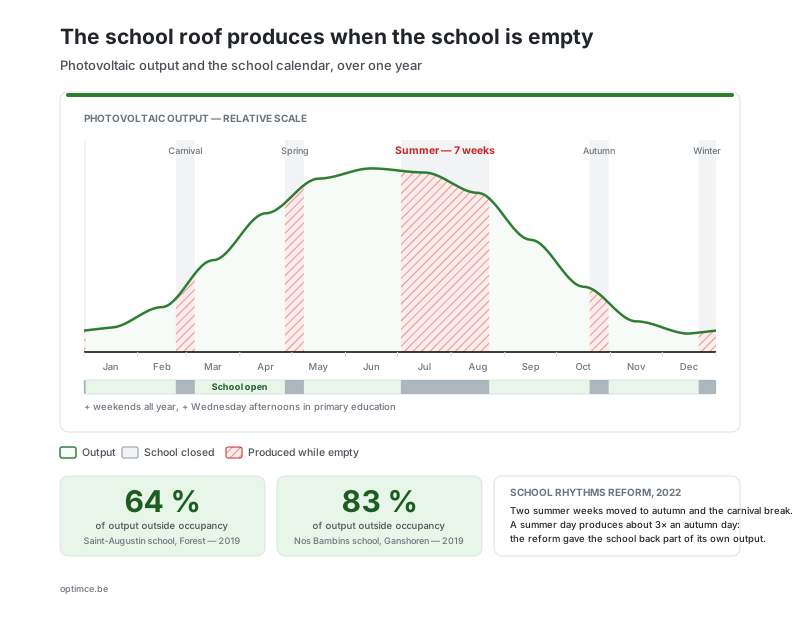
Summer holidays close the establishment for seven consecutive weeks. For the 2026-2027 school year, term started on Monday 24 August 2026 and the summer holidays begin on Friday 2 July 2027: the school is empty from early July to late August, that is, at the exact top of the output curve.
Spread holidays add another eight weeks: two from 19 to 30 October 2026, two from 21 December 2026 to 1 January 2027, two from 22 February to 5 March 2027, two from 26 April to 7 May 2027.
Wednesday afternoons, finally, empty primary education for half a day a week, right in the middle of the strongest output window.
What the Brussels pilots measured
Two schools hosted the first collective self-consumption projects in the Brussels Region, and the project developers quantified what output outside occupancy represented.
At the Saint-Augustin school in Forest, a project developed by Sun for Schools: 64 % of annual photovoltaic output. At the Nos Bambins school in Ganshoren, developed by APERe with Sibelga: 83 %.
Those two numbers call for three cautions. They date from 2019. They concern two specific Brussels installations whose orientation, capacity and consumption profile are not those of your school. And the gap between 64 and 83 shows plainly that this is not a constant: it depends massively on what the building consumes during the week, hence on its ventilation, its IT, its kitchen if it has one, and its heating system.
What is structural, on the other hand, is the sign and the order of magnitude. A school’s occupancy trough coincides with the solar production peak, and that coincidence is not a local accident: it is the school calendar.
The Ganshoren project had a sequel. Belgium’s first renewable energy community started on 1 August 2020 around the Nos Bambins school, with two installations — the school roof and a neighbour’s — sharing their output with local consumers and the municipality. Over one year, participants saw their electricity bill fall by 11 % on average.
The school rhythms reform improved the self-consumption rate
Here is an effect nobody has credited to the Pact for Excellence in Teaching, and it is nonetheless measurable.
Since 2022 the Wallonia-Brussels Federation has applied a calendar based on alternating six to eight weeks of classes with two weeks of holiday. Summer holidays went from about nine weeks to seven, and the two weeks removed were redistributed towards the autumn break and the carnival break. Flanders and the German-speaking Community did not follow and stayed on the classic calendar.
For a photovoltaic roof this shift is not neutral, because a week of holiday does not cost the same depending on the month it falls in. On a Belgian installation monitored from September 2019 to August 2020, average daily output was 16.8 kWh in summer and 5.8 kWh in autumn, for an annual average of 12.1 kWh. A summer day therefore produces roughly three times what an autumn day produces.
Removing two weeks of holiday from high summer and giving them back in October and February therefore returns to the school, as a first approximation, about three times more output than it takes away. The self-consumption rate of a Walloon or Brussels school roof has been mechanically better since 2022 than that of a Flemish school roof with identical characteristics.
Assumptions: average daily output per season measured on one Belgian installation between September 2019 and August 2020, meteorological seasons rather than the school calendar, a year including an exceptionally sunny spring 2020. The order of magnitude of the summer/autumn ratio is robust; computing a precise annual percentage from those data alone would not be.
This should not be over-read: the reform improves the starting point, it does not remove the problem. Seven weeks of closure at peak output is still half the sunny season.
Compose the group against the school calendar
The short-circuit article explains how to compose a sharing group by hourly profile: matching consumers to production hours. For a school that method is necessary but insufficient, because its problem is not hourly — it is seasonal and weekly. A partner that is ideal in hourly terms but also closed in July solves nothing.
The selection principle is therefore different: look for what is open when the school is shut.
The complementarity grid
| Partner | Weekends | July-August | School holidays | Verdict |
|---|---|---|---|---|
| Neighbourhood households | Excellent | Variable (people travel) | Good | The backbone of the group |
| Care home, serviced residence | Excellent | Excellent | Excellent | The best possible partner |
| Municipal pool, sports hall | Excellent | Good | Excellent | Near-perfect complementarity |
| Holiday playschemes, holiday centre | None | Excellent | Excellent | Fills the summer trough precisely |
| Campsite, tourist accommodation | Excellent | Excellent | Good | Excellent in rural areas |
| Local shop, hospitality | Excellent | Good | Good | Solid, depends on annual closure |
| Farm | Excellent | Excellent | Excellent | Often overlooked, often perfect |
| Public charging points | Good | Good | Good | Controllable, hence adjustable |
| Another school | None | None | None | Avoid: same profile, same trough |
| Municipal administration | None | Poor | Poor | Complementary in hours, not in calendar |
Two rows deserve comment.
The care home is the structurally ideal partner, and it is almost always less than a kilometre away. It consumes seven days a week, all year, with a pronounced daytime profile — kitchen, laundry, care, and increasingly air conditioning in July and August, precisely when the school produces most and consumes least. The CPAS that runs it is itself a local authority: the legal structure assembles without difficulty.
Two schools together achieve nothing. This is the most natural mistake, because it is the first reflex of an organising authority running several sites. Two schools have exactly the same calendar: they are empty at the same moments, and sharing between them moves no kilowatt-hour outside occupancy periods. Pooling several school sites makes sense for procurement, engineering and financing. For sharing, you have to leave education.
The allocation key that suits such an irregular profile
Sharing is computed per quarter-hour: only electricity produced, injected and consumed within the same quarter-hour can be shared. A fixed key — allocating each participant a constant percentage of output — is therefore poorly suited to a producer whose surplus goes from almost nothing on a Tuesday in November to the entire output on a Sunday in August.
The correct reflex is a dynamic key based on the consumption ratio, allocating each quarter-hour in proportion to what each participant actually consumes at that moment. The key families recognised by the CWaPE and their counterparts in the other two regions are detailed in “Allocation key in Belgium: the 3 regions”; the point specific to schools is that a school roof is the textbook case in which a fixed key destroys the most value.
Why within-campus sharing probably will not work
An organising authority discovering energy sharing has a very sensible first reflex: start with yourself. The school has several buildings, sometimes several meters, and it seems obvious to share internally before going looking for neighbours.
It is sensible, it is fiscally attractive — and in the vast majority of cases it is legally impossible.
What is at stake: 80 % of the proportional term
Energy sharing within one and the same building enjoys a considerable and often ignored advantage: an 80 % reduction on the proportional term of the network tariff, identified by globalisation codes E216 in distribution and E526 in transmission. It requires neither a legal entity nor prior authorisation from the regulator — a simple notification to the network operator suffices.
Sharing organised within an energy community, by contrast, enjoys no reduction. Shared kilowatt-hours bear the full network charges, excise duties, federal levies and VAT, exactly like kilowatt-hours bought from a supplier.
The gap between the two regimes is therefore massive. Everything hinges on one word: building.
The definition is narrower than it looks
Article 3 of the decree of 17 March 2023 settles it. A building corresponds either to:
1° a fixed, covered and closed immovable construction comprising at least two parts intended for autonomous use; 2° several fixed, covered and closed immovable constructions belonging to one and the same condominium.
The second case is closed from the outset for the vast majority of schools: a school is almost never a condominium. The organising authority is sole owner, or occupies property belonging to a single public body. There are no private lots, no common parts within the meaning of the Civil Code, and therefore no association of co-owners. The route that works for an apartment block — set out in “Energy sharing in a condominium: the guide” — does not open here.
That leaves the first case, which requires two autonomous parts under a single covered and closed construction. A canopy, a playground, a covered outdoor passage do not join two buildings into one. Two blocks separated by twenty metres of playground remain two buildings, even on the same cadastral parcel, even under the same administrative roof.
Paragraph 2 of the same article does attach a building’s annexes — garages, gardens, car parks, land — provided they are on the same cadastral parcel, or share common access with the building while being complementary or ancillary to its main planning use. But an annexe is not a second building: that provision serves connection and siting, not the qualification of the sharing regime.
The cases where it does work
The within-building regime remains open in one precise configuration: several distinct supply points inside a single covered and closed construction. In practice that means:
- a boarding wing with its own meter inside the main volume;
- a caretaker’s flat or service dwelling integrated into the building;
- a sports hall or pool included in the construction and billed separately;
- a nursery or out-of-school care housed in the school building with its own EAN code;
- a mixed school-administration building, common in small municipalities.
This check takes an hour: pull the list of the organising authority’s EAN codes, identify those hanging off one and the same construction, and see whether sharing between them covers a useful volume. If it exists, that is the first operation to set up, before any energy community — it requires neither articles of association nor authorisation, and it carries the 80 % reduction.
In every other case — and they are the majority — the route is the energy community, with no tariff reduction. Better to know that before promising it to the board.
Who owns the kilowatt-hours
Sharing presupposes something wrongly taken for granted: that the school has the electricity produced on its roof at its disposal. That is only true in certain schemes, and the error always runs in the same direction.
The legal condition
An energy community may only share electricity produced by installations it owns, over which it holds a right of use capable of conferring producer status, or held in self-generation by its members for the share injected into the grid.
Translated for a school: either it owns the panels, or it holds their use on terms that make it a producer. If a third party owns the output, that third party has it at its disposal — not the school.
The three schemes, and what each does with the surplus
Purchase from own funds or from a subsidy. The school or its organising authority is the owner. This is the simplest scheme for sharing: nothing to negotiate, the output is theirs. It is also the one that requires capital. The available schemes are real: the Wallonia-Brussels Federation’s exceptional investment plan for school buildings mobilises one billion euros of subsidy across four calls for projects, and the Walloon UREBA programme funds energy performance improvements in buildings over ten years old belonging to public bodies or to non-commercial organisations pursuing, among other things, an educational purpose — including, in its sheet on systems, electrical compliance works with a view to installing photovoltaic panels.
Third-party investment. An operator finances, installs, operates and maintains, and is remunerated on the electricity produced before transferring the installation to the school at the end of the contract. Sun for Schools, active since 2016, has worked with some sixty schools on this model, with the panels transferred after about ten years. The model has one decisive merit: it removes the capital obstacle, which is the real brake in education. It has a symmetrical defect, which is discussed far less.
The collective network scheme. Since September 2022, SeGEC, Belfius, the European Investment Bank through the ELENA programme and the DUSS engineering firm have been rolling out a programme to equip more than a thousand Catholic free-network schools in Wallonia and Brussels with photovoltaic panels, covering some eight hundred organising authorities. On the scale of the school estate, it is the largest movement under way.
The contractual trap
Here is the question to ask, and when to ask it.
As long as the operator owns the output, the school has nothing to bring to an energy community. It buys its electricity from the operator below its supplier’s price, which is a real gain — but the surplus, that of weekends and July, goes to injection for the operator’s benefit. The value that sharing would have created is captured upstream, and for the whole term of the contract.
A third-party investment contract silent on energy sharing is therefore not neutral: it assigns the surplus to the operator by default. And since those contracts run ten to fifteen years, a school discovering the subject three years after signature has no leverage left.
The clauses to include, at negotiation and not after:
- Who has the injected surplus, by name, and at what price it is valued.
- The school’s right to allocate all or part of the output to a sharing activity, with the corresponding financial compensation mechanism for the operator.
- The fate of that right on transfer of the panels, so that an exit clause does not neutralise it.
- Compatibility with the supply procurement contract: the school remains a supplier’s customer for its residual electricity, and sharing does not end that. Two invoices coexist, as explained in “Invoicing shared electricity in Belgium”.
Green certificates, which are lost before the works
One last point of timing, the one that costs most when overlooked.
A school roof almost always exceeds 10 kW. That puts it outside the prosumer tariff, which only concerns installations of 10 kVA or less — good news. But it also places it in the prior reservation of green certificates regime, and there the order of operations is imperative.
Since 1 June 2024 the grant rate for new installations is determined under the levelised cost of production methodology, abbreviated CPMA, whose reference values are set by ministerial decree — that of 1 October 2025 for the current exercise — and adjusted annually. The grant rate is capped at 2.5 green certificates per MWh since 1 January 2015. The SPW Énergie has three months from receipt of a complete and admissible file to analyse it. The transmission network operator is required to buy back Walloon green certificates at the guaranteed minimum price of €65 apiece if the producer so requests.
We do not publish a numerical grant rate for a given capacity here: it is computed file by file, according to the characteristics of the installation, and a generic figure would be wrong. What matters fits in one sentence: reservation happens before the installation is built. A school that installs its panels and then wonders how to obtain green certificates has lost that support entirely and definitively. It is the only one of the three financial levers — subsidy, sharing, green certificates — whose omission cannot be repaired.
What it actually earns
To the figures, and first to what they will not say. Energy sharing does not turn a school roof into a source of revenue. What it does is subtler, and more important: it shifts the optimal size of the installation.
The Walloon starting point
A reference calculation published for Wallonia takes precisely the case of a primary school in an energy community financed by third-party investment: a 20 kWp installation for €25,000, output of 20,000 kWh a year, of which 10,000 kWh self-consumed by the school, 7,000 kWh shared with members and 3,000 kWh sold as surplus. The sharing price there was set at 3 c€/kWh, against 15 c€ for the energy component from a supplier.
That 2023 case fixes the proportions, which is what counts: half the output consumed on site, a third shared, the rest injected. A 50 % self-consumption rate for a school matches what is observed — and it is far below the 70 % reached, for instance, by a municipal works-department roof occupied all year.
What a kilowatt-hour is worth depending on where it goes
The 2023 prices are no longer the right ones. We use those we apply across our other articles, so that the orders of magnitude remain additive.
| Destination of the kWh | Price used | Observed range |
|---|---|---|
| Self-consumed by the school | All-in price paid to the supplier | Read it off the school’s bill |
| Shared within the community | 6 c€/kWh | 3 to 14 c€ |
| Injected into the grid | 3.5 c€/kWh | 0.94 to 4.90 c€ |
Assumptions: injection range surveyed in Belgium on 28 May 2026; sharing price freely set between participants, the range reflecting observed practice; prudent assumption of 3.5 c€ for injection and order of magnitude of 6 c€ for sharing, identical to those in our articles on solar surplus and internal transfer price.
Self-consumption remains, by far, the best use of a kilowatt-hour: it avoids a purchase at retail price. That holds for a school as for a household — the demonstration is in “Solar panels 2026: still worth it in Wallonia?”, and to read the actual price your school pays, “Read your Belgian electricity bill line by line” shows where to look.
Sharing does not compete with self-consumption. It competes with injection.
On the existing installation: a few hundred euros
The calculation is simple and disappointing. On kilowatt-hours already produced, sharing only creates value on the gap between its price and the injection price, roughly 2.5 c€ per kilowatt-hour redirected.
On the 7,000 kWh shared in the reference case: about €175 a year. On a €25,000 installation, that does not change the decision to invest.
It has to be put that way to the organising authority, and put that way beforehand. On an existing estate, the value of sharing is measured mainly among the participants — they are the ones replacing 15 c€ kilowatt-hours with 6 c€ ones — and in the link created with the neighbourhood. That is what the Ganshoren participants measured with their 11 % bill reduction.
On the next installation: the optimum shifts
This is where sharing genuinely changes something, and it is the argument we have seen formulated nowhere.
Today a school sizes its roof on its self-consumption. The reasoning is correct: beyond the volume it consumes itself, each additional kilowatt-peak produces electricity that goes to injection and therefore earns almost nothing. The result is visible on hundreds of Walloon school roofs: a few dozen square metres of panels on thousands of square metres of available roof.
Look at the marginal kilowatt-peak, the one added beyond self-consumption. In Wallonia it produces around 950 kWh a year.
| Destination of the marginal kWp | Annual revenue | Payback on €1,250/kWp |
|---|---|---|
| Injection alone at 3.5 c€ | ≈ €33 | ≈ 38 years |
| Sharing at 6 c€ | ≈ €57 | ≈ 22 years |
| Sharing at 6 c€ + green certificates | Depends on the file’s grant rate | To be computed, appreciably shorter |
Assumptions: yield of 950 kWh/kWp/year in Wallonia; unit cost of €1,250/kWp taken from the reference case of 20 kWp at €25,000, bearing in mind that the marginal kilowatt-peaks of a larger installation actually cost less than the first ones, the connection study, the scaffolding and the inverter room being already paid for; gross revenue excluding operating and community management costs.
Reading that table is the conclusion of this article.
At 3.5 c€, the marginal kilowatt-peak pays back in about forty years, that is, beyond the life of the panels: nobody installs it, and nobody is wrong. At 6 c€ you fall to about twenty years, which stays within the installation’s life without being exciting. Add green certificates, reserved in time, and a subsidy covering part of the investment, and the decision tips.
Energy sharing does not pay for the roof. It makes financeable the part of the roof that self-consumption did not justify. Across an estate of 13,000 buildings whose available area runs into millions of square metres, that shift in the optimum weighs more than one school’s €175 a year.
The four traps
Trap 1 — Promising revenue. On the existing estate, sharing brings in hundreds of euros, not thousands. A board sold on revenue will turn against the project at the first invoice.
Trap 2 — Counting on the 80 % reduction. It is reserved for sharing within one and the same building. In an energy community, shared kilowatt-hours bear the full network charges, excise duties, federal levies and VAT.
Trap 3 — Forgetting to reserve green certificates. Reservation precedes the works. Afterwards it is lost.
Trap 4 — Signing third-party investment with no sharing clause. The surplus is then assigned to the operator for ten to fifteen years, and that is exactly the volume sharing was meant to monetise.
What to remember
-
Every Walloon school is a local authority, whatever its network. Article 4 of the decree of 17 March 2023 covers primary and secondary establishments “organised or subsidised” by a Community, along with university colleges and universities. The reason, written by the SPW Énergie, is to avoid creating discrimination between school networks.
-
That status exempts the school from the test a small enterprise must pass and lets it exercise effective control of a renewable energy community, not merely take part in one.
-
The school does not need its municipality. The simplest proximity criterion is geographical — one single and same municipality — and does not require the local authority to be a party. Partnering with it is almost always desirable; it is not a legal condition.
-
Check the date of everything you read on local authorities. Judgment no. 262.782 of 28 March 2025 annulled article 4 in its entirety. For eleven months only municipalities qualified. The decree of 5 February 2026, published in the Official Gazette of 25 February and in force on 26 February 2026, restored and broadened the list.
-
No building is emptier than a school when the sun is out. Seven weeks of summer, eight weeks of spread holidays, weekends, Wednesday afternoons in primary: the Brussels pilots measured 64 % and 83 % of output outside occupancy. That is what makes a school roof the best sharing resource — and the worst investment if you stop at self-consumption.
-
Compose the group against the calendar, not just the clock. Care home, pool, holiday playschemes, farming, campsite: look for what is open in July. Two schools together share nothing, because they are empty at the same time.
-
What not to expect: neither the 80 % network tariff reduction, which presupposes one and the same building and which a school almost never is; nor significant revenue on the existing installation, where sharing only captures the gap between 6 c€ and 3.5 c€. What to expect is the shift in the sizing optimum of the next installation — and, for the neighbours, a genuinely lower bill.
Build your school’s energy community with OptimCE
Open-source platform designed for Belgian energy communities: members, meters, allocation keys and sharing operations in one place — right through to a quarter-hourly simulation of the volume your partners will actually absorb during the school holidays, before you take the project to your organising authority.
FAQ
Can a school in the free network really be a member of a renewable energy community?
Yes, with nothing to demonstrate. Article 4 of the decree of 17 March 2023 covers primary and secondary establishments, ordinary and specialised, “organised or subsidised” by the French, Flemish or German-speaking Community. The word “subsidised” covers the free network.
The SPW Énergie explains that the extension was decided “in order not to create discrimination between school networks”. University colleges and universities are covered separately by the following categories.
Does a school roof really produce when nobody is there?
The two Brussels pilots quantified it: 64 % of output outside occupancy at Saint-Augustin (Forest), 83 % at Nos Bambins (Ganshoren). Those measurements date from 2019 and concern two specific installations.
The mechanism itself is structural: weekends, seven weeks of summer at peak output, eight weeks of spread holidays, and Wednesday afternoons in primary education. No other building combines those four troughs.
Does the school have to wait for its municipality to create an energy community?
No. The simplest proximity criterion is that all installations and all participants are within the territory of one single and same municipality. It is geographical, not institutional.
A school, neighbourhood households and a care home can therefore form a regular community with no local government involved. Partnering with the municipality is often the right move — a matter of opportunity, not obligation.
Does sharing between campus buildings qualify for the 80 % reduction?
Almost never. That reduction of the proportional term — codes E216 and E526 — presupposes one and the same building, defined as a covered and closed construction with at least two autonomous parts, or several constructions of one condominium. A school is almost never a condominium, and two blocks separated by a playground remain two buildings.
The regime stays open if several meters hang off a single construction: boarding wing, caretaker’s flat, integrated sports hall, nursery. Check that case first — it requires neither a legal entity nor an authorisation.
What happens if a third-party investor financed the panels?
As long as the operator owns the output, the school has nothing to bring to the sharing. The weekend and July surplus goes to injection for the operator’s benefit, for the whole term of the contract.
Have the contract state, at signature, who has the surplus, the right to allocate it to a sharing operation, the corresponding compensation and the fate of that right when the panels are transferred. A silent contract assigns the value to the operator by default.
How much does sharing actually earn the school?
On the existing installation, the gap between 6 c€ shared and 3.5 c€ injected, so about €175 a year on 7,000 kWh shared. That is not a budget.
The real effect is on the next installation: the marginal kilowatt-peak goes from a forty-year payback on injection alone to about twenty years with sharing, before green certificates and subsidy. That is what makes financeable the part of the roof self-consumption did not justify.
Sources
- Belgian Official Gazette — Walloon Government decree of 17 March 2023 on energy communities and energy sharing — primary source for the text of article 4, 10°, which lists among local authorities “establishments of primary and secondary education, ordinary and specialised, organised or subsidised by the French Community, the Flemish Community or the German-speaking Community, located in the territory of the Walloon Region”, and for the 11° and 12° covering respectively the establishments of articles 10 to 13 of the French Community decree of 7 November 2013 and those of the Flemish Higher Education Code; also the source for the definition of a building in article 3, § 1 (a fixed, covered and closed construction with at least two parts intended for autonomous use, or several constructions belonging to one and the same condominium), for the treatment of annexes in § 2, and for the two alternative proximity criteria of article 24. Accessed on 3 September 2026.
- SPW Énergie — Questions on energy communities — source of the full quotation explaining that “schools in the official network being included in this notion by virtue of the nature of their organising authority and in order not to create discrimination between school networks, all schools […] regardless of the network to which they belong, have also been included in the definition of local authorities”; also the source for the partial anchoring of the notion in article L3111-1 of the Walloon Code of Local Democracy and Decentralisation, for the complementary list (public service housing companies, CPAS, associations of public authorities, establishments managing the interests of the non-denominational philosophical community), for the admission of mixed public-private entities subject to control, and for the rebuttable presumption of control based on a majority of voting rights held directly or on more than fifty per cent of the voting rights of the intermediate legal person. Accessed on 3 September 2026.
- CWaPE — Energy communities — source of the condition that only natural persons, local authorities and small or medium-sized enterprises may be members or shareholders of a renewable energy community, of the requirement of effective control by participants located nearby, of the list of activities a community may carry out on the electricity market, of the condition relating to ownership of the installations or a right of use conferring producer status, and of the table of notified communities: thirteen files declared complete as at 3 September 2026, of which five hold at least one authorised sharing activity, and two files carried by economic development inter-municipal companies (IDETA in Péruwelz and Tournai, BEP in Namur). Accessed on 3 September 2026.
- CWaPE — Are network charges payable on shared energy? — source of the 80 % reduction on the proportional term reserved for sharing within one and the same building, of globalisation codes E216 in distribution and E526 in transmission, and of the absence of any reduction for sharing organised within an energy community. Accessed on 3 September 2026.
- UVCW — Energy communities: the Walloon Government broadens the notion of “local authority” following a Council of State judgment — source of the entry into force of the Walloon Government decree of 5 February 2026 on 26 February 2026, of the content of the categories added (inter-regional inter-municipal companies, inter-municipal companies made up solely of German-speaking municipalities, autonomous municipal boards in the German-language region, legal persons controlled by those entities) and of the empowerment given to the Energy Minister to complete the list. Accessed on 3 September 2026.
- UVCW — Partial annulment of the Walloon Government decree of 17 March 2023 on energy communities and energy sharing — source of the applicant’s identity before the Council of State (the inter-regional cooperative company Vivaqua), of the ground of annulment based on the restriction to inter-municipal companies governed by the Walloon Region, held contrary to European law and not authorised by the special act of 8 August 1980 or the cooperation agreement of 13 February 2014, of the absence of maintenance of effects, and of the practical consequence that only municipalities remained qualifiable as local authorities. Accessed on 3 September 2026.
- CWaPE — Opinion CD-25j10-CWaPE-0965 of 10 October 2025 on the draft decree amending the AGW of 17 March 2023 — primary source for the exact reference of the Council of State judgment, no. 262.782 of 28 March 2025, and for its subject matter.
- Renouvelle — First collective self-consumption pilot projects in Brussels — article by Christophe Haveaux and Benjamin Wilkin of 12 December 2019, source of the two measurements of output outside school occupancy: 64 % at the Saint-Augustin school in Forest, a project developed by Sun for Schools, and 83 % at the Nos Bambins school in Ganshoren, developed by APERe with Sibelga; also the source for the list of periods concerned, namely Wednesday afternoons, weekends and school holidays, particularly July and August. Accessed on 3 September 2026.
- Renouvelle — Belgium’s first renewable energy community takes off — source of the start on 1 August 2020 of Belgium’s first renewable energy community around the Nos Bambins school in Ganshoren, of the presence of two installations (the school roof and a neighbour’s), and of the average 11 % fall in participants’ electricity bills over one year. Accessed on 3 September 2026.
- Renouvelle — Examples: economic profitability calculations for electricity sharing in Wallonia — article by Jean Frippiat of 30 October 2023, source of the Walloon reference case of a primary school in an energy community financed by third-party investment: a 20 kWp installation for €25,000, annual output of 20,000 kWh, of which 10,000 kWh self-consumed by the school, 7,000 kWh shared and 3,000 kWh sold as surplus, with a sharing price of 3 c€/kWh compared with 15 c€ from a supplier. The prices in that example date from 2023 and are used here only for their proportions. Accessed on 3 September 2026.
- RTBF — School calendar 2026-2027 in the Wallonia-Brussels Federation — source of the exact 2026-2027 school calendar dates: term start on Monday 24 August 2026, autumn break from 19 to 30 October 2026, winter holidays from 21 December 2026 to 1 January 2027, carnival break from 22 February to 5 March 2027, spring break from 26 April to 7 May 2027, and start of summer holidays on Friday 2 July 2027. Accessed on 3 September 2026.
- RTBF — No new school rhythms reform, minister confirms — source of the maintenance of the school rhythms reform applied since 2022 in the Wallonia-Brussels Federation, of the alternation of six to eight weeks of classes with two weeks of holiday, of the reduction of summer holidays to seven weeks, and of the fact that Flanders and the German-speaking Community stayed on the classic calendar. Accessed on 3 September 2026.
- ENGIE — Solar panel output by season in Belgium — source of the average daily outputs per season measured on a Belgian installation from September 2019 to August 2020: 20.5 kWh in spring, 16.8 kWh in summer, 5.8 kWh in autumn, 5.2 kWh in winter, for an annual average of 12.1 kWh, from which the roughly threefold ratio between a summer day and an autumn day is derived. The measured year includes an exceptionally sunny spring 2020, which is why we draw no annual percentage breakdown from it. Accessed on 3 September 2026.
- RTBF #Investigation — Half of the Wallonia-Brussels Federation’s school buildings need works, 500 should be demolished — source of the count of more than 13,000 school buildings in the Wallonia-Brussels Federation, of the proportion needing upgrading works and of the number of establishments due for demolition. Accessed on 3 September 2026.
- Edubuild — WBE runs education in 500 establishments, i.e. 2,200 buildings and 3,200,000 m² — source of the property perimeter of the Wallonie-Bruxelles Enseignement network: 500 establishments, 2,200 buildings, 3,200,000 m² of floor area. Accessed on 3 September 2026.
- SPW Énergie — Prior reservation of green certificates — source of the obligation of prior reservation for photovoltaic installations above 10 kW, of the principle that reservation precedes the construction of the installation, of the determination of the support rate under the levelised cost of production methodology since 1 June 2024, and of the three-month period the SPW Énergie has from receipt of a complete and admissible file. Accessed on 3 September 2026.
- SPW Énergie — General initial grant rate and CPMA values — source of the referral of reference values and grant rates to the ministerial decree of 1 October 2025 and of their annual adjustment in line with market parameters, which is why no generic grant rate is published in this article. Accessed on 3 September 2026.
- Wallonie.be — Calculating the green certificate grant rate for units subject to prior reservation — source of the grant rate cap, set at 2.5 green certificates per MWh since 1 January 2015. Accessed on 3 September 2026.
- Elia — Wallonia: selling green certificates to Elia — source of the guaranteed minimum price of €65 per green certificate at which the local transmission network operator must buy back Walloon green certificates when the producer so requests. Accessed on 3 September 2026.
- SPW Énergie — UREBA subsidy, sheet 3.0 — source of the eligibility under the UREBA programme of electrical compliance works with a view to installing photovoltaic panels, and of the scope of beneficiaries, including non-commercial organisations pursuing an educational purpose and buildings over ten years old assigned to their missions. Accessed on 3 September 2026.
- Wallonia-Brussels Federation — Exceptional investment plan for school buildings — source of the one billion euros of exceptional subsidy mobilised by the Wallonia-Brussels Federation for its school buildings and of the principle of four successive calls for projects. Accessed on 3 September 2026.
- La Libre — Solar panels on school roofs to better understand energy issues — article of 30 January 2023, source of the Sun for Schools third-party investment model: financing, installation and maintenance by the operator, remuneration taken from the energy savings, transfer of the panels to the school after about ten years, and the order of magnitude of some sixty schools supported since 2016. Accessed on 3 September 2026.
- European Investment Bank — Thanks to ELENA, more than 1,000 schools in Wallonia and Brussels will be equipped with solar panels within four years — source of the programme launched in September 2022 by SeGEC with Belfius, the European Investment Bank through the ELENA programme and the DUSS engineering firm, of its target of more than a thousand Catholic free-network schools in Wallonia and Brussels, and of the order of eight hundred organising authorities concerned.
- Énergie Plus — Energy consumption and carbon emissions in schools — source of the average electricity consumption of about 200 kWh per pupil per year in Walloon schools, and of the order of magnitude of about 80,000 kWh a year for a medium-sized establishment, excluding ventilation. Accessed on 3 September 2026.
- Test-Achats — Survey of injection tariffs, 28 May 2026 — source of the range of injection tariffs applied in Belgium, from 0.94 to 4.90 c€/kWh depending on the supplier, used here to stay consistent with our articles on solar surplus and internal transfer price. Accessed on 3 September 2026.