
Energy community billing software
From the price per kWh to the payment received: your members' invoices, calculated on the allocation sent by the grid operator.
Every period, the manager of an energy community turns the shared volumes into one invoice per member: apply the right price, number without gaps, add a structured payment reference, then check who has paid. In a spreadsheet, each of these steps is redone by hand, and every mistake is corrected by hand. OptimCE’s billing module takes over this work from the allocation sent by the grid operator, within the Walloon framework.
How OptimCE handles it
The module follows the whole cycle, from tariff to payment. Tariffs and invoices are always attached to a sharing operation: a community that runs several operations bills them separately.
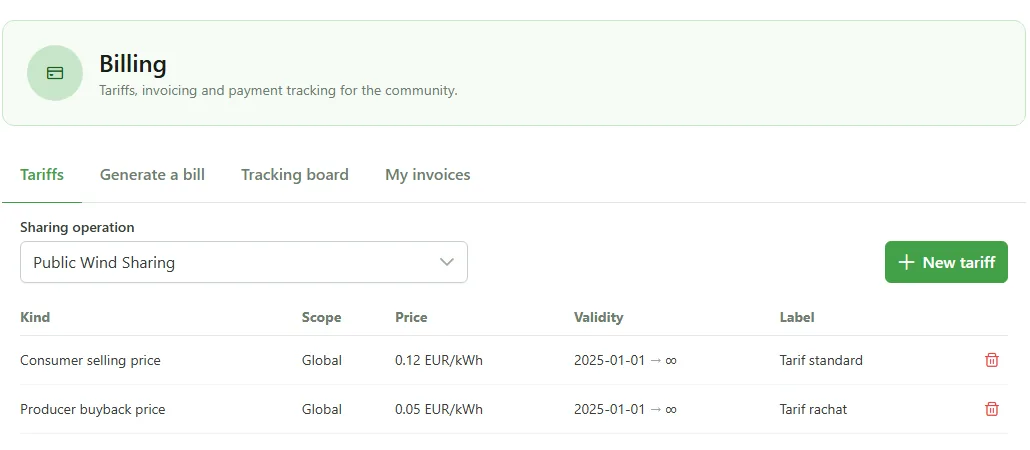
You set two prices
The community decides its own prices, in €/kWh. The selling price applies to the shared energy consumed by members; the buyback price pays for the injection that producers share with the community.
Each price applies to the whole operation, to a customer segment (residential, professional, industrial) or to a specific supply point, and carries a validity period. When several rules target the same member, the most specific one wins. A reduced tariff for a school or a household therefore does not call for a second operation: a price on its EAN is enough.
You launch a billing run for a period
You choose the operation and the period to bill: a month or a quarter, at the community’s own pace. Billing relies on the quarter-hourly readings that the grid operator sends for the operation. At launch, OptimCE freezes a snapshot of these volumes: amounts are calculated on frozen data, which can be traced back if a member asks a question.
The calculation runs in the background. It produces a draft per member, downloadable as a PDF with a “proforma” watermark. A draft can be reviewed, deleted or recalculated freely: nothing is final until you issue it.
You issue the documents
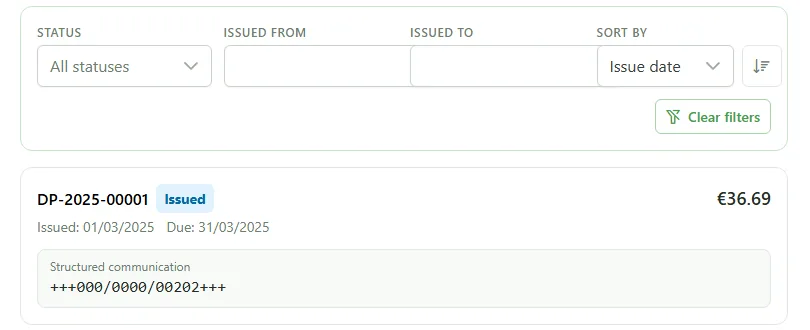
On issue, each document receives a number in a continuous sequence, a structured payment reference and a due date. OptimCE generates three documents as PDFs, each with its own series:
- the invoice (F-…), for the shared energy consumed by a member;
- the credit note (NC-…), to cancel an invoice that has already been issued;
- the remuneration statement (DP-…), for a producer’s shared injection.
A member who is both a consumer and a producer receives two separate documents. An issued invoice can no longer be modified: a mistake is corrected with a credit note, then a new invoice, and the history stays complete.
You track payments
Members pay by bank transfer, quoting the structured payment reference. You record each payment received; the amount is prefilled with the document’s total, and partial payments are accepted. The invoice switches to “paid” once the total is reached, and invoices past their due date show as overdue.
For their part, members find their own documents in the application, with their number, amount, status and structured payment reference. Each member sees only their own.
What it does not do
Brussels and Flanders: planned, not yet available. The billing module is currently designed for Walloon communities, under the supervision of the CWaPE. The Flemish and Brussels frameworks are planned, but not yet implemented.
Shared energy only. The community’s invoice values the shared energy at the internal price, excluding network fees and taxes. The energy that sharing did not cover is still billed by each member’s supplier, at their contract rate.
No payment collection. OptimCE debits nothing and receives no payments: members pay by transfer into the community’s account, and you record what has arrived.
Documents in French. The PDFs are generated in French, whatever the interface language.
A single VAT rate, for now. The module currently applies a 21% rate to every document. Differentiated rates, such as the reduced 6% rate on a household’s electricity, and the small-business VAT exemption are not handled yet. The community’s regime, whether it is liable for VAT and at which rates depending on the member, is settled with an accountant before the first invoice: our guide to invoicing shared electricity sets out the cases.
Frequently asked questions
Where does the billing data come from?
From the allocation sent by the grid operator: the quarter-hourly shared volumes, which you import for the operation and the period to bill. When the billing run starts, OptimCE freezes a snapshot of these volumes; amounts are calculated on that frozen data, which can be traced back.
Can different members be charged different prices?
Yes. Each price applies to the whole operation, to a customer segment (residential, professional, industrial) or to a specific supply point (EAN), for a validity period. When several rules target the same member, the most specific one wins: an EAN’s price takes precedence over its segment’s, which takes precedence over the global price.
How do you correct an invoice that has already been issued?
An issued invoice has received a number in a continuous sequence: it can no longer be modified or deleted. To correct it, you issue a credit note that cancels it, then invoice again. While a document is still a draft, on the other hand, you can delete or recalculate it.
Does OptimCE handle VAT?
Partly. The module calculates VAT, but with a single 21% rate for every document: rates that differ by member and the small-business VAT exemption are not handled yet. The community’s VAT regime (whether it is liable, and the rates that apply to each member) is decided with an accountant before the first invoice.
Further reading
- Invoicing shared electricity in Belgium: who invoices what, VAT and the mandatory invoice details.
- Internal transfer price in an energy community: how to set a price you can defend before the general meeting.
- Billing in an energy community: the module announcement, with the details of the documents and their life cycle.