
Energy communities in Europe: RED II and IEMD
Energy communities are not an informal idea: they are legal objects defined by European law. Two directives govern them, they do not say the same thing, and confusing the two is expensive when it comes time to pick a structure.
The first is Directive (EU) 2018/2001, known as RED II, which creates the renewable energy community (REC). The second is Directive (EU) 2019/944 on the internal electricity market — often shortened to IEMD or EMD — which creates the citizen energy community (CEC). One is about renewable energy and proximity; the other about electricity and openness. Everything else follows from that.
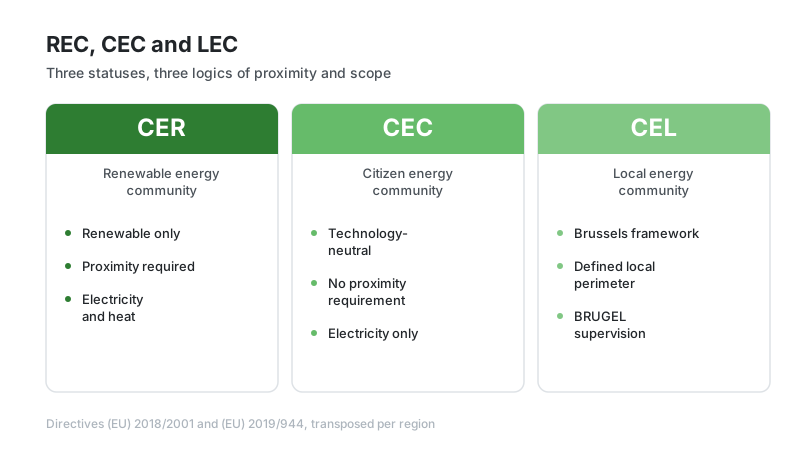
Two directives, two legal objects
The renewable energy community (RED II)
RED II defines the REC in its Article 2 and requires Member States, in Article 22, to put an enabling framework in place. The text is explicit about the right to participate: Member States must ensure that final customers, household customers in particular, are entitled to join a renewable energy community while keeping their rights as final customers, and without being subject to unjustified or discriminatory conditions or procedures (EUR-Lex).
Three traits characterise the REC:
- it covers renewable energy exclusively — electricity, but heat as well;
- its members or shareholders must be located in proximity to the generation assets the community owns;
- its primary purpose is to deliver environmental, economic or social community benefits to its members or to the local area, rather than financial profits.
A private undertaking may take part, provided that this does not constitute its primary commercial or professional activity. A solar installer cannot therefore turn a REC into the vehicle for its own business.
The citizen energy community (internal market directive)
Directive 2019/944 defines the CEC in its Article 2 and frames it in Article 16. It is a legal entity based on voluntary and open participation, effectively controlled by members who are natural persons, local authorities — municipalities included — or small enterprises. Its primary purpose is, again, environmental, economic or social benefit rather than profit (EUR-Lex).
Two major differences from the REC:
- the CEC is technology-neutral. It may generate from renewable sources, but nothing obliges it to;
- in exchange, it is limited to electricity. No heat, no gas.
Its range of activities is broader, though: generation, distribution, supply, consumption, aggregation, storage, energy efficiency services, and electric vehicle charging.
What really separates a REC from a CEC
| Renewable energy community | Citizen energy community | |
|---|---|---|
| Directive | RED II — (EU) 2018/2001 | Internal market — (EU) 2019/944 |
| Carrier | Renewable energy, heat included | Electricity only |
| Technology | Renewable required | Neutral |
| Proximity | Required | Not required |
| Effective control | Natural persons, SMEs, local authorities | Natural persons, small enterprises, local authorities |
| Large companies | Restricted participation | May participate, may not control |
The thing to hold on to: proximity and the renewable requirement are the price paid for the REC’s wider scope (heat included). Conversely, the CEC trades geographic and technological openness for a limitation to electricity.
What both forms have in common
On three points the directives converge, and those three points are what define an energy community as opposed to an ordinary supplier:
- A legal person. An energy community is not an arrangement between neighbours: it is a constituted legal entity.
- Effective control by the members. Decision-making power cannot drift towards a dominant energy player. This is the scheme’s anti-capture guarantee.
- A non-financial primary purpose. The benefits sought are environmental, economic or social, for the members or for the local area.
Transposition is where it is actually decided
A directive sets a result, not a directly applicable rule. Each Member State chooses legal forms, capacity thresholds, authorisation procedures and tariff treatment. That is the level at which the differences become structural.
Belgium — three regional frameworks
Energy is a regional competence. Wallonia, Brussels and Flanders each apply their own decree or ordinance, with their own regulator — CWaPE, BRUGEL, VREG — and their own families of allocation keys. A Brussels community and a Walloon community do not follow the same rules, even though both derive from the same directives.
The detail of the three frameworks, the CER, CEC and CEL statuses and the role of the grid operator are covered in our reference article: “Energy communities in Belgium: CER, CEC, CEL”.
France — collective self-consumption as the entry point
France transposed both forms into its Energy Code, but most activity runs through the collective self-consumption regime (autoconsommation collective), particularly its “extended” variant. The structuring criterion there is kilometric, and it is set by decree: the distance between the two most distant participants must not exceed 2 km, and all of them must be connected to the low-voltage network of a single distribution operator. An extension to 20 km remains possible by ministerial derogation in sparsely populated areas (Légifrance — arrêté of 21 November 2019, article 1).
The same text, as amended by the arrêté of 21 February 2025, raised the cumulative capacity ceiling from 3 to 5 MW on the continental mainland — 0.5 MW in non-interconnected zones.
Deployment can be tracked at source: Enedis publishes the number of active collective self-consumption operations, their generation capacity and their producer and consumer counts as open data, refreshed quarterly (Enedis Open Data).
Netherlands — the Energiewet and direct sharing
The Netherlands is where the framework has moved most recently. The Energiewet entered into force on 1 January 2026, replacing the Elektriciteitswet 1998 and the Gaswet. It defines the energiegemeenschap and makes direct energy sharing legally possible between members (wetten.overheid.nl).
The contractual structure that follows looks a lot like the Belgian one. The regulator ACM points out that a participant needs several contracts: a sharing contract, a supply contract for the moments when shared energy is not enough, and a feed-in contract for electricity generated but not consumed. One point matters for governance: the ACM supervises the supplier’s tariffs for supply and feed-in, but not the prices agreed inside the sharing contract (ACM).
The economic lever remains the SCE (Subsidieregeling Coöperatieve Energieopwekking), which replaced the older “postcoderoos” scheme in 2021 and pays an operating subsidy per kWh over a guaranteed 15-year term, anchored in a postcode-based proximity logic (RVO).
The contrast is instructive: where France sets a kilometre perimeter and Belgium a regionally defined sharing zone, the Dutch support scheme reasons in postcode areas. Three national translations of a single European word — “proximity”.
What this changes for a community manager
The European framework determines what you are allowed to do. The national framework determines how you have to prove it. In practice, three operational consequences:
- The allocation key is not a free choice. Each region or country recognises its own families of keys, and stepping outside the catalogue usually requires an authorisation. See “Allocation key in Belgium: the 3 regions”.
- Invoicing depends on the status. Who issues which invoice, and at what VAT rate, follows from the national regime. See “Invoicing shared electricity in Belgium”.
- Effective control has to stay demonstrable. This is a continuing governance requirement, not a box ticked at incorporation. See “Engaging energy community members”.
This is exactly what OptimCE manages: members, meters, allocation keys and regulatory reporting, on an architecture built for national frameworks that diverge.
FAQ
What is the difference between a renewable energy community and a citizen energy community?
A renewable energy community (REC) comes from the RED II directive: it covers renewable energy only, and its members must be located in proximity to the generation assets. A citizen energy community (CEC) comes from the internal electricity market directive: it is technology-neutral, covers electricity only, and imposes no geographic proximity requirement. In both cases effective control must remain with natural persons, local authorities or small enterprises.
Which European directives govern energy communities?
Two of them. Directive (EU) 2018/2001, known as RED II, defines the renewable energy community in its Article 2 and sets Member State obligations in Article 22. Directive (EU) 2019/944 on the internal electricity market defines the citizen energy community in its Article 2 and frames it in Article 16. Both must be transposed into national law, which is why the rules differ so much from one country to the next.
Can a large company take part in an energy community?
It can participate, but it cannot control. Both directives require that effective control stays with natural persons, local authorities — municipalities included — or small enterprises. For a renewable energy community, a private undertaking’s participation must additionally not constitute its primary commercial or professional activity. The point is to stop a dominant energy player from capturing governance.
Does the proximity requirement apply everywhere in Europe?
No. It follows from the RED II definition of a renewable energy community, so it applies only to that form. How it is translated into practice is left to Member States, and the gap is wide: France sets a kilometre perimeter for collective self-consumption, Belgium a regionally defined sharing zone, and the Dutch support scheme reasons in postcode areas. A citizen energy community faces no proximity constraint at all.
Why do the rules differ so much between countries?
Because a directive sets a result to achieve, not a directly applicable rule. Each Member State chooses the legal form, the thresholds, the authorisation procedures and the tariff treatment. In Belgium, energy is on top of that a regional competence, so Wallonia, Brussels and Flanders run three distinct frameworks inside one country.
Take it further
The European framework sets the principle; the concrete decisions are taken at national and regional level.
Energy communities in Belgium: CER, CEC, CEL
The three Belgian statuses, energy sharing, and the role of the regulator and the grid operator.
Create an energy community in Wallonia
From choosing the model through to starting the sharing with your grid operator.
Manage your energy community with OptimCE
Members, meters, allocation keys and regulatory reporting: OptimCE is an open-source platform built for national frameworks that diverge. Browse the open sharing operations or create your own.
Sources
- Directive (EU) 2018/2001 (RED II) — EUR-Lex — definition of the renewable energy community and Member State obligations.
- Directive (EU) 2019/944 on the internal electricity market — EUR-Lex — definition and framing of the citizen energy community.
- European Commission — Energy Communities — overview of both forms and what they share.
- Légifrance — arrêté of 21 November 2019 setting the geographic proximity criterion, article 1 — 2 km perimeter, low-voltage connection to a single operator, 5 MW and 0.5 MW thresholds.
- Légifrance — arrêté of 21 February 2025 — raising the cumulative capacity ceiling from 3 to 5 MW.
- Enedis Open Data — active collective self-consumption operations — the official count, refreshed quarterly.
- Energiewet — wetten.overheid.nl — the text in force since 1 January 2026.
- ACM — Energiedelen biedt kansen voor energiegemeenschappen — contracts required and the limits of the regulator’s remit.
- RVO — Subsidieregeling Coöperatieve Energieopwekking (SCE) — the Dutch support scheme for energy cooperatives.