
Moving house in Wallonia: electricity steps
When you move house in Wallonia, the electricity steps come down to very little: a contract at your new address, meter readings taken on handover day, a signed takeover document. Forgetting them is expensive. In 2025, failed moving procedures led to 4,929 electricity cut-offs among Walloon households, 54.1% of the total, according to the CWaPE, the Walloon energy regulator. These are not unpaid bills: they are homes where the power was on but no contract covered the address.
This guide gives the checklist in order, for electricity and gas: a month before, on the day, after. It then covers the cases that cost money, the closed meter and the home without a contract, and two questions people ask too late: what happens to your solar panels, and what happens to your place in an energy community? It takes into account the new Walloon technical regulation (RTDE), published in the Belgian Official Gazette on 20 November 2026 and in force on 30 November 2026.
It does not repeat what is written elsewhere on this site: reading a meter is in “Electricity meter readings in Wallonia: the guide”, finding a code in “Belgian EAN code: where to find it, what it’s for”, who does what in “DSO vs supplier: who does what in Belgium?”. The rules described are Walloon. Brussels and Flanders are compared at the end. Most official pages are in French; the French names are given where you will need them.
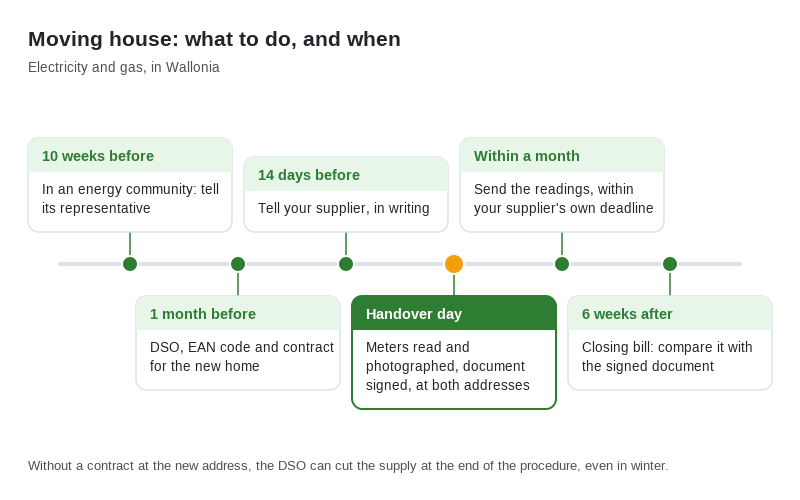
A month before: DSO, EAN code and contract
Identify the grid operator (DSO) of the new home. It depends on the address, not on you. The “Find your DSO” tool gives it from the postcode, for electricity and gas. It is the only one that can open a closed meter.
Ask the owner or the occupant for the EAN code and the meter number. There is one code per energy, and it changes with the address: your old home’s code is no use to you now. In a block of flats, check the number on the meter itself.
Decide on your contract. In Wallonia, supply “continues at the customer’s new address under the same conditions” (Walloon Government order of 30 March 2006, article 3bis, our translation; the same rule applies to gas). There are four exceptions:
- you end the contract on the moving date;
- you sign with another supplier from that date;
- you move abroad or to another region;
- you move in with someone who already has a contract.
Moving is therefore a good time to compare: “Which electricity tariff to choose in Belgium?” helps you decide. If you are arriving from abroad or have no contract in your name yet, the CWaPE advises signing one “ideally at least a month before” moving in. If your DSO is also your social supplier, it is the one to tell.
Tell your supplier in writing. There is no single Walloon deadline: each supplier must publish its own.
| Source | Deadline for telling them |
|---|---|
| CWaPE | “as quickly as possible” |
| Federal agreement, advice from signatory suppliers | preferably 14 days before |
| ENGIE | readings no later than 1 month after |
| Eneco | date and readings no later than 30 days after |
Assumptions: federal agreement on the consumer in the liberalised electricity and gas market, point 3.1; ENGIE help page and Eneco general terms of June 2026, article 10, accessed on 24 November 2026, in French. The two suppliers are examples: read your own supplier’s deadline.
Miss it and you remain liable at the old address: Eneco writes that the energy used there stays due, “whoever” used it. The move itself is free: the agreement rules out any penalty or administrative cost, even if you change supplier at that moment.
Handover day: meter readings and the takeover document
The energy takeover document (document de reprise des énergies) records the readings when occupants change. There are two versions, valid throughout Belgium: the standard one, and one for homes with solar panels. Every supplier must accept it. Plan for four copies: two for the home you leave, two for the new one.
- Read every meter, electricity and gas, and photograph it with its number.
- Check it is the right one. In a block of flats, ORES suggests switching off the circuit breaker: if your home goes dark, that is your meter. For gas, see which one stops when your appliances are off.
- Fill in everything: date, EAN codes, numbers and readings, contact details and suppliers of both parties, whether prepayment is active.
- Sign together, with the words “Lu et approuvé” (read and approved). Keep the original and send a copy to your supplier.
This document is not a contract. Signing it does not start supply in your name.
With a smart meter, fill it in anyway: the form asks for it, even though a remote reading takes precedence. The RTDE specifies that the new user, or failing that the owner, owes the consumption recorded after the remote reading on the moving date, at 00:00:00 (article V.63bis, § 2).
Nobody to sign with? The owner can. Otherwise, send your photos and the document signed on your side: a missing second signature does not make the notice invalid (agreement, point 3.1). If nobody takes over the home, the CWaPE refers you to the DSO.
Are you the landlord? Between two tenants, consumption is yours: you need a contract in your name, or a closed meter.
Afterwards: contract, advance payments and closing bill
The closing bill is issued within six weeks of the end of the contract, and any overpayment refunded within thirty days (order of 30 March 2006, article 7, § 3). Compare its reading with the one on the signed document; “Read your Belgian electricity bill line by line” shows where to find it.
The start date of the new contract is the costliest trap. The regional mediation service describes households that signed both the takeover document and a contract, and were still billed for a period before they arrived. From 30 November 2026, the RTDE rules this out: the new user “cannot be assigned consumption from before they entered the premises” (article V.76, § 4, our translation). It also applies to ongoing situations. How to dispute a bill is in “Electricity settlement bill too high: what to do”.
Advance payments at the new address rest on an estimate. Ask for them to be adjusted if your home is nothing like the previous one.
A forgotten or wrong reading makes you pay for someone else’s consumption, or the other way round. Orders of magnitude for a household using 3,500 kWh a year:
| Period wrongly assigned | Volume | Amount |
|---|---|---|
| 15 days | 144 kWh | 66 € |
| 1 month | 288 kWh | 132 € |
| 3 months | 863 kWh | 396 € |
Assumptions: the reference case of our guides, 3,500 kWh on a single-rate meter; average Walloon “all in” price of 45.89 c€/kWh, fixed fees included, according to the CREG dashboard of October 2026; consumption spread evenly over the year, months of 30 days.
A closed meter in your new home
The order matters: the contract first, the DSO second. Give the supplier the EAN code and say that the meter is closed. Once the contract is registered, ask for the meter to be opened. The RTDE gives the DSO three working days, at the user’s expense (article IV.12; the previous version said the same).
| DSO | To have a meter opened | What it says |
|---|---|---|
| ORES | 078/15.78.01, option 1 | quote and appointment by phone |
| RESA | 04/220.12.11 | billed after the opening |
| AIEG | 085/27.49.00, menu 2 | paid when the work is done |
| AIESH | 060/45.91.60 | no page about moving |
| REW | REW contacts you | once the contract is registered |
Assumptions: websites of the five DSOs, accessed on 24 November 2026; general number for AIESH.
The price is the same at all five: 128.33 € excluding VAT in 2026 when a technician comes, 130.64 € in 2027, and 0 € remotely with a smart meter. For gas, ORES and RESA apply the same price. Closing costs as much: closing then reopening a meter on site comes to 256.66 € excluding VAT per energy. That is why ORES, AIEG and REW advise leaving the meters open when you go. Between landlord and tenant, the lease can say who pays for the opening.
Power on, but no contract: the regularisation procedure
This is the “problematic move”, long known in the sector as MOZA. The steps are set by the order of 30 March 2006 (article 22bis) and the ministerial order of 3 March 2008, amended in 2023; they also apply to gas.
| Step | Deadline |
|---|---|
| The previous occupant’s supplier withdraws; the DSO writes to the new occupant or the owner | 5 working days |
| You tell your supplier, or sign a contract | 10 calendar days |
| Without a reply, the DSO tries to reach you, by phone among other means | 15 days |
| It visits and leaves a regularisation form (formulaire de régularisation) | 15 working days |
| You return the form | 7 calendar days |
| The supplier you name is told, then sends an offer | 3 days, then 10 days |
| You sign, with that supplier or another | 20 calendar days |
| Failing that, the DSO suspends the supply | RTDE: 30 working days at most, 7 with a smart meter |
Assumptions: electricity procedure; the last deadline comes from article IV.16, § 3 of the RTDE in force on 30 November 2026, whose article I.3 counts in working days. Naming the previous occupant’s supplier on the form does not commit you: you can sign elsewhere.
Winter does not protect you. The ban on cut-offs covers those authorised by a justice of the peace and contracts that have expired (decree of 12 April 2001, article 33bis/4). Énergie Info Wallonie, the regional advice service, is blunt: the procedure can lead to a cut-off “even in winter”. And a smart meter, which can be closed remotely, shortens the wait.
Moving when you have solar panels
Use the version of the document made for solar panels: it asks for the consumption readings (1.8.1 and 1.8.2) and the injection readings (2.8.1 and 2.8.2).
When you sell, declare the change of owner if the installation still receives green certificates: form C3, to the DSO, within 45 calendar days. If the granting period is over, there is nothing more to declare: the DSO learns of it through the takeover document.
Compensation, the Walloon net metering scheme, depends on the installation, not on the occupant: it runs until 31 December 2030 for installations commissioned before 1 January 2024. One exception matters: a previous occupant who joined a sharing scheme gave it up for good, and the right “cannot be reactivated” for the new owner or tenant either. The CWaPE warns that the property may lose value. Ask before you sign.
The date matters. Compensation is calculated per billing period. ORES advises dealing with the supplier during the month of the annual reading, so as not to lose the surplus injected since the last one.
The prosumer tariff is charged to the occupant who consumes, not to the owner of the panels. A plug-and-play kit, on the other hand, moves with you: “Renting: the no-roof guide to solar” gives the two declarations to make.
Leaving or joining an energy community when you move
Sharing is attached to the supply point. Your EAN code stays on the wall, and your place in the sharing scheme stays with it. Two things need to be kept apart. You remain a member of the association or cooperative for as long as its statutes allow: they must set out how members withdraw and what happens to their shares (decree, article 35duodecies, § 1, 5°). You are a participant in the sharing through a list kept by the DSO, which changes only through a procedure. Leaving and joining do not follow the same one.
| Leaving the sharing scheme | Joining at the new address | |
|---|---|---|
| Who applies | the community’s representative | the community’s representative |
| Who decides | the DSO | the DSO, then the CWaPE |
| Examination | 20 working days | 10 + 20 + 40 working days |
| Amendment proposed, then signed | 10 working days | 10 + 10 working days |
| Default effective date | 20th working day | 20th working day |
| Maximum | 50 working days, 10 weeks | 110 working days, 22 weeks |
Assumptions: Walloon Government order of 17 March 2023, articles 20 to 22, and the CWaPE guide to modifying a sharing scheme, July 2025 version. Maximum times, complete file, standard allocation key, excluding Saturdays, Sundays and public holidays. In sharing within a single building, joining follows the short route.
Tell your representative ten weeks ahead. Nothing changes before the amendment takes effect.
The RTDE adds a safety net. From 30 November 2026, when the DSO learns that a participant “is no longer the holder of the access point”, it withdraws them as soon as it knows, and tells the supplier within ten working days (article IX.12, § 1). The text refers to when the DSO finds out, not to when you leave: what happens in between is for you and your community to settle.
Ask for a separate form. If your withdrawal is on the same form as someone else’s arrival, everything takes the long route. The CWaPE advises grouping changes, but for a departure with a date, the short route is worth it.
At the new address, you need an active smart meter and a supply contract. In a renewable energy community, sharing takes place close to the installations: check that your new municipality is within the perimeter. A different DSO does not rule you out: the RTDE provides for sharing across several grids (article IX.10). And if the home was already in a sharing scheme, you do not inherit it: you join if you wish. “Join an energy community in Wallonia” sets out the conditions and what to check.
Moving to another region
The contract stops at the regional border: you need a new one, even with the same supplier. The takeover document is the same everywhere.
| Wallonia | Brussels | Flanders | |
|---|---|---|---|
| Telling the supplier | deadline published by the supplier | no later than 7 days after | within 7 days of getting the keys |
| Opening a meter | 128.33 € excl. VAT on site, free remotely | 198.44 € incl. VAT (Sibelga) | 106.26 € incl. VAT for an analogue meter, free for a digital meter (Fluvius) |
| Your place in a sharing scheme | withdrawal requested by the representative; automatic once the DSO finds out | ends on the date the occupant changes | removed by Fluvius on the date of the change |
Assumptions: 2026 prices. Brussels: Brugel, Sibelga and the technical regulation, article 4.69, § 3. Flanders: Fluvius, 2026 prices and sharing protocol v3.2.
Key takeaways
- A contract in your name before you get the keys: more than half of electricity cut-offs follow a move that was never registered, and winter changes nothing.
- Readings at both addresses, four documents, photos: the takeover document is not a contract, but it is your evidence.
- No single Walloon deadline for telling your supplier: its own is on its website.
- A closed meter costs 128.33 € excluding VAT to open on site in 2026, and nothing remotely.
- From 30 November 2026, you can no longer be assigned consumption from before you moved in.
- In an energy community, allow ten weeks to leave and up to twenty-two to join at the new address.
FAQ
When should I tell my electricity supplier that I am moving?
As soon as you know the date, in writing, preferably fourteen days ahead. Each supplier must publish its deadline: ENGIE wants readings within a month, Eneco the date and readings within thirty days. Without a contract in your name, sign one at least a month before you move in.
Where do I find the energy takeover document, and is it compulsory?
On the website of the CWaPE, your DSO or your supplier, in a standard version or one for solar panels. Its absence does not make your notice invalid, but it is your evidence on the readings, and every Belgian supplier must accept it.
The meter in my new home is closed: what do I do, and what does it cost?
Sign a contract, then ask the DSO to open it; it has three working days. The 2026 price is 128.33 € excluding VAT on site at all five electricity DSOs, and opening a smart meter remotely is free.
What happens if I move in without an electricity contract?
The DSO writes, calls, then visits with a regularisation form. At the end of the procedure you have twenty days to sign a contract. Failing that, it suspends the supply, even in winter, and faster if you have a smart meter.
Can I be billed for electricity used before I moved in?
Not from 30 November 2026: the Walloon technical regulation rules out assigning the new user consumption from before they entered (article V.76, § 4). Compare the start date and reading with your takeover document, and dispute any gap in writing.
What happens to my place in an energy community if I move?
It stays with the EAN you leave. Your representative asks the DSO to withdraw you, ten weeks at most. Joining a sharing scheme at the new address also goes through the CWaPE, up to 110 working days. Your membership depends on the statutes.
Sources
Most sources are in French.
- CWaPE — Specific annual report 2025, public service obligations — point 1.14 and table 3: 9,114 electricity cut-offs of residential customers, of which 4,929 (54.1%) after a failed moving procedure; cases in which no cut-off takes place in winter. Document of 3 July 2026, accessed on 24 November 2026.
- CWaPE — Specific annual report 2025, regional energy mediation service — households billed for a period before they moved in. Accessed on 24 November 2026.
- Belgian Official Gazette — Technical regulation for the management of and access to electricity distribution networks in the Walloon Region, decision CD-26h27-CWaPE-1284, published on 20 November 2026 — articles I.3 (working days), I.4 (entry into force on the tenth day, immediate application), IV.12 (service within three working days), IV.16, § 3 (suspension after a move), V.63bis, § 2 (remote reading), V.76, § 4 (earlier consumption), IX.4 (supply contract), IX.10 (sharing across several grids), IX.12 (automatic withdrawal of a participant). The CWaPE confirms entry into force on 30 November 2026 on its page Règlements et contrats. Accessed on 24 November 2026.
- Wallex — Walloon Government order of 30 March 2006 on public service obligations in the electricity market — articles 3bis (continuation of the contract, deadlines published by the supplier), 7, § 3 (closing bill), 22bis (contact by the DSO). Accessed on 24 November 2026.
- Wallex — Ministerial order of 3 March 2008 on the regularisation procedure in the event of a move, version in force since 23 December 2023 — steps and deadlines, electricity and gas. Accessed on 24 November 2026.
- Wallex — Decree of 12 April 2001 on the organisation of the regional electricity market — articles 33bis/4 (winter period), 35octies, § 7 (giving up compensation), 35duodecies, § 1 (statutes, withdrawal, shares), 35quinquiesdecies (proximity of installations). Accessed on 24 November 2026.
- Wallex — Walloon Government order of 17 March 2023 on energy communities and energy sharing, version in force since 26 February 2026 — articles 1 (working day), 20, 21 and 22, § 2 (withdrawal of a participant). Accessed on 24 November 2026.
- CWaPE — Explanatory guide to the form for modifying electricity sharing, July 2025 — points 1, 2.1, 2.2 and 2.3: withdrawal handled by the DSO alone, addition examined by the CWaPE, grouped changes. Accessed on 24 November 2026.
- CWaPE — Explanatory guide to the electricity sharing form, July 2025 — giving up compensation, final for the next occupant, effect on the value of the property. Accessed on 24 November 2026.
- CWaPE — Je change d’adresse and Formulaire de reprise des énergies, with the standard and solar versions — steps, legal value, obligation to accept, empty rented homes, meter codes. Accessed on 24 November 2026.
- FPS Economy — Agreement on the consumer in the liberalised electricity and gas market — point 3.1: fourteen days, no penalty, missing signature. Accessed on 24 November 2026.
- CWaPE — harmonised non-periodic electricity tariffs 2026 and 2027; gas: ORES, decision CD-26c26-CWaPE-1246 and RESA 2026 — opening and closing a meter, on site and remotely, excluding VAT. Accessed on 24 November 2026.
- ORES — J’emménage, Je déménage and Produire son énergie; RESA — Mon déménagement; AIEG — Je déménage / J’emménage; REW — Emménager / déménager; AIESH — open or closed meters, contacts, checking the meter, social supplier, timing for a prosumer. Accessed on 24 November 2026.
- SPW Énergie — Solwatt forms and compensation scheme; Wallonia — Solwatt: administrative change to an account; CWaPE — Explanatory note on the prosumer tariff — form C3 and 45 days, end of the granting period, compensation per billing period, who pays the prosumer tariff. Accessed on 24 November 2026.
- Énergie Info Wallonie — Je n’ai pas de contrat d’énergie pour mon nouveau logement (page of 8 March 2026) and Puis-je faire fermer les compteurs entre deux locataires ? (page of 26 February 2026) — possible cut-off in winter, opening costs and the lease. Accessed on 24 November 2026.
- CREG — Monthly dashboard, October 2026 — average “all in” price for a Walloon household using 3,500 kWh. Accessed on 24 November 2026.
- ENGIE — Quand dois-je communiquer mon déménagement ? and Eneco — General terms, June 2026, article 10 — deadlines after the move. Accessed on 24 November 2026.
- Brussels: Brugel — Encore une question ? (seven days, contract) and technical regulation, article 4.69, § 3 (end of sharing); Sibelga — Opening meter (in English). Flanders: Fluvius — Elektriciteit na mijn verhuis, 2026 prices and sharing protocol v3.2 (in Dutch). Accessed on 24 November 2026.