
DSO vs supplier: who does what in Belgium?
The difference between a DSO and a supplier fits in one sentence: the supplier sells you electricity, the distribution system operator (DSO) carries it to your meter. You choose the first. Never the second: it comes with your address. Upstream, Elia moves the power at high voltage, and four regulators share oversight of the whole system.
The confusion comes from the fact that only one of these players writes to you. “It is the energy supplier that issues and sends you your energy bill”, ORES points out, and it “then shares it out among all the parties” (ORES, in French). So people call their supplier about an outage it cannot fix, and switch supplier hoping to cut network costs it does not set.
This guide does not repeat what is already on this site. “Read your Belgian electricity bill line by line” shows who sets and who collects each line, and which ombudsman to contact; “Why your electricity bill stays high in Belgium” analyses each block of the bill in euros; “Local electricity: the short-circuit guide” sets out the quarter-hour rule; “Invoicing shared electricity in Belgium” covers the sharing invoice.
The question here is about the players: who does what, who decides what, and who to call when something goes wrong? The guide describes Wallonia; Brussels and Flanders are flagged where they differ.
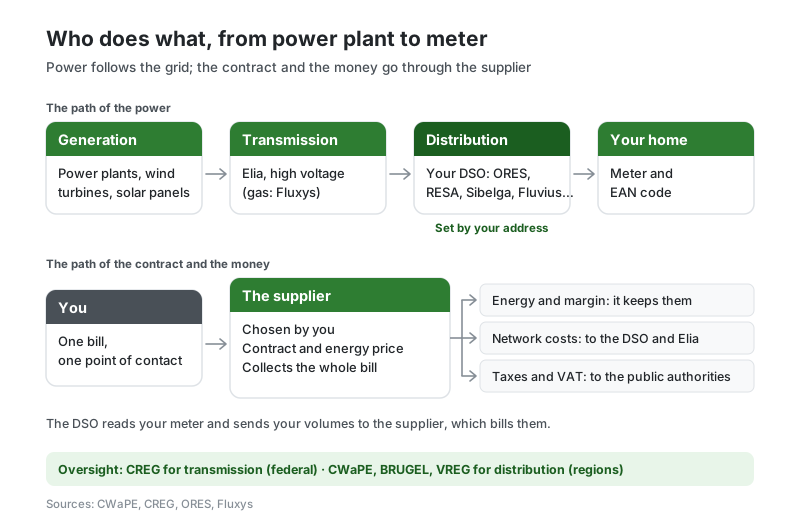
The chain in one diagram: generation, transmission, distribution, supply
Electricity follows a physical path in three steps. Generators feed it into the grid: power plants, wind turbines, your neighbour’s solar panels. Elia carries it at high voltage. Your DSO distributes it to your meter. Gas follows the same path, with Fluxys for transmission.
The contract follows another path. Your supplier buys or generates the energy you use and sells it to you. It runs no cables: it pays for the grid on your behalf, then bills you for it.
The link between the two paths is the meter. In Wallonia, “only the grid operator may collect metering data on its grid” (Walloon electricity decree, article 11 § 2). It installs meters and manages the data “needed for […] market processes” (article 34, 2°): the supplier bills what the DSO measured. A wrong meter reading is settled with the DSO, a wrong price with the supplier.
The supplier: what it does, what it bills
In Wallonia, selling electricity to a final customer requires a supply licence granted by the CWaPE (electricity decree, article 30 § 2). The CWaPE lists thirteen electricity suppliers for residential customers, from Aspiravi Energy to TotalEnergies (CWaPE, in French).
The supplier does three things:
- it sells you energy, at a price it sets freely, plus an annual standing charge depending on the offer;
- it signs and manages the contract: advance bills, annual statement, moving house, termination;
- it collects the whole bill, network costs, taxes and VAT included, and passes on each party’s share.
You can leave at any time. Federal law caps the notice period at “a maximum of three weeks” and forbids any exit fee (law of 29 April 1999, article 18 § 2/3). The new supplier handles the switch: it needs your EAN code.
It also applies the social tariff. “Every quarter, the CREG calculates this tariff”, and for a federally protected customer, “your supplier automatically applies the social tariff on your next bill” (CREG, in French).
The DSO: grid, meter, readings, outages, connections
The CWaPE sums up the job of a distribution system operator: “operating, maintaining and developing the grid, metering and handling outages” (CWaPE, in French). The Walloon electricity decree lists its tasks in full (articles 11 and 34). For a household, they come down to:
- connecting to the grid “any final customer who requests it”;
- installing, maintaining and reading meters, including the smart meters it is rolling out;
- managing metering data and sending it to the supplier;
- repairing faults: power cuts, damaged cables, and gas smells for ORES and RESA;
- installing a prepayment meter after a payment default: the supplier requests it, the DSO installs it (CWaPE, in French).
Except in the cases where it becomes your supplier, described below, the DSO does not sell you energy: what it costs you goes through the supplier’s bill.
Designated for an area, never chosen
- In Wallonia, the Government designates the DSO “after an opinion from the CWaPE and on the proposal of the municipality or municipalities” concerned, “for a renewable term of at most twenty years”. A municipality “cannot propose several distribution system operators” for electricity (electricity decree, article 10).
- In Flanders, the VREG designates the operators for twelve renewable years (Energiedecreet, articles 4.1.1 and 4.1.3); “you cannot choose your grid operator yourself”, the Flemish government writes (Vlaanderen.be, in Dutch).
- In Brussels, Sibelga is the only operator for electricity and gas (BRUGEL, in French).
Wallonia has five electricity DSOs: ORES, RESA, AIEG, AIESH and REW; only ORES and RESA also distribute gas (CWaPE). Yours depends on your municipality, sometimes on the former municipality within it: find yours with your postcode, or browse the list of DSOs by municipality.
Your DSO only changes if you move or if your municipality switches operator. That happened in Brunehaut, whose electricity grid “was transferred to AIEG with effect from 1 January 2026”, 0.27 % of ORES’s access points (CWaPE, decision of 15 October 2026, in French). Your supply contract carries on; in Couvin, though, the 2024 takeover by AIESH changed the EAN code.
When the DSO becomes your supplier
This is the exception, and it is mostly social. In Wallonia, the DSO supplies electricity in three cases:
- regionally protected customers: the DSO “supplies electricity at the social tariff” to them, unless the customer asks otherwise (electricity decree, article 33bis). It becomes their social supplier (Walloon Government order of 30 March 2006, article 2; CWaPE). A federally protected customer can also ask for it;
- winter, without a contract: during the period when disconnections are banned, it temporarily supplies a household whose contract ended with no new supplier (same order, article 37bis);
- a supplier’s failure: it takes over that supplier’s customers as “substitute supplier” (electricity decree, articles 2, 35°, and 11 § 2).
In Flanders, Fluvius becomes the sociale leverancier when a supplier has ended the contract and the household cannot find another one (Fluvius, in Dutch). The help to activate before that point is described in “Energy poverty in Wallonia: available support”.
Elia and Fluxys: transmission, and why they are not DSOs
Elia is the electricity transmission system operator (TSO). It is designated not by a region but by the federal minister, “after an opinion from the commission and deliberation in the Council of Ministers”, for “a renewable term of twenty years” (law of 29 April 1999, article 10). Its grid is “the national interconnected very-high-voltage and high-voltage electricity transmission grid” (article 2, 7°). In Wallonia, Elia also runs the local transmission grid, up to 70 kV (CWaPE).
Three differences set it apart from a DSO:
- it does not connect households: a business connected directly to its grid has Elia as its operator, a household never does;
- its tariffs are federal: the CREG “sets the tariff methodology” the transmission system operator must follow (law of 29 April 1999, article 12 § 2), while distribution tariffs are regional;
- you pay it indirectly: your DSO re-invoices transmission to you, then your supplier collects it. In Wallonia, this “transmission re-invoicing tariff” is 2.74 c€/kWh including VAT in 2026, the same at all five DSOs (CWaPE, 2026 tariff summary, in French).
Fluxys Belgium plays this role for gas: it transports it at high pressure and sells capacity to suppliers (Fluxys). Neither Elia nor Fluxys sells you energy or repairs a fault at your home.
The regulators: CWaPE, BRUGEL, VREG, CREG
A regulator supplies nothing and repairs nothing: it sets the rules, approves tariffs, oversees companies and handles complaints. Distribution tariffs are a regional matter, transmission tariffs a federal one.
| Regulator | Level | What it oversees |
|---|---|---|
| CWaPE | Wallonia | Tariff method and approval of DSO tariffs; DSOs’ public service obligations; supply licences; regional energy ombudsman service |
| BRUGEL | Brussels | Tariff method for Sibelga’s distribution tariffs |
| VREG | Flanders | Designation of grid operators; yearly approval of distribution tariffs |
| CREG | Federal | Transmission tariff method (Elia); market transparency and competition; maximum prices; quarterly calculation of the social tariff |
Assumptions: powers that affect a household, taken from the Walloon electricity decree (articles 30, 43 and 48), the Flemish Energiedecreet (article 4.1.1), the law of 29 April 1999 (articles 12 and 23) and the regulators’ websites, as at 28 October 2026.
For a complaint, write to the company concerned first. After that, the split is simple: meters and the grid go to the regional service, contracts and prices to the federal Energy Ombudsman Service. The full table of complaint routes is in our guide to reading the bill.
Network costs, energy, taxes: what each weighs on the bill
The CREG publishes the breakdown of a typical bill every month. For a Walloon household using 3,500 kWh a year on a single-rate meter, in September 2026:
| Block | Share | ≈ €/year | Who collects it |
|---|---|---|---|
| Energy | 42.78 % | 631 € | your supplier |
| Transmission and distribution | 29.96 % | 442 € | your DSO and Elia |
| Taxes and levies | 21.61 % | 319 € | the federal state and the region |
| VAT | 5.65 % | 83 € | the federal state |
| Total | 100 % | 1,475 € |
Assumptions: CREG monthly dashboard for September 2026, residential profile of 3,500 kWh on a single-rate meter, average “all-in” commercial price in Wallonia, i.e. 42.14 c€/kWh. The euro column is our calculation from the published shares. For Belgium as a whole, the CREG gives 44.25 % energy, 27.10 % network, 23.00 % taxes and 5.66 % VAT.
The consequence: switching supplier acts on 43 % of the bill. Network costs depend on your DSO, so on your address, and on the tariff formula you choose; taxes depend on lawmakers.
Within the network block, distribution weighs far more than transmission. On the ORES 2026 tariff grid, a 3,500 kWh household on a single-rate meter pays about 433 € including VAT for distribution (a 14.10 € fixed part plus 11.98 c€/kWh), against 96 € of transmission re-invoiced for Elia. Since transmission is the same at all five Walloon DSOs, distribution is what makes network costs vary from one municipality to the next.
Assumptions: CWaPE summary of 2026 tariffs (updated 3 February 2026), residential low-voltage customers without peak metering. The method differs from the CREG’s: do not mix these amounts with the previous table.
Who to call for what
| Your situation | Who to contact | Why |
|---|---|---|
| Power cut, torn-down cable | your DSO | it runs and repairs the grid |
| Gas smell | your gas DSO (ORES or RESA) | it works on the gas grid |
| Disputed reading, faulty meter | your DSO | it installs and reads the meter |
| New connection, solar panels to declare | your DSO | it connects and receives declarations |
| Lost EAN code | your DSO | it assigns the code |
| Price, advance bills, invoice, contract | your supplier | it sets the price and manages the contract |
| Switching supplier | the new supplier | it ends the old contract for you |
| Moving house | your supplier | the contract follows you to the new address |
| Payment difficulties | your supplier, then your CPAS (public social welfare centre) | the supplier starts the procedure, the DSO installs the prepayment meter |
| Social tariff, regionally protected customer | your DSO | it is your social supplier |
| Unresolved complaint | regional or federal ombudsman | depending on whether it concerns the grid or the contract |
Assumptions: Walloon rules. When you move, the contract continues at the new address (Walloon Government order of 30 March 2006). Solar panels are declared on the UP10 form.
The name and breakdown number of your DSO are printed on your annual or final statement: a royal decree requires it (royal decree of 9 December 2021, article 4, 7°). Otherwise:
| Operator | Power cut | Gas smell |
|---|---|---|
| ORES | 078/78.78.00 | 0800/87.087 |
| RESA | 04/263.18.80 or 04/220.12.11 | 04/362.98.38 (French-speaking area), 087/74.20.18 (German-speaking area) |
| AIEG | 085/27.49.00 | no gas |
| AIESH | 060/41.10.10 | no gas |
| REW (Wavre) | 010/23.78.69 | no gas, see ORES |
| Sibelga (Brussels) | 02 274 40 66 | 0800 19 400 |
| Fluvius (Flanders) | 078 35 35 00 | 0800 65 0 65 |
Assumptions: numbers published on the operators’ websites, checked on 28 October 2026, in each operator’s own format. In Wallonia, only ORES and RESA operate gas grids.
In an energy community: what the DSO does, what the supplier does
Joining an energy community changes neither your DSO nor your supplier. It adds a third party: the representative of the sharing scheme.
The DSO measures and allocates. Its tasks include “metering the volumes of shared electricity” (electricity decree, article 11 § 2). Grid operators “determine the volumes of electricity consumed under the sharing operation […] on the basis of the readings” and of the allocation key, then “send the respective suppliers” the data needed for billing (article 35sexdecies § 2). The calculation is done “on a quarter-hourly basis” (CWaPE, sharing form guide, in French): only electricity produced and consumed in the same quarter-hour counts, as our short-circuit guide explains. It also sends the data to the representative of the sharing scheme (CWaPE) and checks that each meter’s communication function is switched on.
The supplier bills the rest. It “will bill the residual electricity”, the part the sharing did not cover, plus network tariffs, taxes and levies “on the whole volume of electricity withdrawn (shared and residual)” (CWaPE, in French). Sharing does not remove the DSO’s or Elia’s share.
The representative bills the shared kWh, at the price agreed within the community. You receive two invoices; what they contain is set out in “Invoicing shared electricity in Belgium”.
Participants do not need the same DSO: the application goes to “the grid operator or operators” concerned (electricity decree, article 35quaterdecies § 3). In OptimCE, each meter in a community is recorded with its EAN code and its grid operator (Start a community on OptimCE). To take the step, our guide “Join an energy community in Wallonia” walks through the process.
Key takeaways
- The supplier sells, the DSO carries: the first sets the energy price and collects the bill, the second runs the grid, reads the meter and fixes outages.
- You choose your supplier, never your DSO: it is designated for your municipality, for at most twenty years in Wallonia.
- Elia is not your grid operator: it transmits at high voltage and you pay it through your DSO.
- Switching supplier acts on 43 % of a typical Walloon bill; network costs depend on your address.
- Outage, meter reading, connection: the DSO. Price, contract, moving house: the supplier.
- The DSO can become your supplier, as social supplier of a regionally protected customer or, in winter, without a contract.
- In an energy community, the DSO allocates volumes per quarter-hour; the supplier bills the rest, network costs included.
Find your grid operator
Enter your postcode: OptimCE’s free tool shows your electricity and gas DSO, in all 565 Belgian municipalities.
FAQ
What is the difference between a DSO and an electricity supplier?
The supplier sells you energy, sets its price, signs the contract and collects the whole bill. The DSO runs the local grid, installs and reads the meter, sends your consumption data and repairs outages. You choose the supplier; the DSO depends on your address.
Can I choose or change my distribution system operator?
No. In Wallonia, the Government designates it for your municipality, for at most twenty years; in Flanders, the VREG does; in Brussels, it is Sibelga. It only changes if you move or if your municipality switches, as Brunehaut did on 1 January 2026.
Who do I call during a power cut in Wallonia?
Your DSO: 078/78.78.00 for ORES, 04/263.18.80 or 04/220.12.11 for RESA, 085/27.49.00 for AIEG, 060/41.10.10 for AIESH, 010/23.78.69 for REW. The number is also on your annual statement.
Why are network costs on my supplier’s bill?
Because the supplier collects the whole bill and passes their share on to the DSO and Elia. These costs made up 29.96 % of a typical Walloon bill in September 2026, according to the CREG. Switching supplier does not change them.
What does the CWaPE do, and how does it differ from the CREG?
The CWaPE approves Walloon DSOs’ tariffs, grants supply licences and handles complaints about the regional market. The federal CREG frames Elia’s transmission tariffs, monitors the market and calculates the social tariff.
Is Elia my grid operator?
No, unless a business is connected directly to its grid. Elia carries electricity at high voltage to the distribution grids; a household is connected to its DSO’s grid, which re-invoices transmission.
Sources
- Wallex — Walloon decree of 12 April 2001 on the organisation of the regional electricity market (in French) — article 2, 35° (substitute supplier), article 10 (designation of DSOs by the Government on the municipalities’ proposal and after an opinion from the CWaPE, one proposal per municipality, renewable term of at most twenty years), article 11 § 2 (DSO tasks, metering of shared volumes, exclusive collection of metering data), article 30 § 2 (supply licence granted by the CWaPE), article 33bis (supply at the social tariff by the DSO), article 34, 2° (connection, metering equipment and data), article 35quaterdecies § 3 and article 35sexdecies § 2 (role of grid operators in sharing), article 43 § 2 (CWaPE tasks), article 48 (regional ombudsman service). Accessed 28 October 2026.
- Wallex — Walloon Government order of 30 March 2006 on public service obligations in the electricity market (in French) — article 2, 2° (social supplier), article 3bis (contract continued when moving), articles 30sexies and 31bis (prepayment request and activation), article 37bis (temporary supply by the DSO during the disconnection ban). Accessed 28 October 2026.
- Justel — Law of 29 April 1999 on the organisation of the electricity market (in French) — article 10 (designation of the transmission system operator by the minister, twenty-year term), article 12 § 2 (tariff methodology set by the CREG), article 18 § 2/3 (notice of at most three weeks, no fee), article 23 § 2 (CREG tasks). Accessed 28 October 2026.
- Justel — Royal decree of 9 December 2021 on gas and electricity bills (in French) — article 4, 7°: name and breakdown number of the grid operator on the annual and final statement. Accessed 28 October 2026.
- Codex Vlaanderen — Energiedecreet of 8 May 2009 (in Dutch) — article 4.1.1 (designation of grid operators by the VREG) and article 4.1.3 (renewable twelve-year term). Accessed 28 October 2026.
- Vlaanderen.be — Klacht over energieleverancier, netbeheerder of Vlaamse Nutsregulator (in Dutch) — the grid operator depends on where you live and cannot be chosen. Accessed 28 October 2026.
- CWaPE — Transport et distribution d’électricité et de gaz (in French) — DSO tasks, designation by the Walloon Government, five electricity DSOs and two gas DSOs, Elia as local transmission operator up to 70 kV. Accessed 28 October 2026.
- CWaPE — List of suppliers to residential customers (in French) — thirteen electricity suppliers; list without an update date. Accessed 28 October 2026.
- CWaPE — Le tarif social and CWaPE — Le compteur à prépaiement (in French) — supply of regionally protected customers by the DSO; request by the supplier and installation by the DSO. Accessed 28 October 2026.
- CWaPE — Decision CD-26i15-CWaPE-1318 of 15 October 2026 on ORES’s authorised revenue for 2026-2029 (in French) — section 5.2.8: Brunehaut transferred to AIEG on 1 January 2026, 0.27 % of ORES’s EANs. Accessed 28 October 2026.
- CWaPE — Summary of network tariffs and levies for residential electricity customers in 2026, updated 3 February 2026 (in French) — ORES: 14.10 € a year and 11.98070 c€/kWh on a single-rate meter; transmission re-invoicing: 2.74252 c€/kWh including VAT at all five DSOs. Accessed 28 October 2026.
- CWaPE — Qui facture l’électricité partagée ? and CWaPE — Quel est le rôle du gestionnaire de réseau dans le cadre du partage d’énergie ? (in French) — billing of residual electricity and of network tariffs on the whole volume withdrawn; application of the key and data sent to the representative. Accessed 28 October 2026.
- CWaPE — Explanatory guide to the energy sharing form in Wallonia, July 2025 version (in French) — quarter-hourly calculation, check of the meter’s communication function. Accessed 28 October 2026.
- CREG — Monthly electricity and natural gas dashboard, September 2026 (in French) — breakdown of the average all-in commercial price for a 3,500 kWh residential customer on a single-rate meter, by region. Accessed 28 October 2026.
- CREG — Tarif social pour l’énergie (in French) — quarterly calculation by the CREG, automatic application by the supplier. Accessed 28 October 2026.
- ORES — Comprendre ma facture d’énergie (in French) — the supplier issues the bill and shares it out among the parties. ORES — Contacter ORES (in French) — breakdown and gas smell numbers. Accessed 28 October 2026.
- RESA — Report a power cut and RESA — Report a gas smell; AIEG; AIESH — Unplanned outages; REW; Sibelga — Contact; Fluvius — Contact — breakdown numbers. Accessed 28 October 2026.
- BRUGEL — The distribution system operator and BRUGEL — Distribution tariffs (in French) — Sibelga as the only operator in Brussels; tariff method set by BRUGEL. Accessed 28 October 2026.
- VREG — Aanwijzing netbeheerders and VREG — Hoeveel bedragen de distributienettarieven? (in Dutch) — designation of operators by the VREG; yearly approval of distribution tariffs. Accessed 28 October 2026.
- AIESH — FAQ on the takeover of the Couvin grid (in French) — new EAN code on 1 January 2024, supply contract maintained. Accessed 28 October 2026.
- Fluvius — De rol van Fluvius als sociale leverancier (in Dutch) — supply by Fluvius when a commercial supplier has ended the contract. Accessed 28 October 2026.
- Fluxys — Fluxys Belgium — natural gas transmission, capacity sold to suppliers. Accessed 28 October 2026.