
Impact tariff and energy communities
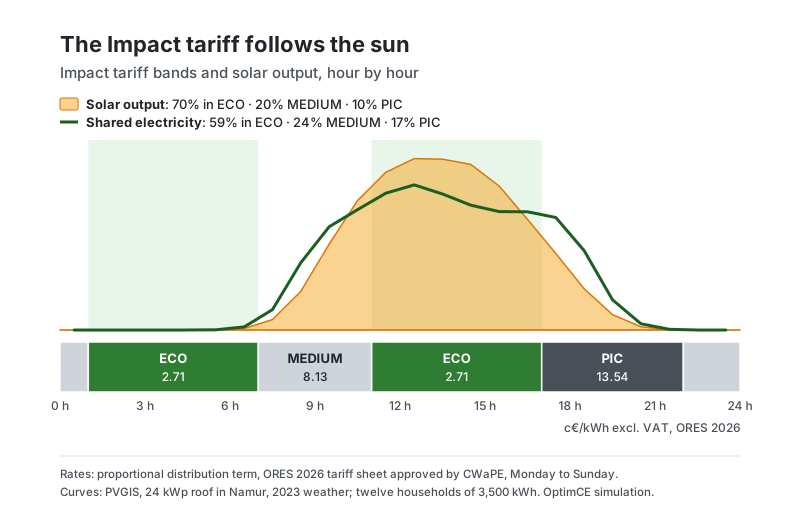
The Impact tariff charges five times less for the distribution grid between 11 am and 5 pm than between 5 pm and 10 pm. For an energy community, that is a useful coincidence: the cheapest grid window is also when solar panels produce, so when there are kilowatt-hours to share. The Impact tariff and the energy community pull in the same direction.
This guide does the calculation band by band. What does a member pay for a shared kilowatt-hour? How much of the gap comes from sharing, and how much from Wallonia’s incentive tariff? And what does it change for the manager who sets the allocation key and the internal transfer price?
The full tariff sheet, the 2026 dual-rate hours and the 10 pm – 1 am trap are covered in “Reduce your electricity bill: Wallonia 2026”, and the quarter-hour rule in “Local electricity: the short-circuit guide”. We do not repeat them here.
The scope is Wallonia, where the Impact tariff has existed since 1 January 2026, using the 2026 tariff sheets approved by CWaPE. Brussels and Flanders are covered at the end.
The Impact tariff bands in thirty seconds
The Impact tariff splits the day into five windows billed at three rates, Monday to Sunday, with no seasonal variation:
- ECO: 11 am to 5 pm and 1 am to 7 am;
- MEDIUM: 7 am to 11 am and 10 pm to 1 am;
- PIC (peak): 5 pm to 10 pm.
In the FAQ CWaPE published in July 2024, these bands were still called “green hours”, “orange hours” and “red hours”. The principle has not changed: orange costs three times green, red five times.
The rate depends on your distribution system operator (DSO). If you do not know which one serves your address, our “Find your DSO” tool gives it from your postcode.
| DSO | Single rate | Dual rate off-peak / peak | Impact ECO | Impact MEDIUM | Impact PIC |
|---|---|---|---|---|---|
| AIEG | 10.87 | 6.66 / 12.05 | 4.56 | 9.82 | 15.08 |
| AIESH | 13.64 | 8.21 / 15.17 | 5.50 | 12.28 | 19.07 |
| ORES | 11.98 | 7.39 / 13.27 | 5.09 | 10.83 | 16.57 |
| RESA | 11.06 | 7.01 / 12.20 | 4.99 | 10.05 | 15.11 |
| REW | 12.48 | 7.84 / 13.78 | 5.52 | 11.32 | 17.11 |
Assumptions: 2026 distribution rates in c€/kWh including 6% VAT, with public service obligations, regional levies and regulatory balances included, from the CWaPE summary of 3 February 2026. Transmission comes on top: 2.74 c€/kWh for every DSO and every band. Excludes the energy contribution, special excise duty and connection fee, which are the same in every configuration.
At ORES, the proportional distribution term is 2.71 c€ in ECO and 13.54 c€ in PIC, excluding VAT. The fixed term of 13.30 € a year does not apply on the Impact tariff.
What is billed on a shared kWh, band by band
Sharing replaces only one line of the bill: the energy component. The shared kilowatt-hour is paid at the community’s internal transfer price instead of the supplier’s price. Everything else is still due.
CWaPE puts it plainly: all grid charges, transmission and distribution, are due on shared electricity, and there is no tariff reduction for sharing within an energy community.
A shared kilowatt-hour is still an offtake, recorded by your meter and billed by your supplier according to your tariff configuration. No text provides a specific tariff for the shared volume. On the Impact tariff, a kilowatt-hour shared at 1 pm therefore carries the ECO rate, and one shared at 7 pm the PIC rate. This follows from the tariff sheets rather than from a rule written out in full, and we flag it as such.
At ORES, for a member consuming one kilowatt-hour:
| Kilowatt-hour | Energy | Grid | Total |
|---|---|---|---|
| Bought from the supplier, single rate | 14.22 | 14.72 | 28.94 |
| Bought from the supplier, Impact tariff, PIC band | 14.22 | 19.32 | 33.54 |
| Bought from the supplier, Impact tariff, ECO band | 14.22 | 7.83 | 22.05 |
| Shared, Impact tariff, ECO band | 6.00 | 7.83 | 13.83 |
| Shared within the same building, ECO band | 6.00 | 5.54 | 11.54 |
Assumptions: c€/kWh including VAT, ORES 2026. Supplier energy: 14.22 c€, i.e. 38.5% of the all-in price of 36.94 c€ recorded by CREG in June 2026. Internal transfer price: 6 c€, the order of magnitude of documented Belgian cases used throughout our articles. Grid: distribution from the CWaPE summary plus 2.74 c€ of transmission. The “same building” line applies the 80% reduction to the proportional distribution term only; the tariff sheet also applies it to transmission, which we do not quantify here. Excludes levies, identical on every line.
A kilowatt-hour shared in the ECO band costs less than half a kilowatt-hour bought on the single rate. The same kilowatt-hour bought in the PIC band costs 2.4 times as much.
The same-building case
This is the only configuration where sharing also reduces grid charges. The 2026 tariff sheets of all five Walloon DSOs apply an 80% reduction to the proportional term on energy shared within a single building. At ORES, in ECO, distribution falls from 2.71 to 0.54 c€ excluding VAT: combined with the Impact tariff, it is the cheapest grid kilowatt-hour in Wallonia. The reduction applies neither to residual offtake nor to energy communities, even when their members live on the same street.
Is the Impact tariff worth it? The double effect of a kWh shared in ECO hours
Between a kilowatt-hour bought on the single rate (28.94 c€) and one shared in ECO (13.83 c€), the gap is 15.11 c€. It comes from two mechanisms that need to be kept apart:
- 8.22 c€ come from sharing: the internal price of 6 c€ replaces energy at 14.22 c€;
- 6.89 c€ come from the Impact tariff: distribution falls from 11.98 c€ on the single rate to 5.09 c€ in ECO.
The first discount applies at any hour, the second only in the ECO band. Sharing only happens when the sun produces, so the two meet in the middle of the day.
How many kilowatt-hours really fall in ECO?
We reused the data behind the quarter-hour grid on our homepage: a 24 kWp south-facing roof in Namur, modelled with the European Commission’s PVGIS tool using 2023 weather, and twelve households of 3,500 kWh a year. Every quarter-hour of the year was assigned to its Impact band, in Brussels time.
| ECO | MEDIUM | PIC | |
|---|---|---|---|
| Solar output, full year | 69.7% | 20.0% | 10.3% |
| Solar output, April to September | 67.5% | 19.5% | 13.0% |
| Solar output, October to March | 75.5% | 21.2% | 3.2% |
| Shared electricity, full year | 59.2% | 23.5% | 17.3% |
| Household consumption, full year | 43.9% | 25.5% | 30.6% |
Assumptions: hourly PVGIS v5.3 output (SARAH-3 database), 14% losses, 35° tilt; consumption follows the documented synthetic profile of our homepage, with morning and evening peaks, not a Synergrid profile; shared = the lower of production and consumption in each quarter-hour. These are shapes, not amounts: they change with roof orientation and members’ habits.
Seven solar kilowatt-hours out of ten are produced in the ECO band. The shared share drops to 59% because households consume mostly in the evening: in summer, output between 5 pm and 9 pm finds takers, in the PIC band.
The calculation on our reference case
Take the reference installation used across our articles: 4 kWp, 3,800 kWh produced a year, 37.76% self-consumed, leaving 2,365 kWh of surplus, assumed to be fully shared at 6 c€ with community members.
| Members’ tariff configuration | Distribution paid on the 2,365 kWh | Saving against single rate |
|---|---|---|
| Single rate | 283 € | — |
| Dual rate | 232 € | 52 € |
| Impact tariff, hourly split of our simulation | 199 € | 84 € |
| Impact tariff, everything in ECO | 120 € | 163 € |
Assumptions: ORES 2026 distribution including VAT, transmission excluded because identical on every line. Hourly split of shared electricity in our simulation (59.2% ECO, 23.5% MEDIUM, 17.3% PIC); the last line is a theoretical ceiling, reached only if the entire shared volume is consumed between 11 am and 5 pm.
Sharing earns members 2,365 × (14.22 − 6) c€, i.e. 194 € a year, whatever their configuration. The Impact tariff adds between 84 € and 163 € depending on how much of the shared volume is consumed in ECO. The double effect is real, but not automatic: it depends on when members consume.
The honest answer to “is it worth it?”
For a household on its own, the Impact tariff is not a good deal by default. On our simulation’s profile, 3,500 kWh a year, distribution at ORES costs 419 € on the single rate, 355 € on the dual rate and 353 € on the Impact tariff. Without shifting anything, the Impact tariff beats the dual rate by just 2 €, plus the 14.10 € (VAT included) fixed term it does not charge.
CWaPE says so itself: it describes the Impact tariff as an option not intended for the majority of consumers, but for those with large loads they can shift, such as an electric water heater or an electric car. A 1,800 kWh-a-year water heater that moves from the single rate to the Impact tariff and heats between 11 am and 5 pm saves 124 € of distribution at ORES; if it was already heating at night in dual-rate off-peak hours, the saving drops to 41 €.
Sharing adds another reason to consume at noon: in summer, that water heater runs on shared solar at 6 c€ instead of supplier energy at 14.22 c€, on top of paying the grid at the ECO rate. That combination is what the two mechanisms, taken separately, do not show.
What it changes for the allocation key and the internal price
The Impact tariff changes none of the sharing rules. It changes what a community has an interest in deciding.
The allocation key
A dynamic key, proportional to each member’s consumption in each quarter-hour, gives more shared kilowatt-hours to those who consume when production is there. It therefore rewards the behaviour the Impact tariff also rewards: a member who moves their water heater or car charging to 1 pm receives more solar and pays less for the grid on it.
A fixed key, which gives everyone a constant percentage of production, sends no such signal. It can be justified by simplicity or solidarity, but it takes no advantage of the Impact tariff. Key types and their rules are covered in “Allocation key in Belgium: the 3 regions”.
The internal transfer price
The internal price must stay below the energy price each member would pay their supplier at the same moment, otherwise sharing costs them more than it earns. That is the ceiling of the defensible range described in “Internal transfer price in an energy community”.
Some Impact-linked offers also lower the energy price in the ECO band. On the Octa+ FLUX card for September 2026, energy costs an estimated average of 12.26 c€ in ECO, against 15.61 c€ on the single rate and 19.87 c€ in PIC, VAT included. For a member who chose this kind of offer, the ceiling on the internal price drops in the middle of the day, precisely when most sharing takes place.
At 6 c€, the margin remains comfortable: 6.26 c€ per kilowatt-hour instead of 9.61. But a community that set its price close to 12 c€, benchmarked on the single rate, would no longer save those members anything. Benchmark the internal price on the ECO-band energy price of your members’ offers, not on their single-rate price.
In OptimCE, the allocation key feature lets you define a key per quarter-hour and simulate its distribution before applying it.
Impact tariff and smart meter: access conditions
The conditions are the same at all five Walloon DSOs:
- a connection of 56 kVA or less, which covers households;
- an electronic meter whose communication function is active;
- an explicit request to your supplier, not to the DSO. Without a request, you stay on single-rate or dual-rate. The choice is reversible.
In practice, a fourth condition applies: your data must be sent quarter-hour by quarter-hour, the R3 metering regime. CWaPE refused to make it mandatory, partly so that the tariff would not depend on consent to data transmission. But some suppliers require it, such as Octa+, and on 15 October 2026 CWaPE asked ORES to report on the availability of the Impact tariff for customers still on the R1 metering regime.
A community member often already has the required meter: CWaPE requires every sharing participant to have an electronic meter, smart or AMR. With a smart meter, the condition is met; with an AMR meter, it is not.
Two situations to check
You are a prosumer on net metering (compensation). ORES says that keeping compensation on the Impact tariff depends on your supplier’s offer. To share your production, you must give up compensation anyway, according to CWaPE: the question only arises if you consume without sharing.
You receive the social tariff. To take part in sharing, a residential customer gives up the social tariff on the shared part, as explained in “Which electricity tariff to choose in Belgium?”. And the Octa+ card lists the social tariff among the situations incompatible with its Impact offer. Ask your supplier before doing anything.
What suppliers offer
Since 9 January 2026, the Walloon decree has required every supplier to offer households at least one offer for each tariff configuration, aligned with its time bands. The grid is always billed by the three bands; what varies is the energy price:
| Supplier and offer | Energy price by band |
|---|---|
| Octa+ FLUX | Three prices: 12.26 (ECO), 16.69 (MEDIUM), 19.87 (PIC) c€/kWh incl. VAT |
| Bolt | Three prices, based on the Belpex average of each band |
| Eneco Soleil & Vent Flex | Two prices: ECO at the night price, MEDIUM and PIC at the day price |
| TotalEnergies Impact Variable | One price for all three bands |
| ENGIE | Activation from the online account |
Assumptions: tariff cards for September and October 2026, consulted on 26 October 2026; Octa+ prices are estimated twelve-month averages. Not exhaustive: we only list offers whose tariff card or supplier page confirms how the bands are treated.
A single-price offer keeps the grid advantage without rewarding shifting on the energy side. A three-price offer rewards it more, but lowers the ceiling on the internal price.
The limits: winter, evenings, the supplier
Winter. From October to March, the roof in our simulation produces only 27% of its annual output. The ECO band stays cheap, but there is little solar to share. The double effect is first and foremost a summer effect.
Evenings. Cooking, lighting and supplementary heating often fall between 5 pm and 10 pm. On the Impact tariff, those kilowatt-hours pay 16.57 c€ of distribution at ORES, against 11.98 c€ on the single rate, and sharing does not make up for it in winter. If your consumption is concentrated in the evening and you cannot shift it, the dual rate remains the safer choice.
The supplier’s offer. The signal reaches you through the supplier’s bill: a single energy price erases part of it, and sharing participation fees, which some suppliers charge, eat into the sharing gain.
Control. Shifting consumption requires programmable appliances, such as a water heater with a timer or a solar diverter, or a smart charging point. The options and their costs are compared in “Solar surplus: the 5 options compared”.
Impact tariff: where does the Febeg challenge stand?
The challenge targets the obligation on suppliers, not the grid tariff.
The contested text. The Walloon decree of 19 December 2025 containing various energy provisions, in force since 9 January 2026, added a public service obligation to Article 34bis of the Walloon electricity decree: offer residential customers at least one product for each tariff configuration, single-rate, dual-rate and Impact. This is its Article 25, 2°.
The action. Febeg, the Belgian federation of electricity and gas companies, is seeking its annulment before the Constitutional Court, as case number 8718 (received on 30 June 2026, notice in the Belgian Official Gazette of 22 July 2026). It puts forward three arguments: organising commercial offers is mainly a federal matter, EU law only allows interference in price formation under strict conditions, and suppliers must remain free to choose their products. It says it does not dispute Wallonia’s flexibility objectives.
During the proceedings. Febeg did not request a suspension: the obligation remains fully in force. As of 26 October 2026, the Court’s list of pending cases shows no hearing date and no judgment date.
What the outcome would change. Even if the provision were annulled, the time bands and grid tariffs approved by CWaPE would still apply: they derive from the tariff methodology, not from the contested article. Only the obligation to offer an aligned commercial product would fall. The grid discount in the ECO band therefore does not depend on the challenge.
The other news: 2027 tariffs. On 15 October 2026, CWaPE ruled on a request to revise ORES’s allowed revenue for 2026-2029 (decision CD-26i15-CWaPE-1318). The resulting 2027 tariff sheets have not been published yet: the amounts in this article are those of 2026. The same decision requires ORES to report on Impact tariff requests and activations, and on energy sharing requests.
Brussels and Flanders
The Impact tariff is Walloon.
In Brussels, the dual rate is still organised around nights and weekends: there is no cheap midday window. Sharing does, however, benefit from proximity grid tariffs that remove the proportional term within a single building, as explained in our guide to the internal transfer price.
In Flanders, there is no Impact tariff: the grid tariff is based on the capaciteitstarief, which charges for the quarter-hour power peak. Energy sharing and person-to-person sales are open there, without any grid tariff reduction.
Key takeaways
- The ECO band, from 11 am to 5 pm, covers most solar output. In our simulation, 70% of output and 59% of shared electricity fall in it.
- A kilowatt-hour shared in ECO costs 13.83 c€ at ORES, against 28.94 c€ bought on the single rate, energy and grid including VAT: 8.22 c€ of the gap comes from sharing, 6.89 c€ from the Impact tariff.
- Sharing does not reduce grid charges, except within a single building (−80% on the proportional term). The shared kilowatt-hour pays the grid tariff of your configuration.
- Without shifting, the Impact tariff breaks even with the dual rate. It pays off with loads that can move to 11 am – 5 pm, and penalises consumption between 5 pm and 10 pm.
- For a manager, two decisions change: a dynamic key rewards midday consumption, a fixed key does not; and the internal price must stay below the ECO-band energy price of members’ offers.
- The Febeg challenge (case 8718) does not threaten the grid discount. It targets the obligation to offer an aligned product, comes with no suspension request, and is still pending.
Manage your allocation key quarter-hour by quarter-hour
OptimCE is an open-source platform for energy communities, born from a Walloon research project and still in alpha. It keeps the member register, calculates the allocation key for every quarter-hour and prepares the statements. If your community is considering a key that rewards midday consumption, you can define and simulate it for free.
FAQ
Is the Impact tariff worth it for an energy community member?
Yes, if a good share of their consumption falls between 11 am and 5 pm, which is when sharing supplies them with kilowatt-hours. At ORES in 2026, a kilowatt-hour shared in the ECO band costs about 13.83 c€ in energy and grid charges, against 28.94 c€ for a kilowatt-hour bought on the single rate, VAT included and levies excluded. The 15.11 c€ gap breaks down into 8.22 c€ from sharing and 6.89 c€ from the Impact tariff.
Against the dual rate, the grid advantage shrinks to 2.30 c€, because 11 am to 5 pm has been off-peak there too since 2026. And the Impact tariff penalises consumption between 5 pm and 10 pm. On a typical 3,500 kWh profile, without shifting anything, it breaks even with the dual rate and only saves the fixed term, about 14 € a year at ORES.
Are grid charges reduced on shared electricity in Wallonia?
No, except within a single building. CWaPE states that all grid charges are due on shared electricity and that there is no tariff reduction for sharing within an energy community. Within a single building, the 2026 tariff sheets apply an 80% reduction to the proportional term, for distribution and transmission alike.
For a community member, the shared kilowatt-hour therefore pays the grid tariff of their own configuration. At noon at ORES, that is 11.98 c€ of distribution on the single rate, 7.39 c€ on the dual rate and 5.09 c€ on the Impact tariff, VAT included.
Do you need a smart meter for the Impact tariff?
Yes. The Impact tariff is reserved for connections of 56 kVA or less fitted with an electronic meter whose communication function is active. It is optional, requested from the supplier and reversible.
In practice, it currently requires quarter-hour data transmission, the R3 regime: some suppliers write this into their terms, and on 15 October 2026 CWaPE asked ORES to report on its availability under the R1 regime. A participant in an energy sharing scheme already has an electronic meter, smart or AMR: if it is a smart meter, the first condition is met.
Which suppliers offer the Impact tariff?
Since 9 January 2026, every supplier must offer households at least one offer per tariff configuration. Offers differ in their energy price: Octa+ and Bolt apply three prices, one per band (at Octa+ in September 2026, 12.26 c€ in ECO against 19.87 c€ in PIC, VAT included); TotalEnergies applies a single price; Eneco bills ECO at the night price and the rest at the day price; ENGIE lets customers activate the tariff from their online account.
In every case, the grid is billed by the three bands. Compare the current tariff card before requesting the change.
What is the status of the court challenge against the Impact tariff?
The challenge does not target the tariff itself, but the obligation on suppliers to offer a product aligned with each tariff configuration. Febeg filed an action for annulment of Article 25, 2° of the Walloon decree of 19 December 2025 with the Constitutional Court on 30 June 2026, as case number 8718.
It did not request a suspension: the obligation remains in force. As of 26 October 2026, no hearing or judgment date has been set. Even if the provision were annulled, the time bands and grid tariffs approved by CWaPE would still apply.
Sources
- CWaPE — Summary of 2026 electricity distribution tariffs (FR) — source of the VAT-inclusive distribution rates of the five Walloon DSOs, by configuration and band, of the 2.74 c€/kWh transmission rate, and of the note that the fixed term does not apply on the Impact tariff. Updated 3 February 2026. Consulted on 26 October 2026.
- CWaPE — ORES 2026 periodic offtake tariffs (FR) — tariff sheet approved on 18 December 2025, valid from 1 January to 31 December 2026. Source of the Impact and dual-rate time bands, the proportional terms excluding VAT (ECO 2.70875, MEDIUM 8.12624, PIC 13.54374, single rate 9.20974 c€/kWh), the fixed term of 13.30 € a year, the capacity term set at 0 €/kW for 2026-2029, the access conditions (56 kVA, active communication function) and the 80% reduction of the proportional term on energy shared within a single building (codes E216 and E526). Consulted on 26 October 2026.
- CWaPE — Press kit “New tariffs for the distribution grid” (FR) — press kit of 3 November 2025. Source of the optional nature of the Impact tariff, of the statement that it is not intended for the majority of consumers, of the explicit request to the supplier, of the R1 and R3 metering regimes and of CWaPE’s refusal to make R3 mandatory. Consulted on 26 October 2026.
- CWaPE — FAQ on incentive tariffs (FR) — FAQ of 15 July 2024, source of the former names “green”, “orange” and “red” hours and of the ratios of 3 and 5 between bands. Consulted on 26 October 2026.
- CWaPE — Do grid charges apply to shared energy? (FR) — updated 23 April 2026. Source of the rule that all grid charges are due on shared electricity, of the 80% reduction reserved for a single building, and of the absence of any tariff reduction within an energy community. Consulted on 26 October 2026.
- CWaPE — Energy sharing (FR) — legal definition of sharing and the same-quarter-hour rule. Consulted on 26 October 2026.
- CWaPE — Conditions for taking part in energy sharing (FR) — source of the waiver of the social tariff on the shared part and of the requirement of an electronic meter, smart or AMR, for every participant. Consulted on 26 October 2026.
- CWaPE — Can a prosumer keep compensation when sharing energy? (FR) — source of the obligation for a prosumer to give up compensation to take part in sharing, quarter-hour sharing being incompatible with annual compensation. Consulted on 26 October 2026.
- CWaPE — Decision CD-26i15-CWaPE-1318 on ORES’s request to revise its allowed revenue (FR) — decision of 15 October 2026. Source of the reporting required from ORES on Impact tariff requests and activations, on its availability under the R1 regime and on sharing requests. Consulted on 26 October 2026.
- CWaPE — Evaluation of the electricity and gas decrees (FR) — report of 30 September 2026, consulted for the state of notified energy communities (13 communities, 222 participants). Consulted on 26 October 2026.
- Wallex — Decree of 19 December 2025 containing various energy provisions (FR) — consolidated text in force since 9 January 2026. Source of Article 25, 2°, which inserts into Article 34bis of the decree of 12 April 2001 the obligation to offer at least one product per tariff configuration, and of the definition of a tariff configuration. Consulted on 26 October 2026.
- Constitutional Court — Pending cases (FR) — entry for case 8718: action for annulment of Article 25, 2° of the Walloon decree of 19 December 2025, received on 30 June 2026, brought by Febeg, with no hearing or judgment date. Consulted on 26 October 2026.
- Febeg — Action for annulment before the Constitutional Court against a provision of the Walloon decree (FR) — press release of 30 June 2026. Source of the federation’s three arguments and of the absence of a suspension request. The position of a party to the case, quoted as such. Consulted on 26 October 2026.
- ORES — The Impact tariff (FR) — grid operator page on activation through the supplier and on keeping compensation depending on the supplier’s offer. Consulted on 26 October 2026.
- Octa+ — FLUX electricity tariff card, Wallonia (FR) — September 2026 card: estimated average prices of 15.61 c€ on the single rate and 12.26, 16.69 and 19.87 c€ in ECO, MEDIUM and PIC, VAT included; requirement of a meter configured in SMR3 and incompatibility with the social tariff. Consulted on 26 October 2026.
- TotalEnergies — Impact Variable tariff card, Wallonia (FR) — October 2026 card: the same price formula for the PIC, MEDIUM and ECO bands. Consulted on 26 October 2026.
- Eneco — Soleil & Vent Flex tariff card (FR) — September 2026 card: ECO hours billed as night hours, MEDIUM and PIC hours as day hours. Consulted on 26 October 2026.
- Bolt — Residential electricity tariff card (FR) — September 2026 card: separate prices for consumption in the Eco, Medium and Pic bands, each based on the Belpex average of its band. Consulted on 26 October 2026.
- ENGIE — The Impact tariff in Wallonia (FR) — article of 19 January 2026 on activating the tariff from the online account. Consulted on 26 October 2026.
- CREG — Monthly electricity market dashboard — source of the all-in price of 36.94 c€/kWh and of the 38.5% energy share, June 2026 reading for a residential profile of 3,500 kWh. Consulted on 26 October 2026.
- European Commission, JRC — PVGIS — hourly output of a 24 kWp installation in Namur, south-facing at 35°, with 2023 weather (version 5.3, SARAH-3 database), used to assign production and sharing to time bands. Consulted on 26 October 2026.